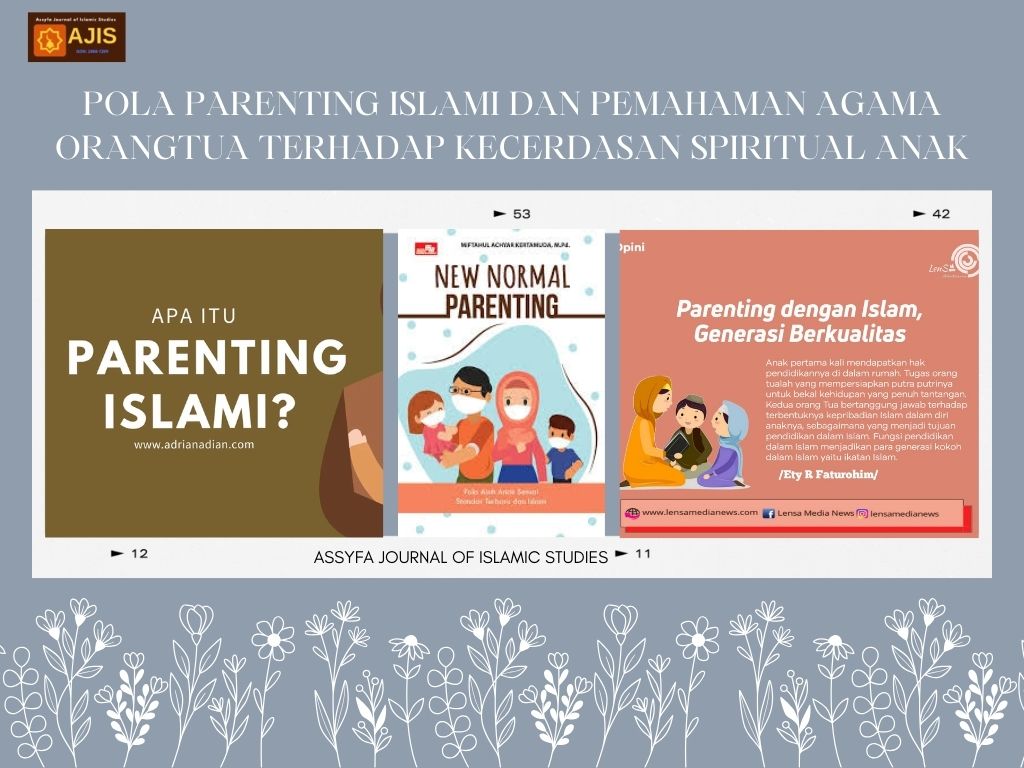
The Influence Of Islamic Parenting Patterns and Parents Religious Understanding On Children’s Spiritual Intelligence In Muslim Families In Metro City
DOI:
https://doi.org/10.61650/ajis.v2i2.628Keywords:
Children's Spiritual Intelligence, Islamic Parenting, Muslim Family, Parental Religious UnderstandingAbstract
Islamic parenting faces significant challenges in the modern context, especially with the influence of technology that can divert children's attention from religious practices. This study aims to explore the influence of Islamic parenting and parental religious understanding on the spiritual intelligence of children in Muslim families in Metro City. The method used is quantitative, with the population being Muslim parents who have children aged 5-9 years. The sampling technique used is proportional stratified random sampling, with a total sample of 100 individuals. Data were collected through questionnaires and analyzed using multiple linear regression. The results of the study show that Islamic parenting has a significant effect on children's spiritual intelligence. This study also found that parents' religious understanding significantly contributes to the development of children's spiritual intelligence. Regression analysis results indicate that Islamic parenting and religious understanding together positively influence children's spiritual intelligence, with the regression equation ȳ = 23.576 + 0.223X1 + 0.452X2.
Downloads
References
Abdelmalak, M. (2015). Participatory curriculum planning: Students’ perceptions. Curriculum and Teaching, 30(1), 67–84. https://doi.org/10.7459/ct/30.1.06
Alsheikh, M. A. (2014). Machine learning in wireless sensor networks: Algorithms, strategies, and applications. IEEE Communications Surveys and Tutorials, 16(4), 1996–2018. https://doi.org/10.1109/COMST.2014.2320099
Aslan, E. (2019). A Pluralistic Account of Religious Upbringing in Islamic Religious Education: Fundamentals and Perspectives. Religious Education, 114(4), 436–442. https://doi.org/10.1080/00344087.2019.1631956
Bagozzi, R. P. (2012). Specification, evaluation, and interpretation of structural equation models. Journal of the Academy of Marketing Science, 40(1), 8–34. https://doi.org/10.1007/s11747-011-0278-x
Bedford, J. (2020). COVID-19: towards controlling of a pandemic. The Lancet, 395(10229), 1015–1018. https://doi.org/10.1016/S0140-6736(20)30673-5
Blickle, G. (1996). Personality traits, learning strategies, and performance. European Journal of Personality, 10(5), 337–352. https://doi.org/10.1002/(SICI)1099-0984(199612)10:5<337::AID-PER258>3.0.CO;2-7
Capizzi, A. M. (2005). Effects of curriculum-based measurement with and without diagnostic feedback on teacher planning. Remedial and Special Education, 26(3), 159–174. https://doi.org/10.1177/07419325050260030401
Diener, E. (2003). Personality, Culture, and Subjective Well-being: Emotional and Cognitive Evaluations of Life. Annual Review of Psychology, 54, 403–425. https://doi.org/10.1146/annurev.psych.54.101601.145056
Dombi, J. (1982). Basic concepts for a theory of evaluation: The aggregative operator. European Journal of Operational Research, 10(3), 282–293. https://doi.org/10.1016/0377-2217(82)90227-2
DONATO, R. (1994). A Sociocultural Perspective on Language Learning Strategies: The Role of Mediation. The Modern Language Journal, 78(4), 453–464. https://doi.org/10.1111/j.1540-4781.1994.tb02063.x
Dong, L. (2020). Public Mental Health Crisis during COVID-19 Pandemic, China. Emerging Infectious Diseases, 26(7), 1616–1618. https://doi.org/10.3201/eid2607.200407
Edwards, M. M. (2011). Planning’s core curriculum: Knowledge, practice, and implementation. Journal of Planning Education and Research, 31(2), 172–183. https://doi.org/10.1177/0739456X11398043
Elbay, R. Y. (2020). Depression, anxiety, stress levels of physicians and associated factors in Covid-19 pandemics. Psychiatry Research, 290. https://doi.org/10.1016/j.psychres.2020.113130
Essabane, K. (2022). Islamic Religious Education and Citizenship Education: Their Relationship According to Practitioners of Primary Islamic Religious Education in The Netherlands. Religions, 13(9). https://doi.org/10.3390/rel13090826
Feng, D. (2020). Solving hard AI planning instances using curriculum-driven deep reinforcement learning. IJCAI International Joint Conference on Artificial Intelligence, 2021, 2198–2205.
Fuchs, D. (1997). Peer-assisted learning strategies: Making classrooms more responsive to diversity. American Educational Research Journal, 34(1), 174–206. https://doi.org/10.3102/00028312034001174
Fuchs, L. S. (1989). Effects of curriculum-based measurement on teachers’ instructional planning. Journal of Learning Disabilities, 22(1), 51–59. https://doi.org/10.1177/002221948902200110
Gates, B. (2020). Responding to Covid-19 - A once-in-a-century pandemic? New England Journal of Medicine, 382(18), 1677–1679. https://doi.org/10.1056/NEJMp2003762
Gawronski, B. (2006). Associative and propositional processes in evaluation: An integrative review of implicit and explicit attitude change. Psychological Bulletin, 132(5), 692–731. https://doi.org/10.1037/0033-2909.132.5.692
Gössling, S. (2020). Pandemics, tourism and global change: a rapid assessment of COVID-19. Journal of Sustainable Tourism, 1–20. https://doi.org/10.1080/09669582.2020.1758708
GREEN, J. M. (1995). A Closer Look at Learning Strategies, L2 Proficiency, and Gender. TESOL Quarterly, 29(2), 261–297. https://doi.org/10.2307/3587625
Grimshaw, J. M. (1993). Effect of clinical guidelines on medical practice: a systematic review of rigorous evaluations. The Lancet, 342(8883), 1317–1322. https://doi.org/10.1016/0140-6736(93)92244-N
Hamidi, S. (2020). Does Density Aggravate the COVID-19 Pandemic?: Early Findings and Lessons for Planners. Journal of the American Planning Association, 86(4), 495–509. https://doi.org/10.1080/01944363.2020.1777891
Hanemann, W. (1984). Welfare evaluations in contingent valuation experiments with discrete responses. American Journal of Agricultural Economics, 66(3), 332–341. https://doi.org/10.2307/1240800
Harris, J. (2011). Technological pedagogical content knowledge (TPACK) in action: A descriptive study of secondary teachers’ curriculum-based, technology-related lnstructional planning. Journal of Research on Technology in Education, 43(3), 211–229. https://doi.org/10.1080/15391523.2011.10782570
Hasan, Z. (2020). Leading Issues in Islamic Economics and Finance: Critical Evaluations. Leading Issues in Islamic Economics and Finance: Critical Evaluations, 1–402. https://doi.org/10.1007/978-981-15-6515-1
Heikkilä, A. (2006). Studying in higher education: Students’ approaches to learning, self-regulation, and cognitive strategies. Studies in Higher Education, 31(1), 99–117. https://doi.org/10.1080/03075070500392433
İnal, K. (2024). Argumentation in Religious Education-An Analysis on German Islamic Religion Textbooks. Journal for Critical Education Policy Studies, 22(1), 316–356.
Jain, A. (1997). Feature selection: evaluation, application, and small sample performance. IEEE Transactions on Pattern Analysis and Machine Intelligence, 19(2), 153–158. https://doi.org/10.1109/34.574797
Jalili, J. (2023). Philosophy of Islamic Education: environmental and behavioral pathology of children’s religious education. Journal of Philosophical Investigations, 16(41), 49–61. https://doi.org/10.22034/jpiut.2022.52370.3275
Jones, S. (1998). Learning styles and learning strategies: Towards learner independence. Forum for Modern Language Studies, 34(2), 114–129. https://doi.org/10.1093/fmls/XXXIV.2.114
Judd, C. M. (1981). Process analysis: Estimating Mediation in Treatment Evaluations. Evaluation Review, 5(5), 602–619. https://doi.org/10.1177/0193841X8100500502
Kendal, R. L. (2018). Social Learning Strategies: Bridge-Building between Fields. Trends in Cognitive Sciences, 22(7), 651–665. https://doi.org/10.1016/j.tics.2018.04.003
Khan, B. H. (2005a). Managing e-learning strategies: Design, delivery, implementation and evaluation. Managing E-Learning Strategies: Design, Delivery, Implementation and Evaluation, 1–424. https://doi.org/10.4018/978-1-59140-634-1
Khan, B. H. (2005b). Managing e-learning strategies: Design, delivery, implementation and evaluation. Managing E-Learning Strategies: Design, Delivery, Implementation and Evaluation, 1–424. https://doi.org/10.4018/978-1-59140-634-1
Khanmohammadi, S. (2020). Potential of thermoelectric waste heat recovery in a combined geothermal, fuel cell and organic Rankine flash cycle (thermodynamic and economic evaluation). International Journal of Hydrogen Energy, 45(11), 6934–6948. https://doi.org/10.1016/j.ijhydene.2019.12.113
Kim, B. (2009). Not just fun, but serious strategies: Using meta-cognitive strategies in game-based learning. Computers and Education, 52(4), 800–810. https://doi.org/10.1016/j.compedu.2008.12.004
Knaus, W. (1981). APACHE-acute physiology and chronic health evaluation: a physiologically based classification system. Critical Care Medicine, 9(8), 591–597. https://doi.org/10.1097/00003246-198108000-00008
Kolb, J. (2023). Muslim diversity, religious formation and Islamic religious education. Everyday practical insights into Muslim parents’ concepts of religious education in Austria. British Journal of Religious Education, 45(2), 172–185. https://doi.org/10.1080/01416200.2021.1911787
Krackov, S. (2011). Building expertise using the deliberate practice curriculum-planning model. Medical Teacher, 33(7), 570–575. https://doi.org/10.3109/0142159X.2011.578172
Leinster, S. (2003). Curriculum planning. Lancet, 362(9385), 750. https://doi.org/10.1016/s0140-6736(03)14222-5
Lesort, T. (2020). Continual learning for robotics: Definition, framework, learning strategies, opportunities and challenges. Information Fusion, 58, 52–68. https://doi.org/10.1016/j.inffus.2019.12.004
Liu, Y. C. (2020). COVID-19: The first documented coronavirus pandemic in history. Biomedical Journal, 43(4), 328–333. https://doi.org/10.1016/j.bj.2020.04.007
Lucas, R. (1976). Econometric policy evaluation: A critique. Carnegie-Rochester Confer. Series on Public Policy, 1, 19–46. https://doi.org/10.1016/S0167-2231(76)80003-6
MAHONEY, F. (1965). FUNCTIONAL EVALUATION: THE BARTHEL INDEX. Maryland State Medical Journal, 14, 61–65.
McLachlan, C. (2010). Early childhood curriculum: Planning, assessment and implementation. Early Childhood Curriculum: Planning, Assessment and Implementation, 1–229. https://doi.org/10.1017/CBO9780511844829
McLachlan, C. (2019). Early childhood curriculum: Planning, assessment and implementation. Early Childhood Curriculum: Planning, Assessment and Implementation, 1–255. https://doi.org/10.1017/9781108131810
Moodie, M. R. (1993). Symposium on religious law: Roman Catholic, Islamic, and Jewish treatment of familial issues, including education, abortion, in vitro fertilization, prenuptial agreements, contraception, and marital fraud. Loyola of Los Angeles International and Comparative Law Journal, 16(1), 9–106.
Muhaemin. (2023). Religious Moderation in Islamic Religious Education as a Response to Intolerance Attitudes in Indonesian Educational Institutions. Journal of Social Studies Education Research, 14(2), 253–274.
Mujiburrahman. (2020). Structuration in religious education: The ideological burdens of Islamic education in Indonesian schools. International Journal of Innovation, Creativity and Change, 6, 300–316.
Muniyappa, R. (2020). COVID-19 pandemic, coronaviruses, and diabetes mellitus. American Journal of Physiology - Endocrinology and Metabolism, 318(5). https://doi.org/10.1152/ajpendo.00124.2020
Mu’ti, A. (2023). Pluralistic Islamic Religious Education: A Vision for Indonesia. Review of Faith and International Affairs, 21(2), 121–127. https://doi.org/10.1080/15570274.2023.2200280
Neer, C. S. (1970). Displaced proximal humeral fractures. I. Classification and evaluation. The Journal of Bone and Joint Surgery. American Volume, 52(6), 1077–1089. https://doi.org/10.2106/00004623-197052060-00001
Niyozov, S. (2016). Religious pluralism and Islamic education: Addressing mutual challenges. Philosophies of Islamic Education: Historical Perspectives and Emerging Discourses, 202–219. https://doi.org/10.4324/9781315765501
Paris, S. (1984). Informed Strategies for Learning: A program to improve children’s reading awareness and comprehension. Journal of Educational Psychology, 76(6), 1239–1252. https://doi.org/10.1037/0022-0663.76.6.1239
Pignon, J. P. (2008). Lung adjuvant cisplatin evaluation: A pooled analysis by the LACE collaborative group. Journal of Clinical Oncology, 26(21), 3552–3559. https://doi.org/10.1200/JCO.2007.13.9030
Punt, A. E. (2016). Management strategy evaluation: Best practices. Fish and Fisheries, 17(2), 303–334. https://doi.org/10.1111/faf.12104
Reber, A. S. (1978). Analogic and abstraction strategies in synthetic grammar learning: A functionalist interpretation. Cognition, 6(3), 189–221. https://doi.org/10.1016/0010-0277(78)90013-6
Ribeiro, M. A. P. (2013). Constitutive Pluralism of Chemistry: Thought Planning, Curriculum, Epistemological and Didactic Orientations. Science and Education, 22(7), 1809–1837. https://doi.org/10.1007/s11191-011-9434-4
Rosenbaum, L. (2020). The untold toll — The pandemic’s effects on patients without covid-19. New England Journal of Medicine, 382(24), 2368–2371. https://doi.org/10.1056/NEJMms2009984
Saepudin, A. (2023). Strengthening Character Education: An Action Research in Forming Religious Moderation in Islamic Education. International Journal of Learning, Teaching and Educational Research, 22(12), 84–105. https://doi.org/10.26803/ijlter.22.12.5
Seed, H. B. (1985). Influence of SPT procedures in soil liquefaction resistance evaluations. Journal of Geotechnical Engineering, 111(12), 1425–1445. https://doi.org/10.1061/(ASCE)0733-9410(1985)111:12(1425)
Selçuk, M. (2023). Making It Different? Islamic Religious Education, Gender and Leadership. Religious Education, 118(3), 241–253. https://doi.org/10.1080/00344087.2023.2227785
Sirén, C. A. (2012). Exploration and exploitation strategies, profit performance, and the mediating role of strategic learning: Escaping the exploitation trap. Strategic Entrepreneurship Journal, 6(1), 18–41. https://doi.org/10.1002/sej.1126
Spoorthy, M. S. (2020). Mental health problems faced by healthcare workers due to the COVID-19 pandemic–A review. Asian Journal of Psychiatry, 51. https://doi.org/10.1016/j.ajp.2020.102119
Sullivan, E. (1983). Nursing’s future: use of the Delphi technique for curriculum planning. The Journal of Nursing Education, 22(5), 187–189.
Supriyadi, T. (2024). Religious Literacy Reinforcement-Based Tolerance Education: A Didactic Reflection Method on Islamic Religious Education Through Action Research. International Journal of Religion, 5(6), 886–900. https://doi.org/10.61707/kgte7813
Suwaed, M. (2016). Education, identity, and ideology: the Islamic movement and Moslem religious education in Israel. Social Identities, 22(4), 426–449. https://doi.org/10.1080/13504630.2015.1128811
Tănase, L. (2015). Religious education, European citizenship and religious pluralism: Islamic education–the Case of romania. Islam and Citizenship Education: In Cooperation with Minela Salkic Joldo, 161–176. https://doi.org/10.1007/978-3-658-08603-9_12
Topalovic, S. (2019). Hattie’s “Visible Learning” in Islamic religious education. What works to what effect? Osterreichisches Religionspadagogisches Forum, 27(1), 245–260. https://doi.org/10.25364/10.27:2019.1.15
Ucan, A. D. (2019a). Improving the pedagogy of Islamic religious education through an application of critical religious education, variation theory and the learning study model. British Journal of Religious Education, 41(2), 202–217. https://doi.org/10.1080/01416200.2018.1484695
Ucan, A. D. (2019b). Improving the pedagogy of Islamic religious education through an application of critical religious education, variation theory and the learning study model. British Journal of Religious Education, 41(2), 202–217. https://doi.org/10.1080/01416200.2018.1484695
Wang, H. (2022). Estimating excess mortality due to the COVID-19 pandemic: a systematic analysis of COVID-19-related mortality, 2020–21. The Lancet, 399(10334), 1513–1536. https://doi.org/10.1016/S0140-6736(21)02796-3
Zheng, D. (2021). Afraid to travel after COVID-19? Self-protection, coping and resilience against pandemic ‘travel fear.’ Tourism Management, 83. https://doi.org/10.1016/j.tourman.2020.104261
Published
How to Cite
Issue
Section
License
Copyright (c) 2024 Assyfa Journal of Islamic Studies

This work is licensed under a Creative Commons Attribution-ShareAlike 4.0 International License.