The Effect of Chromebook Usage and Learning Interest on Islamic Religious Education Literacy among Elementary School Students
Abstract
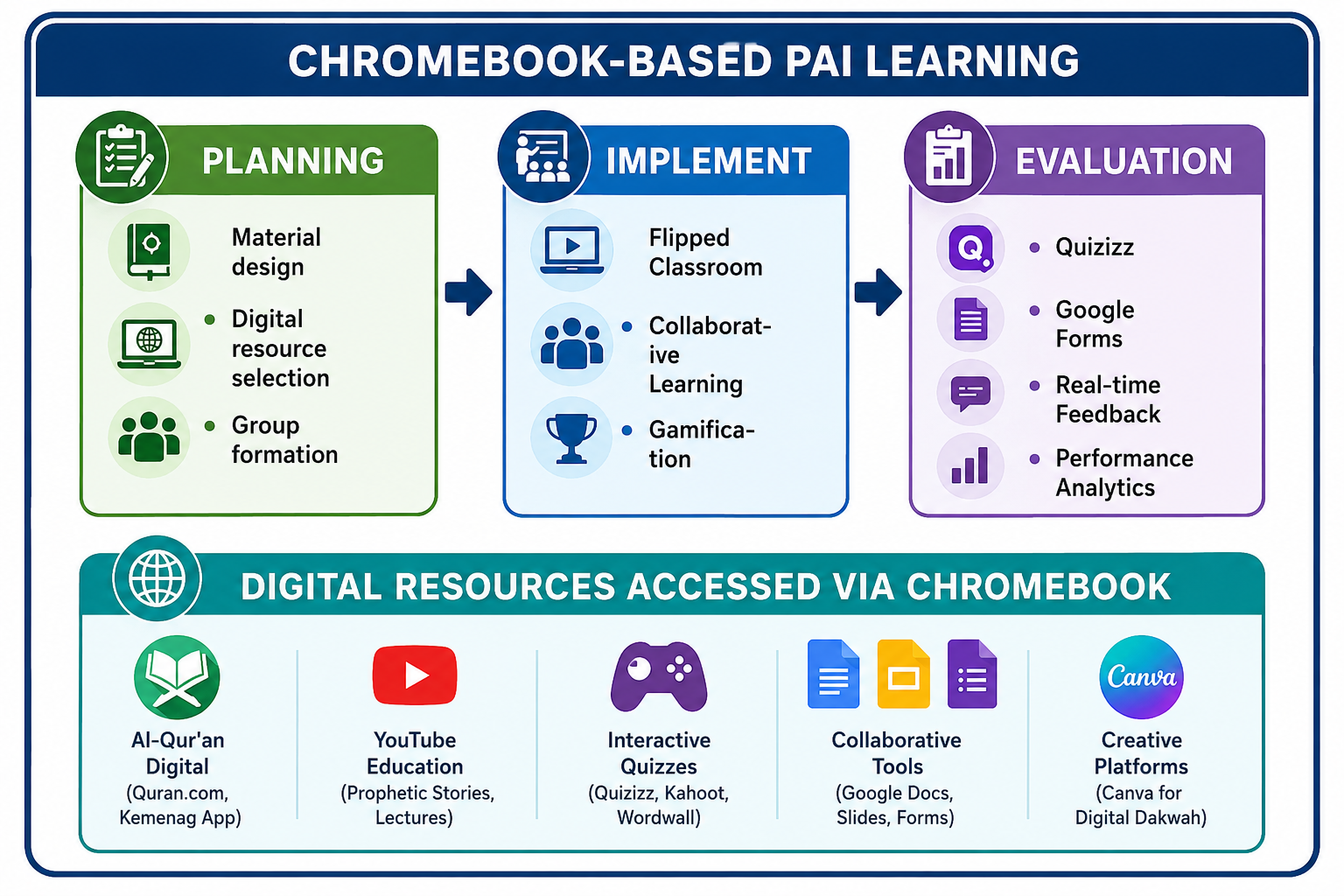
This study examines the influence of Chromebook usage and learning interest on Islamic Religious Education (PAI) literacy among fifth and sixth-grade students at SD Negeri 8 Metro Barat. Employing a quantitative causal-correlational ex post facto design, data were collected from 49 students selected through simple random sampling from a population of 140. Instruments included a 45-item Likert-scale questionnaire validated through expert judgment and reliability testing (Cronbach's Alpha 0.842–0.875). Results from multiple regression analysis revealed three key findings: (1) Chromebook usage significantly and positively affects PAI literacy (β = 0.348, p = 0.009); (2) learning interest significantly and positively affects PAI literacy (β = 0.430, p = 0.001); and (3) both variables simultaneously explain 45.2% of the variance in PAI literacy (R² = 0.452, F = 18.456, p = 0.000). These findings demonstrate that technology integration and students' internal motivation collectively enhance religious literacy. The study contributes theoretical insights into technology-based PAI learning models and offers practical recommendations for schools, teachers, and policymakers to optimize Chromebook utilization and foster learning interest in Islamic education.
Downloads
Published
How to Cite
Issue
Section
License
Copyright (c) 2026 Endang Citra Surya Indah, Choirudin Choirudin, Siti Roudhotul Jannah

This work is licensed under a Creative Commons Attribution-ShareAlike 4.0 International License.