The Principal's Strategy in Improving Teachers' Teaching Motivation at MA Al Huda Tulung Balak
DOI:
https://doi.org/10.61650/ajis.v4i1.1180Keywords:
Principal Strategy, Teacher Teaching Motivation, Transformational Leadership, Private MadrasahAbstract
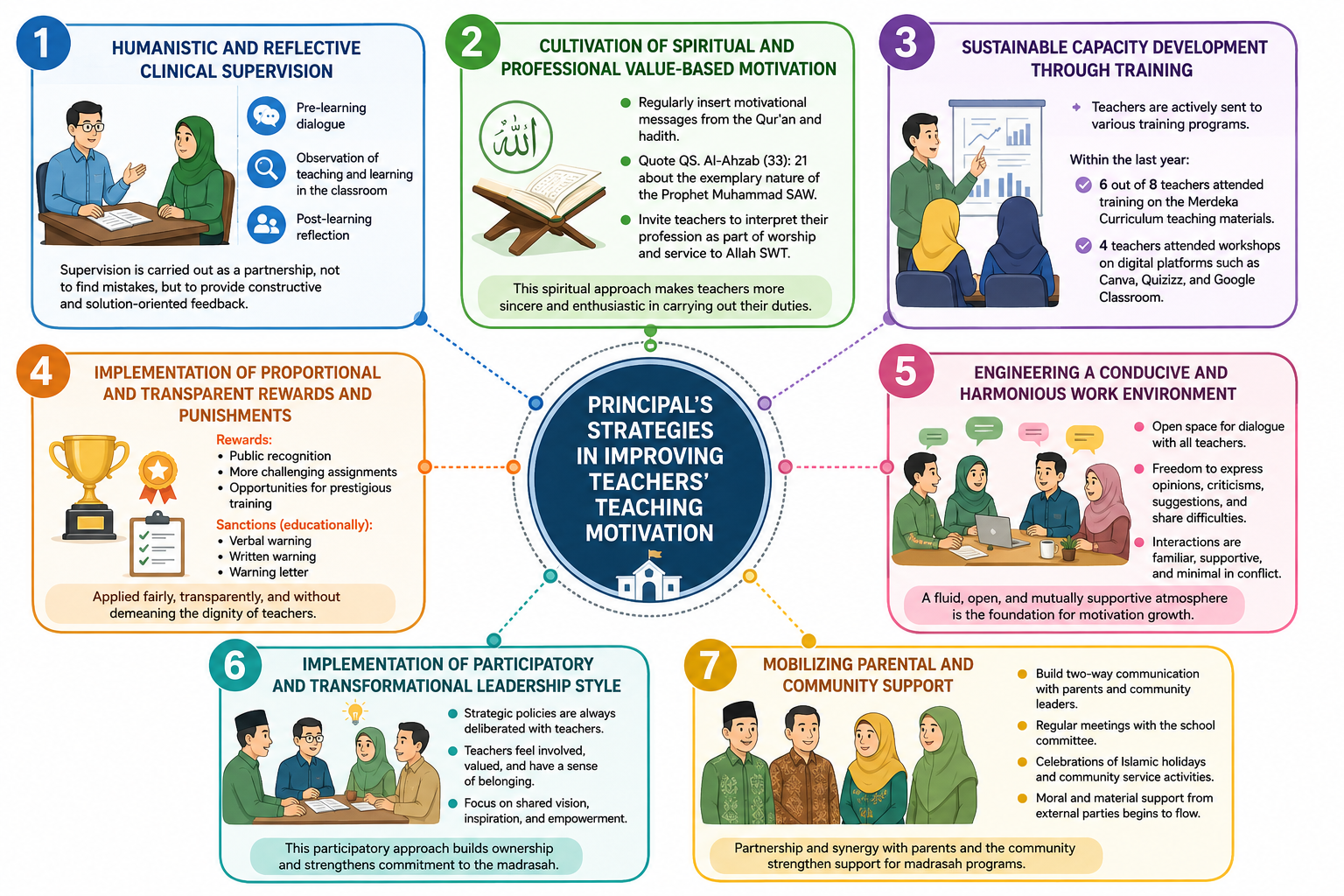
This study aims to analyze the principal's strategies in improving teachers' teaching motivation, their impact on teacher performance, and the challenges faced in implementation. The research employed a qualitative approach with a case study design at MA Al Huda Tulung Balak, East Lampung. Data were collected through participant observation, in-depth interviews with 8 informants (principal, 6 teachers, and 1 administrative staff), and document study. Data analysis used the Miles and Huberman model. The findings reveal that the principal implemented seven holistic and integrative strategies: (1) humanistic and reflective clinical supervision, (2) spiritual and professional value-based motivation, (3) sustainable capacity development through training, (4) proportional reward and punishment system, (5) conducive work environment engineering, (6) participatory and transformational leadership style, and (7) mobilization of parental and community support. The impacts include increased teaching innovation (teachers using varied methods rose from 40% to 75%), participation in professional development (90%), administrative discipline (from 65% to 85%), and technology utilization (from 30% to 55%). Challenges include limited infrastructure, weak external support, teacher competency heterogeneity, the principal's heavy workload, and low internal drive among a small portion of teachers. This study confirms Maslow's Hierarchy of Needs Theory, Deci and Ryan's Self-Determination Theory, and Bass's Transformational Leadership Theory in the context of pesantren-based rural private madrasahs.
Downloads
References
Ahmad, F. (2023). Kepemimpinan transformasional kepala sekolah dan motivasi kerja. Jurnal Iltar: Jurnal Ilmiah Bidang Pendidikan, 3(2), 75–84. https://karya.brin.go.id/id/eprint/36493/
Bass, B. M. (1985). Leadership and performance beyond expectations. New York: Free Press.
Creswell, J. W. (2016). Research design: Pendekatan kualitatif, kuantitatif, dan mixed. Yogyakarta: Pustaka Pelajar.
Deci, E. L., & Ryan, R. M. (2000). The "what" and "why" of goal pursuits: Human needs and the self-determination of behavior. Psychological Inquiry, 11(4), 227–268. https://doi.org/10.1207/S15327965PLI1104_01
Haw, J. Y., & King, R. B. (2023). Perceived need-supportive leadership, perceived need-supportive teaching, and student engagement: A self-determination perspective. Social Psychology of Education, 26, 1289–1319. https://doi.org/10.1007/s11218-023-09790-2
Kamilata, N. (2025). Gaya kepemimpinan kepala madrasah dalam mendukung kesejahteraan psikologis guru [Skripsi, UIN Kiai Haji Achmad Siddiq Jember]. https://digilib.uinkhas.ac.id/50102/
Kemendikbudristek. (2023a). Statistik pendidikan Indonesia 2023. Jakarta: Pusat Data dan Teknologi Informasi Kemendikbudristek.
Kemendikbudristek. (2023b). Laporan kinerja guru nasional. Jakarta: Direktorat Jenderal Guru dan Tenaga Kependidikan.
Kemendikbudristek. (2024). Supervisi akademik oleh kepala sekolah: Peran, tantangan, dan dampaknya terhadap peningkatan kualitas pendidikan. Garuda - Garba Rujukan Digital. https://garuda.kemdiktisaintek.go.id/documents/detail/4637263
Lembaga Penelitian Pendidikan Indonesia. (2024). Survei motivasi guru Indonesia 2024. Jakarta: LPPI.
Maslow, A. H. (1943). A theory of human motivation. Psychological Review, 50(4), 370–396. https://doi.org/10.1037/h0054346
Miles, M. B., Huberman, A. M., & Saldaña, J. (2014). Qualitative data analysis: A methods sourcebook (3rd ed.). Thousand Oaks: Sage Publications.
Moleong, L. J. (2018). Metodologi penelitian kualitatif. Bandung: Remaja Rosdakarya.
Ningtyas, D. T., Farida, N. A., & Firadilah, A. (2022). Implementasi teori motivasi Abraham Maslow dalam pembelajaran Pendidikan Agama Islam. Tapis: Jurnal Penelitian Ilmiah, 6(1). https://doi.org/10.32332/tapis.v6i1.5311
OECD. (2023). PISA 2022 results: The state of learning and equity in education. Paris: OECD Publishing. https://doi.org/10.1787/53f23881-en
Palembangan, C. N., & Sihotang, H. (2023). Kepemimpinan transformasional kepala sekolah dalam meningkatkan kinerja guru. Jurnal Pendidikan Tambusai, 7(3), 26725–26736. http://repository.uki.ac.id/13166/
Purnamasari, D., Rachbini, D. J., Sudibjo, N., & Hariandja, E. S. (2024). Study of teacher's career sustainability in Islamic millennial generation teachers. Pegem Journal of Education and Instruction, 14(3), 355–362. https://eric.ed.gov/?id=EJ1431733
Riswan, D., Fauroni, R. L., & Suhardi, M. (2024). Pengaruh kepemimpinan transformasional kepala sekolah terhadap motivasi berprestasi siswa dengan kinerja guru sebagai variabel moderasi. Manajerial, 4(4). https://doi.org/10.51878/manajerial.v4i4.3759
Ryan, R. M., & Deci, E. L. (2020). Intrinsic and extrinsic motivation from a self-determination theory perspective: Definitions, theory, practices, and future directions. Contemporary Educational Psychology, 61, 101860. https://doi.org/10.1016/j.cedpsych.2020.101860
Shula, M. (2023). Principals' servant leadership practices and teacher motivation: Perspectives from South African rural schools' context. Perspectives in Education, 41(4), 162–176. https://doi.org/10.38140/pie.v41i4.7196
Skaalvik, E. M., & Skaalvik, S. (2014). Teacher self-efficacy and teacher burnout: A study of relations. Teaching and Teacher Education, 26(4), 1059–1069. https://doi.org/10.1016/j.tate.2014.05.003
Subandi, S., Mispani, M., Maba, A. P., Suhono, S., & Fitria, M. (2024). Teacher's management skills, well-being, religiosity, and academic motivation in Islamic education. International Journal of Evaluation and Research in Education (IJERE), 13(3). http://doi.org/10.11591/ijere.v13i3.26894
Sugiyono. (2019). Metode penelitian kualitatif, kuantitatif, dan R&D. Bandung: Alfabeta.
Supriyanto, S. (2025). Strategi kepemimpinan kepala sekolah dalam meningkatkan mutu pendidikan di MIS Generasi Rabbani Kota Bengkulu. BICOIN: Journal of Islamic Education, 2(1). https://bicoin.or.id/journal/index.php/bicoin/article/view/156
Sutisna, S. (2023). Pengaruh gaya kepemimpinan partisipatif Kepala Sekolah dan motivasi kerja Guru terhadap kepuasan kerja Guru pada Pendidikan Dasar Se-Kecamatan Ciwidey Kabupaten Bandung [Tesis, UIN Sunan Gunung Djati Bandung]. https://digilib.uinsgd.ac.id/66968/
Waliudin, A. S., & Chotimah, C. (2023). Strategi kepala sekolah dalam meningkatkan kinerja guru. SKILLS: Jurnal Riset dan Studi Manajemen Pendidikan Islam, 2(1), 13–21. https://doi.org/10.xxxx/skills.v2i1.xxx
Yin, R. K. (2018). Case study research and applications: Design and methods (6th ed.). Thousand Oaks: Sage Publications.
Zohriah, A., Suryana, A., & Pandidin, I. R. (2022). Pengaruh supervisi akademik kepala sekolah terhadap peningkatan kinerja guru. Jurnal Ilmu Manajemen dan Pendidikan, 2(1), 15–22. https://jurnal.fkip.unmul.ac.id/
Published
How to Cite
Issue
Section
License
Copyright (c) 2026 Siti Maryamah, Mispani Mispani, Choirudin Choirudin

This work is licensed under a Creative Commons Attribution-ShareAlike 4.0 International License.