Implementation of Islamic Religious Education in Shaping Adolescent Morals
DOI:
https://doi.org/10.61650/ajis.v3i2.1176Keywords:
Islamic Religious Education, Adolescent Morals, Community EnvironmentAbstract
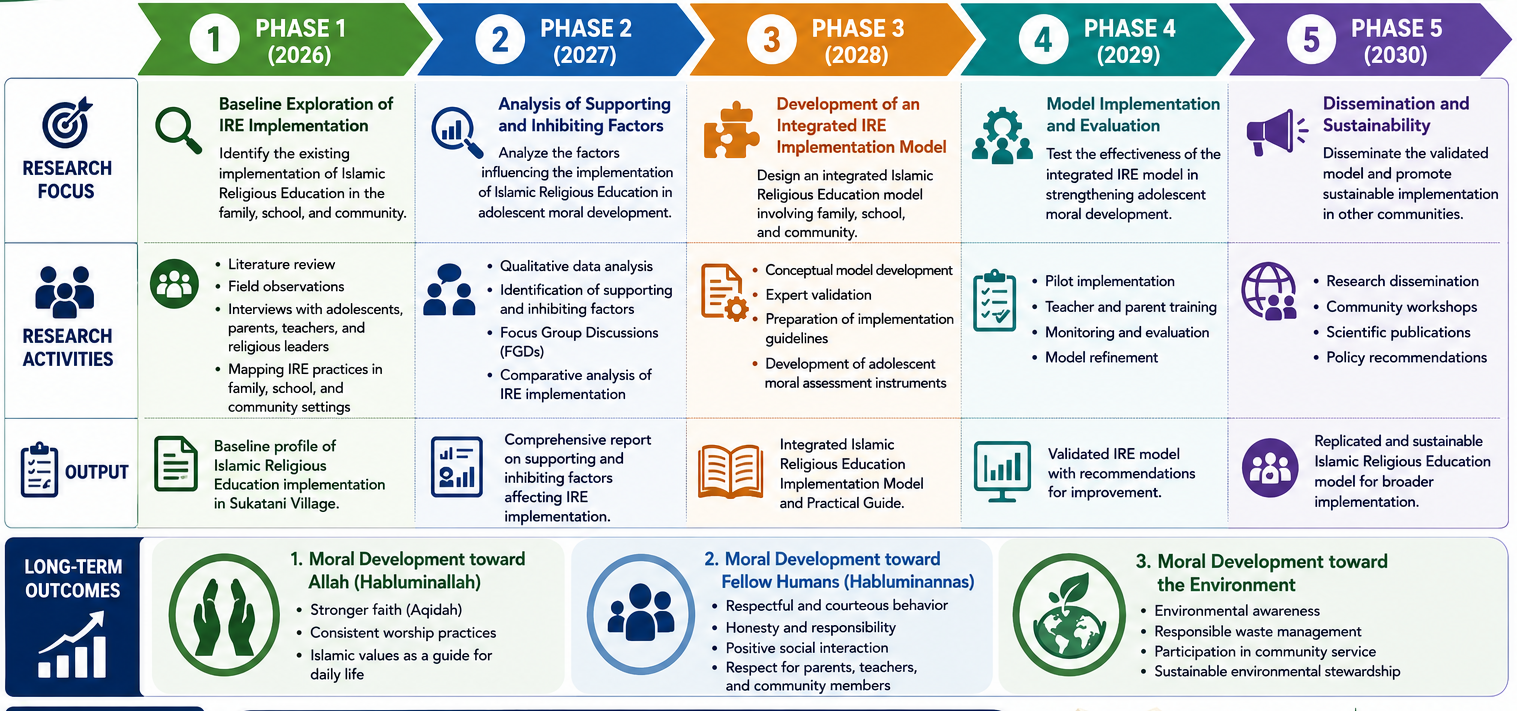
This study examines the implementation of Islamic Religious Education (IRE) in shaping adolescent morals in Sukatani Village, Kalianda District, South Lampung Regency. The research is motivated by the declining quality of adolescent morals amid rapid globalization and technological advancement, even in rural areas. Using a qualitative descriptive approach, data were collected through observation, in-depth interviews, and documentation. Subjects included religious leaders, educators, parents, and adolescents. Data analysis followed Miles and Huberman's interactive model: reduction, display, and verification. Results indicate that IRE implementation occurs through formal and non-formal channels, including school learning, TPA activities, youth religious gatherings, and family roles. This implementation positively impacts moral formation, evidenced by increased worship awareness, politeness, and improved social interaction. Supporting factors include a religious community environment, the role of religious leaders, and community religious activities. Inhibiting factors include limited parental involvement, negative social media influence, and weak inter-institutional coordination. The study concludes that IRE plays a vital role in adolescent moral formation, yet stronger synergy between schools, families, and communities is essential for optimal outcomes.
Downloads
References
Alfansyur, A., & Mariyani. (2020). Seni mengelola data: Penerapan triangulasi teknik, sumber dan waktu pada penelitian pendidikan sosial. Jurnal Kajian, Penelitian dan Pengembangan Pendidikan Sejarah, 5(2), 28.
An-Nahlawi, A. (1996). Pendidikan Islam di rumah, sekolah dan masyarakat. Jakarta: Gema Insani Press.
Creswell, J. W. (2012). Research design: Pendekatan kualitatif, kuantitatif, dan mixed. Yogyakarta: Pustaka Pelajar.
Daradjat, Z. (2012). Ilmu pendidikan Islam. Jakarta: Bumi Aksara.
Furqon, A., & Hanif, M. (2022). Strengthening character education through Islamic religious education: A case in Indonesian context. Tadibia Islamika, 2(2), 65–71. https://doi.org/10.28918/tadibia.v2i2.6261
Jurnal Pendidikan Islam. (2022). Management of character education in creating student morals: A multiple-case study. Jurnal Pendidikan Islam, 11(1), 95–105. https://doi.org/10.14421/jpi.2022.111.95-105
Jurnal Pendidikan Islam. (2023). Enhancing student moral development through character education management based on religious culture in special education schools: A case study in Cirebon, Indonesia. Jurnal Pendidikan Islam, 12(1), 125–134. https://doi.org/10.14421/jpi.2023.121.125-134
Juwariyah. (2008). Pendidikan moral dalam puisi Imam Syafi'i dan Ahmad Syauqi. Yogyakarta: Bidang Akademik.
Kementerian Agama RI. (2019). Moderasi beragama. Jakarta: Balitbang-Diklat.
Khan, H. M., Khan, W., Farooq, S., Aleem, A., Mann, A., & Akhtar, S. (2021). The role of Islamic education in moral character building of Pakistani youth: An analytic study. Multicultural Education, 7(9), 174–181. https://doi.org/10.5281/zenodo.5500731
Majid, A., & Andayani, D. (2011). Pendidikan karakter perspektif Islam. Bandung: Remaja Rosdakarya.
Miles, M. B., & Huberman, A. M. (1994). Qualitative data analysis: An expanded sourcebook (2nd ed.). Thousand Oaks: Sage Publications.
Moleong, L. J. (2018). Metodologi penelitian kualitatif. Bandung: Remaja Rosdakarya.
Monicha, R. E., Asha, L., Karolina, A., Yanuarti, E., Maryamah, M., Mardeli, M., & Soraya, N. (2020). Penanaman nilai-nilai akhlak dalam pembelajaran pendidikan agama Islam menghadapi era milenial di SMA Negeri 2 Rejang Lebong. Tadrib: Jurnal Pendidikan Agama Islam, 6(2). [ISSN 2549-6433]
Muhaimin. (2001). Paradigma pendidikan Islam: Upaya mengefektifkan pendidikan agama Islam di sekolah. Bandung: PT Remaja Rosdakarya.
Muslih, M. (2021). The efforts of Islamic religious education teachers in fostering student morals. Belajea: Jurnal Pendidikan Islam, 6(1). https://doi.org/10.29240/belajea.v6i1.2114
Mustofa, A. (2019). Media sosial dan moralitas remaja. Jurnal Pendidikan Islam, 7(1), 54.
Nata, A. (2012). Akhlak tasawuf. Jakarta: Rajawali Pers.
Rachmawati, I. N. (2007). Pengumpulan data dalam penelitian kualitatif: Wawancara. Jurnal Keperawatan Indonesia, 11(1), 35–40. https://doi.org/10.7454/jki.v11i1.184
Ramayulis. (2015). Ilmu pendidikan Islam. Jakarta: Kalam Mulia.
Shihab, M. Q. (2005). Membumikan Al-Qur'an. Bandung: Mizan.
Sugiyono. (2015). Metode penelitian pendidikan. Bandung: Alfabeta.
Sukino, S., & Utami, S. P. (2020). Islamic religious education models in preventing negative behaviors of youth and adolescents. Tarbawi: Jurnal Pendidikan Islam, 6(2). https://doi.org/10.32678/tarbawi.v6i02.3539
Sultana, M., & Bukhari, S. A. G. (2020). Factors of ethical decline and religious measures to overcome. Journal of Islamic and Religious Studies, 5(1), 17. https://doi.org/10.36476/JIRS.5:1.06.2020.17
Yanti, N. (2020). Peranan remaja masjid muslimin dalam implementasikan pendidikan akhlak di RW 07 Kelurahan Babussalam Duri. Indonesian Journal of Social Science Education (IJSSE), 2(2). https://doi.org/10.29300/ijsse.v2i2.3459
Zuhdi, M. (2020). Pendidikan Agama Islam dan tantangan sosial remaja. Jurnal Pendidikan Islam, 15(2), 101–114.
Published
How to Cite
Issue
Section
License
Copyright (c) 2025 Lilik Khotimatul Ahdziyah, Ihsan Mustofa, M. Sayyidul Abrori

This work is licensed under a Creative Commons Attribution-ShareAlike 4.0 International License.