Prophetic Economic Resilience through an Inclusive and Just Community Governance Model: Transdisciplinary Integration of Mapalus Local Wisdom and Sharia Values for Post-Pandemic Community Sustainability
DOI:
https://doi.org/10.61650/ajis.v4i2.1080Keywords:
Ethno-Prophetic Economics, Mapalus Wisdom, Community Resilience, Islamic Social Finance, Sustainable DevelopmentAbstract
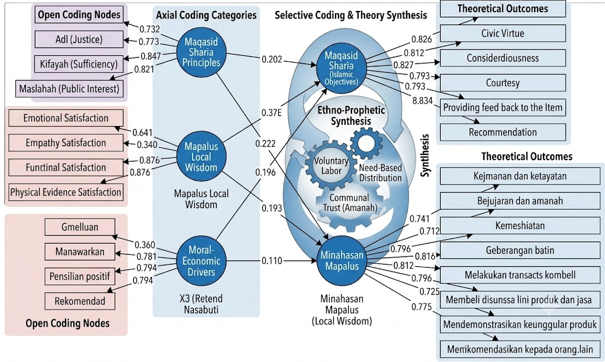
Background: The global economic challenges and the demand for post-pandemic community sustainability necessitate resilient, values-based economic models to counteract exploitative conventional structures. Objective: This research aims to investigate the transdisciplinary integration of Islamic economic principles and Mapalus local wisdom as a strategic model for inclusive and just community economic sustainability in Kampung Jawa Tondano, North Sulawesi. Method: Utilizing a qualitative grounded theory approach, data were meticulously collected through in-depth interviews and longitudinal observations, followed by open, axial, and selective coding to construct a theoretical framework. Results: The findings reveal a unique ethno-prophetic economic framework where Minahasan collective reciprocity (Mapalus) undergoes a spiritual transformation through Islamic ethical values. This synergy transcends basic social cohesion, creating a robust socio-economic safety net that systematically eliminates exploitative practices, such as Riba and Gharar, through localized mutual-aid mechanisms. Conclusion: The hybridization of prophetic ethics and indigenous wisdom offers a pragmatic solution for modern civilization challenges, contributing significantly to Sustainable Development Goals (SDGs) by fostering inclusive economic growth, enhancing resilience, and reducing social inequality.
Downloads
References
Achyar, D. H. (2026). Islamic finance for sustainable development in clean technology: dynamic capabilities and natural resource-based view. Sustainability Accounting, Management and Policy Journal, 17(4), 1253–1278. https://doi.org/10.1108/SAMPJ-10-2024-1119
Adoui, A., & Seilstad, B. (2025). Introduction: Centering Moroccan Higher Education from an Internationalization Perspective. In Internationalization of Higher Education: Moroccan Perspectives and Global Connections (pp. 1–12). Springer Nature. https://doi.org/10.1007/978-981-96-9290-3_1
Agustina, Y., Aisjah, S., & Wijayanti, R. (2026). Reframing MSME Sustainability through Contextualized Islamic Law and Local Wisdom: Financial Knowledge, Risk-Taking, and Dynamic Capability Perspective. Jurnal Ilmiah Mizani, 13(1), 406–433. https://doi.org/10.29300/mzn.v13i1.10860
Ahn, Y.-J., & Juraev, Z. (2025). Civilizational spatiality in context: Ibn Khaldun and the sacred geography of authority. Cultural Geographies. https://doi.org/10.1177/14744740251393672
Ahn, Y.-J., Juraev, Z., & Rasulov, I. (2025). Integrating Ibn Khaldun’s wisdom into urban sustainability. SN Social Sciences, 5(4). https://doi.org/10.1007/s43545-025-01080-2
Allahham, A. (2025). The untold stories of “Islamic” architecture and urbanism: rationality and power manifestations. City, Territory and Architecture, 12(1). https://doi.org/10.1186/s40410-025-00264-w
Alsoud, M. M. (2025). The Problem of the State in Islamic Political Thought: An Analytical Reading of the Proposals of the Pioneers of Islamic Political Thought. Dirasat: Human and Social Sciences, 52(3). https://doi.org/10.35516/hum.v52i3.6538
Augusto Alexandre, H. (2025). A phenomenological approach to Ibn Khaldun’s concept of group feeling. Thesis Eleven, 187(1), 128–144. https://doi.org/10.1177/07255136241308892
Ben-Nun, G. (2026). TWO TYPES OF “GROUP FEELING”: Ibn Khaldun’s Asabiyyah and Its North African Legacies. In Routledge Handbook of Social Cohesion in Africa (pp. 61–71). Taylor and Francis. https://doi.org/10.4324/9781003473657-8
Carland, S., & Buckley, A. (2025). Beyond external theories: Muslims, ‘asabiyya, and the jihad of Ramadan. Contemporary Islam, 19(2), 333–357. https://doi.org/10.1007/s11562-025-00576-1
Devendra, N. (2026). Soft power or geoeconomic contest? A comparative study of gulf sport diplomacy. Public Relations Inquiry, 15(1 Special Issue: Public Relations in the Middle East and North Africa: Critical Perspectives), 97–118. https://doi.org/10.1177/2046147X251383019
Forte, F. (2025). Ibn Khaldun in Contemporary Moroccan Thought. In H. M. (Ed.), Handbook of Oriental Studies. Section 1, The Near and Middle East (Vol. 186, pp. 308–328). Brill Academic Publishers. https://doi.org/10.1163/9789004519534_011
Gallouj, F., & Gallouj, C. (2025). Ibn Khaldun, retailing, and the retailer. In Elgar Encyclopedia of Retailing (pp. 182–184). Edward Elgar Publishing Ltd. https://doi.org/10.4337/9781035319701.00053
Gbeti, C., Donkor, I. A., & Wumbei, A. (2026). Predictors of open defecation amidst community-led total sanitation approach. Discover Public Health, 23(1). https://doi.org/10.1186/s12982-026-01975-2
Koch, B. (2025). Forced Labour and the Destruction of the Marketplace: Economic Violence in Fourteenth-Century English and Eastern Mediterranean Discourses. Global Intellectual History, 10(3), 254–269. https://doi.org/10.1080/23801883.2023.2201954
Le Bris, D., & Sekeris, P. G. (2026). Kinship, group loyalty and conflict. European Economic Review, 184. https://doi.org/10.1016/j.euroecorev.2026.105276
Miranda de Souza, V., Rebehy, P. C. P. W., Cardoso de Mattos, P., Pigosso, D. C. A., & Fröhling, M. (2026). Community-oriented reuse organisations: A strong sustainability articulation of the circular economy. Journal of Environmental Management, 404. https://doi.org/10.1016/j.jenvman.2026.129405
Murtadho, A., Murtadho, A., Nihayah, H., & Masfiah, U. (2025). From Labour- to Human-Oriented Views:Shifting Paradigm of Unemployment in al-Muqaddimah by Ibn Khaldun (1332-1405 AD). Journal of Islamic Thought and Civilization, 15(1), 296–313. https://doi.org/10.32350/jitc.151.17
Nofianti, L., Mukhlisin, M., & Irfan, A. (2026). Cash waqf innovation in Islamic financial institutions and its governance issues, case studies: Indonesia, Malaysia, Türkiye. Journal of Islamic Accounting and Business Research, 17(4), 819–837. https://doi.org/10.1108/JIABR-12-2023-0420
Obenaus-Emler, R., Pachera, C., & Murphy, M. (2026). Community-Engaged Learning in Engineering Education 5.0: MOSA and SAFE Initiative. In L. F., S. V., & F. E. (Eds.), Procedia Computer Science (Vol. 277, pp. 1403–1412). Elsevier B.V. https://doi.org/10.1016/j.procs.2026.02.179
Ramli, R. M., Ismail, A. G., Alias, M. S., & Sulaiman, N. A. A. (2025). Ibn Khaldun’s Thoughts on Sustainable Development. International Journal of Islamic Thought, 28, 151–171. https://doi.org/10.24035/ijit.28.2024.342
Riyanto, W. F. (2025). INTERSUBJECTIVE SOCIAL SCIENCE AND DIVINE FOUNDATIONS IN INDONESIA: A CIVILISATIONAL READING OF IBN KHALDŪN AND KUNTOWIJOYO. Al-Shajarah, 30(2), 421–456. https://doi.org/10.31436/shajarah.v30i02.1766
Rusmini, R., Alamsah Deliarnoor, N., Yuningsih, N. Y., & Sagita, N. I. (2025). Rethinking e-government failure: a readiness-based assessment of Indonesia’s digitalization efforts. Cogent Social Sciences, 11(1). https://doi.org/10.1080/23311886.2025.2559867
Sastre-Merino, S., Marchamalo, M., Albertella, A., Nguyen, Q. H., Michalková, J., Michalko, M., Filippi, E., & Messina, P. (2026). Empowering youth through local mapping: a community-driven approach using OpenStreetMap. Journal of Geography in Higher Education. https://doi.org/10.1080/03098265.2026.2683992
Scribano, A. (2026). What are the politics of sensibilities? In Politics of Sensibilities in Global Perspective (pp. 11–31). Taylor and Francis. https://doi.org/10.4324/9781003640783-2
Sehlikoglu, S. (2025). Genealogy, critique, and decolonisation: Ibn Khaldun and moving beyond filling the gaps. Open Research Europe, 4. https://doi.org/10.12688/openreseurope.16148.2
Shaikh, I. M., Arijo, S., Noordin, K., & Amin, H. (2026). Massive open online courses (MOOCs) acceptance amongst Islamic digital social finance practitioners: the role of online collaborative learning and technology factors. Information Discovery and Delivery, 54(2), 173–183. https://doi.org/10.1108/IDD-06-2024-0080
Sidaway, J. D. (2026). On the sources for critical Muslim geographies: Rebellion and tradition. Dialogues in Human Geography, 16(1), 221–225. https://doi.org/10.1177/20438206251345545
Sulaeman, S., Herianingrum, S., & Mirzal, H. (2026). Exploring the potential role of green-oriented Islamic agricultural financing in national food security: empirical insights from Indonesia. Agricultural Finance Review, 1–18. https://doi.org/10.1108/AFR-10-2024-0162
Tawil, A. (2025). Ali Oumlil’s Reform Agenda: Historical Consciousness, Tradition, and Modernity. In H. M. (Ed.), Handbook of Oriental Studies. Section 1, The Near and Middle East (Vol. 186, pp. 195–221). Brill Academic Publishers. https://doi.org/10.1163/9789004519534_006
Telukhunoana, M. M., Kali, M., & Lemaire, X. (2026). Community-driven approaches to rural electrification: insights and lessons from Lesotho. SN Social Sciences, 6(2). https://doi.org/10.1007/s43545-025-01219-1
Van Loenen, T., Podda Connor, M., Wojczewski, S., Tsereteli, Z., Korzh, O., Monteiro, I., De Graaf, P., Ibrahiim, K., Güner, S., Glasdam, S., Al-Tashi, S., Ungan, M., & Van Den Muijsenbergh, M. (2026). Person-centred, community-oriented, and diversity sensitive primary care for migrants; a EFPC position paper. Primary Health Care Research and Development, 27. https://doi.org/10.1017/S1463423626101017
Wang, Y., Nagireddy, S. R., Thota, C. T., Ho, D. H., & Lee, Y. (2022). Community-in-The-loop: Creating Artificial Process Intelligence for Co-production of City Service. Proceedings of the ACM on Human-Computer Interaction, 6(CSCW2). https://doi.org/10.1145/3555176
Wijaya, I. F., Hassan, M. K., & Moro, A. (2026). Moral values or competence: Which is more critical for Islamic financing activities? International Review of Financial Analysis, 117. https://doi.org/10.1016/j.irfa.2026.105254
Published
How to Cite
Issue
Section
License
Copyright (c) 2026 Rahmini Hadi, Yoiz Shofwa Shafrani, Laily Nurhayati

This work is licensed under a Creative Commons Attribution-ShareAlike 4.0 International License.