The Effectiveness of the Contextual Teaching and Learning (CTL) Model in Improving Elementary School Students' Fraction Problem-Solving Ability
DOI:
https://doi.org/10.61650/ajis.v4i2.1153Keywords:
CTL, Problem-Solving Skills, MathematicsAbstract
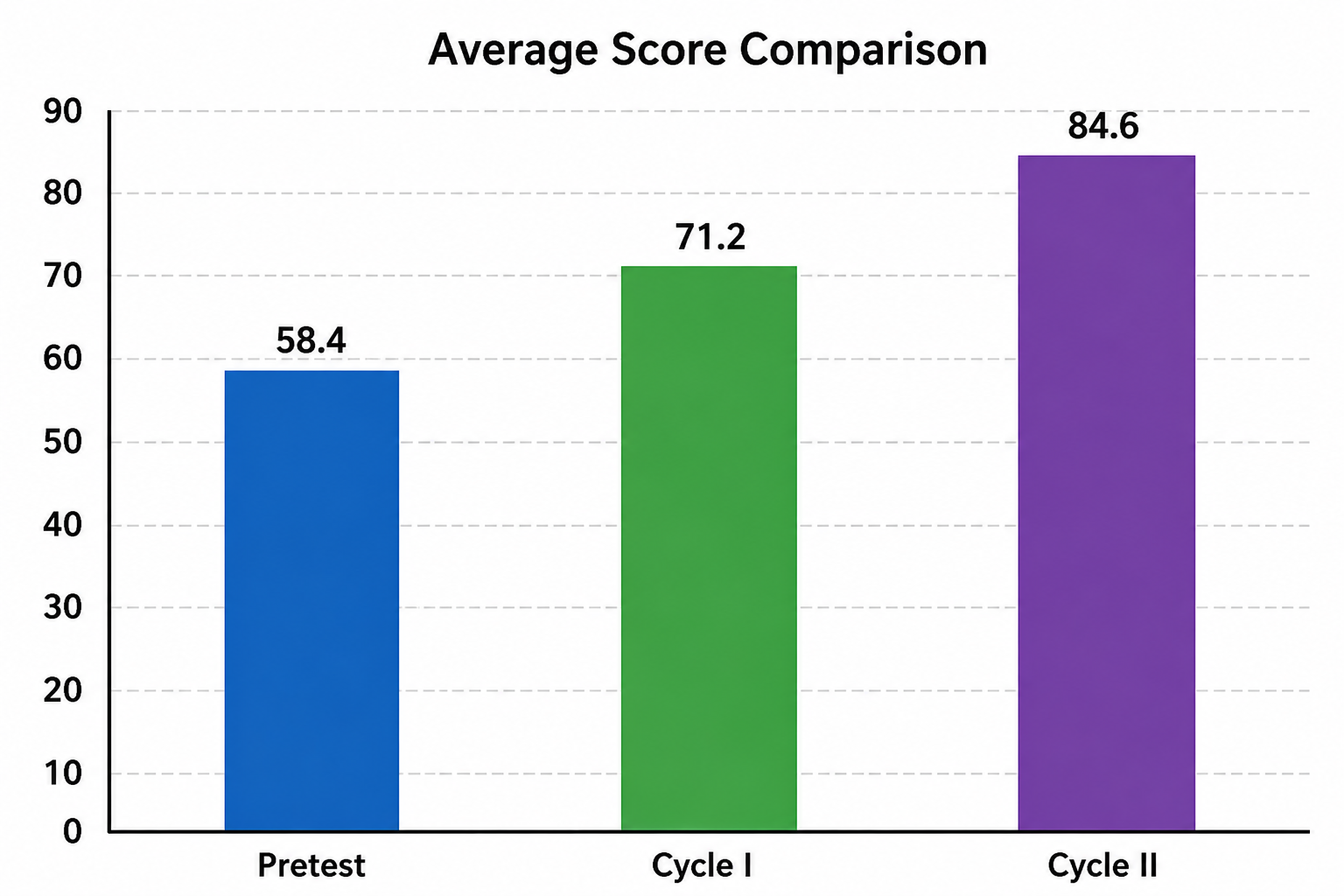
This study aims to determine the effectiveness of the Contextual Teaching and Learning (CTL) model in improving the mathematical problem-solving skills of fourth-grade students at SDN Mekar Jaya 31 in Depok regarding fractions. The study employed a quantitative approach with a one-group pretest-posttest design. The study sample consisted of 32 fourth-grade students. Data collection techniques included tests, observations, and documentation. Tests were used to measure students' mathematical problem-solving skills before and after the implementation of the CTL model, while observations and documentation were used to support data on the implementation of the learning process. The results of the study indicate that the implementation of the CTL model was able to improve students' mathematical problem-solving skills in the topic of fractions. This was demonstrated by an increase in students' learning outcomes from the pretest to the posttest scores. The results of the paired-sample t-test also showed a significant difference between the scores before and after the intervention. These findings indicate that instruction using the CTL model is effective because it helps students understand the concept of fractions through real-life contexts, encourages active student engagement, and facilitates students' ability to develop problem-solving strategies. Thus, the CTL model can serve as an effective instructional alternative for improving elementary school students' mathematical problem-solving skills, particularly in the topic of fractions.
Downloads
References
Afni, N., & Hartono. (2020). Contextual teaching and learning (CTL) as a strategy to improve students' mathematical literacy. Journal of Physics: Conference Series, 1581(1), 012043. https://doi.org/10.1088/1742-6596/1581/1/012043
Ajmain, A., Herna, & Masrura, S. I. (2020). Implementasi pendekatan etnomatematika dalam pembelajaran matematika. SIGMA: Jurnal Pendidikan Matematika, 12(1), 45–54. https://doi.org/10.26618/sigma.v12i1.3910
Bognar, B., Mužar Horvat, S., & Jukić Matić, L. (2025). Characteristics of effective elementary mathematics instruction: A scoping review of experimental studies. Education Sciences, 15(1), 76. https://doi.org/10.3390/educsci15010076
Elysa, Y., & Lena, M. S. (2020). Peningkatan prestasi belajar matematika menerapkan pendekatan Contextual Teaching and Learning (CTL) di kelas V SD. e-Jurnal Inovasi Pembelajaran Sekolah Dasar, 8(10).
http://dx.doi.org/10.24036/e-jipsd.v10i3.11108
Fauzi, I., Rakhmat, C., & Budiman, N. (2023). Complex Thinking: How are Students’ Mathematical Problem-Solving Skills in Elementary School?. Bulletin of Science Education, 3(3), 228–240. https://doi.org/10.51278/bse.v3i3.916
Hardiningsih, E. F., Masjudin, M., Abidin, Z., Salim, M., & Aziza, I. F. (2023). Penerapan Model Pembelajaran Project Based Learning Untuk Meningkatkan Kemampuan Pemecahan Masalah Statistika Matematika Siswa SMKN 2 Mataram. Reflection Journal, 3(1), 21-29. https://doi.org/10.36312/rj.v3i1.1264
Hellstrand, T. V. M. D. H. (2025). Individual characteristics associated with elementary school children's mathematical word problem-solving skills: A systematic review and meta-analysis. Review of Education, 13, 1–39. https://doi.org/10.1002/rev3.70045
Jannah, M., Hilyana, F. S., & Purwaningrum, J. P. (2023). Penggunaan model Contextual Teaching and Learning untuk meningkatkan kemampuan pemecahan masalah matematis siswa sekolah dasar. Jurnal Pendidikan Dasar, 9(2), 239–244. https://doi.org/10.29100/jp2m.v9i2.4484
Meitesya Putri, Salmaini Safitri Syam, & Chandra Chandra. (2025). Kesulitan Siswa Sekolah Dasar dalam Memahami Konsep Pecahan. Pentagon : Jurnal Matematika Dan Ilmu Pengetahuan Alam, 3(2), 43–54. https://doi.org/10.62383/pentagon.v3i2.488
Misqa, L., Oviana, W., Hayati, Z., & Jannah, M. (2024). Improving Student Learning Outcomes in Mathematics Learning through a Contextual Teaching and Learning Approach in Elementary Schools. Journal of Indonesian Primary School, 1(2), 19–26. https://doi.org/10.62945/jips.v1i2.34
Misqa, M., Yuliana, Y., Nurhidayah, N., & Rukayah, R. (2024). The effect of Contextual Teaching and Learning (CTL) approach on improving elementary students' mathematics learning outcomes. Journal of Indonesian Primary School, 1(1), 19–26. https://doi.org/10.61227/joips.v1i1.397
Muchtar, F. Y., Nurdin, F. A., Kasmawati, K., Nurwahyuningsih, N., Yamin, M., & S, M. I. (2023). Meningkatkan Hasil Belajar Matematika Peserta Didik Sekolah Dasar Melalui Model Pembelajaran Contextual Teaching and Learning (CTL). Journal on Education, 5(4), 14615-14624. https://doi.org/10.31004/joe.v5i4.2522
Nolceana Elisabeth Edita, N. (2025). Efforts to Improve Students’ Mathematics Learning Outcomes through the Contextual Teaching and Learning (CTL) Learning Model on Cube and Block Materials in Class VIII A Christian Junior High School. MATH-EDU: Jurnal Ilmu Pendidikan Matematika, 10(3), 271–283. https://doi.org/10.32938/jipm.v10i3.10529
Panjaitan, C. D., & Sinambela, P. N. (2023). Penerapan Model Pembelajaran Contextual Teaching and Learning (CTL) Berbantuan Media Audiovisual untuk Meningkatkan Kemampuan Pemahaman Konsep Matematika Siswa di SMP Swasta R.A Kartini Tebing Tinggi. Journal on Education, 5(2), 5016-5025. https://doi.org/10.31004/joe.v5i2.1212
Paputungan, F., & Siradjang, M. (2025). Contextual learning model practice. Indonesian Journal of Social Science and Education (IJOSSE), 1(2), 34–43. https://doi.org/10.62567/ijosse.v1i2.1008
Paudi, F., & Ngaito, O. (2026). Pengembangan bahan ajar berbasis kontekstual untuk meningkatkan pemahaman siswa. Inovasi Pendidikan dan Anak Usia Dini, 3(1), 86–96. https://doi.org/10.61132/inpaud.v3i1.874
Pradinar, A. P., Wiryanto, & Rahaju, E. B. . (2026). Analysis of Learning Difficulties of Grade IV Elementary School Students on Fractal Materials Reviewed from Numeracy Ability and Self-Efficacy. Journal of Innovation and Research in Primary Education, 5(1), 239–249. https://doi.org/10.56916/jirpe.v5i1.2752
Rahman, A. A., Zulkifli, Z., Kamaruddin, I., Azhari, D. S., & Supriyadi, A. (2023). The Effect of Contextual Teaching Learning (CTL) Model on Students’ Achievement in Elementary School. Edunesia : Jurnal Ilmiah Pendidikan, 4(1), 146–157. https://doi.org/10.51276/edu.v4i1.282
Riza, S., Mardhatillah, Rizki, D., & Ihsan, M. A. N. (2024). The effect of the use of Contextual Teaching and Learning (CTL) learning model on the cognitive value of students of elementary school. Jurnal Penelitian Pendidikan IPA, 10(5), 2702–2710. https://doi.org/10.29303/jppipa.v10i5.6988
Samigaluh, M., & Elementary, P. (2023). Contextual Teaching Learning (CTL) models with auxiliary objects of the surrounding environment. Indonesian Journal of Elementary Education, 7, 7–10. https://doi.org/10.20885/ijcer.vol7.iss2.art4
Syah, A., Harizahayu, H., Haddar, G. A., Annisah, A., & Pratiwi, E. Y. R. (2023). Improving Students’ Mathematical Problem-Solving Ability through the Use of External Representations. Journal on Education, 5(2), 5313-5323. https://doi.org/10.31004/joe.v5i2.1274
Wang, M., Effendi, M., & Mohd, E. (2025). A systematic literature review on analytical thinking development in mathematics education: Trends across time and countries. Frontiers in Psychology, 16, Article 1523836. https://doi.org/10.3389/fpsyg.2025.1523836
Yuliandari, R., Faizah, M., Mubarok, H., Anggraini, D. M., & Salsabila, S. (2025). Development of student worksheets based on contextual teaching and learning integrated Malang culture for elementary school students. Al-Ishlah: Jurnal Pendidikan, 17(3), 4498–4509. https://doi.org/10.35445/alishlah.v17i3.4712
Downloads
Published
How to Cite
Issue
Section
License
Copyright (c) 2026 Dina Rahma Wardana, Desty Arfiyani, Febriana Nur Cahyaningrum, Ayu Made Juniwati Wiratha, Kurniatun Nisak, Jauharul Ifadhi, Cholifah Tur Rosidah, Rosmiati Rosmiati

This work is licensed under a Creative Commons Attribution-ShareAlike 4.0 International License.