Beyond Conventional Literacy: Embedding Algorithmic Religious Literacy into Islamic Madrasah Curriculum through a Participatory Action Research-Informed Framework
DOI:
https://doi.org/10.61650/ajis.v3i3.1314Abstract
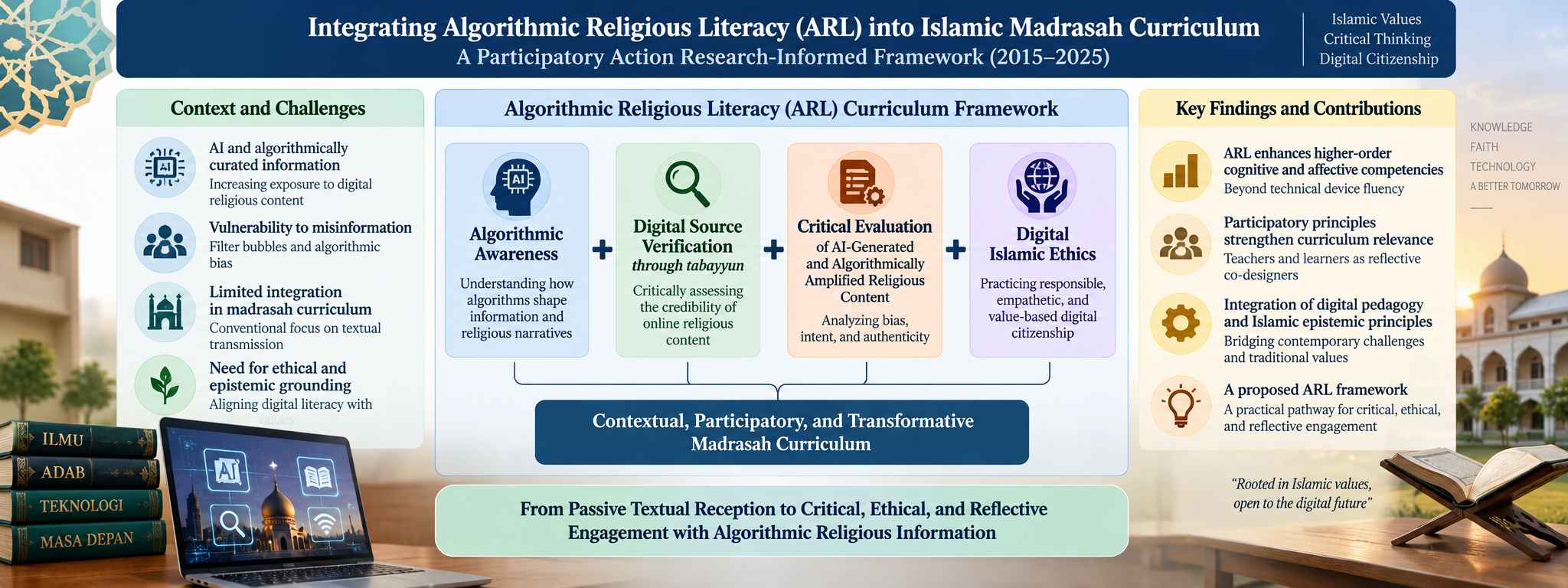
In the era of artificial intelligence and algorithmically curated information, Islamic madrasahs face growing challenges in preparing students to evaluate digital religious content critically while preserving established ethical and epistemic traditions. This study examines the integration of Algorithmic Religious Literacy (ARL) into Islamic madrasah curriculum through a Participatory Action Research-informed framework. Using an integrative literature review and mixed evidence synthesis of studies published between 2015 and 2025, the research analyzes evidence on Islamic education curriculum, digital pedagogy, madrasah learning, participatory action research, algorithmic literacy, and digital ethics. Findings indicate that effective ARL requires more than technical device fluency or conventional digital literacy. Four interconnected curriculum components emerged from the synthesis: algorithmic awareness, digital source verification through tabayyun, critical evaluation of AI-generated and algorithmically amplified religious content, and digital Islamic ethics. The review also shows that participatory principles can strengthen curriculum relevance by positioning teachers and learners as reflective co-designers of contextual learning activities. Based on these findings, the study proposes an ARL curriculum framework that integrates critical digital pedagogy with Islamic epistemic principles. This framework offers a contextual pathway for transforming madrasah literacy from passive textual reception toward critical, ethical, and reflective engagement with algorithmic religious information in digital environments.
Downloads
References
Alam, A. (2023). Educational technology: Exploring the convergence of technology and pedagogy through mobility, interactivity, AI, and learning tools. In Cogent Engineering (Vol. 10, Number 2). https://doi.org/10.1080/23311916.2023.2283282
Balán, L. (2023). Solar Community Hubs: how multinational ‘sustainable’ technology companies are replacing church and state in their ‘civilising and philanthropic’ educational work. Globalisation, Societies and Education, 24(3), 963–974. https://doi.org/10.1080/14767724.2023.2288155
Berthelot, D., Carlini, N., Cubuk, E. D., Kurakin, A., Zhang, H., Raffel, C., & Sohn, K. (2020). Remixmatch: Semi-Supervised Learning With Distribution Alignment and Augmentation Anchoring. In 8th International Conference on Learning Representations, ICLR 2020. https://www.scopus.com/inward/record.uri?partnerID=HzOxMe3b&scp=85150642697&origin=inward
Bortolotti, I., Rossi, F., & Biraglia, A. (2025). The Use of Technology by Children Aged 0–6: A Study on Educational Models, Attitudes, and Media Behaviors of Educators and Teachers in the Context of the “New Normal.” In T. L. (Ed.), Communications in Computer and Information Science: 2537 CCIS (pp. 19–32). Springer Science and Business Media Deutschland GmbH. https://doi.org/10.1007/978-3-031-95627-0_2
Boude, O., Acuña, N., & Vargas, A. (2025). Training of early childhood pedagogy graduates on educational technology: Systematic review. Estudios Pedagogicos, 51(1), 281–294. https://doi.org/10.4067/S0718-07052025000100281
Cailleba, P., & Edelbloude, J. (2026). Career anchors of French chefs: keys to success in haute cuisine. Journal of Global Mobility, 1–30. https://doi.org/10.1108/JGM-09-2025-0087
Chootongchai, S., & Maneerat, P. (2026). NextGen Talent-Driven AI Educational Agent. International Journal of Information and Education Technology, 16(3), 658–667. https://doi.org/10.18178/ijiet.2026.16.3.2538
Cooper, M., & Rockel, J. (2025). Enacting Pedagogies of Care: Weaving Māori Indigenous Concepts of Compassion and Respect into the Curriculum for 1-Year-Olds. In Early Childhood Pedagogical Practices Across the World: Selected Case Studies on the Role of Teachers for Learning and Care (pp. 107–116). Springer Science+Business Media. https://doi.org/10.1007/978-981-96-2747-9_9
Dallavalle, S., Ribeiro, L. R. B., & Moreira, S. A. S. (2026). Educating for Next-Generation BPM: A PBL-Process Mapping Blueprint Anchored in the Drifts of the Digital Era. In E. R. M., G. A., G. T., S. F., W. M., D. R.M., K. D., A. B., B. W., & R. K. (Eds.), Lecture Notes in Business Information Processing: 565 LNBIP (pp. 299–314). Springer Science and Business Media Deutschland GmbH. https://doi.org/10.1007/978-3-032-02936-2_21
De Leon, J. A., San Juan, J. L., Mayol, A. P., Vicerra, R. R., Concepcion, R. S., Bandala, A., Ambata, L., Orillo, J. C., & Culaba, A. B. (2023). Educational Management Information System: A Short Review. 2023 IEEE 15th International Conference on Humanoid, Nanotechnology, Information Technology, Communication and Control, Environment, and Management, HNICEM 2023. https://doi.org/10.1109/HNICEM60674.2023.10589235
Fernandez-Herrero, J., Urrea-Solano, M., & Alvarez-Herrero, J. F. (2026). Participatory evaluation of an educational augmented reality application in development using the technology acceptance model (TAM). Discover Education, 5(1). https://doi.org/10.1007/s44217-026-01377-1
Gunawardena, S. A., Chandraratne, A., & Jayasekara, T. I. (2026). Integrating One Health in human medical curricula: A scoping review of pedagogical strategies and challenges. Medical Teacher, 48(6), 1069–1090. https://doi.org/10.1080/0142159X.2025.2604244
Jafari, R., Sarhadi, P., Paykani, A., Refaat, S. S., & Asef, P. (2025). A TD3-Based Reinforcement Learning Algorithm With Curriculum Learning for Adaptive Yaw Control in All-Wheel-Drive Electric Vehicles. IEEE Access, 13, 127150–127169. https://doi.org/10.1109/ACCESS.2025.3587938
Kakana, D., & Gkloumpou, A. (2025). Pedagogical Documentation as a “Bridge” Between Parents and the Early Childhood Curriculum. Social Sciences, 14(1). https://doi.org/10.3390/socsci14010007
Khoveyni, M., & Eslami, R. (2026). Identifying anchor points and determining adjustment bounds in data envelopment analysis with negative data. European Journal of Operational Research, 330(1), 182–198. https://doi.org/10.1016/j.ejor.2025.08.001
Kinoshita, K., Maruyama, T., Kobayashi, N., Imanishi, S., Maruyama, M., Ohira, G., Endo, S., Tochigi, T., Kinoshita, M., Fukui, Y., Kumazu, Y., Kita, J., Shinohara, H., & Matsubara, H. (2024). An artificial intelligence-based nerve recognition model is useful as surgical support technology and as an educational tool in laparoscopic and robot-assisted rectal cancer surgery. Surgical Endoscopy, 38(9), 5394–5404. https://doi.org/10.1007/s00464-024-10939-z
K.W., L., & L.H., W. (Eds.). (2025). 2nd International Conference on Intelligent Technology for Educational Applications, ITEA 2025. Communications in Computer and Information Science, 2643 CCIS. https://www.scopus.com/pages/publications/105019672221?origin=resultslist
Li, A., Li, J., & Nong, L. (2025). Research on Improving Preschool Teachers’ Educational Research Ability Supported by Big Data Technology. International Journal of E-Collaboration, 21(1). https://doi.org/10.4018/IJeC.368067
McCormack, M. (2026). The community anchor model in rural development: lessons from Northern Ireland. Social Enterprise Journal. https://doi.org/10.1108/SEJ-06-2025-0142
Milton, J., Deguara, J., Bonello, C., Camilleri, R., & Muscat, T. (2025). Reconfiguring Initial Teacher Education Through COVID-19 Times: Student Teachers’ Perspectives and Experiences in Malta. In Innovations in Pedagogical Practice and Curriculum Development in Higher Education: Contemporary Global Perspectives (pp. 125–143). Emerald Publishing. https://doi.org/10.1108/978-1-83549-506-320251010
Mohammed, A. S., Amoah, C., & Diploma, I. B. A. (2025). Technology integration on infrastructure to support educational needs in a college in Ghana. Infrastructure Asset Management, 13(1), 50–66. https://doi.org/10.1680/jinam.24.00030
Nandiyanto, A. B. D., Kurniawan, T., Bilad, M. R., Al-Obaidi, A. S. M., Farobie, O., & Hammouti, B. (2026). How to Integrate Nanotechnology into Chemical Engineering Education: A Bibliometric and Technological Review of Curriculum Standards, Research Trends, Pedagogical Challenges, and Future Prospects. ASEAN Journal of Educational Research and Technology, 5(2), 245–260. https://www.scopus.com/pages/publications/105038388205?origin=resultslist
Opoku, M. J. (2021). Pedagogical model for decolonising, indigenising and transforming science education curricula: A case of south africa. Journal of Baltic Science Education, 20(1), 93–107. https://doi.org/10.33225/jbse/21.20.93
Sari, N. K., & Wicaksana, M. F. (2024). Assessment of “Gemoy” Campaign Strategy: Evaluating Digital Media Instruments and Learning Technologies in Political Communication. In Applied Observation and Pedagogical Studies Poster (Vol. 3, Number 2, p. 1). https://scholar.google.com/citations?view_op=view_citation&hl=en&user=rOXoKHoAAAAJ&pagesize=100&citation_for_view=rOXoKHoAAAAJ:ldfaerwXgEUC
Simbolon, M., Pongkondek, J. J., Henukh, A., & Ronchintaniawati, D. (2025). AI-Driven Sociocultural Interactive Digital Module for Papua: Advancing Educational Technology to Sustainable Development Goals. International Journal of Learning, Teaching and Educational Research, 24(2), 543–559. https://doi.org/10.26803/ijlter.24.2.27
Soriano-Alcantara, J. M., Guillén-Gámez, F. D., & Ruiz-Palmero, J. (2025). Exploring Digital Competencies: Validation and Reliability of an Instrument for the Educational Community and for all Educational Stages. Technology, Knowledge and Learning, 30(1), 307–326. https://doi.org/10.1007/s10758-024-09741-6
Su, R., Liu, C., Ma, X., Chen, R., Luo, Y., & Chen, Y. (2026). Using Artificial Intelligence to Reshape Higher Education Such That It Is in Line with Sustainability: A Systematic Review of Pedagogical and Curricular Innovations. Sustainability (Switzerland), 18(5). https://doi.org/10.3390/su18052360
Sun, Q., & Hsiao, I.-H. (2026). Lessons learned from an AI-assisted educational technology for environmental sustainability and waste management. Educational Technology and Society, 29(1), 388–407. https://doi.org/10.30191/ETS.202601_29(1).SP08
Tang, S. (2025). Technology and Education Integration’: Reconstruction of the Path of Classroom Teaching Empowered by Intelligent Educational Technology - The Rational Use of Artificial Intelligence Based Technology. 2025 International Conference on Artificial Intelligence and Education, ICAIE 2025, 845–851. https://doi.org/10.1109/ICAIE64856.2025.11158652
Yespanova, I., Turmanov, R., Niyazova, D., Appazov, N., Uaidullakyzy, E., Toibazarova, A., & Zhanbekov, K. (2026). Application of Waste Recycling Technology in Educational Laboratory Research: Wastewater Treatment with Sorbent Derived from Rice Straw and Husk of the Kyzylorda Region. Journal of Chemical Education, 103(4), 2195–2201. https://doi.org/10.1021/acs.jchemed.5c01402
Published
How to Cite
Issue
Section
License
Copyright (c) 2025 Akhmad Sirojuddin, Rahmat Rahmat

This work is licensed under a Creative Commons Attribution-ShareAlike 4.0 International License.