Implementation of the Muhadharah Program in Improving the Disciplined, Creative and Self-Confident Character of Students in Islamic Boarding Schools
DOI:
https://doi.org/10.61650/ajis.v3i2.1020Keywords:
Muhadharah, Disciplined Character, Creativity, Self-ConfidenceAbstract
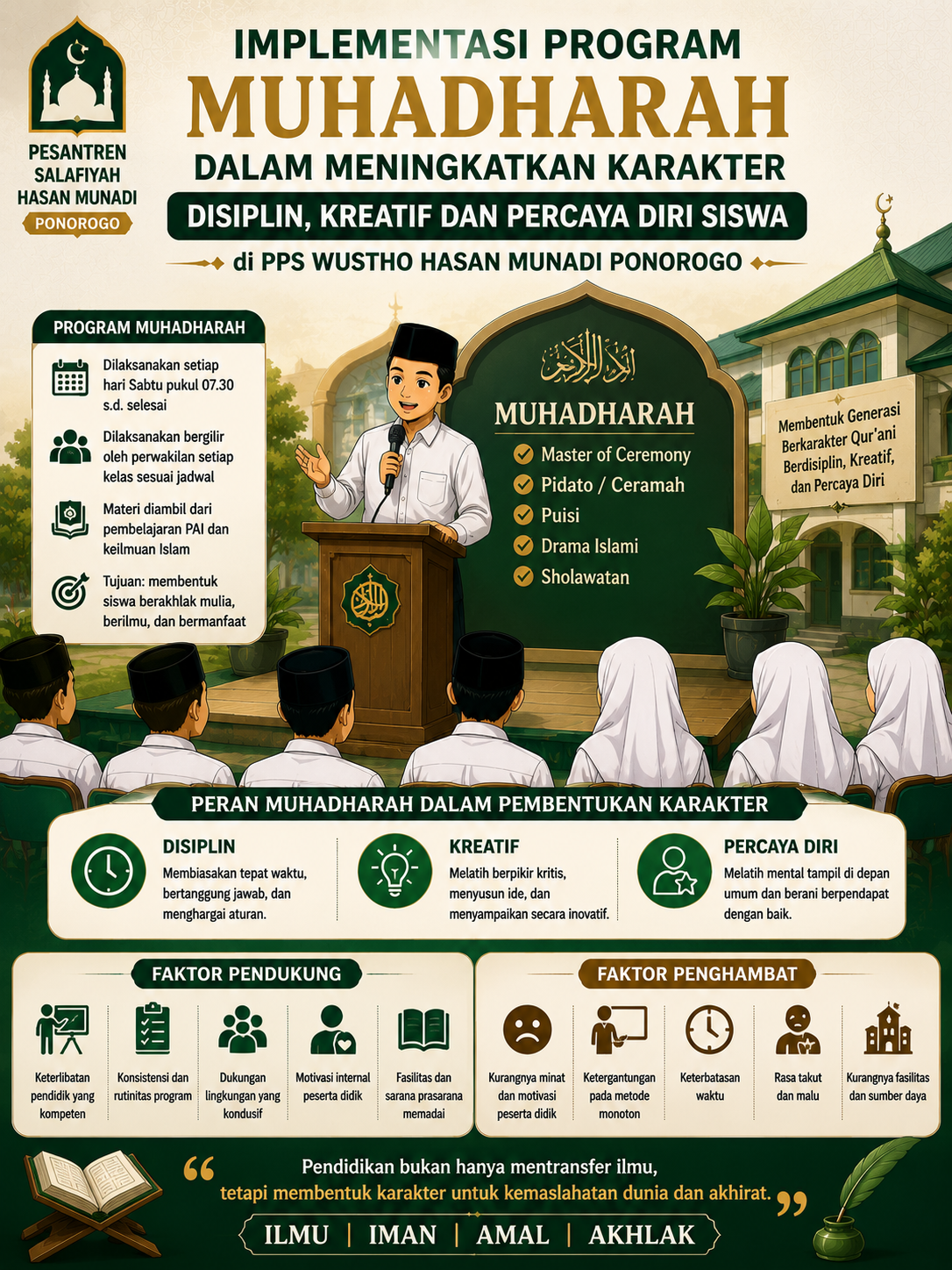
In the midst of the rampant problems of indiscipline, stagnation and inferiority of some Indonesian students, but different Pesantren Salafiyah Hasan Munadi Ponorogo, developed the Muhadharah Program in improving the character of discipline, creativity and self-confidence of students. This study uses a qualitative descriptive approach research method, field research type. Data collection techniques use interviews, observations and documentation. Then the analysis technique through the stages of data codification, data presentation and drawing conclusions. The results of this study are 1) The Muhadharah Program is a superior program in this institution that must be followed by all students. Its implementation is carried out every Saturday, this program is carried out in turns by representatives of each class according to a predetermined schedule 2) The Muhadharah Program plays an important role in shaping the character of discipline and creativity and self-confidence of students. 3) supporting factors, namely, the involvement of competent educators, consistency and routine in implementing the program, support for a conducive environment, internal motivation of students and adequate supporting facilities. While the inhibiting factors are, lack of interest and motivation of students, dependence on monotonous teaching methods, time constraints, fear and shame, lack of learning oriented towards developing creativity and lack of facilities/resources. The purpose of this study is 1) To analyze the implementation of the Muhadharah program in fostering the character of discipline and creativity of students, 2) To analyze the role of Muhadharah in improving the character of discipline, creativity and confidence of students, 3) to analyze the supporting and inhibiting factors. This study recommends that the muhadharah program routinely and consistently can improve the character of discipline, creativity and confidence of students.
Downloads
References
Akram, M., & Malik, M. I. (2023). Comparing the use of Robert Marzano's model of instructional strategies in the Pakistani context. Journal of Teacher Development and Education, 1(1), 51-63. [https://doi.org/10.5281/zenodo.10257957]
Aly, A. (2017). Pengembangan pembelajaran karakter berbasis soft skills di perguruan tinggi. Ishraqi, 1(1), 18-30. [https://doi.org/10.23917/ishraqi.v1i1.2926]
Dwivedi, Y. K., Kshetri, N., Hughes, L., Slade, E. L., Jeyaraj, A., Kar, A. K., ... & Wright, R. (2023). Opinion Paper:"So what if ChatGPT wrote it?" Multidisciplinary perspectives on opportunities, challenges and implications of generative conversational AI for research, practice and policy. International Journal of Information Management, 71, 102642. [https://doi.org/10.1016/j.ijinfomgt.2023.102642]
Farid, A. (2023). Literasi digital sebagai jalan penguatan pendidikan karakter di era society 5.0. Cetta: Jurnal Ilmu Pendidikan, 6(3), 580-97. [https://doi.org/10.37329/cetta.v6i3.2603]
Finowa'a, S. (2022). Transparansi pemerintah desa dalam menjalankan program-program di desa Hilisoromi Kecamatan Toma Kabupaten Nias Selatan. FAGURU: Jurnal Ilmiah Mahasiswa Keguruan, 1(2), 239-250. [https://doi.org/10.57094/faguru.v1i2.697]
Glăveanu, V. P., & Beghetto, R. A. (2021). Creative experience: A non-standard definition of creativity. Creativity Research Journal, 33(2), 75-80. [https://doi.org/10.1080/10400419.2020.1827606]
Hassan, H. M. (2020). The effect of using a program based on multiple intelligences theory in teaching geometry on developing preparatory stage pupils' habits of mind. Journal of Research in Curriculum Instruction and Educational Technology, 6(1), 149-174. [https://doi.org/10.21608/jrciet.2020.67947]
Hattie, J. (2008). Visible learning: A synthesis of over 800 meta-analyses relating to achievement. Routledge. [https://doi.org/10.4324/9780203887332]
Iskandar, M. Y. (2024). Implementasi teori belajar behavioristik dalam proses pembelajaran abad 21. Murabby: Jurnal Pendidikan Islam, 7(1), 57-70. [https://doi.org/10.15548/mrb.v7i1.3477]
Kurniawan, S., & Fitriyani, F. N. (2023). Thomas Lickona's idea on character education which builds multicultural awareness: Its relevance for school/madrasah in Indonesia. Al-Tadzkiyyah: Jurnal Pendidikan Islam, 14(1), 33-53. [https://doi.org/10.24042/atjpi.v14i1.15820]
Mamun, M. A., Lawrie, G., & Wright, T. (2020). Instructional design of scaffolded online learning modules for self-directed and inquiry-based learning environments. Computers & Education, 144, 103695. [https://doi.org/10.1016/j.compedu.2019.103695]
Mekarisce, A. A. (2020). Teknik pemeriksaan keabsahan data pada penelitian kualitatif di bidang kesehatan masyarakat. Jurnal Ilmiah Kesehatan Masyarakat: Media Komunikasi Komunitas Kesehatan Masyarakat, 12(3), 145-151. [https://doi.org/10.52022/jikm.v12i3.102]
Mujahid, I. (2021). Islamic orthodoxy-based character education: Creating moderate Muslim in a modern pesantren in Indonesia. Indonesian Journal of Islam and Muslim Societies, 11(2), 185-212. [https://doi.org/10.18326/ijims.v11i2.185-212]
Rahmawati, L., & Wahdah, S. (2024). Preservasi naskah kuno (manuskrip) Kalimantan Selatan (studi kasus pada Dinas Perpustakaan dan Kearsipan Provinsi dan Museum Lambung Mangkurat Kalimantan Selatan). Pustaka Karya: Jurnal Ilmiah Ilmu Perpustakaan dan Informasi, 12(1), 95-111. [https://doi.org/10.18592/pk.v12i1.12459]
Rohmah, M. (2025). Implementasi kegiatan ekstrakurikuler muhadharah dalam meningkatkan motivasi dan percaya diri santri putri Pondok Pesantren Darul Amal Metro. Jurnal Sosial Teknologi, 5(3), 565-571. [https://doi.org/10.59188/jurnalsostech.v5i3.32034]
Rosidi, A., Zainuddin, M., & Arifiana, I. (2024). Metode dalam penelitian hukum normatif dan sosiologis (field research). Journal Law and Government, 2(1), 46-58. [https://doi.org/10.31764/jlag.v2i1.21606]
Saadah, M., Prasetiyo, Y. C., & Rahmayati, G. T. (2022). Strategi dalam menjaga keabsahan data pada penelitian kualitatif. Al-'Adad: Jurnal Tadris Matematika, 1(2), 54-64. [https://doi.org/10.24260/add.v1i2.1113]
Septianingrum, N. A., Kiswantoro, A., & Rahardjo, S. (2022). Mengatasi rendahnya disiplin belajar siswa dalam pembelajaran daring pada masa pandemi Covid-19 melalui konseling behavioristik teknik self management. Jurnal Muria Research Guidance and Counseling (MRGC), 1(1), 1-17. [https://doi.org/10.24176/mrgc.v1i1.8602]
Septianti, N., & Afiani, R. (2020). Pentingnya memahami karakteristik siswa sekolah dasar di SDN Cikokol 2. As-Sabiqun, 2(1), 7-17. [https://doi.org/10.36088/assabiqun.v2i1.611]
Sinaga, M. N., Ringo, S. S., & Netrallia, M. C. (2024). Teori belajar sebagai landasan bagi pengembangan teknologi pendidikan. Jurnal Pendidikan Indonesia: Teori, Penelitian, Dan Inovasi, 4(1). [https://doi.org/10.59818/jpi.v4i2.646]
Suryantoro, B., & Kusdyana, Y. (2020). Analisis kualitas pelayanan publik pada Politeknik Pelayaran Surabaya. Jurnal Baruna Horizon, 3(2), 223-229. [https://doi.org/10.52310/jbhorizon.v3i2.42]
Susanto, D., & Jailani, M. S. (2023). Teknik pemeriksaan keabsahan data dalam penelitian ilmiah. QOSIM: Jurnal Pendidikan, Sosial & Humaniora, 1(1), 53-61. [https://doi.org/10.61104/jq.v1i1.60]
Syawala, A. (2025). Analisis strategi pengembangan kurikulum merdeka berbasis pembentukan karakter dalam meningkatkan kedisplinan siswa di MTs Asy-Syafi'iyyah Singkawang. Jurnal Pengabdian Masyarakat dan Riset Pendidikan, 3(4), 1759-1765. [https://doi.org/10.31004/jerkin.v3i4.747]
Tambak, S., Ahmad, M., Sukenti, D., & Ghani, A. R. B. A. (2020). Profesionalisme guru madrasah: Internalisasi nilai Islam dalam mengembangkan akhlak aktual siswa. Jurnal Pendidikan Agama Islam Al-Thariqah, 5(2), 79-96. [https://doi.org/10.25299/al-thariqah.2020.vol5(2).5885]
Tan, L., Kocsis, A., & Burry, J. (2023). Advancing Donald Schön's reflective practitioner: Where to next?. Design Issues, 39(3), 3-18. [https://doi.org/10.1162/desi_a_00722]
Tanjung, R., Ritonga, T., & Siregar, E. Y. (2021). Analisis minat belajar siswa dalam pembelajaran daring pada masa pandemi covid-19 di desa ujung batu barus. Jurnal MathEdu (Mathematic Education Journal), 4(1), 88-96. [https://doi.org/10.37081/mathedu.v4i1.2201]
Waddington, J. (2023). Self-efficacy. ELT Journal, 77(2), 237-240. [https://doi.org/10.1093/elt/ccac046]
Waruwu, M., Puat, S. N., Utami, P. R., Yanti, E., & Rusydiana, M. (2025). Metode penelitian kuantitatif: Konsep, jenis, tahapan dan kelebihan. Jurnal Ilmiah Profesi Pendidikan, 10(1), 917-932. [https://doi.org/10.29303/jipp.v10i1.3057]
Wijaya, A. J., Pujiastuti, H., & Hendrayana, A. (2022). Tingkat kemampuan berpikir kreatif siswa dalam menyelesaikan soal open ended. JIPM (Jurnal Ilmiah Pendidikan Matematika), 11(1), 108-22. [https://doi.org/10.25273/jipm.v11i1.10866]
Zuhri, S., Nazmudin, D., & Asmuni, A. (2022). Konsepsi pendidikan karakter menurut Al-Zarnuji dan Thomas Lickona. Al-Tarbawi Al-Haditsah: Jurnal Pendidikan Islam, 7(2), 56-78. [https://doi.org/10.24235/tarbawi.v7i2.11836]
Downloads
Published
How to Cite
Issue
Section
License
Copyright (c) 2025 Binti Rofii’ah, Katni Katni, Devid Dwi Erwahyudin, Muhamad Nabil Abidin, Kholid Muhtar Aziz, Achmad Basith Setiawan, Nila Agustin

This work is licensed under a Creative Commons Attribution-ShareAlike 4.0 International License.