Implementation of Islamic Religious Education in Character Formation at the Salafiyah Ula Nashrus Sunnah Madrasah in Madiun City
DOI:
https://doi.org/10.61650/ajis.v2i2.1011Keywords:
Islamic Religious Education, Character Formation, ReligiousAbstract
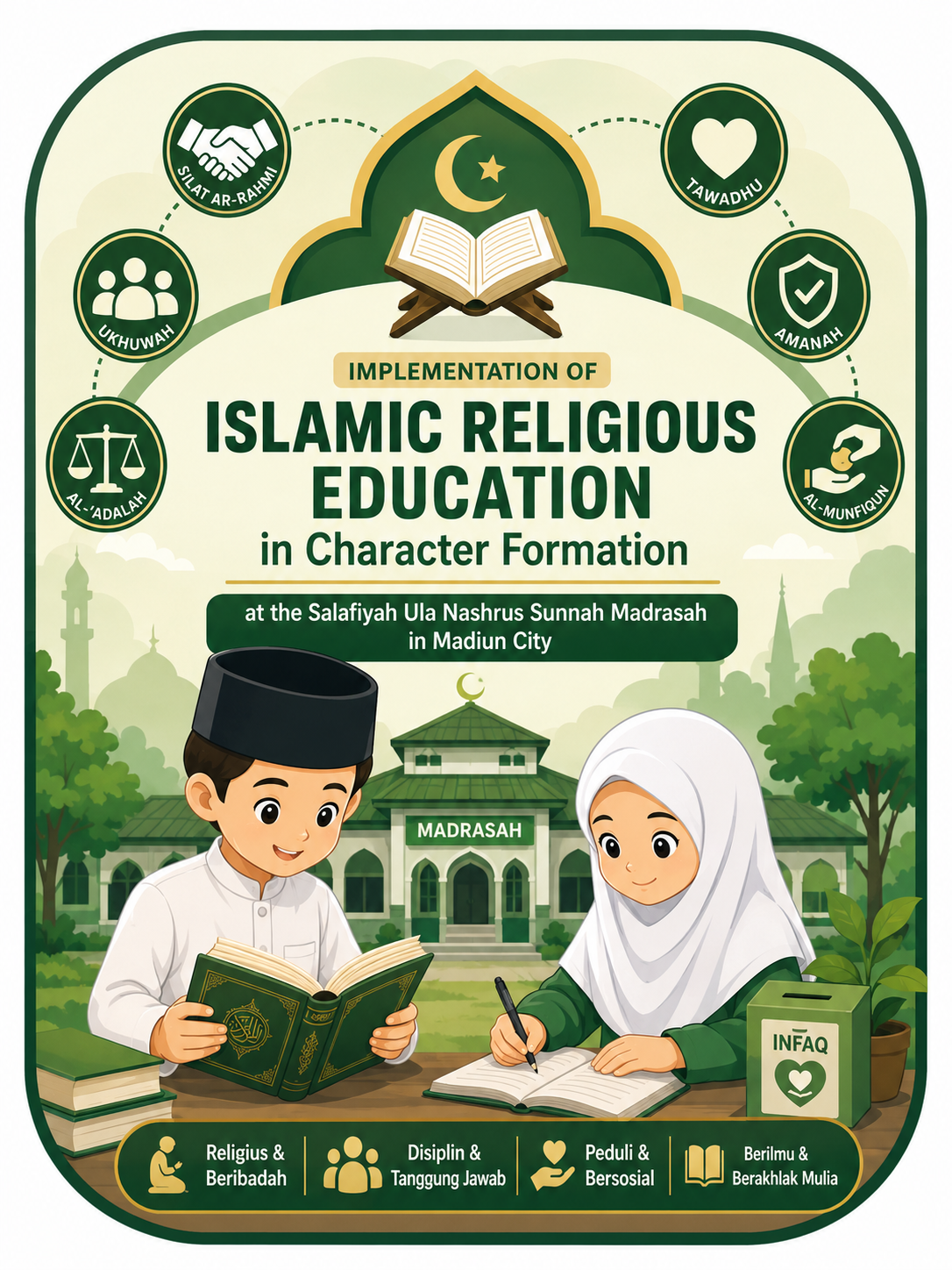
This study aims to examine the role of Islamic Religious Education (PAI) in shaping the religious character of students at Madrasah Salafiyah Ula Nashrus Sunnah, Madiun City. The research is motivated by concerns about the decline in students’ moral and spiritual values due to the influence of globalization, social media, and the weakening role of the family as the primary educator. This condition highlights the importance of Islamic Religious Education in developing students’ religious character from an early age. The study employs a descriptive qualitative approach, with data collected through observation, in-depth interviews, and documentation. The findings reveal that PAI plays a significant role in instilling religious character through the integration of Islamic values into the curriculum, teachers’ exemplary behavior, daily worship practices, and social activities such as charity (infak) and cooperation among students. The Islamic character values developed include silat ar-rahmi, ukhuwah, al-‘adalah, husnudzan, tawadhu, amanah, iffah, and al-munfiqun. These values shape students’ religious attitudes as reflected in their morality, discipline, and sense of responsibility, both within and outside the school environment. However, this process faces challenges such as diverse family backgrounds and the negative influence of digital environments. The study concludes that the success of religious character formation through PAI largely depends on the synergy between teachers, families, and the social environment, as well as the implementation of contextual learning strategies that touch upon students’ spiritual aspects.
Downloads
References
Bali, Muhammad Mushfi El Iq, and Susilowati Susilowati. 2019. "Transinternalisasi Nilai-Nilai Kepesantreanan Melalui Konstruksi Budaya Religius Di Sekolah." Jurnal Pendidikan Agama Islam 16(1):1–16. doi:10.14421/jpai.jpai.2019.161-01.
Choli, Ifham. 2019. "Pembentukan Karakter Melalui Pendidikan I." Tahdzib Al-Akhlaq: Jurnal Pendidikan Islam 2(2):35–52. doi:10.34005/tahdzib.v2i2.511.
Daulay, Rahmad Muliadi Saleh, and Fatkhur Rohman. 2023. "Keteladanan Guru Membentuk Kedisiplinan Beribadah Siswa: Analisis Implementasi Pada Siswa Madrasah Aliyah." Hikmah 20(1):69–80. doi:10.53802/hikmah.v20i1.194.
Hafid, Moh. 2017. "Pengaruh Motivasi Dan Kompetensi Guru Terhadap Kinerja Guru Sekolah Dan Madrasah Di Lingkungan Pondok Pesantren Salafiyah Syafi'iyah Sukorejo." Jurnal Pendidikan Islam Indonesia 1(2):293–314. doi:10.35316/jpii.v1i2.55.
Hardani, Nur hikmatul Lailiyah. 2020. Metode Penelitian Kualitatif & Kuantitatif. edited by H. Abadi. Yogyakarta: CV. Pustaka Ilmu Group Yogyakarta.
Izzah, Ismatul. 2018. "Peran Pendidikan Agama Islam Dalam Membentuk Masyarakat Madani." Pedagogik Jurnal Pendidikan. doi:https://doi.org/10.33650/pjp.v5i1.219.
Kementerian Pendidikan Nasional. 2010. Pengembangan Pendidikan Budaya Dan Karakter Bangsa: Pedoman Sekolah. Jakarta: Pusat Kurikulum dan Perbukuan, Balitbang, Kemendiknas.
Lexy, Moleong. 2014. Metode Penelitian Kualitatif Edisi Revisi. Jakarta: Remaja Rosda Karya.
Maryati. 2024. "Implementasi Pendidikan Karakter Di Sekolah Dasar Dalam Pembentukan Pribadi Siswa." JISPE Journal of Islamic Primary Education 5(2). doi:https://doi.org/10.51875/jispe.v5i02.535.
Nashrudin, Ega. 2023. "Penguatan Pendidikan Karakter Religius Melalui Ekstrakurikuler Keagamaan Di SMA Negeri 3 Bandung." Jurnal Pendidikan Karakter 14(1). doi:https://doi.org/10.21831/jpka.v14i1.55288.
Nursanjaya, Nursanjaya. 2021. "Memahami Prosedur Penelitian Kualitatif: Panduan Praktis Untuk Memudahkan Mahasiswa." Negotium: Jurnal Ilmu Administrasi Bisnis (Vol. 4 No. 1 (2021): Negotium Vol. 4 No. 1 Januari-Juni 2021):126–41.
Nurussalam, Afifah. 2022. "Peran Guru Pendidikan Agama Islam Dalam Membentuk Karakter Religius Peserta Didik Di SMK Ekonomika Depok." Skripsi tidak dipublikasikan, Program Studi Agama Islam, Universitas Muhammadiyah Jakarta.
Prasetio, Agus. 2022. "Implementasi Pendidikan Karakter Melalui Mata Pelajaran Pendidikan Agama Islam Di SMP 2 Negeri Jatianom Klaten Tahun 2021/2022." Skripsi Tidak di Terbitkan, Fakultas Agama Islam, Pendidikan Agama Islam, Universitas Muhammadiyah Surakarta.
Sari, Dian. 2020. "Peranan Pembelajaran Pendidikan Agama Islam Dalam Membentuk Karakter Religius Siswa Di SDN 55 Olang Luwu." Skripsi Tidak diterbitkan, Program Studi Pendidikan Agama Islam, Institut Agama Islam Negeri Palopo.
Saris, Suhardi. 2021. "Implementasi Pembelajaran Akidah Akhlaq Dalam Pembentukan Karakter Peserta Didik Di MTS Muhammadiyah Lempangan Panciro Kabupaten Gowa." Universitas Negeri Alauddin Makassar.
Sholahudin, Tammam, Ibnu Abid, and Mufid Ikhwanudin. 2025. "Evaluasi Hasil Pembelajaran Pendidikan Agama Islam (PAI) Tinjauan Terhadap Ayat Al-Qur'an Dalam Aspek Kognitif, Afektif, Dan Psikomotorik." Ainara Journal (Jurnal Penelitian Dan Pengabdian Kepada Masyarakat Bidang Pendidikan) 6(1). doi:https://doi.org/10.54371/ainj.v6i1.808.
Sholihah, Abdah Munfaridatus, and Windy Zakiya Maulida. 2020. "Pendidikan Islam Sebagai Fondasi Pendidikan Karakter." QALAMUNA: Jurnal Pendidikan, Sosial, Dan Agama 12(01):49–58. doi:10.37680/qalamuna.v12i01.214.
Sugiyono. 2010. Metode Penelitian Pendidikan: Pendekatan Kuantitatif, Kualitatif, Dan R&D. Bandung: ALFABETA.
Sulistiawati, Anjar, and Khoirudin Nasution. 2022. "Upaya Penanaman Pendidikan Karakter Di Sekolah Dasar Telaah Pendekatan Struktural Fungsional Talcott Parsons." Jurnal Papeda: Jurnal Publikasi Pendidikan Dasar 4(1):24–33. doi:10.36232/jurnalpendidikandasar.v4i1.1839.
Tanjung Saputra, Ilham. 2022. "Media Sosial Dan Perubahan Pola Interaksi Sosial Generasi Millenial Pedesaan (Studi Di Desa Dwi Warga Tunggal Jaya Kecamatan Banjar Agung Kabupaten Tulang Bawang)." Universitas Islam Negeri Raden Intan Lampung.
Wahyuni. 2021. "Pola Pengasuhan Anak Antar Generasi Dalam M
Published
How to Cite
Issue
Section
License
Copyright (c) 2024 Fitrian Nurazizah, Maulid Roikhan Mustafit, Azzah Ayu Azzahroh, Fretina Ananta Nurya Putri, Aci Ardian

This work is licensed under a Creative Commons Attribution-ShareAlike 4.0 International License.