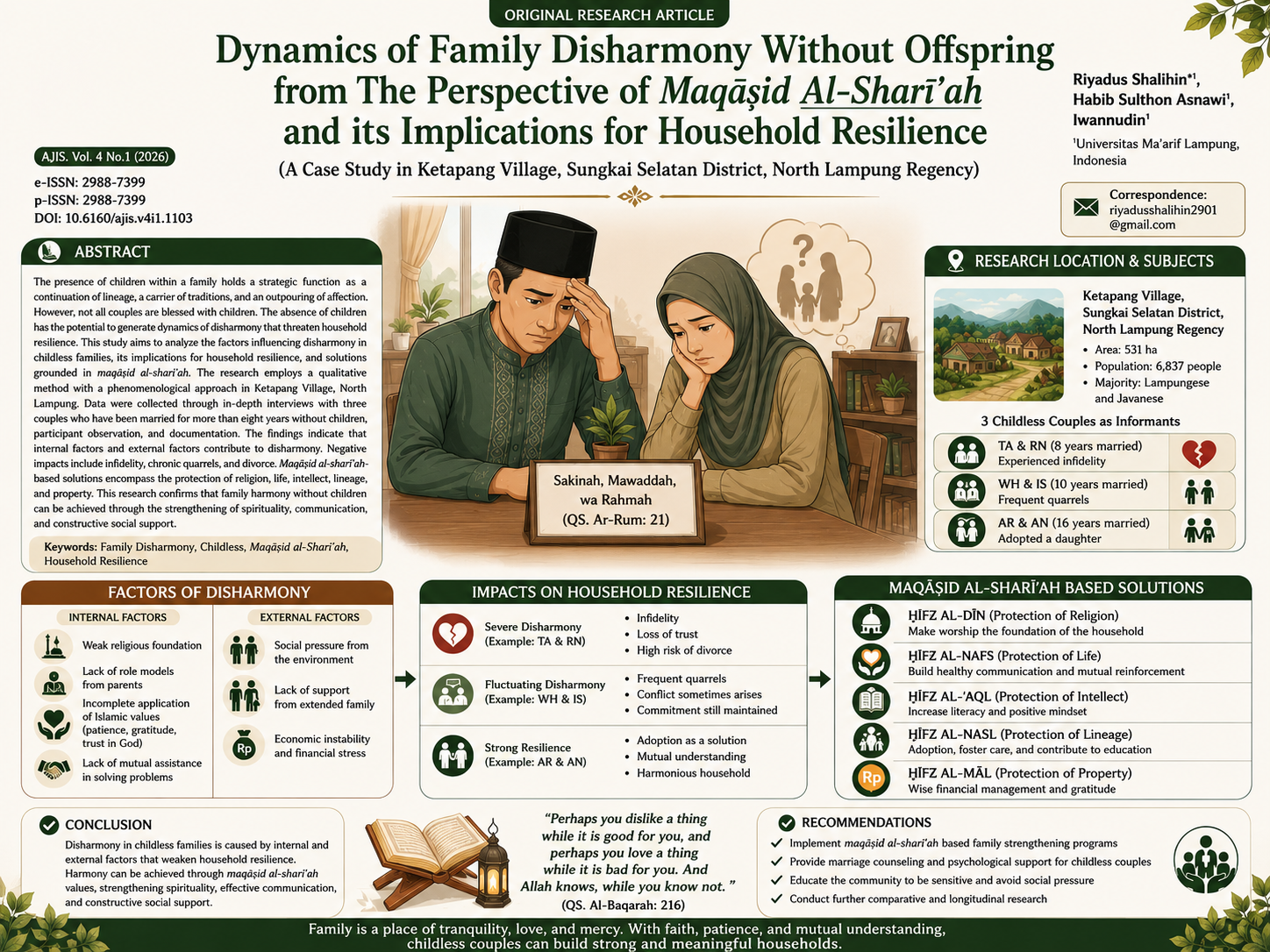
Dynamics of Family Disharmony Without Offspring from The Perspective of Maqāṣid Al-Sharī'ah and its Implications for Household Resilience (A Case Study in Ketapang Village, Sungkai Selatan District, North Lampung Regency)
DOI:
https://doi.org/10.61650/ajis.v4i1.1103Keywords:
Family Disharmony, Childless, Maqāṣid al-Sharī'ah, Household ResilienceAbstract
The presence of children in a family has a strategic function as a continuation of lineage, heir to traditions, and outpouring of affection. However, not all couples are blessed with children. The absence of children has the potential to create dynamics of disharmony that threaten household resilience. This study aims to analyze the factors influencing disharmony in childless families, its implications for household resilience, and solutions based on maqashid sharia. The research employs a qualitative method with a phenomenological approach in Ketapang Village, North Lampung. Data were collected through in-depth interviews with three couples who have been married for more than eight years without children, participant observation, and documentation. The findings indicate that internal factors (weak religious foundation, lack of role models, and non-comprehensive application of Islamic values) and external factors (social pressure and lack of family support) contribute to disharmony. Negative impacts include infidelity, chronic quarrels, and divorce. Maqashid sharia-based solutions include the protection of religion (hifz al-din), life (hifz al-nafs), intellect (hifz al-aql), lineage (hifz al-nasl), and property (hifz al-mal). This research confirms that family harmony without children can be achieved through strengthening spirituality, effective communication, and constructive social support.
Downloads
References
Abylkassymova, A., Mubarakov, A., Yerkisheva, Z., Turganbayeva, Z., & Baysalov, Z. (2020). Assessment of financial literacy formation methods in mathematics education: Financial computation. International Journal of Emerging Technologies in Learning, 15(16), 49–67. https://doi.org/10.3991/ijet.v15i16.14587
Arikunto, S. (2010). Prosedur Penelitian Suatu Pendekatan Praktek. Jakarta: Rineka Cipta.
Bugin, B. (2013). Metodologi Penelitian Sosial dan Ekonomi. Jakarta: Kencana Prenada Media Group.
Effendi, J. (2024). Nafqah Penyediaan Tempat Tinggal (Maskan) Keluarga dalam Perspektif Maqāshid al-Syarī'ah. Skripsi. Universitas Islam Negeri Sultan Syarif Kasim Riau. https://repository.uin-suska.ac.id/78958/
Faridah, Y. (2025). Upaya Mempertahankan Keharmonisan Rumah Tangga Tanpa Anak Perspektif Maqashid al-Syari'ah di Kecamatan Tambusai. Thesis. Universitas Islam Negeri Sultan Syarif Kasim Riau. https://repository.uin-suska.ac.id/91367/
Fathoni, A. (2006). Metode Penelitian dan Teknik Penyusunan Skripsi. Jakarta: Rineka Cipta.
Gottman, J. (2015). The Seven Principles for Making Marriage Work. New York: Harmony Books.
Hadi, S. (2000). Metodologi Research. Yogyakarta: Andi Offset.
Harahap, I., Siregar, F. A., & Hariyanto, E. (2025). Understanding The Rise of Childfree Marriage: Avoiding Toxic Family, Being Happy and Well Without Children Despite Contradiction With Maqashid al-Sharia. Al-Istinbath: Jurnal Hukum Islam, 10(1). https://doi.org/10.29240/jhi.v10i1.9984
Helmawati. (2016). Pendidikan Keluarga. Bandung: Remaja Rosdakarya Offset.
Herman, S. (2023). Implikasi Infertilitas Dalam Membina Keutuhan Rumah Tangga Perspektif Hukum Islam (Studi di Kota Parepare). Thesis. IAIN Parepare. https://repository.iainpare.ac.id/id/eprint/6959/
Hermawan, A. (2005). Penelitian Bisnis Paradigma Kuantitatif. Jakarta: PT Grasindo.
Idain, M. (2015). Pesan-Pesan Rasulullah untuk Membangun Keluarga Sakinah. Yogyakarta: Araska.
Iskandar, A. M., Kasim, H., & Halim, H. (2019). Upaya Pasangan Suami Istri yang Tidak Mempunyai Anak dalam Mempertahankan Harmonisasi Keluarganya. Society, 7(2), 145-160.
Khairuddin. (2008). Sosiologi Keluarga. Yogyakarta: Nur Cahaya.
Meichiati. (2014). Membangun Keharmonisan Keluarga. Bandung: Alfabeta.
Moloeng, L. J. (2014). Metodologi Penelitian Kualitatif. Bandung: Remaja Rosdakarya.
Muslimin, A., & Asnawi, H. S. (2019). Perkawinan Tanpa Dihadiri Wali Perspektif Hukum Islam. Melayunesia Law, 3(2), 198-215.
Nurrohim, A. (2024). Konsep Nusyuz dalam Al-Qur'an: Analisis Komparatif Tafsir Klasik dan Modern. Jurnal Studi Al-Qur'an, 20(1), 45-67.
Nurrohim, A., & Nirwana, A. (2024). Mediasi Konflik Keluarga Perspektif Maqashid Syariah. Al-Mawarid: Jurnal Hukum Islam, 18(2), 89-108.
Nurrohim, A. (2024). Reinterpretasi Ayat-Ayat Jender dalam Keluarga Muslim. Musawa: Jurnal Studi Gender dan Islam, 23(1), 34-52.
Nurrohim, A. (2024). Pola Komunikasi Suami Istri dalam Al-Qur'an. Komunika: Jurnal Dakwah dan Komunikasi, 18(1), 67-86.
Nurrohim, A. (2025). Ketahanan Keluarga di Era Disrupsi: Studi Tematik Ayat Keluarga. Jurnal Ilmu Keluarga dan Konsumen, 18(1), 23-41.
Nurrohim, A., dkk. (2024). Pendidikan Anak dalam Islam: Pendekatan Psikologi dan Tafsir. Jurnal Pendidikan Agama Islam, 21(2), 145-167.
Nurrohim, A. (2024). Eksistensi Hak Istri dalam Hukum Keluarga Islam. Al-Adalah: Jurnal Hukum dan Politik Islam, 9(1), 56-78.
Pandanwati, K. I. S., & Suprapti, V. (2012). Resiliensi Keluarga pada Pasangan Dewasa Madya yang Tidak Memiliki Anak. Jurnal Psikologi Pendidikan dan Perkembangan, 1(3), 1-8.
Sahla, A., & Nazara, N. (2011). Buku Pintar Pernikahan. Jakarta: Belanoor.
Sainul, A. (2018). Konsep Keluarga Harmonis dalam Islam. Jurnal Al-Maqasid, 4(1), 83-98.
Shihab, Q. (2007). Tafsir Al-Misbah. Jakarta: Lentera Hati.
Sugiyono. (2013). Penelitian Kuantitatif, Kualitatif, dan R&D. Bandung: Alfabeta.
Suryabrata, S. (2011). Metodologi Penelitian. Jakarta: Rajawali Pers.
Yani, I. (2018). Harmonisasi Keluarga Pasangan Suami Istri yang Tidak Memiliki Keturunan di Desa Bangun Jaya Kecamatan Tambusai Utara Kabupaten Rokan Hulu. Jom Fisip, 5(1), 1-15
Downloads
Published
How to Cite
Issue
Section
License
Copyright (c) 2026 Riyadus Shalihin shalihin

This work is licensed under a Creative Commons Attribution-ShareAlike 4.0 International License.