Eco-Pesantren Management: Harmonizing Islamic Values and Environmental Conservation in Traditional Educational Institutions
Authors
-
 Akhmad Saikhu
Universitas Islam Negeri Maulana Malik Ibrahim Malang, Indonesia
Akhmad Saikhu
Universitas Islam Negeri Maulana Malik Ibrahim Malang, Indonesia
-
Akhmad Baiquni
Universitas Islam Negeri Maulana Malik Ibrahim Malang, Indonesia
-
Muhammad Khoirul Lutfi
Universitas Nahdlatul Ulama Pasuruan, Indonesia
DOI:
https://doi.org/10.61650/ajis.v3i2.135Keywords:
Eco-Pesantren Management, Islamic Values, Environmental Conservation, Sustainable Education, Green DeenAbstract
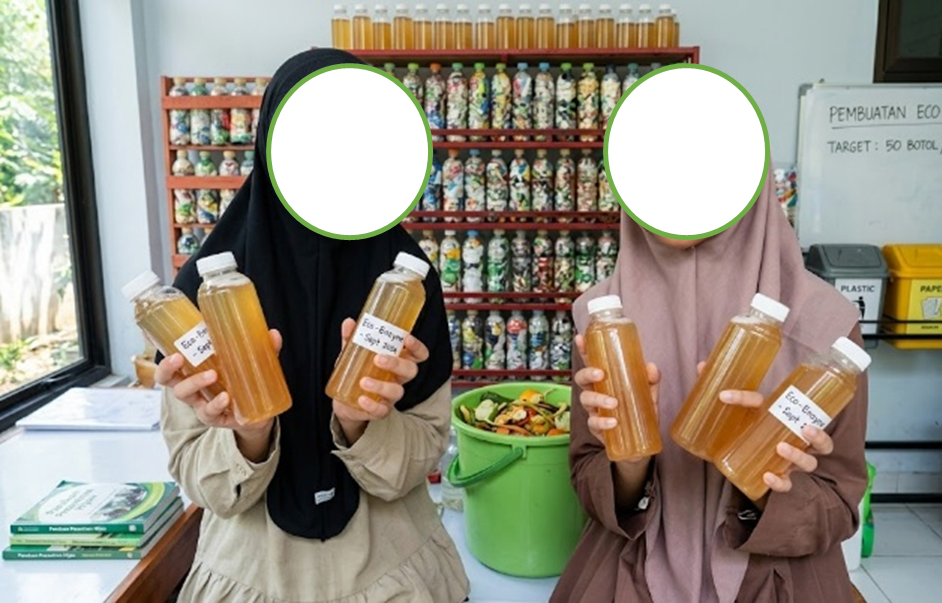
Environmental degradation and climate change necessitate a shift toward sustainable educational models that integrate moral and spiritual values. This study aims to analyze the implementation of the Eco-Pesantren management model at Pondok Pesantren Mambaul Hikam Jombang as a strategy to harmonize Islamic doctrines with environmental conservation efforts. Using a qualitative case study approach, data were gathered through observations of institutional policies and documentation of participatory environmental activities. The results indicate that the institution successfully integrates "Green Deen" principles through four strategic pillars: environmental policy formulation, human resource development in ecology, curriculum integration (PRLH), and participatory actions such as eco-enzyme production, waste management using 3R methods, and "plastic waste alms". The study found that this management model not only fosters ecological awareness among students (santri) but also transforms the pesantren into a center for community environmental education. In conclusion, the harmonization of Islamic values—such as Khalifah (stewardship) and Rahmatan lil’alamin—with structured ecological management provides a sustainable framework for traditional institutions to address modern environmental challenges. This model offers a replicable prototype for integrating spiritual ethics into practical conservation initiatives within the Islamic educational landscape
Downloads
References
Abdallah, A. K., Akaabi, A. K., & Talvio, M. (2026). Human-AI Leadership for Transforming Schools. In Human-AI Leadership for Transforming Schools. IGI Global. https://doi.org/10.4018/979-8-2600-0388-6
Alemi, M., Fard, N. B., & Rezanejad, A. (2023). The Triumph of Human-Robot Interaction: Employing Humanoid Robot to Boost Grammar Acquisition and Retention Among Iranian Young EFL Learners. Mextesol Journal, 47(3). https://www.scopus.com/pages/publications/85167875014?origin=resultslist
Baber, C., Kandola, P., Apperly, I., & McCormick, E. (2025). Human-centred explanations for artificial intelligence systems. Ergonomics, 68(3), 391–405. https://doi.org/10.1080/00140139.2024.2334427
ben Saad, S. (2026). Impacts of Human-Centered Interactive Technologies on Consumer Engagement. In Impacts of Human-Centered Interactive Technologies on Consumer Engagement. IGI Global. https://doi.org/10.4018/979-8-3373-6450-6
Darmayanti, R., & Sugianto, R. (2026). The Ed Taylor Way: Revolusi Visual Belajar Aljabar. UNU PASURUAN PRESS. https://scholar.google.com/citations?view_op=view_citation&hl=en&user=3YBrj-MAAAAJ&cstart=200&pagesize=100&citation_for_view=3YBrj-MAAAAJ:PRBOrcbp7OUC
Eloy, L., Doherty, E., Spencer, C., & Hirshfield, L. (2026). Enhancing Adaptive Human-Agent Teaming Systems with Functional Near-Infrared Spectroscopy. International Journal of Human-Computer Interaction, 42(3), 1394–1426. https://doi.org/10.1080/10447318.2025.2524490
Harahap, D., & Uthman, Y. (2024). Bridging the Gap: Environmental Education as a Catalyst for Human-Environmental Harmony. Available at SSRN 4834363. https://papers.ssrn.com/sol3/papers.cfm?abstract_id=4834363
Heo, S., & Ahn, S. (2026). Predicting wildfires triggered by human-caused ignition: A spatial framework integrating AI models. Ecological Informatics, 94. https://doi.org/10.1016/j.ecoinf.2026.103640
Jiang, G., Yang, S., Wang, Y., & Hui, P. (2026). When trust collides: Exploring human-LLM cooperation intention through the prisoner’s dilemma. International Journal of Human Computer Studies, 209. https://doi.org/10.1016/j.ijhcs.2026.103740
Kang, J., & Huang, Y. (2026). Talking Like a Human, Thinking With the Brain: EEG and Behavioral Evidence of Perceived Affective Alignment in Contextual Human-AI Interaction. IEEE Transactions on Affective Computing, 17(1), 930–941. https://doi.org/10.1109/TAFFC.2025.3639299
Lantu, D. C., Lestari, Y. D., & Putri, A. N. A. (2026). Human-in-the-Loop: From Complete Automation to Dark Factories. Foresight and STI Governance, 20(2). https://doi.org/10.17323/fstig.2026.28237
Lutfi, M. K. (2022a). Pembentukan Karakter Religius Santri Madrasah Diniyah: Studi Kasus di Madrasah Diniyah Miftakhul Ulum Gambirkuning Kraton Pasuruan. In Tarbawi: Jurnal Studi Pendidikan Islami (Vol. 10, Number 2, pp. 108–121). https://scholar.google.com/citations?view_op=view_citation&hl=en&user=JOxlt0cAAAAJ&pagesize=100&citation_for_view=JOxlt0cAAAAJ:LI9QrySNdTsC
Lutfi, M. K. (2022b). Studi Foundational Problem Pendidikan: Sosiologis, Budaya Sebagai Pengembangan Kurikulum. In Tarbawi: Jurnal Studi Pendidikan Islami (Vol. 10, Number 1, pp. 10–27). https://scholar.google.com/citations?view_op=view_citation&hl=en&user=JOxlt0cAAAAJ&pagesize=100&citation_for_view=JOxlt0cAAAAJ:rmuvC79q63oC
Lutfi, M. K. (2024). PENGEMBANGAN LIFE SKILL SOCIETY 5.0 SANTRI DI PONDOK PESANTREN DARUL ULUM REJOSO KAB. PASURUAN. In Center of Education Journal (CEJou) (Vol. 5, Number 1). https://scholar.google.com/citations?view_op=view_citation&hl=en&user=JOxlt0cAAAAJ&pagesize=100&citation_for_view=JOxlt0cAAAAJ:HtEfBTGE9r8C
Lutfi, M. K., Nafisah, D., Nuriyya, S. D., & Ismail, M. (2024). Implementasi Metode Demonstrasi Untuk Meningkatkan Pemahaman Materi Fikih Kelas X. In Ashlach: Journal of Islamic Education (Vol. 2, Number 1, pp. 14–23). https://scholar.google.com/citations?view_op=view_citation&hl=en&user=JOxlt0cAAAAJ&pagesize=100&citation_for_view=JOxlt0cAAAAJ:owLR8QvbtFgC
Mokhtar, T. H. (2025). HCST-NHSR a Design Framework Integrating Human-Centric Systems Thinking to Enhance the Design of Non-humanoid Social Robotic Environments. In M. Kurosu & A. Hashizume (Eds.), Lecture Notes in Computer Science: 15769 LNCS (pp. 269–285). Springer Science and Business Media Deutschland GmbH. https://doi.org/10.1007/978-3-031-93861-0_17
Mykoliuk, A., Budzyn, V., Rybchych, I., Bazyliak, N., Yaroshovych, V., & Kharechko, D. (2024). Educational Technologies in Support of Pedagogical Activity and Public Health Improvement Amidst the Implementation of State Policies on Humanistic-Legal Values in Education. Journal of Ecohumanism, 3(6), 434–441. https://doi.org/10.62754/joe.v3i6.4016
Natale, S., & Ji, D. (2025). Human-machine communication cultures: Introduction. Global Media and China, 10(4), 417–424. https://doi.org/10.1177/20594364251353382
Nols, T., Ulfert, A.-S., & Gevers, J. (2026). Human-autonomy-teaming in e-sports: An exploratory study. Computers in Human Behavior Reports, 21. https://doi.org/10.1016/j.chbr.2025.100919
Peñacoba Yagüe, M., Sierra García, J. E., & Peñas, M. S. (2026). Human-intelligent trajectory optimization for robotic manipulators with hybrid PSO-PS algorithm. Advanced Engineering Informatics, 69. https://doi.org/10.1016/j.aei.2025.103941
Seabra, A., Cavalcante, C., dos Santos, V., Schwabe, D., & Lifschitz, S. (2026). From Asking to Understanding: A Human-Centered Approach for Human-AI Interaction. In J. F. Krems, da S. H. P, & P. Cipresso (Eds.), Communications in Computer and Information Science: 2835 CCIS (pp. 235–248). Springer Science and Business Media Deutschland GmbH. https://doi.org/10.1007/978-3-032-16451-3_16
Shishakly, R., Almaiah, M. A., Lutfi, A., & Alrawad, M. (2024). The influence of using smart technologies for sustainable development in higher education institutions. International Journal of Data and Network Science, 8(1), 77–90. https://doi.org/10.5267/j.ijdns.2023.10.015
Tengler, K., & Brandhofer, G. (2025). Exploring the difference and quality of AI-generated versus human-written texts. Discover Education, 4(1). https://doi.org/10.1007/s44217-025-00529-z
Turvey, K., & Pachler, N. (2025a). A topological exploration of convergence/divergence of human-mediated and algorithmically mediated pedagogy. British Journal of Educational Technology. https://doi.org/10.1111/bjet.70007
Turvey, K., & Pachler, N. (2025b). A topological exploration of convergence/divergence of human-mediated and algorithmically mediated pedagogy. British Journal of Educational Technology. https://doi.org/10.1111/bjet.70007
van Kraalingen, I., & Beames, S. (2024). Presence and (dis)connectedness – the influence of smartphones usage on human–nature and human–human interactions in outdoor studies. Frontiers in Education, 9. https://doi.org/10.3389/feduc.2024.1369591
Waggett, N. (2025). Digital transformations: Exploring the human-technology constellation in our entangled organisations. Organisational and Social Dynamics, 25(1), 52–72. https://doi.org/10.33212/osd.v25n1.2025.52
Yasir, H., Al-Kerea, Z., Qahtan, A. M., Gorbacheva, L., & Muthanna, A. (2026). A Novel Collaborative Reinforcement Learning Method for Human-to-Avatar Interactions. In Y. Koucheryavy & A. Aziz (Eds.), Lecture Notes in Computer Science: 15554 LNCS (pp. 67–78). Springer Science and Business Media Deutschland GmbH. https://doi.org/10.1007/978-3-031-95299-9_7
Zajko, M. (2026). A sociology without humans: Artificial intelligence as a threat to humanity, and sociology’s response. Current Sociology. https://doi.org/10.1177/00113921261426574
Published
How to Cite
Issue
Section
License
Copyright (c) 2026 Akhmad Saikhu, Akhmad Baiquni, Muhammad Khoirul Lutfi

This work is licensed under a Creative Commons Attribution-ShareAlike 4.0 International License.