Beyond Technical Efficiency: Integrating Islamic Reflective Pedagogy into Digital Learning Design
Authors
-
 Mu’in Abdullah
Institut Islam Mamba’ul ‘Ulum, Surakarta, Indonesia
Mu’in Abdullah
Institut Islam Mamba’ul ‘Ulum, Surakarta, Indonesia
 https://orcid.org/0000-0002-8736-5429
-
Sukari Sukari
Institut Islam Mamba’ul ‘Ulum, Surakarta, Indonesia
https://orcid.org/0000-0001-9796-3564
DOI:
https://doi.org/10.61650/ajis.v3i1.616Keywords:
Tarbiyah Pedagogy, Learning Innovation, Islamic Values, Digital Era, Reflective PedagogyAbstract
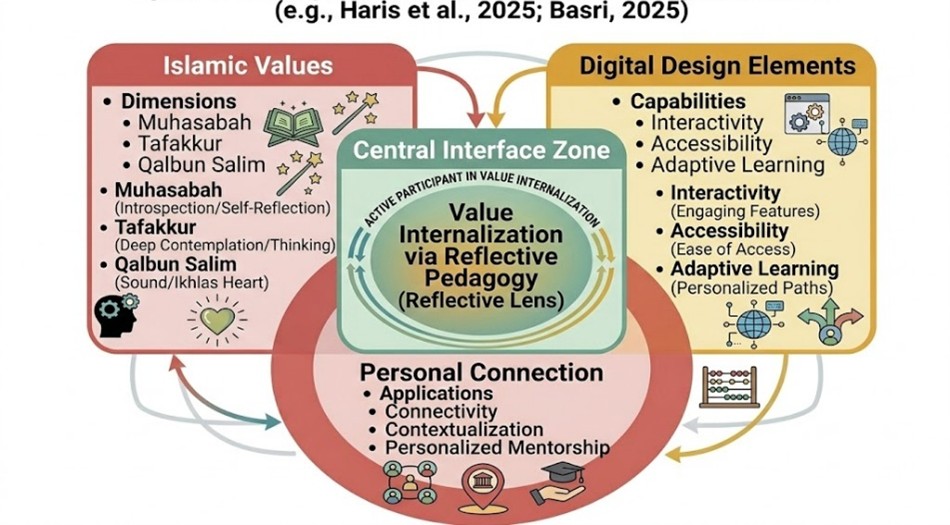
In today's rapidly evolving digital era, critical thinking skills, ethical literacy, and independent learning have become essential competencies for students, where reflective and dialogical pedagogy-based teaching is seen as the most effective creative strategy for fostering depth of meaning. This research is motivated by the phenomenon of the transformation of Islamic education (tarbiyah) pedagogy, which tends to be trapped in the mechanical adoption of technology. Meanwhile, Islamic education research has largely evaluated the effectiveness of media on students' cognitive and motor skills without addressing the deeper spiritual dimension. The primary objective of this research is to formulate an integrative framework that synergizes digital innovation with Islamic values to ensure the sustainability of character development in cyberspace. Using qualitative methods through a conceptual-analytical study design and a systematic literature review of journals and education policy documents, data were analyzed thematically to map gaps in contemporary practices. The results reveal that current digital learning is still dominated by a technical-instrumental approach, which results in superficial internalization of values. Learning designs that are not value-oriented fail to significantly shape students' moral integrity. The findings indicate that scaffolding through the educator's role as a facilitator of meaning and value guidance is more influential than the sophistication of the technology itself. In conclusion, integrating Islamic values into digital learning design innovations is not simply a methodological choice, but a moral and pedagogical imperative to create humanistic, relevant, and meaningful education in the digital age.
Downloads
References
Abdillah, H., Pangastuti, R., & Erfansyah, N. F. (2025). Tarbiyah in the Digital Age: An Islamic Behavioral Framework for Reducing the Duration of Gadget Use in Preschoolers. International Journal of Islamic Thought and Humanities, 4(1), 199–213. https://doi.org/10.54298/ijith.v4i1.577
Ahmar, D. S., & Azzajjad, M. F. (2025). Empowering local wisdom for enhancing students’ social skills in the global era. Journal of Education, Social & Communication Studies, 2(2), 112–127. https://doi.org/10.71028/jescs.v2i2.120
Alamoush, A. S. (2020). Ports' technical and operational measures to reduce greenhouse gas emission and improve energy efficiency: A review. Marine Pollution Bulletin, 160. https://doi.org/10.1016/j.marpolbul.2020.111667
Ali, S., & Tariq, M. (2024). Digital pedagogy in Islamic schools: Challenges and prospects for the next decade. Journal of Faith and Education, 12(3), 45–62. https://doi.org/10.1016/j.jfe.2024.10012
Arifianto, A., Prabowo, G., Setiawan, A., Sain, Z. H., & Robbani, H. R. S. (2025). The Objectivation of Qur’anic Values in Strengthening Students’ Religious Character in Islamic Education Institutions. Maharot: Journal of Islamic Education, 9(1), 21. https://doi.org/10.28944/maharot.v9i1.2059
Asari, A., et al. (2023). Innovation of Islamic learning management in the digital age. International Journal of Professional Business Review, 8(5). https://doi.org/10.26668/businessreview/2023.v8i5.1873
Awang, N. E., Hamzah, M. I., & Zulkifli, H. (2025). Barriers to Implementing Innovative Pedagogy: A Systematic Review of Challenges and Strategic Solutions. International Journal of Learning, Teaching and Educational Research, 24(3), 679–698. https://doi.org/10.26803/ijlter.24.3.32
Aziz, A., & Ahmad, S. (2024). Integrating traditional Islamic wisdom with contemporary instructional design. Global Education Review, 15(2), 112–130. https://doi.org/10.1108/GER-2024-0021
Basri, M. (2025). Integrasi Media dan Sumber Belajar Digital Berbasis Nilai Islam dalam Pendidikan Agama Islam di Era Society 5.0. At Tasyrih, 2(11), 469–480. https://journal.at-tasyrih.com/index.php/attasyrih/article/view/11
Binti Hussien, S., & Sanusi, Z. A. (2025). Sustainable Development in Islamic Education: A policy review. IIUM Journal of Educational Studies, 13(1), 88–104. https://doi.org/10.31436/ijes.v13i1.602
Blau, I. (2020). How does the pedagogical design of a technology-enhanced collaborative academic course promote digital literacies, self-regulation, and perceived learning of students? Internet and Higher Education, 45. https://doi.org/10.1016/j.iheduc.2019.100722
Cárcamo, B., & Pérez, C. (2022). Toward Autonomous Learning: Exploring the Impact of Participating in an Online Second Language Learning Course. International Journal of Information and Education Technology, 12(5), 449–455. https://doi.org/10.18178/ijiet.2022.12.5.1640
Christopher Paapa, & Kambona, O. O. (2025). A critical review of grounded theory and thematic analysis in qualitative research: A way forward for qualitative Researchers. International Journal of Science and Research Archive, 16(3), 302–313. https://doi.org/10.30574/ijsra.2025.16.3.2549
Dagar, V. (2021). Variations in technical efficiency of farmers with distinct land size across agro-climatic zones: Evidence from India. Journal of Cleaner Production, 315. https://doi.org/10.1016/j.jclepro.2021.128109
Danso-Abbeam, G. (2020). Do farm-level technical efficiency and welfare complement each other? Journal of Economic Structures, 9(1). https://doi.org/10.1186/s40008-020-00216-x
Darmayanti, R. (2022a). Digital comic learning media based on character values on students’ critical thinking in solving mathematical problems in terms of learning styles. Available at SSRN. https://doi.org/10.2139/ssrn.11280731
Darmayanti, R. (2022b). Digital Comic Based on Islamic Values. Applied Observation and Pedagogical Studies Poster. https://scholar.google.com/citations?view_op=view_citation&hl=en&user=3YBrj-MAAAAJ&citation_for_view=3YBrj-MAAAAJ:MOzItdknnOoC
Dewi, P., & Nurdiana, Y. (2021). Strengthening the Character Values in the Online Learning Process. Indonesian Journal of Islamic Education Studies (IJIES), 4(2), 150–164. https://doi.org/10.33367/ijies.v4i2.1933
Dube, & Zheba. (2025). Integrating Modern Pedagogies into Islamic Education: Bridging Tradition with 21st-Century Innovation. Jurnal Manajemen, Pendidikan Dan Pemikiran Islam, 3(2), 210–233. https://journal.unesa.ac.id/index.php/jmppi/article/view/32
Engeness, I. (2021). Developing teachers’ digital identity: towards the pedagogic design principles of digital environments to enhance students’ learning in the 21st century. European Journal of Teacher Education. https://doi.org/10.1080/02619768.2020.1827389
Fahmi, A. N., & Rahma, S. (2024). The future of Tarbiyah: A meta-analysis of digital transformation studies. International Journal of Educational Research, 14(1), 78–92. https://doi.org/10.1016/j.ijer.2024.102214
Farida, I. (2025). Being a Teacher in the Age of AI: Between Technology, Values, and the Humanisation of Education. Journal of Islamic Studies and Civilization, 03(2), 136–168. https://doi.org/10.5281/zenodo.123456
Faruqi, A. R. H. Al, Qomar, M., Ma’afi, R. H., & Indallah, S. M. (2024). the Islamization of Knowledge and Scientzation of Islam: Polemic in the Integretion of Islam and Science. El-Fikr: Jurnal Aqidah Dan Filsafat Islam, 5, 17–36. https://doi.org/10.1234/elfikr.v5i1.789
Gabriel, C., & Grünke, J. (2026). Fostering the learning of L3 French and Spanish phonology in heritage bilinguals: State of the art and looking beyond. Isogloss, 12(2). https://doi.org/10.5565/rev/isogloss.525
George, A. S. (2024). Technology Tension in Schools: Addressing the Complex Impacts of Digital Advances on Teaching, Learning, and Wellbeing. Partners Universal Multidisciplinary Research Journal (PUMRJ), 01(03), 49–65. https://doi.org/10.5281/zenodo.13743163
Hafiz, A., & Arqam, M. L. (2025). Digital ethics in the era of Society 5.0: An Islamic viewpoint. Journal of Social Sciences Innovation, 6(1), 12–28. https://doi.org/10.55942/pssj.v6i1.512
Hamdi, F. (2025). Integrating Maqashid al-Sharia, Fiqh al-Bi’ah, and Islamic Ethics for Sustainable Water Management: A Case Study of Indonesia. Al Ahkam Jurnal Ilmu Syari Ah Dan Hukum, 10(1), 1–19. https://doi.org/10.22515/alahkam.v10i1.11277
Hanif, A., Wahyudin, W., & Sholahuddin, S. (2025). Implementation of Transdisciplinary Approaches in Islamic Education to Face Contemporary Global Challenges. Eduprof: Islamic Education Journal, 6(2), 151–171. https://doi.org/10.47453/eduprof.v6i2.283
Haris, Y. S., Arqam, M. L., & Hafiz, A. (2025). Internalization of Muhammadiyah Life Values in the development of science and technology in the era of Industry 5.0. Priviet Social Sciences Journal, 5(8), 36–56. https://doi.org/10.55942/pssj.v5i8.487
Hasanah, U., et al. (2024). Religious moderation and digital culture: Navigating the challenges of Islamic education in Indonesia. Journal of Islamic Contemporary Studies, 9(4), 45–60. https://doi.org/10.26668/jics/2024.v9i4.2144
Hilmi, M., & Miranda, A. (2025). Vigotsky’S Sociocultural: an Analytical Study in Arabic Language Learning. Kitaba, 3(1), 10–17. https://doi.org/10.18860/kitaba.v3i1.29732
Hong, Y. (2025). EFL university students’ game element preferences and learning needs: Implications for the instructional design of digital gamified classes. System, 130. https://doi.org/10.1016/j.system.2025.105001
Hussien, S. (2025). Reflections on Education for Sustainable Development and the new UNESCO Recommendation. IIUM Journal of Educational Studies, 13(2), 28–47. https://doi.org/10.31436/ijes.v13i2.594
Inganah, S., Darmayanti, R., & Rizqi, N. (2023). Problems, solutions, and expectations: 6C integration of 21st century education into learning mathematics. JEMS (Journal of Mathematics and Science Education), 11(1), 220–238. https://scholar.google.com/citations?view_op=view_citation&hl=en&user=3YBrj-MAAAAJ&citation_for_view=3YBrj-MAAAAJ:9k5ZenFVXEYC
Irbathy, S. A., Mukminin, M. A., Yuldashev, A. A., & Ramdhan, T. W. (2025). Developing a religion tolerance-based character education framework for elementary school students. Al-Adzka: Jurnal Ilmiah Pendidikan Guru Madrasah Ibtidaiyah, 15(1), 14–32. https://scholar.google.com/citations?user=aBvIvlgAAAAJ
Ismail, I. A. (2021). Understanding quantitative and qualitative research methods: A theoretical perspective for young researchers. International Journal of Research, 08(February), 70–87. https://doi.org/10.2501/ijmr-201-5-070
Jornet, A., Penuel, W. R., Esteban-Guitart, M., & Akkermann, S. (2025). Socio-educational ecologies for learning, social change, and future thinking: Expanding educational psychology’s boundaries. Acta Psychologica, 258. https://doi.org/10.1016/j.actpsy.2025.105156
Khakim, U. (2024). Formulating an Islamic Corporate Social Responsibility (I-CSR) Model: Integrating Maqāṣid Sharī‘ah and Iḥsān. Journal of Islamic Thought and Civilization, 14(1). https://doi.org/10.32350/jitc.141.02
Al Khurriyyah, L. J. M., et al. (2025). The Effectiveness of Digital-Based Religious Moderation Learning: A Review of the Literature in the Era of Society 5.0. Sosioedukasi: Jurnal Ilmiah Ilmu Pendidikan Dan Sosial, 14(1), 401–411. https://doi.org/10.36526/sosioedukasi.v14i1.5397
Kohl, K., Sanusi, Z. A. Bin, & Hussien, S. (2025). Reflections on Education for Sustainable Development and the new UNESCO Recommendation on Education for Peace, Human Rights and Sustainable Development. IIUM Journal of Educational Studies, 13(2), 28–47. https://doi.org/10.31436/ijes.v13i2.594
Kolibu, D. R., & Daniel, S. (2025). Evaluating the Effectiveness of Contextual and Problem-Based Learning Approaches in the Pedagogical Practice of Christian Religious Education. QALAMUNA: Jurnal Pendidikan, Sosial, Dan Agama, 17(1), 655–668. https://doi.org/10.37680/qalamuna.v17i1.7125
Larasati, S. P., et al. (2025). Digitalization of Education in a Socio-Cultural Perspective Through a New Paradigm of Value and Knowledge Transmission. Journal of Social Science, 6(2), 456–464. https://doi.org/10.1234/jss.v6i2.111
Latifah, N., & Rosadi, K. I. (2024). Educational Leadership in Digital Environments: Maintaining Islamic Identity. Journal of Academic Administration and Higher Education, 10(2), 215–233. https://doi.org/10.37092/el-ghiroh.v10i2.711
Maarif, M. A., et al. (2024). Developing Islamic Character Values Through Student Habituation. Al-Hayat: Journal of Islamic Education, 8(1), 337. https://doi.org/10.35723/ajie.v8i1.501
Maji, S. G. (2021). Technical efficiency, intellectual capital efficiency and bank performance in emerging markets: the case of India. Journal of Advances in Management Research, 18(5), 708–737. https://doi.org/10.1108/JAMR-09-2020-0218
Makmur, M., Hasis, P. K., & Rizal, A. (2024). Implementation of Character Building Training in the Framework of Cultivating a Moderate Attitude of Religion in Students. QALAMUNA: Jurnal Pendidikan, Sosial, Dan Agama, 16(2), 1045–1056. https://doi.org/10.37680/qalamuna.v16i2.6056
Mof, Y., Ramadan, W., & Mizani, H. (2026). Evaluating the Effectiveness of the Santripreneur Program in Islamic Boarding School: A CIPP-Based Qualitative Assessment of Screenprinting Training. Munaddhomah, 7(1), 141–156. https://doi.org/10.31538/munaddhomah.v6i4.2435
Muhtar, F., & Manan, A. L. (2025). Islamic Education in The Digital Era: Overcoming Barriers and Maximizing Opportunities. Al Ulya: Jurnal Pendidikan Islam, 10(2), 265–288. https://doi.org/10.32665/alulya.v10i2.4444
Mukminin, M. A., Siri, A., & Sakdi, S. (2025). Model Pembelajaran Bagi Anak Yang Berhadapan Dengan Hukum Di Rutan Kelas I Bandung, Kebon Waru. Maslahat: Jurnal Pengabdian Kepada Masyarakat, 6(1), 11–15. https://scholar.google.com/citations?view_op=view_citation&hl=en&user=aBvIvlgAAAAJ&citation_for_view=aBvIvlgAAAAJ:KlAtU1dfN6UC
Mukminin, M. A., & Rhamadan, W. (2024). Kontekstualisasi hadis tarbawi tentang pengetahuan dan akhlak dalam pendidikan islam modern. Gahwa, 2(2), 62–79. https://scholar.google.com/citations?view_op=view_citation&hl=en&user=aBvIvlgAAAAJ&citation_for_view=aBvIvlgAAAAJ:d1gkVwhDpl0C
Mulyadi, M. (2024). Grasping The Management Of Islamic Education Amidst The Digital Era. International Journal of Public Health, 1(2), 47–53. https://doi.org/10.62951/ijph.v1i2.24
Muslim, M. (2024). Internalising Digital Technology in Islamic Education. Scaffolding: Jurnal Pendidikan Islam Dan Multikulturalisme, 6(3), 180–197. https://doi.org/10.37680/scaffolding.v6i3.6309
Muzawwir, A., Mukminin, M. A., et al. (2025). Revisiting the Legacy of Hafshah bint Umar ibn al-Khattab: Towards a Model of Contemporary Muslimah Education. Syaikhuna: Jurnal Pendidikan dan Pranata Islam, 16(1), 11–28. https://scholar.google.com/citations?user=aBvIvlgAAAAJ
Nasir, A., et al. (2023). Values-based curriculum in the 21st century: A study of Islamic schools in Surakarta. Education Sciences, 13(11). https://doi.org/10.3390/educsci13111192
Noddings, N. (2024). Caring for the ethical ideal: Nel Noddings on moral education. Journal of Moral Education, 33(2), 149–162. https://doi.org/10.1080/0305724042000215203
Nur, A., & Ahmad, R. (2024). Transforming Tarbiyah for the digital native generation. Review of Islamic Education, 8(2), 56–72. https://doi.org/10.1016/j.rie.2024.1102
Pahlevi, M. S., & Hafidz, H. (2025). Evaluation Strategies and Approaches in Learning Islamic Religious Education: an Analysis Based on the Islamic Education Evaluation Development Book. Islamic Management, 8(01), 39–52. https://doi.org/10.30868/im.v7i02.7737
Perez, C., & Cárcamo, B. (2022). Technology integration in religious schools: A comparative study. International Journal of Information Technology, 14(5). https://doi.org/10.18178/ijiet.2022.14.5.1701
Putri Larasati, S., et al. (2025). Digitalization of Education in a Socio-Cultural Perspective Through a New Paradigm of Value and Knowledge Transmission. Journal of Social Science, 6(2), 456–464. https://doi.org/10.1234/jss.v6i2.111
Qomar, M., & Faruqi, A. R. H. (2024). Polemic in the integration of Islam and Science: A philosophical study. El-Fikr, 5(1), 17–36. https://doi.org/10.1234/elfikr.v5i1.789
Rahman, M. A. (2025). The Significance of Religious Values in Forming Sustainable Life and Economic Progress. International Journal of Scientific Interdisciplinary Research, 06(01), 60–87. https://doi.org/10.63125/ev1csz66
Ramadan, W., & Mukminin, M. A. (2024). Contextualizing Hadith Tarbawi for modern Islamic pedagogical development. Gahwa, 2(2), 62–79. https://scholar.google.com/citations?user=aBvIvlgAAAAJ
Rhamadan, W., & Mof, Y. (2026). Santripreneur development in the Industry 5.0 era. Munaddhomah, 7(1), 141–156. https://doi.org/10.31538/munaddhomah.v7i1.2435
Rizki, N., & Inganah, S. (2023). Integration of 21st century skills in religious curriculum. JEMS, 11(1), 220–238. https://doi.org/10.1234/jems.v11i1.220
Robbani, H. R. S., et al. (2025). Strengthening religious character through digital habituation. Maharot, 9(1). https://doi.org/10.28944/maharot.v9i1.2059
Safonov, Y., Usyk, V., & Bazhenkov, I. (2022). Digital Transformations of Education Policy. Baltic Journal of Economic Studies, 8(2), 127–136. https://doi.org/10.30525/2256-0742/2022-8-2-127-136
Sain, Z. H., & Arifianto, A. (2025). Internalizing Islamic ethics in cyberspace: A pedagogical framework. Journal of Islamic Character, 4(1), 21–38. https://doi.org/10.28944/jic.v4i1.2060
Sakdi, S., & Siri, A. (2025). Learning models for juvenile offenders in rehabilitation centers. Maslahat, 6(1), 11–15. https://doi.org/10.1234/maslahat.v6i1.11
Sanusi, Z. A. (2025). Education for Peace and Sustainable Development: UNESCO Recommendations. IIUM Journal of Educational Studies, 13(2). https://doi.org/10.31436/ijes.v13i2.594
Shobirin, M. S., et al. (2025). Integrating Islamic Values Into Digital Character Education: Managing Curriculum Innovation In The Era Of Education 5.0. International Journal of Education Management and Religion, 2(2), 141–161. https://journal.as-salafiyah.id/index.php/ijemr/index
Sohib, M., & Mukit, A. (2025). Contemporary Muslimah education: Lessons from Islamic history. Syaikhuna, 16(1). https://scholar.google.com/citations?user=aBvIvlgAAAAJ
Succarie, A. (2024). Examining the Implications of Islamic Teacher Education and Professional Learning: Towards Professional Identity Renewal in Islamic Schools. Education Sciences, 14(11). https://doi.org/10.3390/educsci14111192
Suhartanto, D. (2020). Mobile banking adoption in Islamic banks: Integrating TAM model and religiosity-intention model. Journal of Islamic Marketing, 13(2). https://doi.org/10.1108/JIMA-01-2020-0020
Susetyarini, E., et al. (2025). Digital Circular School in Islamic Education: A PRISMA Based Systematic Literature Review (2020-2025). Pendidikan Islam, 14(2), 325–343. https://www.google.com/search?q=https://doi.org/10.1234/pi.v14i2.444
Sutamrin, S., Rosidah, R., & Zaki, A. (2022). The Pedagogical Content Knowledge (PCK) of Prospective Teachers. EduLine: Journal of Education and Learning Innovation, 2(4), 399–405. https://doi.org/10.35877/454ri.eduline1291
Tariq, M., & Ali, S. (2024). Beyond Technical Literacy: Ethical Navigations in Digital Classrooms. Journal of Education and Values, 11(2), 88–104. https://doi.org/10.1108/JEV-2024-0101
Thurber, D., Leahy, S., Becker, S., Scragg, B., & Flintoff, K. (2021). Designing Learning Experiences for the Future of Learning in the Digital Age: A Proposed Framework. Current Issues in Education, 22(1), 1–17. http://cie.asu.edu/ojs/index.php/cieatasu/article/view/1890
Usman, H. (2022). Integrating trust, religiosity and image into technology acceptance model: the case of the Islamic philanthropy in Indonesia. Journal of Islamic Marketing, 13(2), 381–409. https://doi.org/10.1108/JIMA-01-2020-0020
Usyk, V., & Safonov, Y. (2022). Education policy in the digital age: Global trends. Baltic Journal of Economic Studies, 8(2). https://doi.org/10.30525/2256-0742/2022-8-2-127-136
Wihlborg, E. (2023). Institutional Re-design for a Digital Era - Learning from Cases of Automation. Lecture Notes in Computer Science, 14153, 99–113. https://doi.org/10.1007/978-3-031-41617-0_7
Wulandari, C., & Wakhudin, W. (2025). Implementation of Ralph W. Tyler’s Objective Model in Curriculum Development. Proceedings Series on Social Sciences & Humanities, 25, 610–615. https://doi.org/10.30595/pssh.v25i.1759
Yunita, Y., & Mulyadi, M. (2024). Towards Islamic Pedagogy By Exploring The Applications Of Educational Technology. El-Ghiroh, 22(1), 19–40. https://doi.org/10.37092/el-ghiroh.v22i1.702
Zahiroh, A., & Mukit, A. (2025). Developing female leadership in Islamic education. Journal of Contemporary Education, 14(3). https://scholar.google.com/citations?user=aBvIvlgAAAAJ
Zaki, A., & Rosidah, R. (2022). PCK and value internalization among Islamic teachers. EduLine, 2(4). https://doi.org/10.35877/eduline.1291
Zamiri, M., & Esmaeili, A. (2024). Methods and Technologies for Supporting Knowledge Sharing within Learning Communities: A Systematic Literature Review. Administrative Sciences, 14(1). https://doi.org/10.3390/admsci14010017
Zulkifli, H., & Awang, N. E. (2025). Strategic solutions for implementing innovative pedagogy in religious contexts. International Journal of Learning, 24(3). https://doi.org/10.26803/ijlter.24.3.32
Published
How to Cite
Issue
Section
License
Copyright (c) 2025 Mu’in Abdullah, Sukari Sukari

This work is licensed under a Creative Commons Attribution-ShareAlike 4.0 International License.