Cultivating the Ethical-Digital Companion: A Socio-Pedagogical Study on Islamic Character Building in the Age of Artificial Intelligence.
DOI:
https://doi.org/10.61650/ajis.v4i2.986Keywords:
Akhlaq Resilience, Digital Parenting, Ethical-Digital Companion, Islamic Character Building, Socio-Pedagogical StudyAbstract
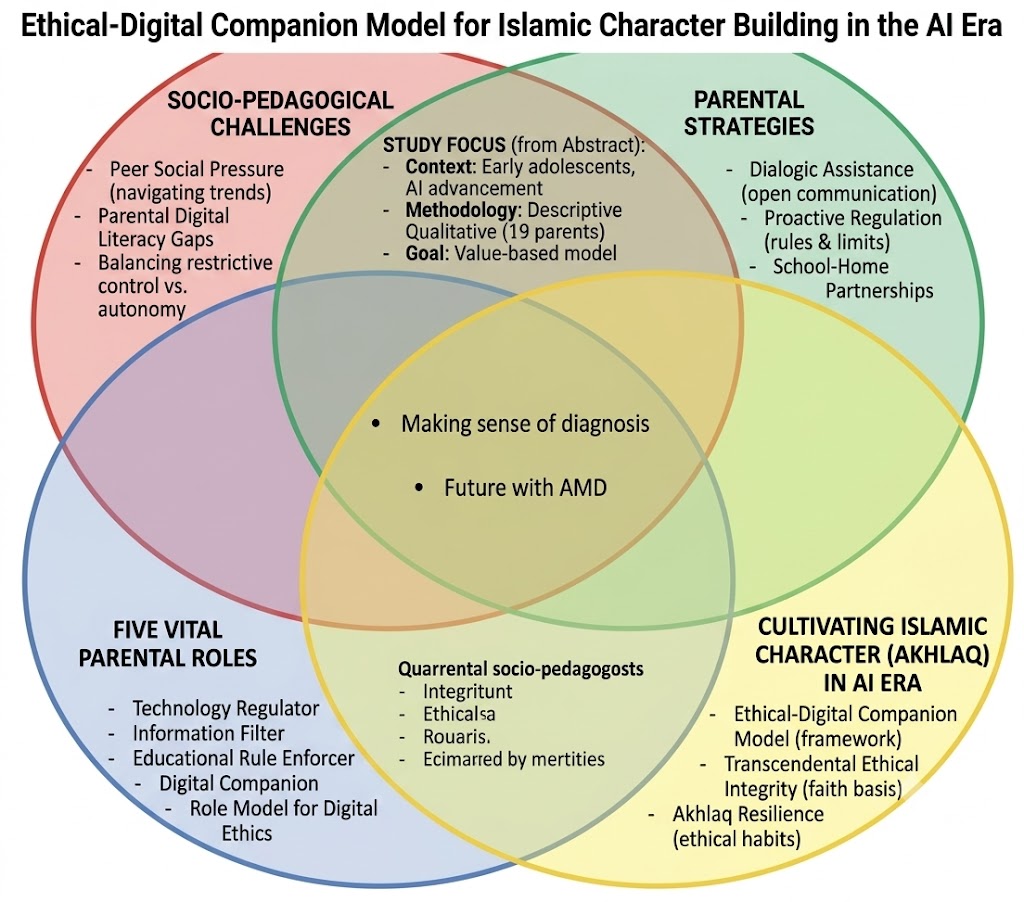
The rapid advancement of artificial intelligence (AI) and digital technology has significantly transformed family dynamics, necessitating a socio-pedagogical shift in Islamic character building (akhlaq) for early adolescents. This study investigates the parental practices, strategies, and socio-pedagogical challenges in digital mediation among parents of seventh-grade students at SMPN 2 Kuningan, Indonesia, aiming to construct a value-based Ethical-Digital Companion model. Utilizing a descriptive qualitative approach, in-depth interviews were conducted with 19 parents. The findings reveal that parents perform five vital socio-pedagogical roles: technology regulators, information filters, educational rule enforcers, digital companions, and role models for digital ethics. The strategies employed include dialogic assistance, proactive regulation, and school-home partnerships, despite persistent challenges such as peer social pressure and parental digital literacy gaps in navigating intelligent technologies. The study concludes that cultivating Islamic character requires a paradigm shift from restrictive technical control to the Ethical-Digital Companion model. This framework contributes to Islamic interdisciplinary studies by synergizing socio-pedagogical strategies with transcendental ethical integrity, ultimately fostering akhlaq resilience in the AI era.
Downloads
References
Ali Masud, M., Fitria, M., & Tinggi Islam Blambangan Banyuwangi, S. (2025). Peran Orang Tua dalam Menanamkan Pendidikan Agama Islam di Era Digital. Jurnal Ilmu Pendidikan, Sosial Dan Humaniora, 1(1), 40–49. https://doi.org/10.58472/jipsh.v1i1.25
Amrillah, H. M. T., Rahmaningtyas, A., Hartati, M., & Agustin, G. (2020). Peran Orang Tua di Era Digital. Zuriah : Jurnal Pendidikan Anak Usia Dini, 1(1), 26–33. https://doi.org/10.29240/zuriah.v1i1.1884
Anbiya, B. F., Ghufron, D. M., & Ikramina, M. B. (2023). Transformasi Pembelajaran Pendidikan Agama Islam Di Era Digital: Modalitas Belajar Dan Tantangan Pendidikan. Jurnal Al Burhan, 3(2), 41–50.
Az-Zuhaili, W. (2009). Tafsir Al-Munir. Dar al-Fikr.
Bandura, A. (1977). Social Learning Theory. General Learning Press.
Banić, L., & Orehovački, T. (2024). A Comparison of Parenting Strategies in a Digital Environment: A Systematic Literature Review. Multimodal Technologies and Interaction, 8(4). https://doi.org/10.3390/mti8040032
Begum, S. R., & Sait, S. Y. (2022). Survey on Artificial Intelligence- based Depression Detection using Clinical Interview Data. 3rd International Conference on Smart Electronics and Communication, ICOSEC 2022 - Proceedings, 1008–1015. https://doi.org/10.1109/ICOSEC54921.2022.9951984
Braun, V., & Clarke, V. (2022). Thematic Analysis: A Practical Guide. Sage Publications.
Bronfenbrenner, U. (1979). The Ecology of Human Development. Harvard University Press.
Chauhan, P., Chaudhary, S., & Sankaralingam, S. (2023). ARTIFICIAL INTELLIGENCE-ENABLED GREEN MANUFACTURING OF MOLDED FIBER PRODUCTS. IPPTA: Quarterly Journal of Indian Pulp and Paper Technical Association, 35(1), 54–56. https://www.scopus.com/pages/publications/85159799909?origin=resultslist
Chen, W. (2021). Digital Parenting and Moral Awareness in Adolescents. Journal of Children and Media, 15(4), 442.
Clark, L. S. (2011). Parental Mediation Theory for the Digital Age. Wiley, 21(4), 323–343.
Creswell, J. W., & Poth, C. N. (2018). Qualitative Inquiry and Research Design: Choosing Among Five Approaches (4th ed.). CA: SAGE.
Cuenca, A., Moncayo, H., & Gavilanez, G. (2025). Artificial-Intelligence-Assisted Geomagnetic Navigation Framework. IEEE Transactions on Aerospace and Electronic Systems, 61(2), 2477–2490. https://doi.org/10.1109/TAES.2024.3477416
Daha, M. Y., Rafferty, J., Ashraf, M. I., & Hadi, M. U. (2024). Artificial intelligence-enhanced signal detection technique for beyond fifth generation networks. Computers and Electrical Engineering, 119. https://doi.org/10.1016/j.compeleceng.2024.109608
Daruhadi, G., & Sopiati, P. (2024). Pengumpulan Data Penelitian. J-CEKI:Jurnal Cendekia Ilmiah, 3(5), 2–4.
Dheasari, A. E., & Fajriyah, L. (2022). Tantangan Orang Tua dalam Mendidik Anak di Era Digital. Al Athfal, 3(1), 25–35.
Ding, Z., Yaakob, R., Azman, A., Rum, S. N. M., Zakaria, N., & Nazri, A. S. A. (2025). Artificial intelligence-powered tuberculosis detection with complementary domain attention model. Neurocomputing, 637. https://doi.org/10.1016/j.neucom.2025.130089
Fang, Z., Han, Q., Ruan, R., Shi, X., Zhang, C., Ruan, D., Fang, X., Vallance, I., & Lachman, J. M. (2026). Effectiveness of a universal digital–human parenting intervention in promoting early childhood development and protection: A pragmatic cluster randomized controlled trial. PLOS Digital Health, 5(5 May). https://doi.org/10.1371/journal.pdig.0001357
Finlay, L. (2021). Negotiating the Swamp: The Opportunity and Challenge of Reflexivity in Research Practice. Qualitative Research, 2(2), 212.
Giglio, B., Albeloushi, A., Alhaj, A. K., Alhantoobi, M., Saeedi, R., Davidovic, V., Uthamacumaran, A., Yilmaz, R., Lapointe, J., Balasubramaniam, N., Tee, T., Fazlollahi, A. M., Correa, J. A., & Del Maestro, R. F. (2025). Artificial Intelligence-Augmented Human Instruction and Surgical Simulation Performance: A Randomized Clinical Trial. JAMA Surgery, 160(9), 993–1003. https://doi.org/10.1001/jamasurg.2025.2564
Hamid, A., Qomaruddin, M., & Rosdianti, S. (2025). Gentle Parenting in The Light of The Sunnah: Cultivating Gen Z Morality Toward a Maslahat Family. An-Nuha: Jurnal Kajian Islam, Pendidikan, Budaya, Dan Sosial, 12(1), 53–73.
Hermawan, D., Wahid, D., & Kudus, A. (2021). Peran Orang Tua Dalam Mencegah Anak Kecanduan Bermain Game Online Du Era Digital. Jurnal Pendidikan Indonesia, 2(5), 782–786.
Hidayati, S. W., Muslikah, R., Munawaroh, H., Haryanto, S., & Salsabila, S. N. (2023). Parenting: Optimalisasi Peran Orang Tua dalam Membentuk Elemen Intrakulikuler Anak Usia Dini. Jurnal Obsesi : Jurnal Pendidikan Anak Usia Dini, 7(3), 2839–2850. https://doi.org/10.31004/obsesi.v7i3.3467
Ilmi, H. N., & Siregar, Mhd. F. Z. (2024). Peran Orang Tua dalam Pembentukan Karakter Anak di Era Digital. Jurnal Pendidikan Islam, 1(3), 1–10. https://doi.org/10.47134/pjpi.v1i3.642
Ingale, S. P., & Bamnote, G. R. (2022). Artificial Intelligences-Based Approaches for Generating Image Caption. In S. Sharma, P. S.-L., J. Agrawal, R. K. Shukla, & L. D.-N. (Eds.), Lecture Notes in Electrical Engineering (Vol. 907, pp. 541–551). Springer Science and Business Media Deutschland GmbH. https://doi.org/10.1007/978-981-19-4687-5_42
Jubaeli, A., Munawaroh, M., Inayah, S., Andriani, N., Nurlaela, Faradila, H., Qomaruddin, M., Hilmi, F. F., Nining, A., Sururi, A., & Yani, A. (2025). Pembinaan Akhlak Di Era Digital (1st ed.). U Me Publishing.
Livingstone, S. (2020). Developing Social Media Literacy. Media@LSE Research Series, 5(1), 18.
Livingstone, S., & Helsper, E. (2008). Parental Mediation of Children’s Internet Use. Journal of Broadcasting & Electronic Media, 52(4), 581–599.
Livingstone, Sonia, Mascheroni, Giovanna, & Staksrud, Elisabeth. (2017). European research on children’s internet use: Assessing the past and anticipating the future. New Media & Society, 20(3), 1103–1122. https://doi.org/10.1177/1461444816685930
Livingstone, Sonia, & Stoilova, M. (2021a). The 4Cs: Classifying Online Risk to Children. (CO:RE Short Report Series on Key Topics). (March), 0–14.
Livingstone, Sonia, & Stoilova, M. (2021b). The 4Cs: Classifying Online Risk to Children. (CO:RE Short Report Series on Key Topics). (March), 0–14.
Merriam, S. B., & Tisdell, E. J. (2016). Qualitative Research: A Guide to Design and Implementation (4th ed.). Jossey-Bass.
Milford, S. C., Murcia, K., Mennell, S., Wilson, S., & Cross, E. (2026). Visible parenting, invisible pressure: Exploring the emotional labour of digital mediation in an early childhood play program. Media International Australia. https://doi.org/10.1177/1329878X261421631
Moysis, L., Iliadis, L. A., Vergos, G., Sotiroudis, S. P., Boursianis, A. D., Papatheodorou, A., Kokkinidis, K.-I. D., Abdul Matin, M., Sarigiannidis, P., Siniosoglou, I., Argyriou, V., & Goudos, S. K. (2025). Artificial Intelligence-Empowered Embryo Selection for IVF Applications: A Methodological Review. Machine Learning and Knowledge Extraction, 7(2). https://doi.org/10.3390/make7020056
Nguyen, T., Wei, Y., Nakada, Y., Zhou, Y., & Zhang, J. (2022). Cardiomyocyte Cell-Cycle Regulation in Neonatal Large Mammals: Single Nucleus RNA-Sequencing Data Analysis via an Artificial-Intelligence–Based Pipeline. Frontiers in Bioengineering and Biotechnology, 10. https://doi.org/10.3389/fbioe.2022.914450
Nikken, P., & Jansz, J. (2014). Parental Mediation of Children’s Internet Use. Communication Research, 41(2), 250.
Nugroho Warasto, H. (2018). Pmbentukan Akhlak Siswa (Studi Kasus Sekolah Madrasah Aliyah Annida Al-Islamy, Cengkareng). J. Mandiri, 2(1), 65–86.
Nurillah, A. H., & Herdiana, I. (2024). The Pandemic and Parental Mental Health: A Conceptual Review of Parental Burnout Pandemi dan Kesehatan Mental Orang Tua: Tinjauan konsep mengenai Parental Burnout. Psikoborneo : Jurnal Imiah Psikologi, 12(2), 244–252.
Quattrini, V., Taylor, L., Lynch-Smith, D., Hemphill, T., Gibson, T., Ford, A., Fox, E., Roesch, A., Turner, T., Hilliard, W., & Anthamatten, A. (2026). Artificial Intelligence-Ready Doctor of Nursing Practice Education: A Competency-Based Approach. Journal of Doctoral Nursing Practice, 19(1), 11–23. https://doi.org/10.1891/JDNP-2025-0051
Rifa’i, Y. (2023). Analisis Metodologi Penelitian Kulitatif dalam Pengumpulan Data di Penelitian Ilmiah pada Penyusunan Mini Riset. Jurnal Ilmu Sosial Dan Humaniora, 1(1), 31–37. https://doi.org/https://glorespublication.org/index.php/ekodestinasi
Saman, A. M., & Hidayati, D. (2023). Pola Asuh Orang Tua Milenial dalam Mendidik Anak Generasi Alpha di Era Transformasi Digital. Jurnal Basicedu, 7(1), 984–992.
Tang, J., Yuan, M., Tian, K., Wang, Y., Wang, D., Yang, J., Yang, Z., He, X., Luo, Y., Li, Y., Xu, J., Li, X., Ding, D., Ren, Y., Chen, Y., Sadda, S. R., & Yu, W. (2022). An Artificial-Intelligence–Based Automated Grading and Lesions Segmentation System for Myopic Maculopathy Based on Color Fundus Photographs. Translational Vision Science and Technology, 11(6). https://doi.org/10.1167/tvst.11.6.16
Turkle, S. (2017). Alone Together: Why We Expect More from Technology and Less from Each Other. Basic Books.
UNICEF, & Oxford, U. of. (2025). Parenting for the Digital Age: Strengthening Parenting Programmes for Preventing Technology-Facilitated Child Sexual Exploitation and Abuse.
Valkenburg, P. M., Krcmar, M., Peeters, A. L., & Marseille, N. M. (2009). Developing a scale to assess three styles of television mediation: “Instructive mediation,” “restrictive mediation,” and “social coviewing.” Journal of Broadcasting & Electronic Media, 43(1), 52.
Widiyastuti, I. (2017a). Tipe Mediasi Ibu Rumah Tangga Terhadap Keselamatan Internet Anak Dan Remaja. Informasi, 47(2), 197–210. https://doi.org/10.21831/informasi.v47i2.16548
Widiyastuti, I. (2017b). Tipe Mediasi Ibu Rumah Tangga Terhadap Keselamatan Internet Anak Dan Remaja. Informasi, 47(2), 197–210. https://doi.org/10.21831/informasi.v47i2.16548
Yujia, P., Xinyi, H., Hongzhao, X., Xizhi, X., Yuxi, W., Songchun, Z., & Zhenliang, Z. (2026). Human Intelligence-Inspired Testing for the Developmental Stages of Artificial General Intelligence: From General to Applicable. Journal of Psychological Science, 49(2), 271–281. https://doi.org/10.16719/j.cnki.1671-6981.20260202
Published
How to Cite
Issue
Section
License
Copyright (c) 2026 Karlina Nina, Septi Gumiandari

This work is licensed under a Creative Commons Attribution-ShareAlike 4.0 International License.