Exploration of the Application of Loose Parts Media in Developing STEAM-Based Early Childhood Creativity at TKS Muslimat NU VI Pamekasan
DOI:
https://doi.org/10.61650/ajis.v4i2.1120Keywords:
Loose Parts, STEAM, Creativity, Early Childhood, Innovative LearningAbstract
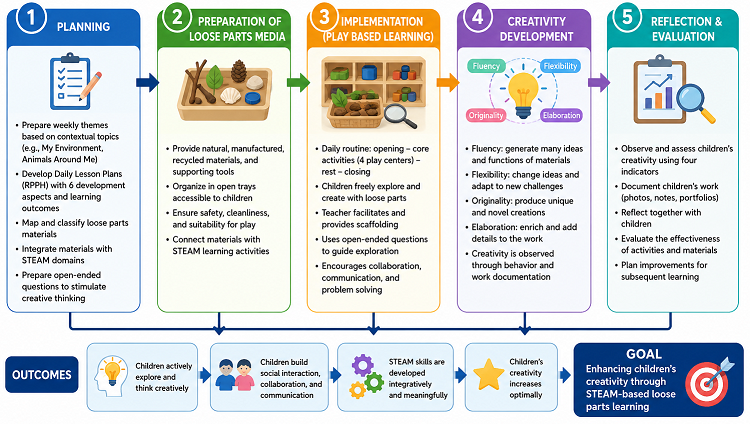
Developing creativity in early childhood requires a learning approach that provides space for exploration, imagination, and meaningful problem solving. This study aims to explore the implementation of STEAM-based loose parts media (Science, Technology, Engineering, Arts, and Mathematics) in developing the creativity of early childhood at TKS Muslimat NU VI Pamekasan. The research employed a qualitative approach with a case study design. The data sources consisted of twenty-two Group B children aged 5–6 years, three classroom teachers, and the school principal. Data collection techniques included participatory observation, in-depth interviews, and documentation of play activities. Data were analyzed using the Miles and Huberman model through the stages of data reduction, data display, and conclusion drawing. The validity of the data was checked through source and technique triangulation. The findings show that the implementation of STEAM-based loose parts media is able to enrich four indicators of creativity, namely fluency, flexibility, originality, and elaboration. The children demonstrated high enthusiasm when arranging, assembling, and designing works using natural materials such as stones, twigs, shells, seeds, and recycled objects. The STEAM approach encourages children to integrate scientific skills, simple technology, engineering, art, and mathematics in one integrated play experience. The study concludes that STEAM-based loose parts media is effectively applied as a creative learning strategy that is in line with the learning characteristics of early childhood.
Downloads
References
Afriyanti, F., & Kurniawati, L. (2020). Pengembangan kreativitas anak usia dini melalui bermain dengan bahan alam. Jurnal Obsesi: Jurnal Pendidikan Anak Usia Dini, 4(2), 711--718. https://doi.org/10.31004/obsesi.v4i2.476
Beghetto, R. A., & Kaufman, J. C. (2014). Classroom contexts for creativity. High Ability Studies, 25(1), 53--69. https://doi.org/10.1080/13598139.2014.905247
Casey, T., & Robertson, J. (2019). Loose parts play: A toolkit (2nd ed.). Inspiring Scotland.
Daly, L., & Beloglovsky, M. (2015). Loose parts: Inspiring play in young children. Redleaf Press.
Daly, L., & Beloglovsky, M. (2018). Loose parts 3: Inspiring culturally sustainable environments. Redleaf Press.
Fitriani, R., & Adawiyah, R. (2018). Pengembangan kreativitas anak usia dini melalui pendekatan saintifik. Jurnal Pendidikan Anak Usia Dini Undiksha, 6(2), 79--88. https://doi.org/10.23887/paud.v6i2.15182
Guilford, J. P. (1967). The nature of human intelligence. McGraw-Hill.
Gull, C., Bogunovich, J., Goldstein, S. L., & Rosengarten, T. (2019). Definitions of loose parts in early childhood outdoor classrooms: A scoping review. International Journal of Early Childhood Environmental Education, 6(3), 37--52.
Hayati, N., & Hosnan, M. (2021). Pendekatan STEAM dalam pembelajaran anak usia dini: Tinjauan konseptual. Jurnal Pendidikan Anak, 10(1), 25--34. https://doi.org/10.21831/jpa.v10i1.39014
Henriksen, D., Mishra, P., & Mehta, R. (2015). Novel, effective, whole: Toward a NEW framework for evaluations of creative products. Journal of Technology and Teacher Education, 23(3), 455--478.
Jeffers, O. (2019). Loose parts and the development of creativity in early years settings. Early Years Educator, 21(4), 24--28.
Kemendikbud. (2014). Peraturan Menteri Pendidikan dan Kebudayaan Nomor 137 Tahun 2014 tentang Standar Nasional Pendidikan Anak Usia Dini. Kementerian Pendidikan dan Kebudayaan Republik Indonesia.
Munandar, U. (2016). Pengembangan kreativitas anak berbakat. Rineka Cipta.
Nicholson, S. (1971). How not to cheat children: The theory of loose parts. Landscape Architecture, 62(1), 30--34.
Permadani, K. G., & Pohan, A. E. (2020). Penerapan pendekatan STEAM pada pendidikan anak usia dini di Indonesia. Jurnal Caksana: Pendidikan Anak Usia Dini, 3(2), 158--166. https://doi.org/10.31326/jcpaud.v3i2.793
Piaget, J. (1972). The psychology of the child. Basic Books.
Rahayu, S., & Suryana, D. (2021). Efektivitas penggunaan loose parts terhadap kreativitas anak usia 5--6 tahun. Jurnal Obsesi: Jurnal Pendidikan Anak Usia Dini, 5(2), 1413--1422. https://doi.org/10.31004/obsesi.v5i2.928
Sousa, D. A., & Pilecki, T. (2018). From STEM to STEAM: Brain-compatible strategies and lessons that integrate the arts (2nd ed.). Corwin Press.
Sugiyono. (2019). Metode penelitian kualitatif. Alfabeta.
Torrance, E. P. (1974). Torrance tests of creative thinking: Norms-technical manual. Personnel Press.
Vygotsky, L. S. (1978). Mind in society: The development of higher psychological processes. Harvard University Press.
Yuliani, N. S. (2017). Konsep dasar pendidikan anak usia dini. Indeks.
Published
How to Cite
Issue
Section
License
Copyright (c) 2026 Iskandar Iskandar, Zahratun Naimah, Muazayyanah Muazayyanah, Siti Nurul Jannah, Yuni Alfian, Siti Azizah, Anni Fatmawati, Cholifah Tur Rosidah, Rosmiati

This work is licensed under a Creative Commons Attribution-ShareAlike 4.0 International License.