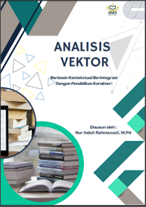
Development of Character Education in Contextual-Based Mathematics Textbooks at Jurai Siwo State Islamic University of Lampung
DOI:
https://doi.org/10.61650/ajme.v4i2.1251Keywords:
Mathematics Textbook, Character Education, Contextual Learning, AssessmentAbstract
The current mathematics textbooks are general and do not fully meet the needs of both lecturers and students. Many students of the Tadris Mathematics program still lack an understanding and personal competence in character education. It is crucial to develop teaching materials, especially for the vector analysis course, that are aligned with the specific needs of students and lecturers. This study aims to explore the development steps of a Contextual Mathematics Textbook Integrated with Character Education at the State Islamic Institute of Metro. This research uses a Research and Development (R&D) approach. The development procedure for the vector analysis teaching material follows the Borg and Gall model. Based on expert validity, the findings are as follows: (1) The content suitability aspect with the curriculum received a 93% rating with the qualification "Very Good," (2) The construction aspect received a 94% rating with the qualification "Very Good," and (3) The readability aspect received a 90% rating with the qualification "Good." Overall, based on the trial with 70 Tadris Mathematics students, the aspects of ease, appeal, and comprehensibility of the design achieved an overall percentage of 81.54%, which is categorized as "Very Good." It is hoped that by developing this mathematics textbook, students will gain an understanding of character education, ensuring that IAIN Metro graduates are not only intellectually capable but also possess the personal qualities associated with national character education. Students agree that the material in the mathematics textbook can enhance character education.
Downloads
References
Afriani, A. (2018). Pembelajaran kontekstual (Contextual Teaching and Learning) dan pemahaman konsep siswa. Al Muta’aliyah: Jurnal Pendidikan Guru Madrasah Ibtidaiyah, 1(3), 80–88. http://ejournal.kopertais4.or.id/sasambo/index.php/mutaaliyah/article/view/3005/2208
Biryukova, N. (2020). Formation of the personal meanings of the study of mathematics among students of agricultural areas of training by means of contextual learning. E3S Web of Conferences, 222, 05013. https://doi.org/10.1051/e3sconf/202022205013
Buckingham, L. J. (2025). Contextual questions and their implications for engineering undergraduates' attitudes towards mathematics. International Journal of Mathematical Education in Science and Technology. https://doi.org/10.1080/0020739X.2025.2574949
Budiman, A., Samani, M., Rusijono, Setyawan, W. H., & Nurdyansyah. (2021). The development of Direct-Contextual Learning: A new model on higher education. International Journal of Higher Education, 10(2), 15–26. https://doi.org/10.5430/ijhe.v10n2p15
Cahyono, B., Tsani, D. F., & Rahma, A. (2018). Pengembangan buku saku matematika berbasis karakter pada materi trigonometri. Phenomenon: Jurnal Pendidikan MIPA, 8(2), 185–199.
Caswita. (2020). The development of mathematical teaching books-based realistic approach to increase creative thinking ability in 5th grade elementary school. In Proceedings of the International Conference on Progressive Education (ICOPE 2019) (pp. 252–257). Atlantis Press. https://doi.org/10.2991/assehr.k.200323.129
Djamaluddin, A., & Wardana. (2019). Belajar dan pembelajaran 4 pilar peningkatan kompetensi pedagogis. CV Kaaffah Learning Center.
Farida, I. (2006). Urgensi pengajaran information literacy pada tingkat perguruan tinggi. Al-Maktabah, 8(2), 34–52.
Firtsanianta, H., & Khofifah, I. (2022). Efektivitas E-LKPD berbantuan Liveworksheets untuk meningkatkan hasil belajar peserta didik. In Membangun karakter dan budaya literasi dalam pembelajaran tatap muka terbatas di SD (pp. 140–147).
Kadir, A. (2013). Konsep pembelajaran kontekstual di sekolah. Dinamika Ilmu, 13(1), 17–38. http://journal.iainsamarinda.ac.id/index.php/dinamika_ilmu/article/view/20
Kalmar, I. D. (2005). Benjamin Disraeli, romantic Orientalist. Comparative Studies in Society and History, 47(2), 348–371. https://doi.org/10.1017/S0010417505000162
Kartika, E. D. (2017). Analisis vektor untuk pendidikan matematika.
Khikmiyah, F. (2021). Implementasi web Live Worksheet berbasis problem-based learning dalam pembelajaran matematika. Pedagogy: Jurnal Pendidikan Matematika, 6(1), 1–12. https://doi.org/10.30605/pedagogy.v6i1.1193
Kirk, J. A. (2004). State of the art: Martin Luther King, Jr. Journal of American Studies, 38(2), 329–347. https://doi.org/10.1017/S0021875804008461
Madrazo, A. L., & Dio, R. V. (2020). Contextualized learning modules in bridging students' learning gaps in calculus with analytic geometry through independent learning. Journal on Mathematics Education, 11(3), 457–476. https://doi.org/10.22342/jme.11.3.12456.457-476
Maunah, B. (2016). Implementasi pendidikan karakter dalam pembentukan kepribadian holistik siswa. Jurnal Pendidikan Karakter, 6(1), 90–101. https://doi.org/10.21831/jpk.v0i1.8615
Muslich, M. (2010). Textbook writing: Dasar-dasar pemahaman, penulisan dan pemakaian buku teks. Ar-Ruzz Media.
Murtadha. (2022). Integrasi pendidikan karakter (Studi melalui pembelajaran Pendidikan Agama Islam). Al-Madaris, 3(2), 12–20. https://journal.staijamitar.ac.id/index.php/al-madaris
Nurhayati, E., et al. (2022). Character education in online mathematics learning during the Covid-19 pandemic. AIP Conference Proceedings, 2479. https://doi.org/10.1063/5.0099718
Nurhayati, N. (2017). Pengembangan bahan ajar trigonometri berbasis kontekstual melalui metode guided discovery untuk meningkatkan pemahaman konsep mahasiswa. FIBONACCI: Jurnal Pendidikan Matematika dan Matematika, 3(1), 31–44. https://doi.org/10.24853/fbc.3.1.31-44
Omerin, & Nopan. (2015). Pentingnya pendidikan karakter dalam dunia pendidikan. Manager Pendidikan, 9(3), 464–468. http://pasca.um.ac.id/conferences/index.php/snbk
Permatasari, D. (2022). Developing realistic problem-based mathematics instructional materials to enhance students' conceptual understanding. Asian Journal of Educational Technology, 1(3), 131–138. https://doi.org/10.53402/ajet.v1i3.187
Pujiastuti, H., Haryadi, R., & Solihati, E. (2021). Pengembangan modul matematika berbasis kontekstual pada materi aljabar. AKSIOMA: Jurnal Program Studi Pendidikan Matematika, 10(1), 63–74. https://doi.org/10.24127/ajpm.v10i1.3392
Purwanto, Y., & Rizki, S. (2015). Pengembangan bahan ajar berbasis kontekstual pada materi himpunan berbantu video pembelajaran. AKSIOMA Journal of Mathematics Education, 4(1), 67–77. https://doi.org/10.24127/ajpm.v4i1.95
Satriani, I., Emilia, E., & Gunawan, M. H. (2012). Contextual teaching and learning approach to teaching writing. Indonesian Journal of Applied Linguistics, 2(1), 10–22. https://doi.org/10.17509/ijal.v2i1.70
Sugiyono. (2016). Metode penelitian kuantitatif, kualitatif dan R&D. PT Alfabet.
Sukandar, A. (2020). Analisis muatan nilai-nilai pendidikan karakter pada buku teks matematika SMA kelas X Kurikulum 2013 revisi 2017 terbitan Kemendikbud RI [Undergraduate thesis, Universitas Islam Sultan Agung Semarang].
Suryanti, S. (2021). Pengembangan buku ajar matematika dasar berbasis kontekstual project untuk meningkatkan keterlibatan mahasiswa dalam pembelajaran. DIDAKTIKA: Jurnal Pemikiran Pendidikan, 27(2), 193–201. https://doi.org/10.30587/didaktika.v27i2.2266
Tim Penyusun Kamus Bahasa Indonesia. (2008). Kamus bahasa Indonesia. Pusat Bahasa Departemen Pendidikan Nasional.
Trianto. (2011). Mendesain model pembelajaran inovatif progresif. Kencana Prenada Media Group.
Wicaksana, I. M. Y., Suparta, I. N., & Suharta, I. G. P. (2020). Pengembangan perangkat pembelajaran matematika sekolah dasar kontekstual berorientasi pengembangan karakter dalam upaya meningkatkan motivasi dan hasil belajar siswa. Jurnal Pendidikan Matematika Undiksha.
Zubaidah, S. (2020). Self regulated learning: Pembelajaran dan tantangan pada era Revolusi Industri 4.0. Publikasi Ilmiah, 5(April), 1–19.
Published
How to Cite
Issue
Section
License
Copyright (c) 2026 Nur Indah Rahmawati

This work is licensed under a Creative Commons Attribution-ShareAlike 4.0 International License.