Sustainable Financing Ecosystem in Islamic Higher Education: Integrating Community Participation and Distributive Justice Principles
DOI:
https://doi.org/10.61650/ajis.v4i1.349Keywords:
Financing Management, Community Participation, Distributive Justice, Sustainable EducationAbstract
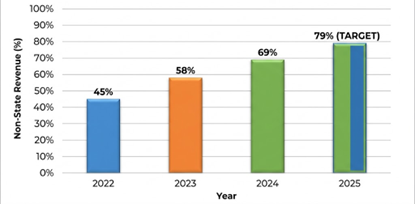
The escalating cost of higher education and the limitations of state funding have created a critical need for sustainable and equitable financing models in Islamic institutions. This study aims to analyze the implementation of a community-based financing management system designed to achieve educational equity at the State Islamic Institute (IAIN) Parepare. Employing a qualitative approach with a case study design, data were gathered through in-depth interviews with university leaders, financial administrators, and students, alongside an analysis of digital financial reports. The findings reveal a robust financing ecosystem integrated through three strategic pillars: the digitalization of financial governance via the e-Monev system to ensure transparency, the implementation of tiered tuition fee (UKT) policies grounded in Islamic distributive justice, and the optimization of participatory funding through Islamic philanthropy, such as cash waqf and zakat. Results indicate that this model significantly reduced dependence on government budgets, with non-state revenue increasing from 45% to 79% over three years. The study concludes that integrating community participation with spiritual values like amanah and ihsan creates a resilient financial structure that safeguards access for underprivileged students. These implications suggest that Islamic higher education institutions can achieve financial sustainability by fostering a "Triple Helix" synergy between the state, the institution, and the community.
Downloads
References
Abylkassymova, A., Mubarakov, A., Yerkisheva, Z., Turganbayeva, Z., & Baysalov, Z. (2020). Assessment of financial literacy formation methods in mathematics education: Financial computation. International Journal of Emerging Technologies in Learning, 15(16), 49–67. https://doi.org/10.3991/ijet.v15i16.14587
Alrasheed, R. A. R. (2025). Building Public Trust in Bahrain: Leveraging Artificial Intelligence to Combat Financial Fraud and Terrorist Financing Through Cryptocurrency Tracking. Social Sciences, 14(5). https://doi.org/10.3390/socsci14050308
Ante, L. (2026). Autonomous AI agents in decentralized finance: Market dynamics, application areas, and theoretical implications. Technological Forecasting and Social Change, 228. https://doi.org/10.1016/j.techfore.2026.124669
Assanova, A., Issaeva, A., Dzhubalieva, Z., Arzikulova, R., & Uchkampirova, A. (2025). Financial-digital investments in human capital as a factor of sustainable economic growth: assessment, dynamics and impact of artificial intelligence (a Kazakhstan case study). Economic Annals-XXI, 213(1–2), 18–29. https://doi.org/10.21003/ea.V213-02
Aysan, A. F., Qadri, H. M. U. D., & Ali, H. (2026). Artificial Intelligence and the Future of Islamic Finance. In Artificial Intelligence and the Future of Islamic Finance. Taylor and Francis. https://doi.org/10.4324/9781003620525
Blue, C. N. (2017). STEM Opportunities for academically capable and financially needy students entitled the “university of southern Maine STEM scholars program,” award # 1153281. ASEE Annual Conference and Exposition, Conference Proceedings, 2017-June. https://www.scopus.com/pages/publications/85030553507?origin=resultslist
Brifkani, I. (2023). Islamic Pedagogy for Guidance and Transformation Toward an Islamic Experiential Learning Model. Journal of Education in Muslim Societies, 5(1), 106–112. https://doi.org/10.2979/jems.5.1.07
Budak, B. (2025). The Development of Islamic Education in Islamic Primary Schools in The Netherlands. Religions, 16(12). https://doi.org/10.3390/rel16121475
Chetioui, Y., Lebdaoui, H., Belouali, Z., & Sarea, A. (2024). Antecedents of Murabaha home financing among Muslim household – an integrated framework. International Journal of Social Economics, 51(12), 1646–1661. https://doi.org/10.1108/IJSE-10-2022-0680
Choir, A., Putra, A. H. S., & ‘Arifin, Z. (2026). Community engagement in education financing: A multi-case study in Indonesia and Laos. Multidisciplinary Science Journal, 8(2). https://doi.org/10.31893/multiscience.2026087
Choudhari, A. A., Meshram, K. A., Das, N. J., Mahankal, M. D., Ghadage, A. H., & Shah, A. H. (2025). AI-Driven Financial Management for MSMEs: Transforming Decision-Making and Access to Finance in Developing Economies. Enterprise Development and Microfinance, 35(2), 74–90. https://doi.org/10.3362/edm.v35i2.560
Disli, M., Hatam, A. K., & Jalaly, S. (2023). Faithful Finance: Unlocking Banking Islamization in Afghanistan. Economies, 11(7). https://doi.org/10.3390/economies11070189
Du, X., & Fang, S. (2026). Smart finance, skilled workers: The role of labor force in FinTech-Driven economic growth. Finance Research Letters, 88. https://doi.org/10.1016/j.frl.2025.109103
Fahmi, M., Nuruzzaman, M. A., Hilmy, M., Alfiyah, H. Y., Abdul Aziz, N. A., & Huriyah, L. (2025). Multicultural Islamic Education as Strategy for Strengthening Social Cohesion in Islamic School. Nazhruna: Jurnal Pendidikan Islam, 8(1), 154–175. https://doi.org/10.31538/nzh.v8i1.67
Hakiem, H., Devi, A., Mulyadi, N., Islahudin, I., & Atika, N. (2023). Islamic scholar thought on intrapreneurial leadership characteristic framework for islamic education institutions. Educational Administration: Theory and Practice, 29(3), 216–237. https://doi.org/10.52152/kuey.v29i3.728
Harsanto, B., Pradana, M., Firmansyah, E. A., Apriliadi, A., & Ifghaniyafi Farras, J. (2024). Sustainable Halal Value Chain performance for MSMEs: the roles of digital technology, R&D, financing, and regulation as antecedents. Cogent Business and Management, 11(1). https://doi.org/10.1080/23311975.2024.2397071
Hosen, M. K., & Shukri, S. F. B. M. (2023). EXECUTION STRATEGIES OF ISLAMIC GOVERNANCE: THE CASE OF TÜRKIYE (2010-2020). Hamdard Islamicus, 46(1), 87–109. https://doi.org/10.57144/hi.v46i1.656
Ibalanky, C., & Wilner, A. (2025). Applying AI to Canada’s Financial Intelligence System: Promises and Perils in Combatting Money Laundering and Terrorism Financing. International Journal, 80(2), 147–165. https://doi.org/10.1177/00207020251334973
Iqbal, A. M., Ahmad, N., & Suhartini, A. (2023). Implications of the Tijaniyah Order for Islamic Education at Zawiyah Islamic Boarding School. Nazhruna: Jurnal Pendidikan Islam, 6(1), 72–87. https://doi.org/10.31538/nzh.v6i1.2467
Mahrus, E., Prasojo, Z. H., Purwanti, N., & Suratman, B. (2025). Transmission of Local Islamic Texts in Islamic Education: Materials, Actors, and the Historical Trajectory of Islamic Knowledge in Borneo. Nazhruna: Jurnal Pendidikan Islam, 8(2), 447–463. https://doi.org/10.31538/nzh.v8i2.200
Memon, N. (2011). What Islamic school teachers want: Towards developing an Islamic teacher education programme. British Journal of Religious Education, 33(3), 285–298. https://doi.org/10.1080/01416200.2011.595912
Meshram, K. A., Dikkatwar, R., Tripathi, D., Choudhari, A. A., Ghadage, A. H., Soni, N. C., & Bhope, A. (2025). AI–Blockchain Convergence for Inclusive Fintech: Enabling Microenterprise Financing and Trust in Emerging Economies. Enterprise Development and Microfinance, 35(2), 1–9. https://doi.org/10.3362/edm.v35i2.554
Mohd, N., Razali, M., Yahaya, M. H., & Baharuddin, Z. N. (2024). The Roles of Islamic Financial Technology (FINTECH) in Fostering Financial Inclusion in Malaysia. Management and Accounting Review, 23(1), 329–355. https://www.scopus.com/pages/publications/85190767332?origin=resultslist
Moldakmatov, A., Idinov, K., Orozonova, A., & Sulaimanov, A. (2025). Islamic Principles of Finance: Features and Prospects of Their Use in Central Asia. International Journal on Culture, History, and Religion, 7(SI1), 765–790. https://doi.org/10.63931/ijchr.v7iSI1.339
Ozer, A., & Aydos, M. (2026). Fraud Detection Framework for Blockchain Finance: Tackling Arbitrage, Liquidity Exploits, and Money Laundering. International Journal of Intelligent Systems, 2026(1). https://doi.org/10.1155/int/3803992
Sanz Martín, L., Parra Dominguez, J., Corchado, J. M., Zafra-Gómez, E., Castillo-Ramos, V., & Zafra-Gómez, J. L. (2026). Recent evolution and growth of AI and advanced technologies in accounting and finance: systematic review and bibliometric analysis. Revista Espanola de Financiacion y Contabilidad, 55(1), 47–88. https://doi.org/10.1080/02102412.2025.2582120
Saptaningrum, I., Azis, M. N. I., Anwar, H., & Djakaria, S. (2025). AN ANALYSIS OF ISLAMIC GRAVESTONES IN INDONESIA: SITES AND ISLAMIC HERITAGE IN BOLAANG MONGONDOW, NORTH SULAWESI. Journal of Islamic Architecture, 8(4), 1158–1173. https://doi.org/10.18860/jia.v8i4.26318
Sumintono, B., & Hakim, L. N. (2025). Critical Islamic educational leadership: investigating how Islamic pedagogic models shape leadership practices. British Journal of Religious Education. https://doi.org/10.1080/01416200.2025.2542225
Usman, J., Akmal, S., Ar, M., & Yusuf, Y. (2023). Does humour used in EFL classrooms in Islamic higher education reflect Islamic values? Journal of Further and Higher Education, 47(5), 647–658. https://doi.org/10.1080/0309877X.2023.2200133
Yasmeen, K., Yasmin, K., & Al Abri, S. (2024). ISLAMIC FRAMEWORK FOR SUSTAINABLE DEVELOPMENT. International Journal of Islamic Finance and Sustainable Development, 16(4), 136–160. https://doi.org/10.55188/ijifsd.v16i4.978
Yuliantri, R. D. A. (2024). Islamic character education model: An in-depth analysis for Islamic boarding school. Cakrawala Pendidikan, 43(2), 370–380. https://doi.org/10.21831/cp.v43i2.66516
Published
How to Cite
Issue
Section
License
Copyright (c) 2026 Dika Tripitasari

This work is licensed under a Creative Commons Attribution-ShareAlike 4.0 International License.