Voices of the Buffer Zone: Harmonizing Language, History, and Biology in Instructional Media Development.
Authors
-
Gina Muta'affif
 Universitas 17 Agustus 1945 Banyuwangi, Indonesia
-
Dewinta Priti Wijayanti
Universitas 17 Agustus 1945 Banyuwangi, Indonesia
-
Iva Novita
Universitas 17 Agustus 1945 Banyuwangi, Indonesia
-
Erinda Salsa Billa
Universitas 17 Agustus 1945 Banyuwangi, Indonesia
-
Ifa Muhimmatin
Universitas 17 Agustus 1945 Banyuwangi, Indonesia
DOI:
https://doi.org/10.61650/alj.v2i2.1264Keywords:
booklet development bilingual local history biodiversity Ijen buffer areaAbstract
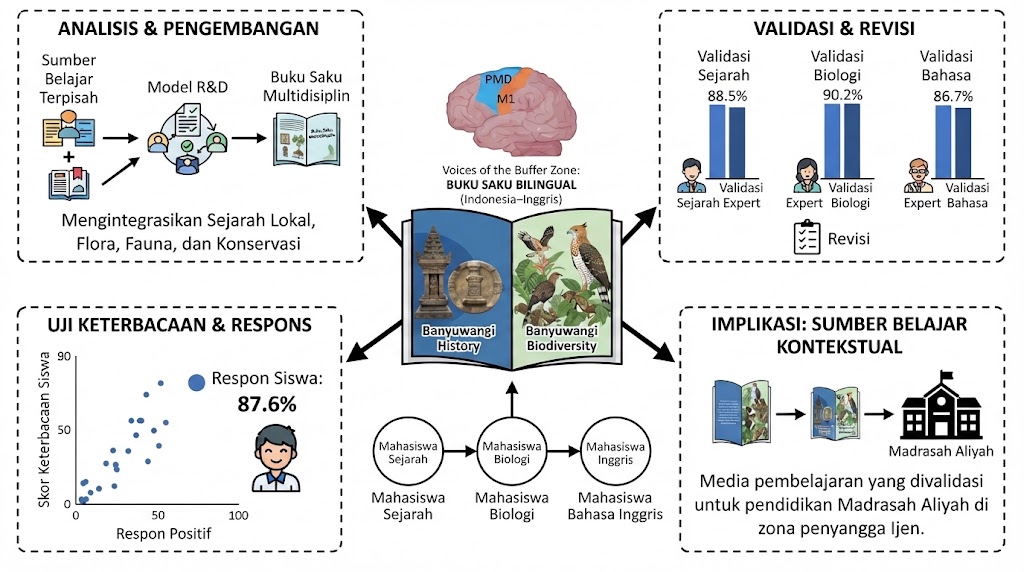
Contextual instructional media integrating local history and biodiversity into accessible bilingual formats remain scarce in secondary education. To bridge this gap, this study developed and evaluated the feasibility of an interdisciplinary bilingual booklet (Indonesian–English) framing the local history, flora, fauna, and conservation messages of the Ijen buffer area in Banyuwangi as a contextual learning resource. Utilizing a Research and Development (R&D) model comprising analysis, development, validation, revision, and readability testing, the project involved student developers from English Language Education, Biology Education, and History Education programs. Data were collected via expert validation and user response questionnaires, subsequently analyzed through descriptive quantitative methods. Findings demonstrated high instructional feasibility across all expert evaluations: History (88.5%), Biology (90.2%), and English (86.7%), while student trial user responses yielded a highly positive rating of 87.6%. In conclusion, the resulting bilingual booklet offers a validated, multidisciplinary instructional medium that harmonizes local socio-ecological knowledge with disciplinary pedagogy, establishing a contextual learning resource tailored for Madrasah Aliyah education.
Downloads
Published
How to Cite
Issue
Section
License
Copyright (c) 2024 Gina Muta'affif, Dewinta Priti Wijayanti, Iva Novita, Erinda Salsa Billa, Ifa Muhimmatin

This work is licensed under a Creative Commons Attribution-ShareAlike 4.0 International License.





 All publications by the CV. Bimbingan Belajar Assyfa [e-ISSN: