Keywords: Digital divide, Digital literacy, Individual empowerment, social participation, Training programs
Abstract
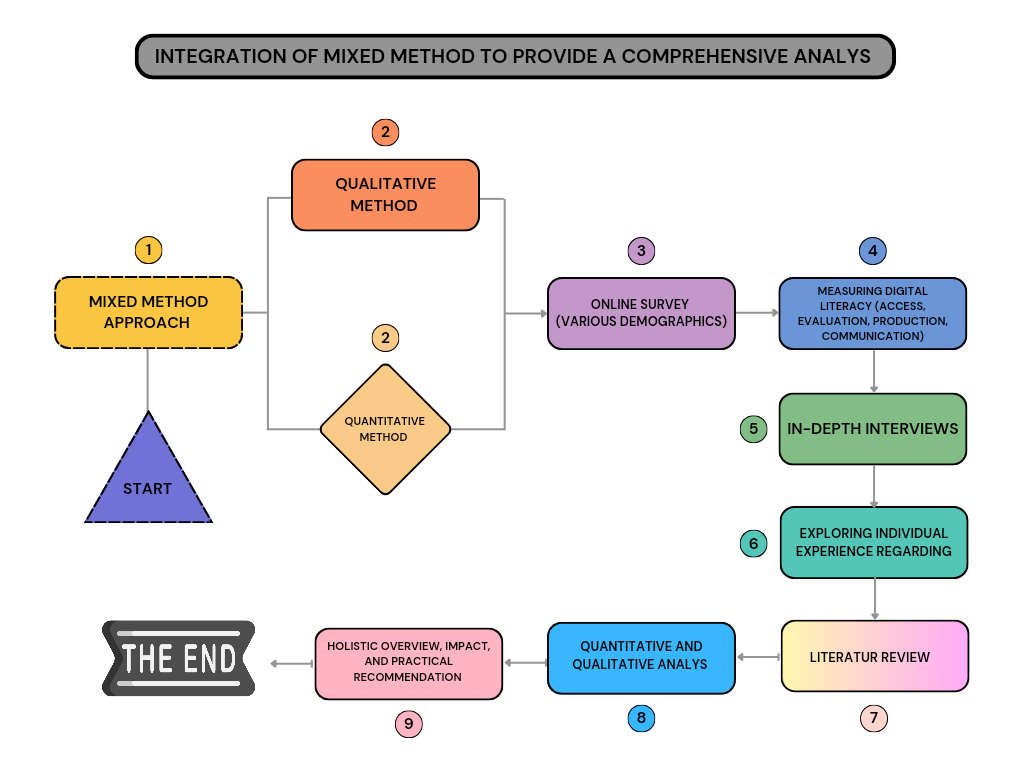
This research aims to explore and measure the impact of digital literacy in empowering individuals in the digital era, focusing on various demographics, including students, working professionals, and the general public. Digital literacy is accessing, evaluating, producing, and communicating information using digital technology. Using a mixed approach, this research integrates qualitative and quantitative methods to provide a comprehensive analysis. An online survey with 500 respondents, in-depth interviews with 30 workers from various sectors, and analysis of relevant literature were carried out to collect data. The main objectives of this research are to measure the level of digital literacy in certain populations, evaluate the effectiveness of digital literacy training programs, and identify the main challenges faced in improving digital literacy, such as access to technology, basic skills, and the digital divide. Preliminary results show that digital literacy significantly improves work skills and social and economic participation. For example, individuals with higher levels of digital literacy tend to have better access to employment opportunities and are more active in online communities. This research proposes promotional strategies to increase digital literacy, including community-based training programs, formal and informal education initiatives, and government policies supporting technology access. Hopefully, this study will provide in-depth insight into how digital literacy can empower individuals and communities and offer practical solutions to overcome existing challenges. Thus, this research contributes to the academic understanding of digital literacy and provides applicable recommendations for educators, policymakers, and organizations focused on improving digital literacy.
References
Ahmed, M. A., & Kumalasari, N. (2023). ANDIN-MU: Development of Android-Based Descriptive Text Interactive Multimedia Materials in High School English Subjects. Assyfa Learning Journal, 1, 49–59. DOI: https://doi.org/10.61650/alj.v1i1.17
Ahmed, M., Usmiyatun, U., Darmayanti, R., Purnamasari, P., & Choirudin, C. (2021). CODE ATI: Sewing activities with various patterns affect the cognitive aspects of kindergarten children? AMCA Journal of Education and Behavioral Change, 1(1), 22–25. DOI: https://doi.org/10.51773/ajeb.v1i1.267
Ahmed, S. T. (2021). Making the connection: Examining the relationship between undergraduate students’ digital literacy and academic success in an English medium instruction (EMI) university. Education and Information Technologies, 26(4), 4601–4620. https://doi.org/10.1007/s10639-021-10443-0 DOI: https://doi.org/10.1007/s10639-021-10443-0
Amoah, P. A. (2021). Digital Health Literacy and Health-Related Well-Being Amid the COVID-19 Pandemic: The Role of Socioeconomic Status Among University Students in Hong Kong and Macao. Asia-Pacific Journal of Public Health, 33(5), 613–616. https://doi.org/10.1177/10105395211012230 DOI: https://doi.org/10.1177/10105395211012230
Anhar, J., Darmayanti, R., & Usmiyatun, U. (2023). Pengaruh Kompetensi Guru Agama Islam Terhadap Implementasi Manajemen Sumber Daya Manusia Di Madrasah Tsanawiyah. Assyfa Journal of Islamic Studies, 1(1), 13–23. DOI: https://doi.org/10.61650/ajis.v1i1.136
Arif, V. R., Afnan, M., Usmiyatun, U., & Lestari, C. Y. (2023). Development of Social Studies Animation Video (S2AV) Teaching Materials on the Material" Plurality of Indonesian Society" for Junior High School Students. Assyfa Learning Journal, 1, 1–11. DOI: https://doi.org/10.61650/alj.v1i1.2
Boada, A., Molina-Ruiz, A. M., & García-Gavin, J. (2016). [Bridging the Digital Divide]. Actas Dermo-Sifiliograficas, 107(2), 93–94. https://doi.org/10.1016/j.ad.2016.01.003 DOI: https://doi.org/10.1016/j.ad.2016.01.003
Bodie, G. D., & Dutta, M. J. (2008). Understanding health literacy for strategic health marketing: eHealth literacy, health disparities, and the digital divide. Health Marketing Quarterly, 25(1), 175–203. https://doi.org/10.1080/07359680802126301 DOI: https://doi.org/10.1080/07359680802126301
Boury, N., Alvarez, K. S., Costas, A. G., Knapp, G. S., & Seipelt-Thiemann, R. L. (2021). Teaching in the Time of COVID-19: Creation of a Digital Internship to Develop Scientific Thinking Skills and Create Science Literacy Exercises for Use in Remote Classrooms. Journal of Microbiology & Biology Education, 22(1). https://doi.org/10.1128/jmbe.v22i1.2433 DOI: https://doi.org/10.1128/jmbe.v22i1.2433
Cao, Q., Zhang, Q., Feng, Y., & Li, X. (2024). Letter to the Editor about “Impact of health and digital health literacy on quality of life following radical prostatectomy for prostate cancer: prospective single-center cohort study.” World Journal of Urology, 42(1), 352. https://doi.org/10.1007/s00345-024-05056-4 DOI: https://doi.org/10.1007/s00345-024-05056-4
Chen, J. (2021). A cross-cultural perspective on the relationships among social media use, self-regulated learning and adolescents’ digital reading literacy. Computers and Education, 175. https://doi.org/10.1016/j.compedu.2021.104322 DOI: https://doi.org/10.1016/j.compedu.2021.104322
Chesser, A., Burke, A., Reyes, J., & Rohrberg, T. (2016). Navigating the digital divide: A systematic review of eHealth literacy in underserved populations in the United States. Informatics for Health & Social Care, 41(1), 1–19. https://doi.org/10.3109/17538157.2014.948171 DOI: https://doi.org/10.3109/17538157.2014.948171
Choi, N. G., & Dinitto, D. M. (2013). The digital divide among low-income homebound older adults: Internet use patterns, eHealth literacy, and attitudes toward computer/Internet use. Journal of Medical Internet Research, 15(5). https://doi.org/10.2196/jmir.2645 DOI: https://doi.org/10.2196/jmir.2645
Cholily, Y. M., Darmayanti, R., Lovat, T., Choirudin, C., Usmiyatun, U., & ... (2023). Si-GEMAS: Serious game mathematical crossword puzzle learning media for students critical thinking ability. Al-Jabar: Jurnal Pendidikan Matematika, 14(1), 165–179. DOI: https://doi.org/10.24042/ajpm.v14i1.16113
Dadaczynski, K. (2021). Digital Health Literacy and Web-Based Information-Seeking Behaviors of University Students in Germany during the COVID-19 Pandemic: Cross-sectional Survey Study. Journal of Medical Internet Research, 23(1). https://doi.org/10.2196/24097 DOI: https://doi.org/10.2196/24097
Darmayanti, R., Milshteyn, Y., & Kashap, A. M. (2023). Green economy, sustainability and implementation before, during, and after the covid-19 pandemic in Indonesia. Revenue Journal: Management and Entrepreneurship, 1(1), 27–33. DOI: https://doi.org/10.61650/rjme.v1i1.222
Din, H. N., McDaniels-Davidson, C., Nodora, J., & Madanat, H. (2019). Profiles of a Health Information-Seeking Population and the Current Digital Divide: Cross-Sectional Analysis of the 2015-2016 California Health Interview Survey. Journal of Medical Internet Research, 21(5). https://doi.org/10.2196/11931 DOI: https://doi.org/10.2196/11931
Doyle, G. J., Furlong, K. E., & Secco, L. (2016). Information Literacy in a Digital Era: Understanding the Impact of Mobile Information for Undergraduate Nursing Students. Studies in Health Technology and Informatics, 225, 297–301.
Eshet-Alkalai, Y., & Chajut, E. (2009). Changes over time in digital literacy. Cyberpsychology & Behavior : The Impact of the Internet, Multimedia and Virtual Reality on Behavior and Society, 12(6), 713–715. https://doi.org/10.1089/cpb.2008.0264 DOI: https://doi.org/10.1089/cpb.2008.0264
Eshet-Alkali, Y., & Amichai-Hamburger, Y. (2004). Experiments in digital literacy. Cyberpsychology & Behavior : The Impact of the Internet, Multimedia and Virtual Reality on Behavior and Society, 7(4), 421–429. https://doi.org/10.1089/cpb.2004.7.421 DOI: https://doi.org/10.1089/cpb.2004.7.421
Harahap, D., & Uthman, Y. O. O.-O. (2024). Bridging the Gap: Environmental Education as a Catalyst for Human-Environmental Harmony. Assyfa Learning Journal, 1, 19–39. DOI: https://doi.org/10.61650/alj.v2i1.186
Jiang, S., Hong, Y. A., & Liu, P. L. (2019). Trends of online patient-provider communication among cancer survivors from 2008 to 2017: a digital divide perspective. Journal of Cancer Survivorship : Research and Practice, 13(2), 197–204. https://doi.org/10.1007/s11764-019-00742-4 DOI: https://doi.org/10.1007/s11764-019-00742-4
Keles, A., Arikan, O., Hamid-Zada, İ., Somun, U. F., Baydili, K. N., & Yildirim, A. (2024). Exploring the impact of digital health literacy on quality of life in patients undergoing retrograde intrarenal surgery for kidney stone treatment: a prospective, single-center study. Urolithiasis, 52(1), 77. https://doi.org/10.1007/s00240-024-01576-1 DOI: https://doi.org/10.1007/s00240-024-01576-1
Kurki, M. (2021). Digital mental health literacy -program for the first-year medical students’ wellbeing: a one group quasi-experimental study. BMC Medical Education, 21(1). https://doi.org/10.1186/s12909-021-02990-4 DOI: https://doi.org/10.1186/s12909-021-02990-4
Kurki, M., Gilbert, S., Mishina, K., Lempinen, L., Luntamo, T., Hinkka-Yli-Salomäki, S., Sinokki, A., Upadhyaya, S., Wei, Y., & Sourander, A. (2021). Correction to: Digital mental health literacy -program for the first-year medical students’ wellbeing: a one group quasi-experimental study. BMC Medical Education, 21(1), 602. https://doi.org/10.1186/s12909-021-03031-w DOI: https://doi.org/10.1186/s12909-021-03031-w
Leung, A. Y. M. (2022). Sense of coherence mediates the relationship between digital health literacy and anxiety about the future in aging population during the COVID-19 pandemic: a path analysis. Aging and Mental Health, 26(3), 544–553. https://doi.org/10.1080/13607863.2020.1870206 DOI: https://doi.org/10.1080/13607863.2020.1870206
Liu, S., Lu, Y., Wang, D., He, X., Ren, W., Kong, D., & Luo, Y. (2023). Impact of digital health literacy on health-related quality of life in Chinese community-dwelling older adults: the mediating effect of health-promoting lifestyle. Frontiers in Public Health, 11, 1200722. https://doi.org/10.3389/fpubh.2023.1200722 DOI: https://doi.org/10.3389/fpubh.2023.1200722
MacLure, K., & Stewart, D. (2015). Self-Reported Digital Literacy of the Pharmacy Workforce in North East Scotland. Pharmacy (Basel, Switzerland), 3(4), 182–196. https://doi.org/10.3390/pharmacy3040182 DOI: https://doi.org/10.3390/pharmacy3040182
MacLure, K., & Stewart, D. (2016). Digital literacy knowledge and needs of pharmacy staff: A systematic review. Journal of Innovation in Health Informatics, 23(3), 840. https://doi.org/10.14236/jhi.v23i3.840 DOI: https://doi.org/10.14236/jhi.v23i3.840
Mas’odi, M., & Arma, I. P. (2024). Characters and Non-Digital Media: Case Study Trends in English Language Learning in Secondary Schools. Assyfa Journal of Multidisciplinary Education, 2. DOI: https://doi.org/10.61650/ajme.v1i2.352
Mathew, M., Morrow, J. R., Frierson, G. M., & Bain, T. M. (2011). Assessing digital literacy in web-based physical activity surveillance: the WIN study. American Journal of Health Promotion : AJHP, 26(2), 90–95. https://doi.org/10.4278/ajhp.091001-QUAN-320 DOI: https://doi.org/10.4278/ajhp.091001-QUAN-320
Mayberry, L. S., Kripalani, S., Rothman, R. L., & Osborn, C. Y. (2011). Bridging the digital divide in diabetes: family support and implications for health literacy. Diabetes Technology & Therapeutics, 13(10), 1005–1012. https://doi.org/10.1089/dia.2011.0055 DOI: https://doi.org/10.1089/dia.2011.0055
Mein, E., Fuentes, B., Más, F. S., & Muro, A. (2012). Incorporating digital health literacy into adult ESL education on the US-Mexico border. Rhetoric, Professional Communication, and Globalization, 3(1), 162–174.
Mubarok, M. Z., Subandi, M., Yusuf, M., & Darmayanti, R. (2023a). Efforts to improve tajwid learning using the An-Nahdliyah method in Diniyah students. Assyfa Journal of Islamic Studies, 1(1), 99–109.
Mubarok, M. Z., Subandi, M., Yusuf, M., & Darmayanti, R. (2023b). Efforts to improve tajwid learning using the An-Nahdliyah method in Diniyah students. Assyfa Journal of Islamic Studies, 1, 99–109. DOI: https://doi.org/10.61650/ajis.v1i1.197
Muhammad, I., Darmayanti, R., & Sugianto, R. (2023). Teori Vygotsky: Kajian bibliometrik penelitian cooperative learning di sekolah dasar (1987-2023). Bulletin of Educational Management and Innovation, 1(2), 81–98. DOI: https://doi.org/10.56587/bemi.v1i2.78
Nasiha, W., Afifah, N., & Amir, A. N. (2023). Design of a website-based arabic typing application for students of arabic language education program at university. Assyfa Learning Journal, 1, 12–24. DOI: https://doi.org/10.61650/alj.v1i1.4
Novoa, A., Kamran, A., & Farooq, S. M. Y. (2024). Understanding the Common Misconceptions of Temperature (ΔT) and Heat (Q) for PSP and Non-PSP Teachers. Assyfa Learning Journal, 1. DOI: https://doi.org/10.61650/alj.v2i1.127
Rahman, M. A. (2023). Professional development in an institution through the GROW model. Assyfa Learning Journal, 2, 112–121. DOI: https://doi.org/10.61650/alj.v1i2.187
Ratzan, S. C., Weinberger, M. B., Apfel, F., & Kocharian, G. (2013). The Digital Health Scorecard: A New Health Literacy Metric for NCD Prevention and Care. Global Heart, 8(2), 171–179. https://doi.org/10.1016/j.gheart.2013.05.006 DOI: https://doi.org/10.1016/j.gheart.2013.05.006
Salovey, P., Williams-Piehota, P., Mowad, L., Moret, M. E., Edlund, D., & Andersen, J. (2009). Bridging the digital divide by increasing computer and cancer literacy: community technology centers for head-start parents and families. Journal of Health Communication, 14(3), 228–245. https://doi.org/10.1080/10810730902805804 DOI: https://doi.org/10.1080/10810730902805804
Santiago, P., Alves, F. R. V, & Darmayanti, R. (2023). GeoGebra in the light of the Semiotic Representation Registers Theory: an international Olympic didactic sequence. Assyfa Learning Journal, 2, 73–90. DOI: https://doi.org/10.61650/alj.v1i2.60
Sekaryanti, R., Darmayanti, R., Choirudin, C., Usmiyatun, U., Kestoro, E., & ... (2022). Analysis of Mathematics Problem-Solving Ability of Junior High School Students in Emotional Intelligence. Jurnal Gantang, 7(2), 149–161. DOI: https://doi.org/10.31629/jg.v7i2.4944
Seok, S., & DaCosta, B. (2017). Digital literacy of youth and young adults with intellectual disability predicted by support needs and social maturity. Assistive Technology : The Official Journal of RESNA, 29(3), 123–130. https://doi.org/10.1080/10400435.2016.1165759 DOI: https://doi.org/10.1080/10400435.2016.1165759
Smolinski, T. G. (2010). Computer literacy for life sciences: helping the digital-era biology undergraduates face today’s research. CBE Life Sciences Education, 9(3), 357–363. https://doi.org/10.1187/cbe.10-03-0050 DOI: https://doi.org/10.1187/cbe.10-03-0050
Solehudin, R. H., & Darmayanti, R. (2018). Does token economy behaviour modification affect young children’s discipline? Jurnal Caksana: Pendidikan Anak Usia Dini, 1(2), 202–215.
Stanley, K. C., Harrigan, P. B., Serrano, E. L., & Kraak, V. I. (2021). Applying a Multi-Dimensional Digital Food and Nutrition Literacy Model to Inform Research and Policies to Enable Adults in the U.S. Supplemental Nutrition Assistance Program to Make Healthy Purchases in the Online Food Retail Ecosystem. International Journal of Environmental Research and Public Health, 18(16). https://doi.org/10.3390/ijerph18168335 DOI: https://doi.org/10.3390/ijerph18168335
Sungkawati, E., & Uthman, Y. O. O.-O. (2024). Adopting Blue-Green Economy Terms to Achieve SDGs: Indonesia’s Opportunities and Challenges. Assyfa Learning Journal, 1. DOI: https://doi.org/10.61650/alj.v2i2.125
Syaifuddin, M., Darmayanti, R., & Rizki, N. (2022). Development of a two-tier multiple-choice (TTMC) diagnostic test for geometry materials to identify misconceptions of middle school students. Jurnal Silogisme: Kajian Ilmu Matematika Dan Pembelajarannya, 7(2). DOI: https://doi.org/10.24269/silogisme.v7i2.5456
Terras, M. M., & Ramsay, J. (2016). Family Digital Literacy Practices and Children’s Mobile Phone Use. Frontiers in Psychology, 7, 1957. https://doi.org/10.3389/fpsyg.2016.01957 DOI: https://doi.org/10.3389/fpsyg.2016.01957
Terry, J., Davies, A., Williams, C., Tait, S., & Condon, L. (2019). Improving the digital literacy competence of nursing and midwifery students: A qualitative study of the experiences of NICE student champions. Nurse Education in Practice, 34, 192–198. https://doi.org/10.1016/j.nepr.2018.11.016 DOI: https://doi.org/10.1016/j.nepr.2018.11.016
Tomczyk, Ł. (2020). Evaluation of the functionality of a new e-learning platform vs. Previous experiences in e-learning and the self-assessment of own digital literacy. Sustainability (Switzerland), 12(23), 1–22. https://doi.org/10.3390/su122310219 DOI: https://doi.org/10.3390/su122310219
Tsai, H.-Y. S., Shillair, R., & Cotten, S. R. (2017). Social Support and “Playing Around”: An Examination of How Older Adults Acquire Digital Literacy With Tablet Computers. Journal of Applied Gerontology : The Official Journal of the Southern Gerontological Society, 36(1), 29–55. https://doi.org/10.1177/0733464815609440 DOI: https://doi.org/10.1177/0733464815609440
Ulrich, B. (2011). The digital divide–which side are you on? Nephrology Nursing Journal : Journal of the American Nephrology Nurses’ Association, 38(2), 109.
van der Vaart, R., & Drossaert, C. (2017). Development of the Digital Health Literacy Instrument: Measuring a Broad Spectrum of Health 1.0 and Health 2.0 Skills. Journal of Medical Internet Research, 19(1). https://doi.org/10.2196/jmir.6709 DOI: https://doi.org/10.2196/jmir.6709
Vedianty, A. S. A., Darmayanti, R., Lestari, A. S. B., Rayungsari, M., & ... (2023). What is the need for" UBUR-UBUR GABUT" media and its urgency in high school mathematics learning. Assyfa International Scientific Journal, 1(1).
Vu, D. N. (2021). Impacts of digital healthy diet literacy and healthy eating behavior on fear of COVID-19, changes in mental health, and health-related quality of life among front-line health care workers. Nutrients, 13(8). https://doi.org/10.3390/nu13082656 DOI: https://doi.org/10.3390/nu13082656
Walther, B., Hanewinkel, R., & Morgenstern, M. (2014). Effects of a brief school-based media literacy intervention on digital media use in adolescents: cluster randomized controlled trial. Cyberpsychology, Behavior and Social Networking, 17(9), 616–623. https://doi.org/10.1089/cyber.2014.0173 DOI: https://doi.org/10.1089/cyber.2014.0173
Wooldridge, J. A. (2005). Digital literacy in a landscape of data: a plea for a broader definition for citizens and patients. Studies in Health Technology and Informatics, 118, 263–269.
Wulandari, T., Nurmalitasari, D., Susanto, K., & Darmayanti, R. (2022). Etnomatematika Pada Batik Daun Sirih dan Burung Kepodang Khas Pasuruan. Seminar Nasional Teknologi Pembelajaran, 2(1), 95–103.
Zahroh, U., Rachmawati, N. I., & Darmayanti, R. (2023). Significance of Collaborative Learning Guidelines in 21st Century Education on Functional Limits Material in Madrasah Tsanawiyah. Assyfa Journal of Islamic Studies, 1(2), 155–161. DOI: https://doi.org/10.61650/ajis.v1i2.239
Published
How to Cite
Issue
Section
License
Copyright (c) 2024 addepalli vijaya sailaja

This work is licensed under a Creative Commons Attribution-ShareAlike 4.0 International License.