Keywords: Artificial Intelligence, Teacher Attitudes, Technology Integration, Learning Media
Abstract
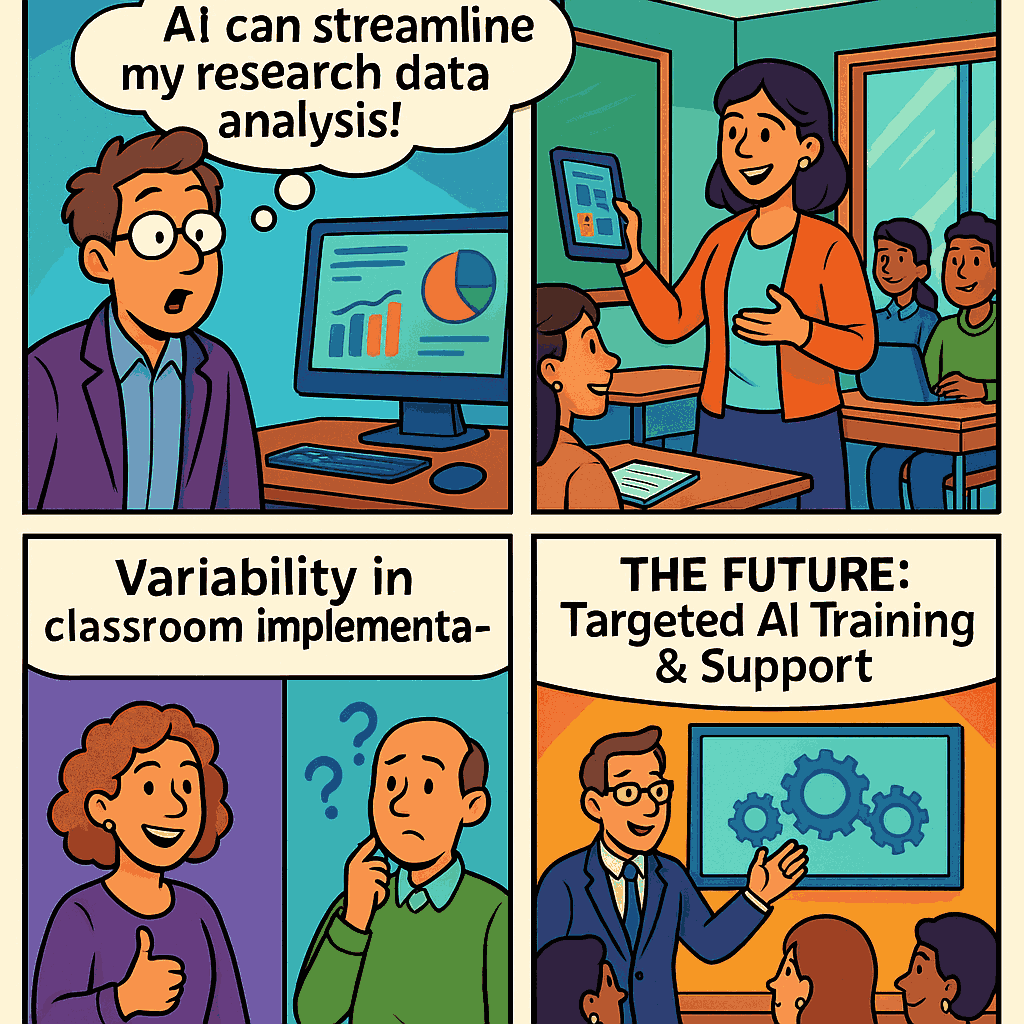
The rapid development of artificial intelligence (AI) in higher education demands a comprehensive understanding of university teachers' readiness and attitudes towards integrating this technology, particularly in the development of innovative learning media. This study aims to explore the beliefs and attitudes of university teachers in Pakistan towards the adoption of AI in teaching practices and examine its implications for the development and integration of technology-based learning media. The study employs a quantitative approach with a structured survey involving 250 teachers from various public and private universities in Pakistan, and the data is analyzed using descriptive statistics and the Chi-square test. The findings indicate that the majority of teachers recognize the potential of AI in enhancing teaching effectiveness, accelerating data analysis, and supporting the development of adaptive learning media. However, significant concerns remain regarding ethical issues, data privacy, and technology adoption readiness. These findings underscore the importance of continuous professional development, the formulation of ethical guidelines, and research collaboration to ensure the optimal integration of AI, contributing to the transformation of learning in higher education, particularly in the development of innovative and ethical learning media.
References
Alrasheed, S. H., Aladhadh, S., & Alabdulatif, A. (2025). Protecting Intellectual Security Through Hate Speech Detection Using an Artificial Intelligence Approach. Algorithms, 18(4). https://doi.org/10.3390/a18040179 DOI: https://doi.org/10.3390/a18040179
Anuprabha, M., Gurugubelli, K., & Vuppala, A. K. (2025). Dysarthric Speech Intelligibility Assessment by Custom Keyword Spotting. IEEE Journal on Selected Topics in Signal Processing. https://doi.org/10.1109/JSTSP.2025.3604709 DOI: https://doi.org/10.1109/JSTSP.2025.3604709
Balasubramanian, A., Pandey, K., Veer, G., & Samanta, D. (2025). Explainable artificial intelligence-based identification of the localized events in imagined speech electroencephalogram. Computers and Electrical Engineering, 127. https://doi.org/10.1016/j.compeleceng.2025.110608 DOI: https://doi.org/10.1016/j.compeleceng.2025.110608
Bocklet, T., Nöth, E., & Riedhammer, K. (2023). Artificial Intelligence for the Analysis of Pathologic Speech; Künstliche Intelligenz für die Analyse pathologischer Sprache. Sprache Stimme Gehor, 47(3), 145–150. https://doi.org/10.1055/a-2089-5778 DOI: https://doi.org/10.1055/a-2089-5778
Burke, M., Rossetti, Z., & Li, C. (2022). Examining the Effectiveness of a Legislative Advocacy Program for Parents of Individuals With Intellectual and Developmental Disabilities. Journal of Policy and Practice in Intellectual Disabilities, 19(3). https://doi.org/10.1111/jppi.12402 DOI: https://doi.org/10.1111/jppi.12402
Coy, A. D., Mohammed, P. S., & Skerrit, P. (2025). Inclusive Deaf Education Enabled by Artificial Intelligence: The Path to a Solution. International Journal of Artificial Intelligence in Education, 35(1), 96–134. https://doi.org/10.1007/s40593-024-00419-9 DOI: https://doi.org/10.1007/s40593-024-00419-9
Dai, X., & Yang, W. (2025). The Application of Artificial Intelligence-Assisted Psychological Training in Enhancing Positive Psychological Qualities of College Students. International Journal for Housing Science and Its Applications, 46(3), 3339–3350. https://doi.org/10.70517/ijhsa463282 DOI: https://doi.org/10.70517/ijhsa463282
Feng, L. (2025). Investigating the Effects of Artificial Intelligence-Assisted Language Learning Strategies on Cognitive Load and Learning Outcomes: A Comparative Study. Journal of Educational Computing Research, 62(8), 1961–1994. https://doi.org/10.1177/07356331241268349 DOI: https://doi.org/10.1177/07356331241268349
Fumero, M. J., Marrufo-Pérez, M. I., Eustaquio-Martín, A., & Lopez-Poveda, E. A. (2024). Factors that can affect divided speech intelligibility. Hearing Research, 441. https://doi.org/10.1016/j.heares.2023.108917 DOI: https://doi.org/10.1016/j.heares.2023.108917
Han, X., Huang, D., Eun-Lee, S., & Hoon-Yang, J. (2023). Artificial Intelligence-Oriented User Interface Design and Human Behavior Recognition based on Human-Computer Nature Interaction. International Journal of Humanoid Robotics, 20(6). https://doi.org/10.1142/S0219843622500207 DOI: https://doi.org/10.1142/S0219843622500207
Jegan, R., & Jayagowri, R. (2024). Voice pathology detection using optimized convolutional neural networks and explainable artificial intelligence-based analysis. Computer Methods in Biomechanics and Biomedical Engineering, 27(14), 2041–2057. https://doi.org/10.1080/10255842.2023.2270102 DOI: https://doi.org/10.1080/10255842.2023.2270102
Kim, E., Shin, D., Cho, S. T., & Chung, K. (2023). Artificial Intelligence-Based Speech Analysis System for Medical Support. International Neurourology Journal, 27(2), 99–105. https://doi.org/10.5213/inj.2346136.068 DOI: https://doi.org/10.5213/inj.2346136.068
Krinkin, K. V, Shichkina, Y. A., & Ignatev, A. G. (2023). Co-evolutionary hybrid intelligence is a key concept for the world intellectualization. Kybernetes, 52(9), 2907–2923. https://doi.org/10.1108/K-03-2022-0472 DOI: https://doi.org/10.1108/K-03-2022-0472
Kumar, G., Das, T., & Singh, K. (2024). Early detection of depression through facial expression recognition and electroencephalogram-based artificial intelligence-assisted graphical user interface. Neural Computing and Applications, 36(12), 6937–6954. https://doi.org/10.1007/s00521-024-09437-z DOI: https://doi.org/10.1007/s00521-024-09437-z
Lee, C., Wang, M., Reformat, M. Z., & Huang, S. (2023). Human intelligence-based metaverse for co-learning of students and smart machines. Journal of Ambient Intelligence and Humanized Computing, 14(6), 7695–7718. https://doi.org/10.1007/s12652-023-04580-2 DOI: https://doi.org/10.1007/s12652-023-04580-2
Lukman, L. (2019). AKTUALISASI MULTIPLE INTELLIGENCES PADA ANAK USIA 5-6 TAHUN MELALUI PERMAINAN OUTBOUND DI TAMAN KANAK-KANAK ISLAM PELANGI ANAK NEGERI YOGYAKARTA. PELANGI: Jurnal Pemikiran Dan Penelitian Islam Anak Usia Dini, 1(1). https://doi.org/10.52266/pelangi.v1i1.277 DOI: https://doi.org/10.52266/pelangi.v1i1.277
Mo, D., & Mo, B. (2024). A Study of Artificial Intelligence-Driven Educational Intervention Strategies for Students with Special Educational Needs. Applied Mathematics and Nonlinear Sciences, 9(1). https://doi.org/10.2478/amns-2024-3059 DOI: https://doi.org/10.2478/amns-2024-3059
Pedersen, M. B., Jensen, S. H., Tan, Z. H., & Jensen, J. H. (2024). Data-Driven Non-Intrusive Speech Intelligibility Prediction Using Speech Presence Probability. IEEE/ACM Transactions on Audio Speech and Language Processing, 32, 55–67. https://doi.org/10.1109/TASLP.2023.3321964 DOI: https://doi.org/10.1109/TASLP.2023.3321964
Peng, S., Chen, Y., Xu, J., Chen, Z., Wang, C., & Jia, X. (2023). Intellectual property protection of DNN models. World Wide Web, 26(4), 1877–1911. https://doi.org/10.1007/s11280-022-01113-3 DOI: https://doi.org/10.1007/s11280-022-01113-3
Prodi, N., Pellegatti, M., & Visentin, C. (2023). Comparing the effects of scattered and specular sound reflections on speech intelligibility in rooms. Building and Environment, 228. https://doi.org/10.1016/j.buildenv.2022.109881 DOI: https://doi.org/10.1016/j.buildenv.2022.109881
Qie, X. (2023). Feedback delay of sports intelligent learning system based on model predictive control and artificial intelligence. Measurement: Sensors, 30. https://doi.org/10.1016/j.measen.2023.100922 DOI: https://doi.org/10.1016/j.measen.2023.100922
Qu, D. (2024). INTELLIGENT COCKPIT APPLICATION BASED ON ARTIFICIAL INTELLIGENCE VOICE INTERACTION SYSTEM. Computing and Informatics, 43(4), 1012–1028. https://doi.org/10.31577/cai_2024_4_1012 DOI: https://doi.org/10.31577/cai_2024_4_1012
Queiroz, A., & Coelho, R. F. (2024). Harmonic Detection From Noisy Speech With Auditory Frame Gain for Intelligibility Enhancement. IEEE/ACM Transactions on Audio Speech and Language Processing, 32, 2522–2531. https://doi.org/10.1109/TASLP.2024.3393727 DOI: https://doi.org/10.1109/TASLP.2024.3393727
Ranjith, R., & Chandra Sekar, A. (2024a). Conv-transformer-based Jaya Gazelle optimization for speech intelligibility with aphasia. Signal, Image and Video Processing, 18(3), 2079–2094. https://doi.org/10.1007/s11760-023-02844-0 DOI: https://doi.org/10.1007/s11760-023-02844-0
Ranjith, R., & Chandra Sekar, A. (2024b). GTSO: Gradient tangent search optimization enabled voice transformer with speech intelligibility for aphasia. Computer Speech and Language, 84. https://doi.org/10.1016/j.csl.2023.101568 DOI: https://doi.org/10.1016/j.csl.2023.101568
Ren, Q., Hou, Y., Botteldooren, D., & Belpaeme, T. (2024). No More Mumbles: Enhancing Robot Intelligibility Through Speech Adaptation. IEEE Robotics and Automation Letters, 9(7), 6162–6169. https://doi.org/10.1109/LRA.2024.3401117 DOI: https://doi.org/10.1109/LRA.2024.3401117
Roßbach, J., Wagener, K. C., & Meyer, B. T. (2025). Multilingual non-intrusive binaural intelligibility prediction based on phone classification. Computer Speech and Language, 89. https://doi.org/10.1016/j.csl.2024.101684 DOI: https://doi.org/10.1016/j.csl.2024.101684
Samardzic, N., Lavandier, M., & Shen, Y. (2023). The Utilization of Psychometric Functions to Predict Speech Intelligibility in Vehicles. SAE International Journal of Vehicle Dynamics, Stability, and NVH, 8(1). https://doi.org/10.4271/10-08-01-0002 DOI: https://doi.org/10.4271/10-08-01-0002
Santiago Perez, T., & Crowe, B. (2021). Community Participation for Transition- Aged Youth with Intellectual and Developmental Disabilities: A Systematic Review. Therapeutic Recreation Journal, 55(1). https://doi.org/10.18666/trj-2021-v55-i1-10296 DOI: https://doi.org/10.18666/TRJ-2021-V55-I1-10296
Xue, W., Cucchiarini, C., van Hout, R. W. N. M., & Strik, H. (2023). Measuring the intelligibility of dysarthric speech through automatic speech recognition in a pluricentric language. Speech Communication, 148, 23–30. https://doi.org/10.1016/j.specom.2023.02.004 DOI: https://doi.org/10.1016/j.specom.2023.02.004
ZainEldin, H. Y., Gamel, S. A., Talaat, F. M., Aljohani, M., Baghdadi, N. A., Malki, A. S., Badawy, M. M., & Elhosseini, M. A. (2024). Silent no more: a comprehensive review of artificial intelligence, deep learning, and machine learning in facilitating deaf and mute communication. Artificial Intelligence Review, 57(7). https://doi.org/10.1007/s10462-024-10816-0 DOI: https://doi.org/10.1007/s10462-024-10816-0
Zhang, X. (2025). Research on the Quality Improvement Path of Artificial Intelligence-Assisted Teaching in the Construction of Higher Vocational English Gold Classes under the Integration of Industry and Education. International Journal for Housing Science and Its Applications, 46(3), 7073–7082. https://doi.org/10.70517/ijhsa463607 DOI: https://doi.org/10.70517/ijhsa463607
Zhang, Y., Tan, X., & Qu, X. (2024). From toy-like to intelligent: ARM-based cloud-injected AI companion robot. International Journal of Information and Communication Technology, 24(7), 17–50. https://doi.org/10.1504/IJICT.2024.139108 DOI: https://doi.org/10.1504/IJICT.2024.139108
Published
How to Cite
Issue
Section
License
Copyright (c) 2025 Haleema Bibi, Mubbsher Shahzad, Rahim Jan, Muhammad Iqbal Majoka

This work is licensed under a Creative Commons Attribution-ShareAlike 4.0 International License.