Keywords: content analysis, William Rumi method, digital learning, educational technology
Abstract
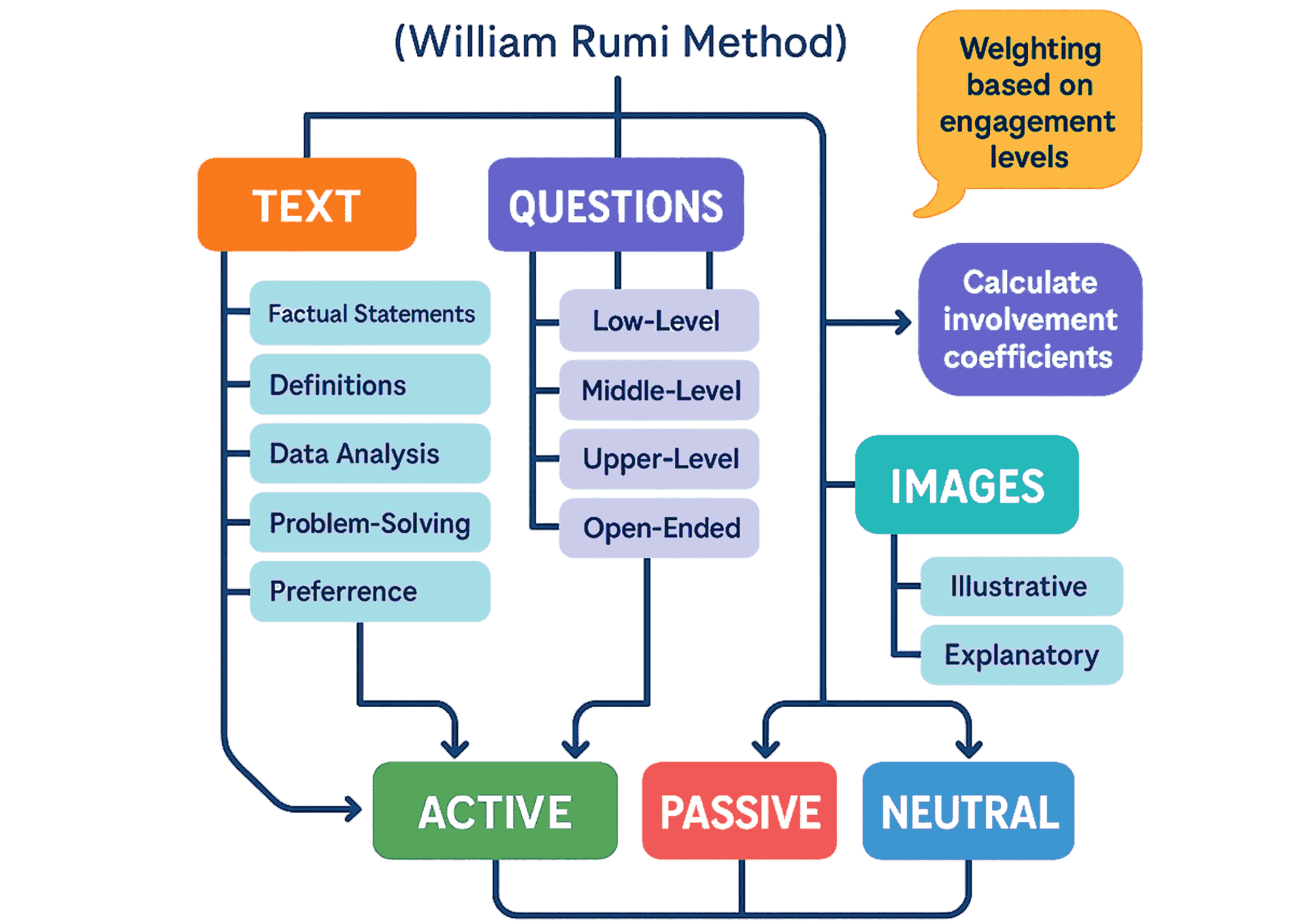
This research employs the William Rumi content analysis method to examine the biology section of Iran’s sixth-grade elementary science textbook, focusing on lessons 10–13. It assesses the text, questions, and images, categorizing them as active, passive, or neutral. The study finds the main text is largely passive, with an engagement coefficient of 0.32, while the questions encourage active learning with a coefficient of 1.50. Images offer minimal engagement, with a coefficient of 0.42. These results underscore the necessity to bolster active learning elements and enhance the use of images. The analysis provides guidance for developing interactive digital textbooks and adaptive, technology-enhanced learning resources, consistent with global educational technology trends. By embedding active learning strategies and digital interactivity, student engagement can be heightened, catering to diverse learning needs in both formal and non-formal educational contexts.
References
Alotaibi, H. S. (2021). The rhetorical structure of preface sections in textbooks: Variations across disciplines. International Journal of Arabic-English Studies, 21(2), 165–182. https://doi.org/10.33806/IJAES2000.21.2.9 DOI: https://doi.org/10.33806/ijaes2000.21.2.9
Andersen, K. N. (2020). Assessing task-orientation potential in primary science textbooks: Toward a new approach. Journal of Research in Science Teaching, 57(4), 481–509. https://doi.org/10.1002/tea.21599 DOI: https://doi.org/10.1002/tea.21599
Audrin, C. (2023). How is biodiversity understood in compulsory education textbooks? A lexicographic analysis of teaching programs in the French-speaking part of Switzerland. Environmental Education Research, 29(8), 1056–1071. https://doi.org/10.1080/13504622.2022.2092597 DOI: https://doi.org/10.1080/13504622.2022.2092597
Bakken, J., & Andersson-Bakken, E. (2021). The textbook task as a genre. Journal of Curriculum Studies, 53(6), 729–748. https://doi.org/10.1080/00220272.2021.1929499 DOI: https://doi.org/10.1080/00220272.2021.1929499
Beresheim, A. C., Zepeda, D., Pharel, M., Soy, T., Wilson, A. B., & Ferrigno, C. (2024). Anatomy’s missing faces: An assessment of representation gaps in atlas and textbook imagery. Anatomical Sciences Education, 17(5), 1055–1070. https://doi.org/10.1002/ase.2432 DOI: https://doi.org/10.1002/ase.2432
Borokh, O. N. (2020). From Western Knowledge to a National Textbook: The Evolution of Li Quanshi’s Socio-economic Views. Vestnik Sankt-Peterburgskogo Universiteta Vostokovedenie i Afrikanistika, 12(3), 426–451. https://doi.org/10.21638/spbu13.2020.308 DOI: https://doi.org/10.21638/spbu13.2020.308
Brock, R., Tsourakis, N., & Kampourakis, K. (2025). Using Text Mining to Identify Teleological Explanations in Physics and Biology Textbooks: An Exploratory Study. Science and Education, 34(4), 2167–2188. https://doi.org/10.1007/s11191-024-00513-3 DOI: https://doi.org/10.1007/s11191-024-00513-3
Celik, S. E., & Karataş, F. Ö. (2022). Representation of Nature of Science in Chemistry Textbooks: Employing Reconceptualized Family Resemblance Approach as a Framework*. Hacettepe Egitim Dergisi, 37(3), 1200–1212. https://doi.org/10.16986/HUJE.2022.455 DOI: https://doi.org/10.16986/HUJE.2022.455
Cheng, T., Curley, M., & Barmettler, A. (2022). Skin Color Representation in Ophthalmology Textbooks. Medical Science Educator, 32(5), 1143–1147. https://doi.org/10.1007/s40670-022-01636-4 DOI: https://doi.org/10.1007/s40670-022-01636-4
Crossley, N. (2024). Pedagogy and the Textbook in Political Science. Journal of Political Science Education, 20(3), 422–439. https://doi.org/10.1080/15512169.2024.2322997 DOI: https://doi.org/10.1080/15512169.2024.2322997
Ferreira, S., & Saraiva, L. (2021). COMPLEXITY of PRACTICAL WORK in PORTUGUESE PRIMARY SCIENCE TEXTBOOKS; Complexidade do trabalho prático em manuais escolares de ciências do 1.ociclo do ensino básico português. Investigacoes Em Ensino de Ciencias, 26(3), 281–297. https://doi.org/10.22600/1518-8795.ienci2021v26n3p281 DOI: https://doi.org/10.22600/1518-8795.ienci2021v26n3p281
Gatiyatullina, G. M., Solnyshkina, M. I., Kupriyanov, R. V., & Ziganshina, C. R. (2023). Lexical density as a complexity predictor: The case of Science and Social Studies textbooks; Лексическая плотность как предиктор сложности (на материале учебников по естествознанию и обществознанию). Research Result. Theoretical and Applied Linguistics, 9(1), 11–26. https://doi.org/10.18413/2313-8912-2023-9-1-0-2 DOI: https://doi.org/10.18413/2313-8912-2023-9-1-0-2
Guenther, L. (2020). A textbook linking theory, research, and practice of science communication. Journal of Science Communication, 19(3). https://doi.org/10.22323/2.19030701 DOI: https://doi.org/10.22323/2.19030701
Habibi, T., Ruban, D. A., & Ermolaev, V. A. (2023). Educational Potential of Geoheritage: Textbook Localities from the Zagros and the Greater Caucasus. Heritage, 6(9), 5981–5996. https://doi.org/10.3390/heritage6090315 DOI: https://doi.org/10.3390/heritage6090315
Huang, R., Tlili, A., Zhang, X., Sun, T., Wang, J., Sharma, R. C., Affouneh, S. J., Salha, S. H., Altinay, F., & Altinay, Z. (2022). A Comprehensive Framework for Comparing Textbooks: Insights from the Literature and Experts. Sustainability (Switzerland), 14(11). https://doi.org/10.3390/su14116940 DOI: https://doi.org/10.3390/su14116940
Isaksen, M., Ødegaard, M., & Utsi, T. H. A. (2025). Science Textbooks: Aids or Obstacles to Inquiry Teaching? Science Teachers’ Experiences in Norwegian Secondary Schools. Science and Education, 34(3), 1461–1487. https://doi.org/10.1007/s11191-023-00492-x DOI: https://doi.org/10.1007/s11191-023-00492-x
Kandahari, E., Smith, E. J., & Goeltz, J. C. (2021). Beyond the Textbook: Introducing Undergraduates to Practical Electrochemistry. Journal of Chemical Education, 98(10), 3263–3268. https://doi.org/10.1021/acs.jchemed.1c00155 DOI: https://doi.org/10.1021/acs.jchemed.1c00155
Kapsala, N., Galani, A., & Mavrikaki, E. (2022). Nature of Science in Greek Secondary School Biology Textbooks; Narava znanosti v grških srednješolskih bioloških učbenikih. Center for Educational Policy Studies Journal, 12(2), 143–168. https://doi.org/10.26529/cepsj.1309 DOI: https://doi.org/10.26529/cepsj.1309
Kim, J., Woo, H., Kim, J., & Lee, W. (2021). Relationship between Korean Informatics Curriculum and Textbook Learning Element Considering Compound Word. International Journal on Informatics Visualization, 5(4), 430–437. https://doi.org/10.30630/JOIV.5.4.731 DOI: https://doi.org/10.30630/joiv.5.4.731
Kim, Y., Lee, Y., Lee, H., & Lim, S. (2022). ALIGNMENT OF CONCEPTS OF MEIOSIS AMONG CURRICULUM, TEXTBOOKS, CLASSROOM TEACHING AND ASSESSMENT IN UPPER SECONDARY SCHOOL IN REPUBLIC OF KOREA. Journal of Baltic Science Education, 21(2), 232–244. https://doi.org/10.33225/jbse/22.21.232 DOI: https://doi.org/10.33225/jbse/22.21.232
Li, Y., Darmi, R. H., & Yap, N. T. (2025). Systematic Literature Review on Evaluation of English Language Textbooks: A Decade of Research. World Journal of English Language, 15(3), 65–78. https://doi.org/10.5430/wjel.v15n3p65 DOI: https://doi.org/10.5430/wjel.v15n3p65
Limiansi, K., Suranto, null, Paidi, P., & Zuchdi, D. (2025). Character education content in science textbook for senior high school students. International Journal of Evaluation and Research in Education, 14(1), 28–36. https://doi.org/10.11591/ijere.v14i1.26389 DOI: https://doi.org/10.11591/ijere.v14i1.26389
Lodge, W. G., & Reiss, M. J. (2021). Visual representations of women in a Jamaican science textbook: perpetuating an outdated, sexist ideology. International Journal of Science Education, 43(13), 2169–2184. https://doi.org/10.1080/09500693.2021.1957514 DOI: https://doi.org/10.1080/09500693.2021.1957514
Lucy, L., Demszky, D., Bromley, P., & Jurafsky, D. S. (2020). Content Analysis of Textbooks via Natural Language Processing: Findings on Gender, Race, and Ethnicity in Texas U.S. History Textbooks. AERA Open, 6(3). https://doi.org/10.1177/2332858420940312 DOI: https://doi.org/10.1177/2332858420940312
Luthfi, K. M., Nugraha, R. S., Farhah, E., Arummi, A., & Hidayati, T. Y. N. (2025). Modern Arabic Language Idioms in the Silsilat Al-Lisan Arabic Language Learning Textbook. Theory and Practice in Language Studies, 15(3), 776–785. https://doi.org/10.17507/tpls.1503.12 DOI: https://doi.org/10.17507/tpls.1503.12
Malovichko, T. V. (2021). Evolution of teaching the probability theory based on textbook by V. P. Ermakov. History of Science and Technology, 11(2), 300–314. https://doi.org/10.32703/2415-7422-2021-11-2-300-314 DOI: https://doi.org/10.32703/2415-7422-2021-11-2-300-314
Monakhov, S. I., Turchanenko, V., & Cherdakov, D. N. (2023). Terminology use in school textbooks: corpus analysis; Школьный учебный текст в аспекте терминоупотребления: корпусный анализ. Research Result. Theoretical and Applied Linguistics, 9(1), 27–49. https://doi.org/10.18413/2313-8912-2023-9-1-0-3 DOI: https://doi.org/10.18413/2313-8912-2023-9-1-0-3
Mongar, K. (2022). Alignment of the Environmental Science Textbooks, Examinations, and Curriculum Framework to Achieve the Teaching Objectives. Journal of Turkish Science Education, 19(1), 52–70. https://doi.org/10.36681/tused.2022.109 DOI: https://doi.org/10.36681/tused.2022.109
Morris, P. H. (2020). Misunderstandings and omissions in textbook accounts of effect sizes. British Journal of Psychology, 111(2), 395–410. https://doi.org/10.1111/bjop.12401 DOI: https://doi.org/10.1111/bjop.12401
Ningrum, D. E. A. F., Rofiki, I., Melinda, V. A., Erfantinni, I. H., & Febriani, R. O. (2020). Development of biotechnology textbook based on bioinformatics research. Universal Journal of Educational Research, 8(11), 5188–5196. https://doi.org/10.13189/ujer.2020.081119 DOI: https://doi.org/10.13189/ujer.2020.081119
Ortuzar-Iragorri, M. A., & Zamalloa, T. (2023). Evolution in the Spanish Primary Education Autonomic Curricula and Textbooks. A Geographic Analysis; Razvoj avtonomnih učnih načrtov in učbenikov v španskem osnovnošolskem izobraževanju – geografska analiza. Center for Educational Policy Studies Journal, 13(1), 143–161. https://doi.org/10.26529/cepsj.1487 DOI: https://doi.org/10.26529/cepsj.1487
Panayides, A. S., Sá-Pinto, X., Mavrikaki, E., Aanen, D. K., Aboim, S., Cavadas, B. F. B. P., Dvořáková, R. M., Eens, M., Filova, E., & Gregorčič, T. (2024). Evolution content in school textbooks: data from eight European countries. Evolution: Education and Outreach, 17(1). https://doi.org/10.1186/s12052-024-00203-2 DOI: https://doi.org/10.1186/s12052-024-00203-2
Rosidin, null, Mardhatillah, M., Andriani, F., & Addakhil, A. R. (2024). MODERATE INTERPRETATIONS IN ISLAMIC RELIGIOUS EDUCATION TEXTBOOKS: A CASE STUDY IN AN INDONESIAN ISLAMIC SENIOR HIGH SCHOOL. Jurnal Lektur Keagamaan, 22(2), 383–420. https://doi.org/10.31291/jlka.v22i2.1273 DOI: https://doi.org/10.31291/jlka.v22i2.1273
Ruiz-Alba, P., & Moreno-Fernández, O. (2020). Are equality policies reflected in textbooks? A study in the textbooks of Social Sciences of Secondary Education; ¿Se reflejan las políticas de igualdad en los libros de texto? Un estudio en los libros de texto de Ciencias Sociales de Educación Secundaria. International Journal of Educational Research and Innovation, 2020(14), 147–166. https://doi.org/10.46661/ijeri.4176
Saether, J. (2023). Fact-value discourses in 19 analyses of genetics in biology textbooks: A critical review. Nordic Studies in Science Education, 19(2), 148–163. https://doi.org/10.5617/nordina.9620 DOI: https://doi.org/10.5617/nordina.9620
Shahid, S., Kanwal, W., & Parveen, K. (2023). Effectiveness of Science Textbook Activities for Conceptual Understanding of Students. Journal of Management Practices, Humanities and Social Sciences (JMPHSS), 7(2), 1–8. https://doi.org/10.33152/jmphss-7.2.1 DOI: https://doi.org/10.33152/jmphss-7.2.1
Suciati, R., Gofur, A., Susilo, H., & Lestari, U. (2022). Development of Textbook Integrated of Metacognition, Critical Thinking, Islamic Values, and Character. Pegem Egitim ve Ogretim Dergisi, 12(4), 20–28. https://doi.org/10.47750/pegegog.12.04.03 DOI: https://doi.org/10.47750/pegegog.12.04.03
Sugiarni, R., Herman, T., Suryadi, D., Prabawanto, S., & Abdullah, K. H. (2024). A Bibliometric Review of Mathematics Textbooks Research. Journal of Scientometric Research, 13(2), 396–405. https://doi.org/10.5530/jscires.13.2.31 DOI: https://doi.org/10.5530/jscires.13.2.31
Yousef, J., Hussain, G., Deva, A. K., & Lajevardi, S. S. (2024). The first English textbook of plastic surgery—William (Jerry) Moore. Australasian Journal of Plastic Surgery, 7(2). https://doi.org/10.34239/ajops.92775 DOI: https://doi.org/10.34239/ajops.92775
Yu, J., Li, C., & Li, G. (2022). Alignment between biology curriculum standards and five textbook editions: a content analysis. International Journal of Science Education, 44(14), 1–20. https://doi.org/10.1080/09500693.2022.2119621 DOI: https://doi.org/10.1080/09500693.2022.2119621
Published
How to Cite
Issue
Section
License
Copyright (c) 2025 Darioush Sharafie

This work is licensed under a Creative Commons Attribution-ShareAlike 4.0 International License.