



Objectives And Scope

ASSYFA LEARNING JOURNAL

Objectives and Scope

International Scholarly Journal in Instructional Science

Core Scholarly Orientation

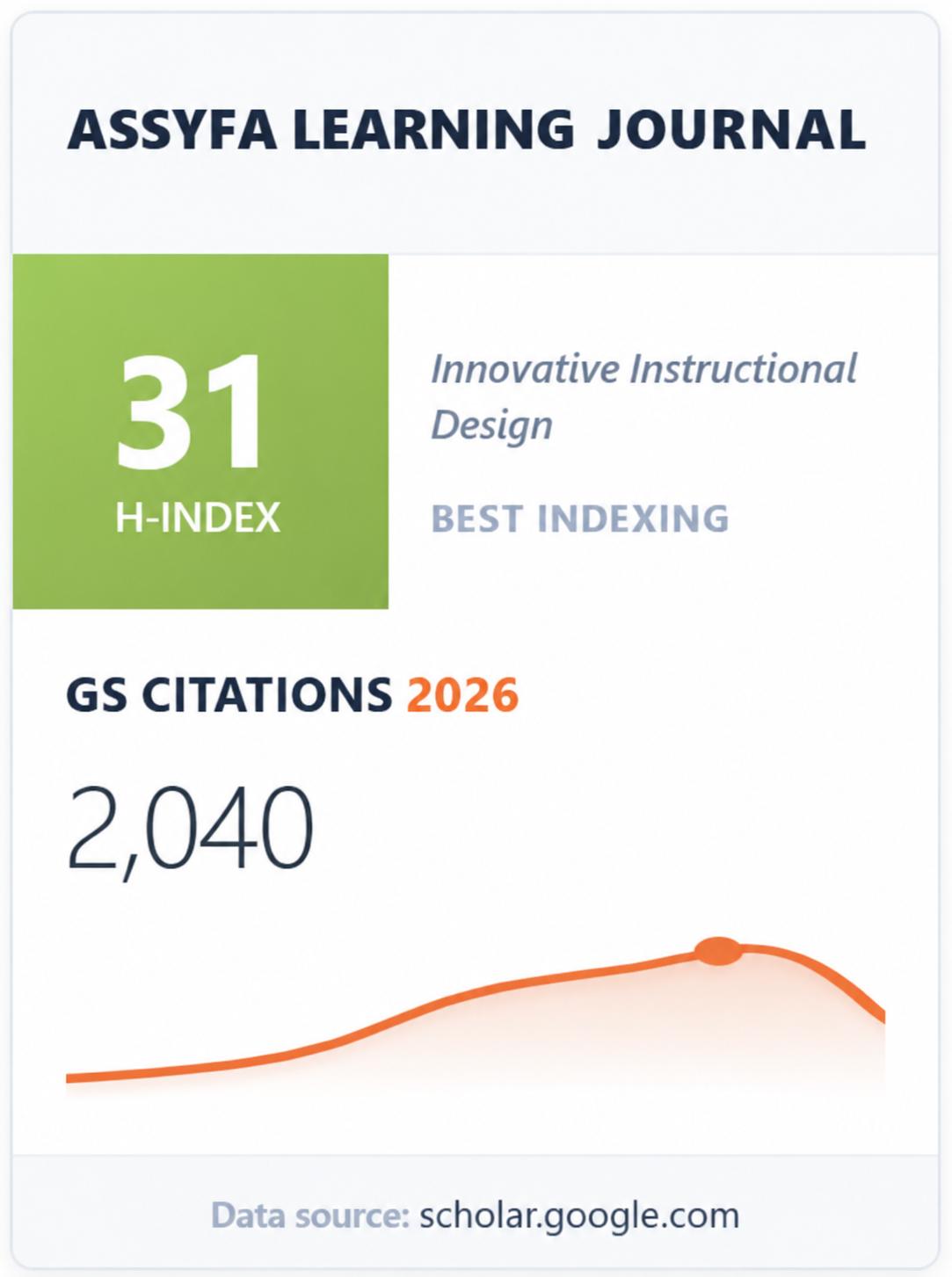
Innovative Instructional Design

Connecting disciplinary expertise, pedagogical innovation, emerging technologies, and evidence-based learning outcomes.

Assyfa Learning Journal advances innovative instructional design through scholarly research that transforms disciplinary expertise, pedagogical knowledge, and emerging educational technologies into effective teaching and learning experiences. The journal provides an international academic platform for rigorous empirical studies, theoretical contributions, and research-based educational development addressing instructional challenges across educational and professional learning environments.

The journal prioritizes research demonstrating how instructional innovations are designed, implemented, evaluated, and improved to strengthen learner engagement, conceptual understanding, academic achievement, transferable competencies, and measurable learning outcomes.

1. Journal Objectives

Assyfa Learning Journal seeks to achieve the following scholarly objectives:

01
Advance Innovative Instructional Design
Promote the development, implementation, and evaluation of innovative instructional models, strategies, learning environments, and research-based teaching approaches.
02
Integrate Disciplinary and Professional Expertise
Investigate how specialized academic knowledge, disciplinary pedagogies, and professional expertise can be transformed into effective instructional practices.
03
Strengthen Evidence-Based Pedagogical Innovation
Support rigorous investigations of teaching approaches and learning interventions that demonstrate meaningful educational improvements.
04
Encourage Responsible Educational Technology Integration
Examine the pedagogically meaningful application of artificial intelligence, adaptive technologies, digital resources, and technology-enhanced learning environments.
05
Improve Curriculum and Competency Development
Contribute research on curriculum innovation, outcome-based education, competency-oriented instruction, and alignment among learning objectives, instructional activities, and assessment.
06
Promote International Scholarly Exchange
Facilitate interdisciplinary research, critical academic dialogue, and international knowledge exchange concerning innovative instructional practices across diverse educational contexts.

2. Scope of the Journal

The journal welcomes original scholarly manuscripts within the following interconnected research areas, provided they demonstrate a clear contribution to instructional design, teaching effectiveness, learner competencies, or educational outcomes.

A. Innovative Instructional Design

Instructional design models, learning experience design, design-based research, instructional development, teaching innovation, and evaluation of instructional interventions.

B. Disciplinary Pedagogy and Expertise

Discipline-specific teaching, pedagogical content knowledge, expert knowledge transfer, professional education, and subject-specific instructional innovation.

C. Curriculum and Competency Development

Curriculum design, outcome-based education, competency-based learning, constructive alignment, curriculum implementation, and professional capability development.

D. Technology-Enhanced Learning

Digital instructional media, blended learning, online learning, mobile learning, learning management systems, immersive learning environments, and educational technology integration.

E. Artificial Intelligence and Adaptive Learning

AI-supported instructional design, generative AI in teaching, adaptive learning systems, intelligent tutoring, personalized instruction, and responsible AI-supported educational innovation.

F. Innovative Pedagogical Approaches

Problem-based learning, project-based learning, inquiry-based learning, collaborative learning, case-based instruction, simulation-based learning, and experiential learning.

G. Assessment and Learning Analytics

Authentic assessment, formative feedback, performance assessment, educational measurement, learning analytics, instructional evaluation, and evidence-based learning outcome assessment.

H. Professional and Lifelong Learning

Instructional innovation in teacher education, higher education, vocational learning, professional development, workplace learning, and lifelong competency development.

3. Expected Scholarly Contributions

Submitted manuscripts are expected to make identifiable contributions to instructional science through one or more of the following:

  • Development or refinement of instructional design models, frameworks, or principles.
  • Empirical evaluation of innovative instructional interventions.
  • Evidence of changes in learning outcomes, learner competencies, engagement, or instructional effectiveness.
  • Research-based development and validation of instructional materials, media, or learning environments.
  • Theoretical advances explaining teaching and learning processes.
  • Critical synthesis of evidence informing instructional design and pedagogical innovation.

4. Research Approaches and Methodological Scope

Assyfa Learning Journal welcomes methodologically rigorous qualitative, quantitative, mixed-methods, experimental, quasi-experimental, design-based, and research-and-development studies that directly address instructional design and learning-related questions.

Systematic reviews, meta-analyses, and theoretically grounded conceptual studies may also be considered when they offer clear, original contributions to instructional science.

Methodological suitability, analytical rigor, ethical compliance, transparency, and the strength of scholarly contribution are central considerations in editorial assessment.

5. Editorial Scope and Manuscript Eligibility

Primary Editorial Requirement

Every submission must demonstrate a substantive relationship to instructional design, pedagogy, instructional innovation, learner competencies, or learning outcomes. The educational contribution must be explicit rather than merely incidental to the research topic.

The following submissions generally fall outside the journal's primary scope:

  • Pure disciplinary research without a meaningful instructional or educational dimension.
  • General descriptive studies without sufficient methodological rigor or theoretical contribution.
  • Technology development studies that do not investigate instructional application or educational relevance.
  • Perception-only or satisfaction-only surveys lacking meaningful implications for instructional design or learning.
  • Administrative or organizational studies without a demonstrable contribution to instructional practice.
  • Manuscripts lacking originality, adequate research evidence, or compliance with scholarly publication ethics.

Interdisciplinary studies are welcome when their central research questions and findings make a clear contribution to instructional science. Compliance with the journal's scope does not guarantee acceptance; all manuscripts remain subject to editorial assessment and applicable peer-review procedures.

6. Publication Frequency

Assyfa Learning Journal is published three times a year, in January, May, and September. The publication schedule supports the regular dissemination of scholarly research in innovative instructional design and related instructional science fields.

7. Related Journal Policies

Authors are encouraged to consult the following journal pages before submitting their manuscripts:

Scholarly Publishing and Research Integrity

The journal is committed to independent editorial decision-making, responsible research practices, transparent peer review policies, and ethical scholarly publishing informed by internationally recognized publication ethics principles, including guidance from the Committee on Publication Ethics (COPE).

Assyfa Learning Journal
Innovative Instructional Design • Evidence-Based Teaching • Measurable Learning Outcomes
Published by CV. Bimbingan Belajar Assyfa