Digital Politeness as Communicative Scaffolding: Emojis and the Batak Angkola Dialect in WhatsApp-Based Academic Communication
Authors
-
Devinna Riskiana Aritonang
 Universitas Muhammadiyah Tapanuli Selatan, Indonesia
-
Eli Marlina Harahap
Universitas Muhammadiyah Tapanuli Selatan
-
Nur Afifah
Universitas Muhammadiyah Tapanuli Selatan
-
Kurrota Akyun Siregar
Universitas Muhammadiyah Tapanuli Selatan, Indonesia
-
Nikmah Sari Hasibuan
Universitas Muhammadiyah Tapanuli Selatan, Indonesia
-
Rofiah Rofiah
Universitas Muhammadiyah Tapanuli Selatan, Indonesia
DOI:
https://doi.org/10.61650/alj.v4i2.1097Keywords:
academic communication Batak Angkola dialect communicative scaffolding digital politeness emojis WhatsAppAbstract
Academic communication through WhatsApp requires students to negotiate institutional hierarchy, interpersonal relationships, and linguistic choices within a digital environment where nonverbal cues are limited. This study aims to examine how emojis and the Batak Angkola dialect function as relational and pragmatic resources in students' academic communication and how their use varies according to participant relationships and academic purposes. The study employed a qualitative case study design with a digital pragmatics approach involving 80 students from the Indonesian Language Education Study Program at Universitas Muhammadiyah Tapanuli Selatan. The primary data consisted of 58 conversation threads comprising 185 messages obtained from eight course-based WhatsApp groups between September and December 2025. The data were complemented by semi-structured interviews with 16 students and 6 lecturers and were analyzed through pragmatic coding, relational analysis, and thematic development. The findings indicate that digital politeness is relational and adaptive rather than determined by isolated linguistic forms. Student-lecturer interactions more consistently employed greetings, academic forms of address, mitigation, explicit communicative purposes, and appreciative closings, whereas student-student communication tended to use a more familiar and direct register. Emojis functioned contextually as resources for mitigation, appreciation, affection, solidarity, humor, and emotional response, while the Batak Angkola dialect contributed to interpersonal closeness, solidarity, clarification, emphasis, and group identity. These resources did not automatically reduce academic formality but were adjusted according to the interlocutor, communicative purpose, and interactional context. The findings demonstrate that digital politeness can function as communicative scaffolding by helping participants manage social distance, preserve interpersonal relationships, and facilitate academic coordination in WhatsApp-based learning environments.
Downloads
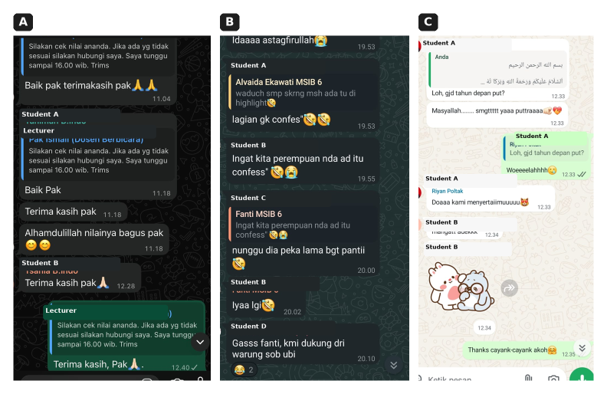
Published
How to Cite
Issue
Section
License
Copyright (c) 2026 Devinna Riskiana Aritonang, Eli Marlina Harahap, Nur Afifah, Kurrota Akyun Siregar, Nikmah Sari Hasibuan, Rofiah Rofiah

This work is licensed under a Creative Commons Attribution-ShareAlike 4.0 International License.







 All publications by the CV. Bimbingan Belajar Assyfa [e-ISSN: