Mirroring Integrity: Deconstructing The Role of Teachers as Moral Architects in Social Learning Ecosystems
Authors
-
Yuwita Rianawati
 Universitas Negeri Yogyakarta, Indonesia
[email protected]
Universitas Negeri Yogyakarta, Indonesia
[email protected]
-
Siti Irene Astuti Dwiningrum
Universitas Negeri Yogyakarta, Indonesia
[email protected]
DOI:
https://doi.org/10.61650/alj.v4i1.1054Keywords:
Social Learning Theory Albert Bandura Character Education Moral ModelingAbstract
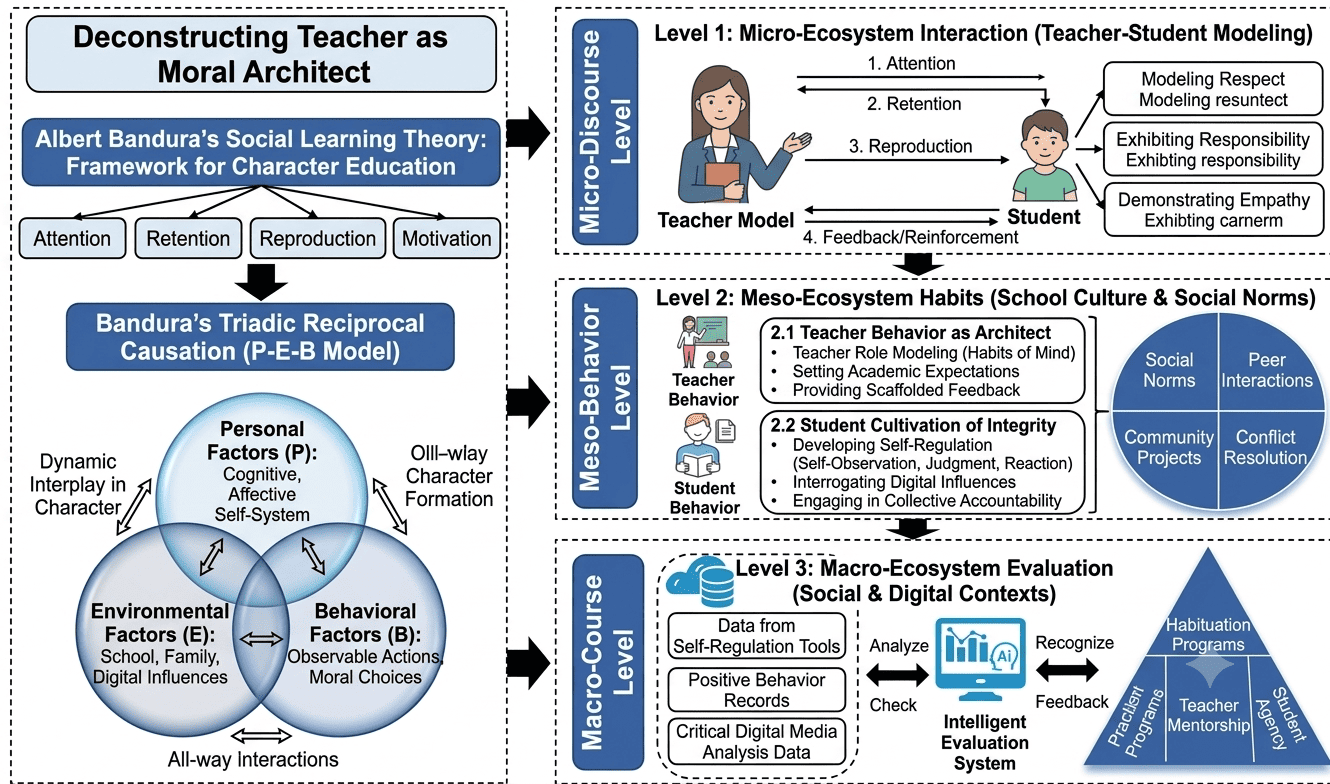
Student character development faces ongoing challenges, such as low discipline, diminishing academic responsibility, and increasing exposure to negative social and digital media influences. This study aims to analyze the influence of Albert Bandura’s Social Learning Theory on students’ character formation and explain its practical relevance to character education within school environments. Utilizing a library research design with a descriptive qualitative approach, data were gathered from books, scientific journals, and scholarly publications, followed by qualitative content analysis. The findings demonstrate that character development operates through observational learning, modeling, reinforcement, and self-regulation, driven by reciprocal interaction among personal, behavioral, and environmental factors. Specifically, observational learning progresses through attention, retention, reproduction, and motivation, emphasizing that teachers, positive school cultures, and digital media figures serve as primary behavioral models. In conclusion, Bandura’s theory offers a comprehensive theoretical framework for modern character education, highlighting that teacher role modeling, habituation programs, and the cultivation of student self-regulation are essential for fostering sustainable moral integrity across physical and digital social learning ecosystems.
Downloads
Alaoui, K. O., Daoudi, N., & Abourezq, M. (2025). Arabic Question Answering Systems Architectures: A Prisma-Based Systematic Literature Review. IAENG International Journal of Computer Science, 52(8), 2533–2556. https://www.scopus.com/pages/publications/105014019409?origin=resultslist
Allender, S., Cowburn, G., & Foster, C. (2006). Understanding participation in sport and physical activity among children and adults: A review of qualitative studies. Health Education Research, 21(6), 826–835. https://doi.org/10.1093/her/cyl063
Andry, D., Hasan, M., & Weldani, F. (2025a). Tren Global dan Prospek Game-Based Learning PJOK : Peningkatan Kompetensi Abad 21 Mendukung SDG 4 , 3 , dan 17 melalui Pendidikan Jasmani. In Internasional Conference on Games Based Learning (Vol. 1, Issue Icgbl, pp. 14–21). https://scholar.google.com/citations?view_op=view_citation&hl=en&user=9BgPsc8AAAAJ&pagesize=100&citation_for_view=9BgPsc8AAAAJ:hMod-77fHWUC
Andry, D., Hasan, M., & Weldani, F. (2025b). Tren Global dan Prospek Game-Based Learning PJOK : Peningkatan Kompetensi Abad 21 Mendukung SDG 4 , 3 , dan 17 melalui Pendidikan Jasmani. Internasional Conference on Games Based Learning, 1(Icgbl), 14–21.
Arifin, F., Priambodo, A. S., Nasuha, A., Winursito, A., & Gunawan, T. S. (2022). Development of Javanese Speech Emotion Database (Java-SED). Indonesian Journal of Electrical Engineering and Informatics, 10(3), 584 – 591. https://doi.org/10.52549/ijeei.v10i3.3888
Arifuddin, A., Zuchdi, D., Rosana, D., Arovah, N. I., Setiawan, C., Prihatni, Y., Setiawan, A., Nur, A. F., Dyastuti, N. E., & Arifuddin, H. (2023). Strengthening of early children’s character education stunting children in Indonesia. Journal of Education and Health Promotion, 12(1). https://doi.org/10.4103/jehp.jehp_1857_22
Bajno, D., Bednarz, Ł., & Grzybowska, A. (2021). The role and place of traditional chimney system solutions in environmental progress and in reducing energy consumption. Energies, 14(16). https://doi.org/10.3390/en14164720
Bani-Khaled, S., Azevedo, G., & Oliveira, J. (2025). Environmental, social, and governance (ESG) factors and firm value: A systematic literature review of theories and empirical evidence. AMS Review, 15(1–2), 228–260. https://doi.org/10.1007/s13162-025-00303-2
Baque, E., Barber, L., Sakzewski, L., Ware, R., & Boyd, R. N. (2017). Characteristics associated with physical activity capacity and performance in children and adolescents with an acquired brain injury. Brain Injury, 31(5), 667–673. https://doi.org/10.1080/02699052.2017.1291990
Barnett, L. M., Stodden, D., Cohen, K. E., Smith, J. J., Lubans, D. R., Lenoir, M., Iivonen, S., Miller, A. D., Laukkanen, A., Dudley, D., Lander, N. J., Brown, H., & Morgan, P. J. (2016). Fundamental movement skills: An important focus. Journal of Teaching in Physical Education, 35(3), 219–225. https://doi.org/10.1123/jtpe.2014-0209
Battraw, M. A., Young, P. R., Welner, M. E., Joiner, W. M., & Schofield, J. S. (2022). Characterizing Pediatric Hand Grasps During Activities of Daily Living to Inform Robotic Rehabilitation and Assistive Technologies. IEEE International Conference on Rehabilitation Robotics, 2022-July. https://doi.org/10.1109/ICORR55369.2022.9896512
Bellini, P., Bologna, D., Fanfani, M., Ipsaro Palesi, L. A., Nesi, P., & Pantaleo, G. (2023). Rapid Prototyping & Development Life Cycle for Smart Applications of Internet of Entities. Proceedings of the IEEE International Conference on Engineering of Complex Computer Systems, ICECCS, 142–151. https://doi.org/10.1109/ICECCS59891.2023.00026
Brecklin, L. R. (2004). Self-Defense/Assertiveness Training, Women’s Victimization History, and Psychological Characteristics. Violence Against Women, 10(5), 479–497. https://doi.org/10.1177/1077801204264296
Burton, E., Cavalheri, V., Adams, R., Browne, C. O., Bovery-Spencer, P., Fenton, A. M., Campbell, B. W., & Hill, K. D. (2015). Effectiveness of exercise programs to reduce falls in older people with dementia living in the community: A systematic review and meta-analysis. Clinical Interventions in Aging, 10, 421–434. https://doi.org/10.2147/CIA.S71691
de Melo, M. E. S., de Arimátea Rocha, E., de Lima, V. M. E., & Silva, F. A. N. (2026). Diagnostic and characterization techniques for historic masonries with rising damp: a systematic literature review. Journal of Building Pathology and Rehabilitation, 11(2). https://doi.org/10.1007/s41024-026-00788-9
Diaz, C. I. E., Maroto, G. A., Barrionuevo, M. C., Moya, J. E., Acosta, J. S., Procel, A. A., Pérez, J. R., & Jaya, A. C. A. (2019). Prevalence, risk factors and clinical characteristics of infantile cerebral palsy. Archivos Venezolanos de Farmacologia y Terapeutica, 38(6), 778–789. https://www.scopus.com/pages/publications/85079056007?origin=resultslist
Dori, N. (2020). Ridiculing the Female Characters in Israeli Hebrew Children’s Literature From a Gender Oriented Stereotype to a Feminist Protest. Studies in Media and Communication, 8(1), 50–60. https://doi.org/10.11114/smc.v8i1.4844
Dosa, N. P., Eckrich, M., Katz, D. A., Turk, M., & Liptak, G. S. (2007). Incidence, prevalence, and characteristics of fractures in children, adolescents, and adults with spina bifida. Journal of Spinal Cord Medicine, 30(SUPPL. 1), S5–S9. https://doi.org/10.1080/10790268.2007.11753961
Elalaoui, O., Abdennaji, T. S., Alanazi, A. O., Fatnassi, A., Tipu, R. K., & Pandya, K. S. (2026). A Systematic and Critical Review of Ensemble, Hybrid, and Stacked Learning Models for Predicting the Compressive Strength of Cement-Based Mortars. Archives of Computational Methods in Engineering. https://doi.org/10.1007/s11831-026-10662-z
Ertmer, P. A., & Glazewski, K. D. (2006). Scaffolding Teachers’ Efforts to Implement Problem-Based Learning. The International Journal of Learning: Annual Review, 12(4), 319–328. https://doi.org/10.18848/1447-9494/cgp/v12i04/46447
Esquivel, C. D., Agular, L. R. R., & Navarrete, P. A. (2026). TEA-MARK: Gamified Virtual Reality Platform for Learning Shopping Skills in Children With ASD. In Advancing Accessibility Through Software Development for Disability and Neurodivergence (pp. 249–291). https://doi.org/10.4018/979-8-3373-6033-1.ch007
Faber, T. J. E., Dankbaar, M. E. W., van den Broek, W. W., Bruinink, L. J., Hogeveen, M., & van Merriënboer, J. J. G. (2024). Effects of adaptive scaffolding on performance, cognitive load and engagement in game-based learning: a randomized controlled trial. BMC Medical Education, 24(1). https://doi.org/10.1186/s12909-024-05698-3
Faust, S. N., Haynes, R., Jones, C. E., Staplin, N., Whittaker, E., Jaki, T., Juszczak, E., Spata, E., Wan, M., Bamford, A., Dimitri, P., Finn, A., Furness, J., Ramanan, A. V, Gale, C., Cathie, K., Drysdale, S., Bernatoniene, J., Murray, C., … Zuriaga-Alvaro, A. (2024). Immunomodulatory therapy in children with paediatric inflammatory multisystem syndrome temporally associated with SARS-CoV-2 (PIMS-TS, MIS-C; RECOVERY): a randomised, controlled, open-label, platform trial. The Lancet Child and Adolescent Health, 8(3), 190 – 200. https://doi.org/10.1016/S2352-4642(23)00316-4
Fudholi, D. H., Zahra, A., Rani, S., Huda, S. N., Paputungan, I. V., & Zukhri, Z. (2023). BERT-based tourism named entity recognition: making use of social media for travel recommendations. PeerJ Computer Science, 9. https://doi.org/10.7717/PEERJ-CS.1731
Gappa, M., & Gerstlauer, M. (2018). Severe asthma—Characteristics in children and adolescents. Pneumologe, 15(3), 154–163. https://doi.org/10.1007/s10405-018-0172-z
Gaser, D., Peters, C., Götte, M., Oberhoffer-Fritz, R., Feuchtinger, T., Schmid, I., von Luettichau, I., & Kesting, S. (2022). Analysis of self-reported activities of daily living, motor performance and physical activity among children and adolescents with cancer: Baseline data from a randomised controlled trial assessed shortly after diagnosis of leukaemia or non-Hodgkin lymphom. European Journal of Cancer Care, 31(2). https://doi.org/10.1111/ecc.13559
Geier, G., Ebner, M., & Burgsteiner, H. (2025). Empowering Self-Regulated Learning Through Technology and the Teacher’s Role – A Systematic Literature Review. Lecture Notes in Computer Science, 15807 LNCS, 61–76. https://doi.org/10.1007/978-3-031-93567-1_5
Gorski, K., Harbold, K., Haverstick, K., Schultz, E., Shealy, S. E., & Krisa, L. (2016). Locomotor training in the pediatric spinal cord injury population: A systematic review of the literature. Topics in Spinal Cord Injury Rehabilitation, 22(2), 135–148. https://doi.org/10.1310/sci2202-135
Greening, T. (1998). Scaffolding for Success in Problem-Based Learning. Medical Education Online, 3(1), 4297. https://doi.org/10.3402/meo.v3i.4297
Grogan, C. (2023). ELIZABETH HAMILTON: Moral Philosophy and Early Childhood Education. In The Oxford Handbook of American and British Women Philosophers in the Nineteenth Century (pp. 29–45). https://doi.org/10.1093/oxfordhb/9780197558898.013.3
Haryono, M., Danim, S., Putra, D. A., & Pura, D. N. (2023). Early Childhood Character Education During Covid-19 Pandemic. AIP Conference Proceedings, 2736(1). https://doi.org/10.1063/5.0174486
Hasdiana, U. (2020). Dimensi Pembelajaran Pendidikan Jasmani dan Olahraga. Fakultas Ilmu Pendidikan, 11(1), 1–5. http://link.springer.com/10.1007/978-3-319-59379-1%0Ahttp://dx.doi.org/10.1016/B978-0-12-420070-8.00002-7%0Ahttp://dx.doi.org/10.1016/j.ab.2015.03.024%0Ahttps://doi.org/10.1080/07352689.2018.1441103%0Ahttp://www.chile.bmw-motorrad.cl/sync/showroom/lam/es/
Horibe, K. (2017). Characteristics of adolescent and young adult cancer. Japanese Journal of Cancer and Chemotherapy, 44(1), 7–11. https://www.scopus.com/pages/publications/85015788248?origin=resultslist
Hrebinko, K. A., Strotmeyer, S., Richardson, W., Gaines, B. A., & Leeper, C. M. (2022). Sex dimorphisms in coagulation characteristics in the pediatric trauma population appear after puberty. Journal of Trauma and Acute Care Surgery, 92(4), 675–682. https://doi.org/10.1097/TA.0000000000003508
Ibinaiye, T., Rotimi, K., Balogun, A., Aidenagbon, A., Oguoma, C., Baker, K., Ogunmola, O., Oresanya, O., Rassi, C., & Nnaji, C. (2024). Urban–rural differences in seasonal malaria chemoprevention coverage and characteristics of target populations in nine states of Nigeria: a comparative cross-sectional study. Malaria Journal, 23(1). https://doi.org/10.1186/s12936-023-04825-7
Jaedun, A., & Manaf, A. (2020). Dimensions of early childhood character education based on multicultural and community local wisdom. International Journal of Instruction, 13(2), 365–380. https://doi.org/10.29333/iji.2020.13225a
Jat, A. S., Grønli, T.-M., Ghinea, G., & Assres, G. (2024). Evolving Software Architecture Design in Telemedicine: A PRISMA-based Systematic Review. Healthcare Informatics Research, 30(3), 184–193. https://doi.org/10.4258/hir.2024.30.3.184
Ji, S., Pan, S., Cambria, E., Marttinen, P., & Yu, P. S. (2022). A Survey on Knowledge Graphs: Representation, Acquisition, and Applications. IEEE Transactions on Neural Networks and Learning Systems, 33(2), 494–514. https://doi.org/10.1109/TNNLS.2021.3070843
Kepley, H. O., & Ostrander, R. (2007). Family characteristics of anxious ADHD children: Preliminary results. Journal of Attention Disorders, 10(3), 317–323. https://doi.org/10.1177/1087054706288102
Khalid Hassan, S., & Al-Alwan, H. A. S. (2025). Impact of Biophilic and Technological Approaches on Enhancing Kindergarten Architecture. IOP Conference Series: Earth and Environmental Science, 1545(1). https://doi.org/10.1088/1755-1315/1545/1/012096
Khudori, M., & Tuasikal, A. R. S. (2015). Implementasi Kurikulum 2013 Pada Mata Pelajaran Pendidikan Jasmani, Olahraga, dan Kesehatan (PJOK) Di Sma Negeri se-Kabupaten Jombang. In Jurnal Pendidikan Olahraga dan Kesehatan (Vol. 3, Issue 1, pp. 211–214). core.ac.uk. https://ejournal.unesa.ac.id/index.php/jurnal-pendidikan-jasmani/article/view/13514
Kim, M. S., & Sohn, S. K. (2019). Emotional intelligence, problem solving ability, self efficacy, and clinical performance among nursing students: A structural equation model. Korean Journal of Adult Nursing, 31(4), 380–388. https://doi.org/10.7475/kjan.2019.31.4.380
Kim, N. J., Belland, B. R., & Axelrod, D. (2019). Scaffolding for optimal challenge in k–12 problem-based learning. Interdisciplinary Journal of Problem-Based Learning, 13(1). https://doi.org/10.7771/1541-5015.1712
Kim, S.-Y., & Youn, J.-J. (2016). A study on creative personality, justice-oriented morality and care-oriented morality in pre-service early childhood teachers. Indian Journal of Science and Technology, 9(40). https://doi.org/10.17485/ijst/2016/v9i40/103285
Korkmaz, C., & Correia, A. P. (2019). A review of research on machine learning in educational technology. Educational Media International, 56(3), 250–267. https://doi.org/10.1080/09523987.2019.1669875
Landschaft, A., Antweiler, D., Mackay, S., Kugler, S., Rüping, S., Wrobel, S., Höres, T., & Allende-Cid, H. (2024). Implementation and evaluation of an additional GPT-4-based reviewer in PRISMA-based medical systematic literature reviews. International Journal of Medical Informatics, 189. https://doi.org/10.1016/j.ijmedinf.2024.105531
León-Mejía, A. C., Gutiérrez-Ortega, M., Serrano-Pintado, I., & González-Cabrera, J. (2021). A systematic review on nomophobia prevalence: Surfacing results and standard guidelines for future research. PLoS ONE, 16(5 May). https://doi.org/10.1371/journal.pone.0250509
Lestari, G. D., Yulianingsih, W., & Tahir, M. (2024). The effect of character-charged maritime textbooks on increasing students’ character values. International Journal of Evaluation and Research in Education , 13(3), 1755–1765. https://doi.org/10.11591/ijere.v13i3.26008
Liqin, Z., & Xiao, H. (2017). Research on evaluation of early childhood education software. ICCSE 2017 - 12th International Conference on Computer Science and Education, 458–463. https://doi.org/10.1109/ICCSE.2017.8085536
Long, H., Bidin, R. B. H., Mustakim, S. S. B., Sharipudin, M.-N. S., Niu, L., & Liu, H. (2026). Continuance Intention of Users to Use E-Learning in Professional Qualification Certification: A PRISMA-based Systematic Literature Review. Pertanika Journal of Social Sciences and Humanities, 34(2), 569–597. https://doi.org/10.47836/pjssh.34.2.02
Maidana, S. A., Esteche, V. P., Hours, R. A., Brumovsky, L. A., & Martos, M. A. (2020). Use of Agro-Industrial Wastes for the Production of a Wild Yeast Enzyme with Disintegration Activity on Plant Tissues. Brazilian Archives of Biology and Technology, 63, 1–13. https://doi.org/10.1590/1678-4324-2020190515
Martínez-Heredia, A. M., & Ortiz, A. (2026). Kolmogorov–Arnold Networks for Sensor Data Processing: A Comprehensive Survey of Architectures, Applications, and Open Challenges. Sensors, 26(8). https://doi.org/10.3390/s26082515
Mas’odi, M., Darmayanti, R., Basri, M. H., Prasetyo, D. A., Weldani, F., Hidayatullah, S. H., & Dhakal, A. (2025). Landscape Kompetensi Calon Guru Pjok Di STKIP PGRI Sumenep Melalui Pelaksanaan Kegiatan Outbound Di Bumi Perkemahan Bedengan Batu. In Center of Education Journal (CEJou) (Vol. 6, Issue 1, pp. 9–20). https://doi.org/10.55757/cejou.v6i1.567
Merkelbach, I., Plak, R. D., Jong, M. T. S. de, & Rippe, R. C. A. (2022). Differential Efficacy of Digital Scaffolding of Numeracy Skills in Kindergartners With Mild Perinatal Aversities. Frontiers in Education, 7. https://doi.org/10.3389/feduc.2022.709809
Morales-Murillo, C. P., Pacheco-Molero, M., León-Estrada, I., Fernández-Valero, R., Ortega, M. G., & McWilliam, R. A. (2025). Measuring Home Activities and Participation of Children Receiving Early Childhood Intervention Services in Spain. Early Childhood Education Journal, 53(5), 1835–1850. https://doi.org/10.1007/s10643-024-01704-x
Morales Murillo, C. P., McWilliam, R. A., Grau Sevilla, M. D., & Grau, P. G. (2018). Internal Consistency and Factor Structure of the 3M Preschool Routines Functioning Scale. Infants and Young Children, 31(3), 246–257. https://doi.org/10.1097/IYC.0000000000000117
Mulyadi, B. (2020). Early childhood character education in japan. E3S Web of Conferences, 202. https://doi.org/10.1051/e3sconf/202020207063
Netshamutshedzi, N., Netshikweta, R., Ndogmo, J.-C., & Obagbuwa, I. C. (2025). A systematic review of the hybrid machine learning models for brain tumour segmentation and detection in medical images. Frontiers in Artificial Intelligence, 8. https://doi.org/10.3389/frai.2025.1615550
Niklas, F., Cohrssen, C., Vidmar, M., Segerer, R., Schmiedeler, S., Galpin, R., Klemm, V. V, Kandler, S., & Tayler, C. (2018). Early childhood professionals’ perceptions of children’s school readiness characteristics in six countries. International Journal of Educational Research, 90, 144–159. https://doi.org/10.1016/j.ijer.2018.06.001
Nugroho, M. A., Salma, A., Pradipa, A. R., & Putra, E. P. (2025). Exploring the Negative Effects of Gamification on Students: A PRISMA-Based Systematic Literature Review. International Conference on Computer and Applications, ICCA 2025 - Proceedings. https://doi.org/10.1109/ICCA66035.2025.11431021
O’Herlihy, A., Worrall, A., Lelliott, P., Jaffa, T., Mears, A., Banerjee, S., & Hill, P. (2004). Characteristics of the residents of in-patient child and adolescent mental health services in England and Wales. Clinical Child Psychology and Psychiatry, 9(4), 579–588. https://doi.org/10.1177/1359104504046161
Padmadewi, N. N., Artini, L. P., Ratminingsih, N. M., Suhardiana, I. P. A., Zamzam, A., & Juniarta, P. A. K. (2023). Designing Project-Based Learning in Research Proposal Writing: Its Effect, Problems, and Scaffolding Utilized. Studies in English Language and Education, 10(2), 841–862. https://doi.org/10.24815/siele.v10i2.27408
Pagani, L. S., Brière, F. N., & Janosz, M. (2017). Fluid reasoning skills at the high school transition predict subsequent dropout. Intelligence, 62, 48–53. https://doi.org/10.1016/j.intell.2017.02.006
Pamungkas, J., Suyuti, S. A., & Rohman, A. (2021). Character value that formed through learning the art of playing GACIL in early childhood. Cypriot Journal of Educational Sciences, 16(4), 1503–1516. https://doi.org/10.18844/cjes.v16i4.6004
Panadero, E. (2017). A review of self-regulated learning: Six models and four directions for research. Frontiers in Psychology, 8(APR). https://doi.org/10.3389/fpsyg.2017.00422
Pendo, K., Swisher, V. S., Leman, T. Y., Rissman, A. J., Peris, T. S., Piacentini, J., Snorrason, I., & Ricketts, E. J. (2024). Clinical Characteristics, Sleep, and Temperament in Infants and Young Children with Problematic Hair Pulling and Skin Picking. Cognitive Therapy and Research, 48(1), 119–136. https://doi.org/10.1007/s10608-023-10435-z
Perkins, M., Furze, L., Roe, J., & Macvaugh, J. (2024). The Artificial Intelligence Assessment Scale (AIAS): A Framework for Ethical Integration of Generative AI in Educational Assessment. Journal of University Teaching and Learning Practice, 21(6). https://doi.org/10.53761/q3azde36
Phillip, O., & Amone-P’Olak, K. (2019). The influence of self-reported childhood sexual abuse on psychological and behavioural risks in young adults at a university in Botswana. South African Journal of Psychology, 49(3), 353–363. https://doi.org/10.1177/0081246318801723
Prasetyo, D. A., Basri, M. H., & Mas’odi, M. (2025). Efektivitas Pembelajaran Berbasis Permainan dalam Pengembangan Keterampilan Motorik Pada Pendidikan PJOK. Jurnal Penelitian Tindakan Kelas, 2(3), 187–192. https://doi.org/10.61650/jptk.v2i3.762
Prasetyo, D. A., Basri, M. H., Mas’odi, M., Weldani, F., & Hidayatullah, S. H. (2025a). Analisis Kebutuhan Pengembangan Model Outbound dalam Mata Kuliah PJOK untuk Meningkatkan Keterampilan Motorik Calon Guru. In Center of Education Journal (CEJou) (Vol. 4, Issue 2, pp. 51–65). https://doi.org/10.55757/cejou.v4i2.484
Prasetyo, D. A., Basri, M. H., Mas’odi, M., Weldani, F., & Hidayatullah, S. H. (2025b). Analisis Kebutuhan Pengembangan Model Outbound dalam Mata Kuliah PJOK untuk Meningkatkan Keterampilan Motorik Calon Guru. Center of Education Journal (CEJou), 4(2), 51–65. https://doi.org/10.55757/cejou.v4i2.484
Rahman, M. H., Bin Amin, M., Yusof, M. F., Islam, M. A., & Afrin, S. (2024). Influence of teachers’ emotional intelligence on students’ motivation for academic learning: an empirical study on university students of Bangladesh. Cogent Education, 11(1). https://doi.org/10.1080/2331186X.2024.2327752
Raymond, T. (2026). Embodying oppression: applying an intersectional lens to character structures. Body, Movement and Dance in Psychotherapy, 21(1), 28–44. https://doi.org/10.1080/17432979.2025.2557940
Rejokirono, R., Supriadi, D., Maryono, M., & Nurwindah, H. (2025). Management of early childhood leadership character education through Leadership Soul for Kids program. Acta Scientiarum - Education, 47(1). https://doi.org/10.4025/actascieduc.v47i1.71157
Safranoff, A. (2017). Psychological violence against women: What factors increase the risk of this kind of intimate partner abuse? Salud Colectiva, 13(4), 611–632. https://doi.org/10.18294/sc.2017.1145
Saihu, Aziz, A., Mubin, F., & Sarnoto, A. Z. (2020). Design of Islamic Education Based on Local Wisdom. In International Journal of Advanced Science and Technology (Vol. 29, Issue 6). researchgate.net. https://www.researchgate.net/profile/Made-Saihu/publication/348379284_DESIGN_OF_ISLAMIC_EDUCATION_BASED_ON_LOCAL_WISDOM_An_analysis_of_Social_Learning_Theories_in_Forming_Character_through_Ngejot_Tradition_in_Bali/links/5ffbaa2b92851c13fe02ea43/DESIGN-OF-
Salasiah, Rahmadi, & Irianto, T. (2020). Instrumen Penilaian Harian Aspek Kognitif Pendidikan Jasmani Olahraga Dan Kesehatan. Stabilitas: Jurnal Pendidikan Jasmani Dan Olahraga, 1(1), 25–31. http://103.81.100.242/index.php/mpj/article/view/485
Sanders, M. R., Morrison, M., Rebgetz, M., Bor, W., Dadds, M., & Shepherd, R. (1990). Behavioural Treatment of Childhood Recurrent Abdominal Pain: Relationships Between Pain, Children’s Psychological Characteristics and Family Functioning. Behaviour Change, 7(1), 16–24. https://doi.org/10.1017/S0813483900007373
Saracho, O. N. (1991). Students’ Preference for Field Dependence-Independence Teacher Characteristics. Educational Psychology, 11(3–4), 323–332. https://doi.org/10.1080/0144341910110308
Scherf, K. S., Griffin, J. W., Judy, B., Whyte, E. M., Geier, C. F., Elbich, D., & Smyth, J. M. (2018). Improving sensitivity to eye gaze cues in autism using serious game technology: Study protocol for a phase i randomised controlled trial. BMJ Open, 8(9). https://doi.org/10.1136/bmjopen-2018-023682
Scifo, L., Fulantelli, G., & Vivas, A. J. (2025). Special Educational Needs in Preschools: Types, Characteristics, and Needed Adaptations. In Physical Education in Early Childhood: Movement and Development from 3 to 6 Years (pp. 359–372). https://doi.org/10.4324/9781003615675-25
Selvin, S. (2004). Cytochrome P450 1A1 polymorphism and childhood leukemia: An analysis of matched pairs case-control genotype data. Cancer Epidemiology Biomarkers and Prevention, 13(8), 1371–1374. https://doi.org/10.1158/1055-9965.1371.13.8
Setiawati, A. S. (2020). Character value in japanese early childhood formed through hajimete no osaka (first errand). International Journal of Innovation, Creativity and Change, 4, 516–527. https://www.scopus.com/pages/publications/85081281973?origin=resultslist
Shin, D. J. D., Lee, M., Ha, J. E., Park, J. H., Ahn, H. S., Son, E., Chung, Y., & Bong, M. (2019). Science for all: Boosting the science motivation of elementary school students with utility value intervention. Learning and Instruction, 60, 104–116. https://doi.org/10.1016/j.learninstruc.2018.12.003
Shin, Y.-J., & Kang, E. (2026). From Tool-Based Training to Integrated Studios: A Review of BIM Education in Architecture. Buildings, 16(1). https://doi.org/10.3390/buildings16010166
Silseth, K. (2018). Students’ everyday knowledge and experiences as resources in educational dialogues. Instructional Science, 46(2), 291–313. https://doi.org/10.1007/s11251-017-9429-x
Sun, X., Lu, Z.-M., He, Z., Lu, Z., & Luo, H. (2023). Reasoning in Different Directions: Triplet Learning for Scene Graph Generation. IEEE Access, 11, 103069 – 103078. https://doi.org/10.1109/ACCESS.2023.3310544
Taylor, M., Hodges, S. D., & Kohányi, A. (2003). The Illusion of Independent Agency: Do Adult Fiction Writers Experience Their Characters as Having Minds of Their Own? Imagination, Cognition and Personality, 22(4), 361–380. https://doi.org/10.2190/FTG3-Q9T0-7U26-5Q5X
Valdivia, J., Mauricio, D., & Guzman-Jimenez, R. (2026). Generative Artificial Intelligence for Software Development Using ISO/IEC 29110 Basic Profile: Gaps and Opportunities. IEEE Access, 14, 31358–31377. https://doi.org/10.1109/ACCESS.2026.3659713
Whiteman, M. (1976). Children’s Conceptions of Psychological Causality as Related to Subjective Responsibility, Conservation, and Language. Journal of Genetic Psychology, 128(2), 215–226. https://doi.org/10.1080/00221325.1976.10533991
Widl, E., Sporr, A., Mairhofer, M., Natiesta, T., Marx, N., & Schmidt, R. R. (2022). Prototype of an open testbed for the lab validation of smart applications of district heating substations. 2022 10th Workshop on Modelling and Simulation of Cyber-Physical Energy Systems, MSCPES 2022. https://doi.org/10.1109/MSCPES55116.2022.9770173
Wu, K. C., Su, Y., Chu, F., Chen, A. T., & Zaslavsky, O. (2022). Behavioral Change Factors and Retention in Web-Based Interventions for Informal Caregivers of People Living With Dementia: Scoping Review. Journal of Medical Internet Research, 24(7). https://doi.org/10.2196/38595
Zhang, X., Cao, D., Wang, M., Cui, G., Shi, Y., & Cui, Y. (2022). NUTRIENT DEFICIENCY DIAGNOSIS IN WHOLE HYDROPONIC LETTUCE BASED ON RANDOM FOREST; [基于随机森林算法的整株水培生菜缺素诊断]. INMATEH - Agricultural Engineering, 68(3), 81 – 90. https://doi.org/10.35633/inmateh-68-08
Zimmerman, B. J., & Ringle, J. (1981). Effects of model persistence and statements of confidence on children’s self-efficacy and problem solving. Journal of Educational Psychology, 73(4), 485–493. https://doi.org/10.1037/0022-0663.73.4.485
Published
How to Cite
Issue
Section
License
Copyright (c) 2026 Yuwita Rianawati, Siti Irene Astuti Dwiningrum

This work is licensed under a Creative Commons Attribution-ShareAlike 4.0 International License.










 All publications by the CV. Bimbingan Belajar Assyfa [e-ISSN: