Teacher Strategies in Managing Gadget Use for Cognitive Development of Children Aged 5-6 Years
DOI:
https://doi.org/10.61650/ajme.v4i2.1298Keywords:
Teacher Strategy, Gadget Use, Cognitive Development, Early ChildhoodAbstract
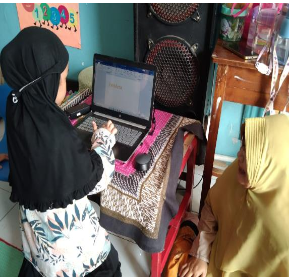
This study aims to examine teacher strategies in managing gadget use for cognitive development of children aged 5-6 years at TKIT Al-Faqih, Bekasi. The development of information technology has transformed the lifestyle of modern society, including young children who are now familiar with various gadget devices. Gadget use in early childhood has the potential for both positive and negative impacts on cognitive development, thus requiring appropriate management strategies from teachers. This research employs a qualitative descriptive method with data collection techniques through participatory observation, in-depth interviews, and documentation. The research subjects included classroom teachers and the school principal as informants. The findings reveal that teacher strategies include planning gadget use aligned with learning objectives, selecting age-appropriate educational applications, limiting usage duration, providing active supervision during activities, and balancing with physical play activities and social interaction. The school has policies supporting wise use of gadgets as alternative learning media. Positive impacts observed include improved memory, concentration, problem-solving abilities, logical thinking, and recognition of letters, numbers, colors, and shapes. This research provides significant contributions to the development of early childhood education in the digital era.
Downloads
References
Baikulova, A., Akimbekova, S., Kerimbayeva, R. K., Arzymbetova, S., & Moldagali, B. (2024). Leveraging digital interactive didactic games to enhance cognitive development in preschool education. E-learning and Digital Media.
Chae, D., & Kim, Y. (2025). The effects of digital block play on children's mathematical problem-solving ability and flow: A collaborative action research approach. Asia-Pacific Journal of Research in Early Childhood Education, 19(2), 103. https://doi.org/10.17206/apjrece.2025.19.2.103
Christiyanti, F. S., Rufi'i, R., & Rachmadtullah, R. (2025). The Effect of The Use of Wordwall and Canva Learning Media and Learning Motivation on The Cognitive Development of 5-6 Year-Old Children at Dharma Wanita Pugeran Kindergarten.
Dong, H. Y., Wang, L. L., Bai, M. S., Du, L., & Yue, X. J. (2025). Screen time is a predictor of cognitive function in children with attention deficit hyperactivity disorder. Pediatric Research. https://doi.org/10.1038/s41390-025-04026-9
Fatimah, S. (2022). Upaya Guru Kelas Dalam Menanamkan Nilai-Nilai Karakter Pada Siswa Kelas 1 SDN Pehkulon Papar Kediri. Skripsi S1. IAIN Kediri.
Gastaud, L. M., et al. (2023). Screen time: Implications for early childhood cognitive development. Early Human Development, 183, 105792. https://doi.org/10.1016/j.earlhumdev.2023.105792
Grieshaber, S., Caughey, J., Highfield, K., & Donahoo, D. (2025). Changing everyday pedagogical practices with digital technologies.
Hanik, S. U., Kurniawan, N., & Barata, M. A. S. (2025). Keamanan Digital Untuk Anak Usia Dini.
Jannah, H. N., Mariyana, R., & Hadi, M. S. (2025). Teachers' Challenges in ICT Integration for Early Childhood Education: A Systematic Literature Review. Aulad, 9(1). https://doi.org/10.31004/aulad.v9i1.1500
Kara, E., & Çağıltay, K. (2023). Designing for executive functions: exploring design issues and preschool-aged children's characteristics through digital games. International Journal of Human-Computer Interaction. https://dx.doi.org/10.1080/10447318.2023.2279403
Khoiriyah, K. (2025). The role of information technology in education: Perspectives of early childhood teachers in Indonesia. Multidisciplinary Science Journal, 8(3), 1-11. https://doi.org/10.31893/multiscience.2026181
Khulduniah, A., et al. (2025). Dampak Positif dan Negatif Gadget pada Perkembangan Anak Usia Dini.
Lakicevic, N., et al. (2025). Screen time exposure and executive functions in preschool children. Scientific Reports, 15, 1839. https://doi.org/10.1038/s41598-024-79290-6
Liu, W., & Yang, F. (2024). The Effect of Tablet App on Preschoolers' Symbolic Number Abilities Development: Based on Activity Theory. International Journal of Human-Computer Interaction, 40(22), 7610-7622. https://doi.org/10.1080/10447318.2023.2266794
Liza, M. M., Iktidar, M. A., Roy, S., et al. (2023). Gadget addiction among school-going children and its association to cognitive function: a cross-sectional survey from Bangladesh. BMJ Paediatrics Open, 7(1), e001759. https://doi.org/10.1136/bmjpo-2022-001759
Mera Cantillo, C., & Aragón Mendizábal, E. (2025). The Impact of Educational Apps on Trajectories of Early Mathematical Thinking. Electronic Journal of Research in Educational Psychology, 23(65). https://doi.org/10.25115/ejrep.v23i65.9868
Mortimer, A., Fiske, A., Biggs, B., Bedford, R., & Hendry, A. (2024). Concurrent and longitudinal associations between touchscreen use and executive functions at preschool-age. Frontiers in Developmental Psychology, 2. https://doi.org/10.3389/fdpys.2024.1422635
Ngalimun. (2016). Strategi Pembelajaran. Yogyakarta: Parama Ilmu.
No, B. (2025). Profiles of technology-rich learning activities for early literacy and teachers' roles in Korea.
Özel, Ö., & Ersoy, B. (2024). Examining the effect of technology integration on behavior management in preschool period. Pedagogical Perspective. https://doi.org/10.29329/pedper.2024.50
Portugal, A. M., Hendry, A., Smith, T., & Bedford, R. (2023). Do pre-schoolers with high touchscreen use show executive function differences? Computers in Human Behavior. https://doi.org/10.1016/j.chb.2022.107553
Rahmi, I. (2025). Strategi Guru Dalam Memanfaatkan Teknologi Informasi Dan Komunikasi Pembelajaran Anak Usia 5-6 Tahun di TK Negeri 2 Yogyakarta. Skripsi. UIN Sunan Kalijaga.
Rawanita, M., & Mardhiah, A. (2024). Strategi Orangtua dalam Mengelola Penggunaan Gadget Anak Usia Dini di Gampong Tanjung Deiah Darussalam.
Restiawan, T. (2025). Strategi Guru Adaptif dalam Mengelola Gadget di Era Digital.
Rizzo, R., Fusto, G., Marino, S., Castagnola, I., Parano, C., & ... (2025). Molecular and Neurobiological Imbalance from the Use of Technological Devices During Early Child Development Stages. Children, 12(7), 909. https://doi.org/10.3390/children12070909
Studhalter, U. T., Jossen, P., Seeli, M., & Tettenborn, A. (2025). Tablet Computers in Early Science Education: Enriching Teacher-Child Interactions. Early Childhood Education Journal, 53(7). https://doi.org/10.1007/s10643-024-01766-x
Sugiyono. (2024). Metode Penelitian Kuantitatif, Kualitatif, dan R&D. Bandung: Alfabeta.
Syafrida, R. (2025). Between Screens and Supervision: A Systematic Review of Parental and Teacher Roles in Managing Technology Use in Early Childhood.
Syaharani, F. P., & Afrianingsih, A. (2025). Penggunaan Media Pembelajaran Game Digital Puzzle Sebagai Upaya Peningkatan Kemampuan Kognitif Anak Usia 5-6 Tahun. CJPE: Cokroaminoto Journal of Primary Education, 8(4).
Tamsil, H. A. (2021). Permasalahan Penggunaan Gadget Pada Tumbuh Kembang Anak Usia Dini di Masa Pandemi COVID-19. Jendela PLS, 6(1), 44-49. https://doi.org/10.37058/jpls.v6i1.3140
Tan, S. (2025). Application of Art-Based Knowledge Management in Preschool Education: Promoting Children's Cognitive Development and Knowledge Creation.
Wang, C. M., Lee, B. T., & Lo, T. Y. (2023). The Design of a Novel Digital Puzzle Gaming System for Young Children's Learning by Interactive Multi-Sensing and Tangible User Interfacing Techniques. Sustainability, 15(4), 3036. https://doi.org/10.3390/su15043036
Winarsih, & Ismail. (2025). Implementasi Pemanfaatan Gadget dalam Proses Pembelajaran Anak Usia Dini. Jurnal PAUD: Kajian Teori dan Praktik Pendidikan Anak Usia Dini, 7(2), 57-66.
YBKB (Yayasan Bangun Kecerdasan Bangsa). (2023). Peran Guru dalam Pembelajaran di Era Digital. https://www.ybkb.or.id
Zeng, S. A. (2025). Dialogues in play: conversational AI and early mathematical thinking. Education Sciences, 15(11), 1516. https://doi.org/10.3390/educsci15111516
Published
How to Cite
Issue
Section
License
Copyright (c) 2026 Pidiyawati Pidiyawati, Roza Yenita, Ajeng Priendarningtyas

This work is licensed under a Creative Commons Attribution-ShareAlike 4.0 International License.