Learning Mahārah Kitābah in the Digital Era: Students’ Experiences and Challenges in Using Digital Technologies
DOI:
https://doi.org/10.61650/ajme.v3i2.1277Keywords:
Mahārah Kitābah, Arabic Writing, Digital Technologies, Student Experiences, Digital LiteracyAbstract
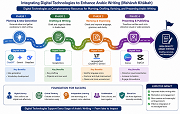
The rapid advancement of digital technology has transformed the learning of Arabic writing skills (Mahārah Kitābah) in higher education, creating new opportunities as well as challenges for students. This study aims to explore students’ experiences and challenges in learning Mahārah Kitābah through the use of digital technologies at Universitas Ma’arif Lampung. Employing a descriptive qualitative approach, the study involved ten students from the Arabic Language Education Program as research participants. Data were collected through semi-structured interviews, classroom observations, and documentation and were analyzed through data reduction, data display, and conclusion drawing. The findings indicate that students utilized various digital platforms and artificial intelligence-based applications, including Google Docs, Canva, CapCut, ChatGPT, Gemini, DeepSeek, and LanguageTool, to support different stages of the writing process. These technologies assisted students in generating ideas, organizing texts, revising language, developing digital writing products, and presenting their work in more engaging formats. However, students experienced several challenges, particularly in transferring ideas from Indonesian into Arabic, constructing grammatically accurate sentences, and selecting appropriate Arabic vocabulary. The findings also reveal that limited digital literacy and insufficient experience in utilizing educational technologies hindered students from maximizing the potential of digital tools. In addition, limited creativity in developing writing content and digital products remained a significant challenge. Despite these challenges, digital technologies provided students with opportunities to engage in more flexible, interactive, and meaningful writing practices. The study concludes that the integration of digital technologies can enrich Mahārah Kitābah learning when supported by adequate digital literacy training, continuous pedagogical guidance, and learning activities that foster creativity, critical thinking, and independent learning.
Downloads
References
Al-Madani, M. S. H., Tampubolon, M. S., Mustofa, A., & Madina, M. G. (2023). The challenges of Maharah Kitabah of ICBB students in Yogyakarta. Amorti: Jurnal Studi Islam Interdisipliner, 2(3). https://doi.org/10.59944/amorti.v2i3.153 DOI: https://doi.org/10.59944/amorti.v2i3.153
Creswell, J. W., & Poth, C. N. (2018). Qualitative inquiry and research design: Choosing among five approaches (4th ed.). SAGE Publications.
García-Sánchez, S., et al. (2020). How does the pedagogical design of a technology-enhanced collaborative academic course promote digital literacies, self-regulation, and perceived learning of students? The Internet and Higher Education, 45, 100722. https://doi.org/10.1016/j.iheduc.2019.100722 DOI: https://doi.org/10.1016/j.iheduc.2019.100722
Hennink, M., Hutter, I., & Bailey, A. (2020). Qualitative research methods (2nd ed.). SAGE Publications. Buku ini secara khusus membahas perencanaan penelitian kualitatif, pengumpulan data, analisis, dan aspek rigor penelitian.
Kasneci, E., Sessler, K., Küchemann, S., Bannert, M., Dementieva, D., Fischer, F., Gasser, U., Groh, G., Günnemann, S., Hüllermeier, E., Krusche, S., Kutyniok, G., Michaeli, T., Nerdel, C., Pfeiffer, F., Poquet, O., Sailer, M., Schmidt, A., Seidel, T., ... Kasneci, G. (2023). ChatGPT for good? On opportunities and challenges of large language models for education. Learning and Individual Differences, 103, 102274. https://doi.org/10.1016/j.lindif.2023.102274 DOI: https://doi.org/10.1016/j.lindif.2023.102274
Miles, M. B., Huberman, A. M., & Saldaña, J. (2014). Qualitative data analysis: A methods sourcebook (3rd ed.). SAGE Publications.
Munawarah, M., & Zulkiflih, Z. (2020). Pembelajaran keterampilan menulis (Maharah al-Kitabah) dalam bahasa Arab. Loghat Arabi: Jurnal Bahasa Arab dan Pendidikan Bahasa Arab, 1(2), 22-34. https://doi.org/10.36915/la.v1i2.15 DOI: https://doi.org/10.36915/la.v1i2.15
Mufidah, N., Suryawati, D., Sa’adah, N., & Bin Tahir, S. Z. (2019). Learning Arabic writing skill based on digital products. Ijaz Arabi Journal of Arabic Learning, 2(2), 185–190. https://doi.org/10.18860/ijazarabi.v2i2.8395 DOI: https://doi.org/10.18860/ijazarabi.v2i2.8395
Sa’diyah, H. (2021). Peluang pembelajaran Maharah al-Kitabah berbantu media WhatsApp bagi mahasiswa di masa daring. Maharaat: Jurnal Pendidikan Bahasa Arab, 4(1), 1–16. https://doi.org/10.18196/mht.v4i1.12255 DOI: https://doi.org/10.18196/mht.v4i1.12255
Braun, V., & Clarke, V. (2021). Thematic analysis: A practical guide. SAGE Publications. DOI: https://doi.org/10.4135/9781036232078.n9
Supriyadi, T., Saptani, E., Rukmana, A., Alif, M. N., & Rahminawati, N. (2020). Students’ technological literacy to improve academic writing and publication quality. Universal Journal of Educational Research, 8(11B), 6022–6035. https://doi.org/10.13189/ujer.2020.082238 DOI: https://doi.org/10.13189/ujer.2020.082238
Yoon, S.-Y., Miszoglad, E., & Pierce, L. R. (2023). Evaluation of ChatGPT feedback on ELL writers’ coherence and cohesion. arXiv.
Qomariah, R. N., Awad, A., Fikri, S., & Lazreque, S. (2025). The role of ChatGPT in enhancing academic Arabic writing skills among students of Arabic Language Education. LISANIA: Journal of Arabic Education and Literature, 9(1), 152–173. https://doi.org/10.18326/lisania.v9i1.152-173 DOI: https://doi.org/10.18326/lisania.v9i1.152-173
Ravitch, S. M., & Carl, N. M. (2020). Qualitative research: Bridging the conceptual, theoretical, and methodological. SAGE Publications
Robbani, A. S., Atmantika, Z. H., & Bhavani, S. G. A. E. (2023). The Use of ChatGPT among Arabic Language and Literature Students: Opportunities and Challenges. Insyirah: Jurnal Ilmu Bahasa Arab Dan Studi Islam, 6(2), 203–215. https://doi.org/10.26555/insyirah.v6i2.9440 DOI: https://doi.org/10.26555/insyirah.v6i2.9440
Tlili, A., Shehata, B., Adarkwah, M. A., Bozkurt, A., Hickey, D. T., Huang, R., & Agyemang, B. (2023). What if the devil is my guardian angel: ChatGPT as a case study of using chatbots in education. Smart Learning Environments, 10, Article 15. https://doi.org/10.1186/s40561-023-00237-x DOI: https://doi.org/10.1186/s40561-023-00237-x
Zawacki-Richter, O., Marín, V. I., Bond, M., & Gouverneur, F. (2019). Systematic review of research on artificial intelligence applications in higher education—Where are the educators? International Journal of Educational Technology in Higher Education, 16, Article 39. https://doi.org/10.1186/s41239-019-0171-0 DOI: https://doi.org/10.1186/s41239-019-0171-0
Zhao, X., Cox, A., & Cai, L. (2024). ChatGPT and the digitisation of writing. Humanities and Social Sciences Communications, 11, Article 482.
https://doi.org/10.1057/s41599-024-02904-x DOI: https://doi.org/10.1057/s41599-024-02904-x
Published
How to Cite
Issue
Section
License
Copyright (c) 2026 Kholida Nur

This work is licensed under a Creative Commons Attribution-ShareAlike 4.0 International License.