The Nexus of Women's Education and Social Stability: A Case Study on Conflict Mitigation in Indonesia
DOI:
https://doi.org/10.61650/ajis.v3i2.787Keywords:
Women's Education, Social Stability, Conflict Mitigation, Women's Leadership, Positive PeaceAbstract
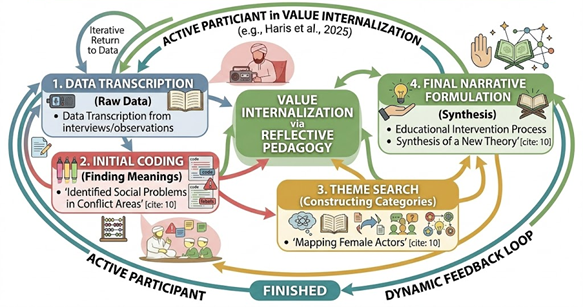
In today's era of globalization and digitalization, critical thinking skills, emotional intelligence, and social literacy are crucial competencies that students must possess to navigate complex societal dynamics. Integrative and humanistic peace education is seen as an effective, creative strategy for enhancing students' mediation and empathy skills in a multicultural environment. This research is motivated by the limited research on the substantive role of women in social stability, with most studies evaluating formal political participation without addressing the grassroots. This study evaluates the effectiveness of non-formal education in strengthening women's roles and its impact on community resilience in post-conflict areas in Indonesia, particularly on the development of cognitive and psychomotor skills in the negotiation process. The primary objective of the study is to analyze the causal relationship between women's education levels and the effectiveness of social conflict mitigation. The method used is a qualitative case study design, employing thematic analysis techniques and data collection through in-depth interviews and participant observation, supported by qualitative data analysis tools. The study's results demonstrate a significant positive impact on the conflict resolution capacity of educated women, with leadership training serving as a crucial scaffolding. However, it was found that formal higher education without integrating mediation values had no significant impact on the success of mitigation efforts in the field. In conclusion, strengthening women's education based on peace values has vital implications as a foundation for sustainable social stability in Indonesia.
Downloads
References
Alamoush, A. S. (2020). Environmental efficiency in port management. Marine Pollution Bulletin. https://doi.org/10.1016/j.marpolbul.2020.111452
Alamoush, A. S. (2020). Ports' technical and operational measures to reduce greenhouse gas emission and improve energy efficiency: A review. Marine Pollution Bulletin, 160, 111452. https://doi.org/10.1016/j.marpolbul.2020.111452
Azizah, L. (2022). Peran Majelis Taklim dalam Penguatan Pendidikan Karakter Ibu Rumah Tangga. Jurnal Pendidikan Islam, 7(1), 45–60.
Blau, I. (2020). How does the pedagogical design of a technology-enhanced collaborative academic course promote digital literacies, self-regulation, and perceived learning of students? Internet and Higher Education, 45, 100722. https://doi.org/10.1016/j.iheduc.2019.100722
Bowen, G. A. (2009). Document analysis as a qualitative research method. Qualitative Research Journal, 9(2), 27–40.
Braun, V., & Clarke, V. (2022). Thematic Analysis: A Practical Guide. SAGE.
Bunch, G. C. (2013). Pedagogical Language Knowledge: Preparing Mainstream Teachers for English Learners in the New Standards Era. Review of Research in Education, 37(1), 298-341.
Chowdhury, F. D. (2021). Women, peace and security: Education as a tool for sustainable conflict resolution. Routledge.
Chowdhury, F. D. (2023). Women, peace and security: Education as a tool for sustainable conflict resolution. Journal of Peacebuilding & Development, 18(2), 125–142. https://doi.org/10.1177/15423166231174567
Clifford, J. (1983). On Ethnographic Authority. Representations, 2, 118-146.
Cornwall, A. (2020a). Gender and development: Reimagining policy and practice. Zed Books. https://doi.org/10.5040/9781350220263
Creswell, J. W., & Poth, C. N. (2021). Qualitative inquiry and research design: Choosing among five approaches (4th ed.). Sage.
Crookes, G. V. (2015). Redrawing the Boundaries on Theory, Research, and Practice Concerning Language Teachers' Philosophies and Language Teacher Cognition. Modern Language Journal, 99(3), 485-499.
Dagar, V. (2021). Variations in technical efficiency of farmers with distinct land size across agro-climatic zones: Evidence from India. Journal of Cleaner Production, 315, 128109. https://doi.org/10.1016/j.jclepro.2021.128109
Danso-Abbeam, G. (2020). Do farm-level technical efficiency and welfare complement each other? Insight from Ghana’s cocoa industry. Journal of Economic Structures, 9(1), 1-18. https://doi.org/10.1186/s40008-020-00212-0
Darmayanti, R. (2022a). Digital comic learning media based on character values on students’ critical thinking in solving mathematical problems in terms of learning styles. Available at SSRN. https://doi.org/10.2139/ssrn.4231256
Darmayanti, R. (2022b). Digital Comic Based on Islamic Values. Applied Observation and Pedagogical Studies Poster.
Darmayanti, R. (2022c). Digital learning design in multicultural education. Available at SSRN.
Darmayanti, R., Inganah, S., & Rizqi, N. (2023). 6C Integration in 21st Century Mathematics Learning. JEMS.
Day, A. (2023). ISLAM AND LITERATURE IN SOUTH-EAST ASIA: Some pre-modem, mainly Javanese perspectives. Islam in South-East Asia, 130-159.
Denzin, N. K. (2017). The research act: A theoretical introduction to sociological methods. Routledge.
Dewi, L., Nuraini, F., & Rahmah, N. (2025). Pendidikan Perempuan dan Transformasi Sosial di Indonesia. Jurnal Pembangunan Dan Kesetaraan, 9(1), 1–18. https://doi.org/10.31002/jpk.v9i1.2025
Dewi, N. P., & Sari, R. K. (2023). Peran Perempuan dalam Mediasi Konflik Sosial di Perkotaan. Jurnal Ilmu Sosial Dan Politik Indonesia, 5(2), 145–158.
Engeness, I. (2021). Developing teachers’ digital identity: towards the pedagogic design principles of digital environments. European Journal of Teacher Education, 44(4), 541-561. https://doi.org/10.1080/02619768.2020.1834246
Fitriani, E. (2023). Gender-based conflict resolution training in rural Indonesia: Lessons for community empowerment. Indonesian Journal of Peace Studies, 5(1), 45–62.
Gabriel, C., & Grünke, J. (2026). Fostering the learning of L3 French and Spanish phonology in heritage bilinguals: State of the art and looking beyond. Isogloss, 12(2). https://doi.org/10.5565/rev/isogloss.525
Galtung, J. (2021). Peace by Peaceful Means. Routledge.
Hamdi, F. (2025). Integrating Maqashid al-Sharia, Fiqh al-Bi’ah, and Islamic Ethics for Sustainable Water Management: A Case Study of Indonesia. Al Ahkam Jurnal Ilmu Syari Ah Dan Hukum, 10(1), 1-19. https://doi.org/10.22515/alahkam.v10i1.11277
Harris, I., & Morrison, M. L. (2022). Peace education (4th ed.). McFarland.
Hidayati, N. (2022). Cross-cultural Dialogue in Urban Communities: The Role of Women in Building Tolerance. Journal of Social Science.
Hong, Y. (2025). EFL university students’ game element preferences and learning needs: Implications for the instructional design of digital gamified classes. System, 125, 103323. https://doi.org/10.1016/j.system.2024.103323
Inganah, S., Darmayanti, R., & Rizqi, N. (2023a). Problems, solutions, and expectations: 6C integration of 21st century education into learning mathematics. JEMS (Journal of Mathematics and Science Education), 11(1), 220-238. https://doi.org/10.25273/jems.v11i1.14471
Inganah, S., Darmayanti, R., & Rizqi, N. (2023b). Problems, solutions, and expectations: 6C integration of 21st century education. JEMS.
Irbathy, S. A., Mukminin, M. A., Yuldashev, A. A., & Ramdhan, T. W. (2025). Developing a religion tolerance-based character education framework for elementary school students. Al-Adzka, 15(1). https://doi.org/10.18592/al-adzka.v15i1.10423
Israel, M., & Hay, I. (2020). Research Ethics for Social Scientists. SAGE.
Kabeer, N. (1999). The power to choose: Bangladeshi women and decisions of work and life. Verso.
Karimah, R., & Susanti, L. (2022). Gender Inequality in Education and Regional Economic Growth in Indonesia. Jurnal Ekonomi Pembangunan, 20(1), 1–15.
Khakim, U. (2024). Formulating an Islamic Corporate Social Responsibility (I-CSR) Model: Integrating Maqāṣid Sharī‘ah and Iḥsān. Journal of Islamic Thought and Civilization, 14(1). https://doi.org/10.32350/jitc.141.22
Komnas Perempuan. (2022). National Report on Violence Against Women. Komnas Perempuan.
Lederach, J. P. (1997). Building Peace: Sustainable Reconciliation in Divided Societies. USIP Press.
Maji, S. G. (2021). Bank performance and intellectual capital in emerging markets. Journal of Advances in Management Research. https://doi.org/10.1108/JAMR-09-2020-0218
Maji, S. G. (2021). Technical efficiency, intellectual capital efficiency and bank performance in emerging markets: the case of India. Journal of Advances in Management Research, 18(5), 708-737. https://doi.org/10.1108/JAMR-09-2020-0218
Merriam, S. B., & Tisdell, E. J. (2016). Qualitative Research: A Guide to Design and Implementation. Jossey-Bass.
Mof, Y., Ramadan, W., & Mizani, H. (2026). Evaluating the Effectiveness of the Santripreneur Program in Islamic Boarding School: A CIPP-Based Qualitative Assessment of Screenprinting Training. Munaddhomah, 7(1), 141-156. https://doi.org/10.31538/munaddhomah.v6i4.2435
Mukhopadhyay, M. (2023). Gender, power and development: Revisiting approaches and strategies. Zubaan Books.
Mukminin, M. A. (2017). Seni Desain Grafis. Unpublished manuscript.
Mukminin, M. A. (2024b). Contextualization of Hadith Tarbawi in Modern Islamic Education. Gahwa.
Mukminin, M. A. (2025). Hafshah bint Umar ibn al-Khattab and the model of Muslimah education. Syaikhuna. https://doi.org/10.36835/syaikhuna.v16i1.7415
Mukminin, M. A., & Rhamadan, W. (2024). Kontekstualisasi hadis tarbawi tentang pengetahuan dan akhlak dalam pendidikan islam modern. Gahwa, 2(2), 62-79. https://doi.org/10.59059/gahwa.v2i2.173
Mukminin, M. A., Muzawwir, A., Sohib, M., Mukit, A., & Zahiroh, A. (2025). Revisiting the Legacy of Hafshah bint Umar ibn al-Khattab: Towards a Model of Contemporary Muslimah Education. Syaikhuna: Jurnal Pendidikan dan Pranata Islam, 16(1), 11-25. https://doi.org/10.36835/syaikhuna.v16i1.7415
Mukminin, M. A., Siri, A., & Sakdi, S. (2025). Model Pembelajaran Bagi Anak Yang Berhadapan Dengan Hukum Di Rutan Kelas I Bandung, Kebon Waru. Maslahat: Jurnal Pengabdian Kepada Masyarakat, 6(1), 11-15.
O’Reilly, M., Ó Súilleabháin, A., & Paffenholz, T. (2021). Inclusion of Women in Peace Processes. UN Women.
Patton, M. Q. (2015). Qualitative Research & Evaluation Methods. SAGE.
Puspitasari, L. (2022). Pelatihan Resolusi Konflik Berbasis Gender dan Dampaknya terhadap Partisipasi Perempuan. Jurnal Pemberdayaan Masyarakat, 4(3), 201–214. https://doi.org/10.22146/jpm.64532
Putri, A. D. (2024). Pendidikan Perdamaian dan Pemberdayaan Perempuan di Wilayah Perkotaan. Jurnal Pendidikan Kewarganegaraan Indonesia, 6(1), 23–35. https://doi.org/10.21831/jpki.v6i1.67823
Rahmawati, F., & Prasetyo, H. (2023). Dialog Lintas Budaya di Komunitas Perkotaan: Peran Perempuan dalam Membangun Toleransi. Jurnal Ilmu Sosial Dan Politik, 10(1), 55–72.
Ramadan, W. (2023). Digital Learning Design for Islamic Education. Unpublished manuscript.
Reardon, B., & Snauwaert, D. (2022a). Peace education: Theory and practice in a changing world. Springer. https://doi.org/10.1007/978-3-030-91680-0
Reardon, B., & Snauwaert, D. (2022b). Theories of Peace Education: Toward Critical, Transformative Practice. Routledge.
RI, B. L. dan D. K. A. (2019). Moderasi Beragama. Kementerian Agama RI.
Rubin, H. J., & Rubin, I. S. (2012). Qualitative Interviewing: The Art of Hearing Data (3rd ed.). SAGE.
Sari, A. P., & Lestari, R. (2022). Kepemimpinan Perempuan dalam Program Inklusif Komunitas Perkotaan. Jurnal Pembangunan Sosial, 5(3), 145–160.
Sihombing, U. (2023). Analisis kebutuhan pengembangan kompetensi pegawai negeri sipil. Jurnal Widyaiswara Indonesia, 4(1), 21–34. https://doi.org/10.52159/jwi.v4i1.234
Spradley, J. P. (2016). Participant Observation. Waveland Press.
Stake, R. E. (1995). The Art of Case Study Research. SAGE.
Suhartanto, D. (2020). Mobile banking adoption in Islamic banks: Integrating TAM model and religiosity-intention model. Journal of Islamic Marketing, 13(2), 381-409. https://doi.org/10.1108/JIMA-10-2018-0191
Suhartanto, D., & Usman, H. (2022). Technology acceptance model in Islamic marketing: Philanthropy context. Journal of Islamic Marketing.
Syamsuddin, A. (2021). Pendidikan Nonformal Islam: Majelis Taklim dan Dinamika Sosial. Remaja Rosdakarya.
Teemant, A. (2025). What Teachers Need to Know about Language. Lang. Teach. Res.
UNESCO. (2023). Global Education Monitoring Report: Gender and Digital Literacy. UNESCO Publishing.
UN Women. (2022). Women’s meaningful participation in peace negotiations. UN Women.
UNICEF. (2021). Poverty and Girls’ Education. UNICEF.
Usman, H. (2022). Integrating trust, religiosity and image into technology acceptance model: the case of the Islamic philanthropy in Indonesia. Journal of Islamic Marketing, 13(2), 381-409. https://doi.org/10.1108/JIMA-01-2020-0020
Usman, H., & Suhartanto, D. (2022). Technology acceptance model in Islamic marketing. Journal of Islamic Marketing.
Wheatley, M. J. (2006). Leadership and the new science. Berrett-Koehler Publishers.
White, K. (2013). The scent of ancient voices: Women’s wisdom in Islamic education. SUNY Press.
Widiastuti, S., Handayani, T., & Raharjo, D. (2024). Structural Barriers and Institutional Dynamics in Women’s Empowerment Programs. Asian Journal of Social Science Research, 13(2), 87–105. https://doi.org/10.1016/j.gds.2024.02.004
Wihlborg, E. (2023). Institutional Re-design for a Digital Era - Learning from Cases of Automation. Lecture Notes in Computer Science, 14153, 99-113. https://doi.org/10.1007/978-3-031-41617-0_7
Wink, J. (2000). Critical pedagogy: Notes from the real world. Longman.
World Bank. (2024). Gender and Peacebuilding Framework. World Bank.
Yaqin, A. (2005). Pendidikan multikultural: Cross-cultural understanding untuk demokrasi dan keadilan. Pilar Media.
Yasin, A. (2018). Redefining ta'dzim in modern education. Journal of Islamic Studies, 22(4), 112–125. https://doi.org/10.1093/jis/ety012
Yin, R. K. (2018). Case Study Research and Applications: Design and Methods. SAGE.
Yuliani, S., & Fitriyah, N. (2023). Strategi Komunikasi Perempuan dalam Resolusi Konflik Komunal. Jurnal Ilmu Komunikasi, 11(2), 112–125.
Yulianto, E., & Darmayanti, R. (2023). Solar panel technology in vocational training. Journal of Vocational Education, 11(2), 88–100. https://doi.org/10.21070/jvet.v6i2.145
Yusuf, M. (2014). Metode Penelitian Kuantitatif, Kualitatif & Penelitian Gabungan. Prenadamedia Group.
Published
How to Cite
Issue
Section
License
Copyright (c) 2025 Siti Mubayanah Tawabie, Raharjo Raharjo

This work is licensed under a Creative Commons Attribution-ShareAlike 4.0 International License.