Implementation of Islamic Values in Daily Life for Character and Behavior Formation
DOI:
https://doi.org/10.61650/ajis.v2i2.1010Keywords:
Character Formation, Student Behavior, Islamic Religious Education, Character Formation, ReligiousAbstract
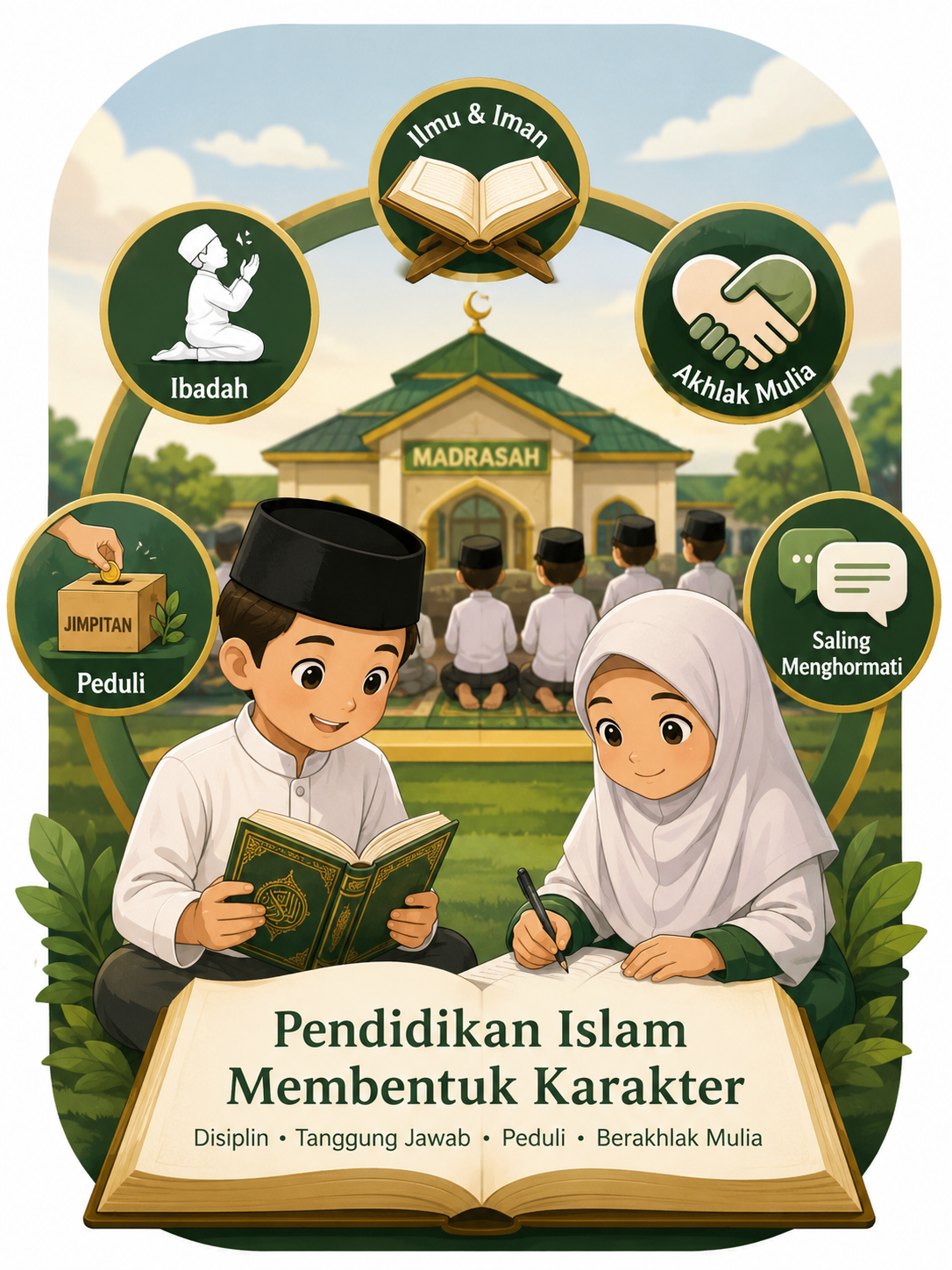
This research analyzes the implementation of Islamic values in shaping the disciplined character and responsible behavior of 3rd-grade students at Madrasah Salafiyah Ula Nashrus Sunnah, Madiun City. The moral crisis among the younger generation demonstrates the urgency of strong character education from an early age, with Islamic values serving as its foundation. This study employs a qualitative approach with a case study method, involving observation, interviews, and documentation of students, teachers, and the principal. The results show that the implementation of Islamic values through the habituation of morning dhikr, Dhuha prayer, congregational Dzuhur prayer, the jimpitan (alms) program, and greeting/salam practices significantly improves students' discipline and responsibility. Students become more obedient to rules, punctual, and demonstrate initiative in tasks and social care. Despite challenges such as consistency outside school and diverse family backgrounds, the findings confirm that Islam-based character education is effective in shaping individuals with high integrity and morality. Strong synergy between school and family, as well as teacher creativity, is needed for the sustainability of this program.
Downloads
References
Abdullah, S., & Nasution, S. N. (2019). Korelasi Praktik Keagamaan dengan Pembentukan Karakter Disiplin Siswa. Jurnal Pendidikan Islam.
Al-Attas, S. M. N. (1979). Aims and Objectives of Islamic Education. King Abdul Aziz University. Al-Ghazali, I. (1999). Ihya' Ulumiddin. Dar al-Fikr.
Al-Ghazali, I. (2004). Minhajul Abidin. Pustaka Azzam. Al-Qardhawi, Y. (1999). Fiqh Az-Zakat. Dar Al-Qalam.
An-Nawawi, I. (2000). Riyadhus Shalihin. Dar al-Kutub al-Ilmiyah. Bandura, A. (1977). Social Learning Theory. Prentice Hall.
Creswell, J. W. (2018). Research Design: Qualitative, Quantitative, and Mixed Methods Approaches (5th ed.). SAGE Publications.
Darmadi, H. (2018). Pengembangan Pendidikan Karakter di Sekolah. Alfabeta.
Fauzi, M., & Handayani, D. (2022). Peran Keluarga dan Sekolah dalam Membentuk Karakter Remaja. Jurnal Ilmu Pendidikan.
Hamid, A. (2015). Pengaruh Program Keagamaan terhadap Karakter Religius dan Disiplin Siswa. Jurnal Pendidikan Agama.
Harahap, S., & Lubis, A. S. (2018). Peran Pendidikan Agama Islam dalam Membentuk Karakter Siswa. Jurnal Studi Pendidikan Islam.
Ibnu Taimiyyah. (2005). Majmu' Fatawa. Dar al-Wafa.
Kartadinata, S. (2020). Bimbingan dan Konseling dalam Perspektif Islam. Rosda Karya.
Khoiriyah, A. (2019). Pembiasaan Salat Dhuha Berjamaah dan Peningkatan Tanggung Jawab Siswa. Jurnal Kependidikan Islam.
Kurniawan, B., & Sari, D. P. (2020). Fenomena Kenakalan Remaja dan Urgensi Pendidikan Karakter. Jurnal Psikologi Pendidikan.
Lickona, T. (1991). Educating for Character: How Our Schools Can Teach Respect and Responsibility. Bantam Books.
Mawardi, A., & Sukmawati, D. (2020). Efektivitas Implementasi Nilai-Nilai Islam dalam Peningkatan Kesadaran Spiritual Siswa. Jurnal Pendidikan dan Kebudayaan Islam.
McClelland, D. C. (1961). The Achieving Society. Free Press.
Miles, M. B., Huberman, A. M., & Saldana, J. (2014). Qualitative Data Analysis: A Methods Sourcebook (3rd ed.). SAGE Publications.
Nasution, A., & Lubis, M. (2018). Peran Nilai Agama dalam Pembentukan Tanggung Jawab Pribadi. Jurnal Kajian Islam.
Nurcholish, A., & Muhaimin. (2019). Integrasi Nilai-Nilai Islam dalam Pendidikan Karakter. Jurnal Pendidikan Islam Kontemporer.
Nuraini, S., & Widyawati, L. (2021). Peran Guru sebagai Teladan dalam Penanaman Nilai-Nilai Islam. Jurnal Guru dan Pembelajaran.
Ramadhan, A., & Amalia, S. (2021). Krisis Moral Generasi Muda dan Solusi Pendidikan Karakter. Jurnal Isu Sosial Kontemporer.
Saragih, A. H., & Simanjuntak, H. (2020). Pengaruh Praktik Keagamaan terhadap Regulasi Diri Siswa. Jurnal Psikologi Pendidikan dan Bimbingan.
Shihab, M. Q. (2004). Wawasan Al-Qur'an: Tafsir Tematik atas Pelbagai Persoalan Umat. Lentera Hati. Sugiyono. (2017). Metode Penelitian Kualitatif. Alfabeta.
Syafi'i, A., & Hasanah, N. (2021). Pengaruh Lingkungan Sosial dan Informasi terhadap Moral Remaja. Jurnal Sosial Humaniora.
Willis, S. S. (2019). Konseling Individual: Teori dan Praktik. Alfabeta.
Published
How to Cite
Issue
Section
License
Copyright (c) 2024 Fakhrun Nisa, Putri Khotimah, Muhammad Delpie Firdaus, Rizki Riyan Khoirulanshori, Salsabila Salsabila, Afifah Ismahani Nur Amalina

This work is licensed under a Creative Commons Attribution-ShareAlike 4.0 International License.