Implementation of Gamification Strategies to Overcome Language Anxiety in Non-Native Arabic Language Learning
DOI:
https://doi.org/10.61650/ajme.v3i1.1275Keywords:
Affective Filter, Arabic Language, Gamification, Language Anxiety, Madrasah TsanawiyahAbstract
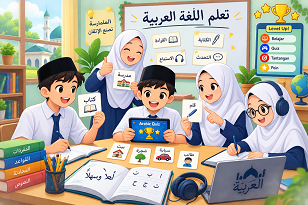
Foreign language anxiety constitutes a primary psychological barrier for Islamic junior high school (madrasah) students in acquiring Arabic language proficiency. This study aims to investigate the effectiveness of gamification in mitigating Arabic language anxiety among students at MTs Nurul Barkah Tanggamus. An empirical approach was employed to evaluate the impact of integrating game mechanics on the fluctuation of students' affective filters and cognitive load during the instructional process. Field findings demonstrate that gamification strategies significantly reduce anxiety levels by fostering a cooperative learning environment devoid of emotional threats. The incorporation of instant feedback and autonomous competition designs proved highly effective in transforming the fear of making grammatical errors into intrinsic motivation and proactive participation. The success of this pedagogical intervention simultaneously confirms the high adaptability of gamified elements within the sociocultural context of rural madrasahs, independent of advanced technological infrastructure. This study concludes that gamification serves as a robust pedagogical accelerator for overcoming the mental blocks experienced by target language learners. This research fundamentally recommends the structural integration of the tal’ib (gamification) approach into madrasah curriculum policies to ensure students' psychological well-being and long-term success in foreign language literacy.
Downloads
References
Abu-Rabia, S. (2004). Teachers' role, learners' gender differences, and FL anxiety among seventh-grade students studying English as a FL. Educational Psychology, 24(5), 711–721. https://doi.org/10.1080/0144341042000262971
Al-Azawi, R., Al-Faliti, F., & Al-Blushi, M. (2016). Educational gamification vs. game-based learning: Comparative study. International Journal of Innovation, Management and Technology, 7(4), 132–136. https://doi.org/10.18178/ijimt.2016.7.4.659
Al-Batal, M. (2018). Arabic as one language: Integrating dialect in the Arabic language curriculum. Georgetown University Press.
Al-Fauzan, A. I. (2011). Idha'at li-mu'allimi al-lughah al-'Arabiyah li-ghayr an-natiqina biha. Al-Arabiyyah Lil-Jami'.
Al-Khuli, M. A. (2000). Asalib tadris al-lughah al-'Arabiyah. Dar al-Falah.
Almalki, S. (2016). Integrating quantitative and qualitative data in mixed methods research—Challenges and benefits. Journal of Education and Learning, 5(3), 288–296. https://doi.org/10.5539/jel.v5n3p288
Al-Osaimi, A., & Al-Ghamdi, H. (2021). The effects of gamification on students' Arabic vocabulary acquisition and foreign language anxiety. Journal of Language Teaching and Research, 12(4), 543–552. https://doi.org/10.17507/jltr.1204.05
Al-Qahtani, M. H. (2019). Gamification in second language acquisition: The case of teaching Arabic as a foreign language. Journal of Taibah University Arts and Humanities, 15(2), 34–51. https://doi.org/10.1016/j.jtuh.2019.05.002
Alrabai, F. (2015). The influence of teachers' anxiety-reducing strategies on learners' foreign language anxiety. Innovation in Language Learning and Teaching, 9(2), 163–190. https://doi.org/10.1080/17501229.2014.890203
Alsowat, H. (2016). An EFL gamified flipped classroom instructional model: Effects on students' motivation and achievement. Arab World English Journal, 7(1), 71–92. https://doi.org/10.24093/awej/vol7no1.6
Asher, J. J. (1969). The total physical response approach to second language learning. The Modern Language Journal, 53(1), 3–17. https://doi.org/10.1111/j.1540-4781.1969.tb04552.x
Creswell, J. W., & Poth, C. N. (2018). Qualitative inquiry and research design: Choosing among five approaches (4th ed.). Sage.
Csikszentmihalyi, M. (2014). Flow and the foundations of positive psychology: The collected works of Mihaly Csikszentmihalyi. Springer. https://doi.org/10.1007/978-94-017-9088-8
Deci, E. L., & Ryan, R. M. (2016). Optimizing students' motivation in the era of testing and pressure: A self-determination theory perspective. In W. Liu et al. (Eds.), Building networks and partnerships in education (pp. 9–29). Springer. https://doi.org/10.1007/978-981-10-0312-2_2
Dehghani, F., Jafari, S. M., & Zarei, G. R. (2019). The effect of gamification on vocabulary learning of Iranian EFL learners. Journal of Applied Linguistics and Language Research, 6(3), 209–223. https://doi.org/10.1111/jallr.2019.6.3.209
Deterding, S., Dixon, D., Khaled, R., & Nacke, L. (2011). From game design elements to gamefulness: Defining gamification. In Proceedings of the 15th International Academic MindTrek Conference (pp. 9–15). Association for Computing Machinery. https://doi.org/10.1145/2181037.2181040
Dichev, C., & Dicheva, D. (2017). Gamifying education: What is known, what is believed and what remains uncertain: A critical review. International Journal of Educational Technology in Higher Education, 14(1), Article 9. https://doi.org/10.1186/s41239-017-0042-5
Dornyei, Z. (2007). Research methods in applied linguistics: Quantitative, qualitative, and mixed methodologies. Oxford University Press.
Dörnyei, Z. (2014). The psychology of the language learner: Individual differences in second language acquisition. Routledge. https://doi.org/10.4324/9781410613349
Figueroa, J. (2015). Using gamification to enhance second language learning. Digital Education Review, 27, 32–54. https://doi.org/10.1344/der.2015.27.32-54
Hassan, M. A., Habiba, U., Majeed, F., & Shoaib, M. (2021). Adaptive gamification in e-learning based on students' learning styles. Interactive Learning Environments, 29(4), 545–565. https://doi.org/10.1080/10494820.2019.1588745
Horwitz, E. K. (2017). On the misreading of Horwitz, Horwitz, and Cope (1986) and the need to balance anxiety research and the experiences of anxious language learners. Foreign Language Annals, 50(1), 71–76. https://doi.org/10.1111/flan.12241
Kapp, K. M. (2012). The gamification of learning and instruction: Game-based methods and strategies for training and education. John Wiley & Sons.
Kementerian Pendidikan, Kebudayaan, Riset, dan Teknologi. (2026). Data pokok pendidikan MTs Nurul Barkah. Kementerian Pendidikan, Kebudayaan, Riset, dan Teknologi Republik Indonesia. https://referensi.data.kemendikdasmen.go.id/residu/satuanpendidikan/detail/10816730
Krashen, S. (2018). The affective filter hypothesis. In Principles and practice in second language acquisition (pp. 30–32). Pergamon Press.
Krashen, S. D. (1982). Principles and practice in second language acquisition. Pergamon Press.
Lincoln, Y. S., & Guba, E. G. (1985). Naturalistic inquiry. Sage.
MacIntyre, P. D., & Gregersen, T. (2012). Emotions that facilitate language learning: The positive-broadening power of the imagination. Studies in Second Language Learning and Teaching, 2(2), 193–213. https://doi.org/10.14746/ssllt.2012.2.2.4
Merriam, S. B., & Tisdell, E. J. (2015). Qualitative research: A guide to design and implementation (4th ed.). John Wiley & Sons.
Miles, M. B., Huberman, A. M., & Saldaña, J. (2014). Qualitative data analysis: A methods sourcebook (3rd ed.). Sage.
Moleong, L. J. (2017). Metodologi penelitian kualitatif (Edisi revisi). PT Remaja Rosdakarya.
Mukhlishin, A., & Nafisah, J. (2021). Advokasi santri melalui pemahaman Islam multikultur untuk mencegah Islam radikal di Lampung Tengah. Jurnal Pengabdian kepada Masyarakat Desa (JPMD), 2(3), 1–21. https://doi.org/10.32923/jpmd.v2i3.1550
Mustofa, S. (2020). Strategi pembelajaran bahasa Arab inovatif. UIN Maliki Press.
Nafisah, J., Koderi, Akmansyah, Erlina, & Mukhlishin, A. (2023). Development of nahwu learning module for students of Madrasah Diniyah Wali Songo Sukajadi Lampung. Mantiqu Tayr: Journal of Arabic Language, 3(2), 90–101. https://doi.org/10.25217/mantiqutayr.v3i2.3361
Patton, M. Q. (2015). Qualitative research & evaluation methods: Integrating theory and practice (4th ed.). Sage.
Pintrich, P. R. (2004). A conceptual framework for assessing motivation and self-regulated learning in college students. Educational Psychology Review, 16(4), 385–407. https://doi.org/10.1007/s10648-004-0006-x
Rahman, A., & Hasanah, N. (2021). Analisis kecemasan berbahasa Arab pada siswa madrasah tsanawiyah. Arabiyatuna: Jurnal Bahasa Arab, 5(1), 101–120. https://doi.org/10.29240/jba.v5i1.2135
Richards, K. (2015). Qualitative inquiry in TESOL. Palgrave Macmillan. https://doi.org/10.1057/9781137510204
Ritonga, A. H., Jamil, M., Harvius, H., & Mukhlishin, A. (2018). Manajemen sumber daya manusia berbasis pendidikan pondok pesantren. Jurnal Penelitian, 12(2), 427–450. https://doi.org/10.21043/jupe.v12i2.3175
Sailer, M., Hense, J. U., Mayr, S. K., & Mandl, H. (2017). How gamification motivates: An experimental study of the effects of specific game design elements on psychological need satisfaction. Computers in Human Behavior, 69, 371–380. https://doi.org/10.1016/j.chb.2016.12.033
Sugiyono. (2019). Metode penelitian pendidikan: Pendekatan kuantitatif, kualitatif, dan R&D. Alfabeta.
Sweller, J. (2011). Cognitive load theory. Psychology of Learning and Motivation, 55, 37–76. https://doi.org/10.1016/B978-0-12-387691-1.00002-8
Vygotsky, L. S. (1978). Mind in society: The development of higher psychological processes. Harvard University Press.
Yin, R. K. (2018). Case study research and applications: Design and methods (6th ed.). Sage.
Yunus, M. M., & Azman, H. (2019). Gamification in language learning: A review of the literature. Journal of Social Sciences and Humanities, 16(4), 65–75. https://doi.org/10.17576/jssh-2019-1604-05
Zainuddin, Z., Chu, S. K. W., Shujahat, M., & Perera, C. J. (2020). The impact of gamification on learning and instruction: A systematic review of empirical evidence. Educational Research Review, 30, Article 100326. https://doi.org/10.1016/j.edurev.2020.100326
Zheng, D., Young, M. F., Wagner, M. M., & Brewer, R. A. (2015). Negotiation for action: English language learning in game-based virtual worlds. The Modern Language Journal, 93(4), 489–511. https://doi.org/10.1111/j.1540-4781.2009.00927.x
Zichermann, G., & Cunningham, C. (2011). Gamification by design: Implementing game mechanics in web and mobile apps. O'Reilly Media.
Zourou, K. (2016). Social networking and language learning. In The Routledge handbook of language learning and technology (pp. 175–188). Routledge. https://doi.org/10.4324/9781315657899-13
Published
How to Cite
Issue
Section
License
Copyright (c) 2025 Jauharotun Nafisah

This work is licensed under a Creative Commons Attribution-ShareAlike 4.0 International License.