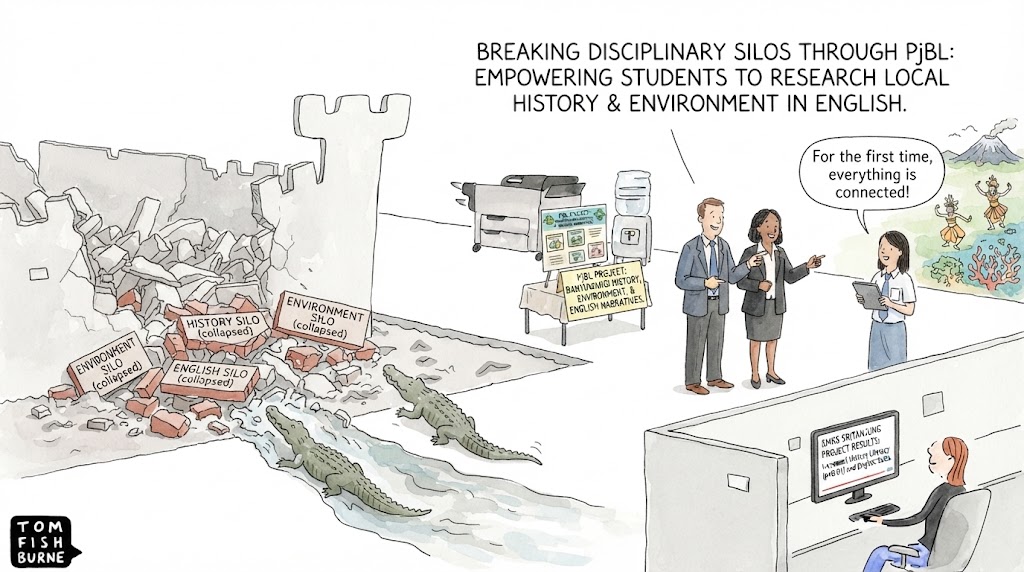
Breaking the Disciplinary Silos: Empowering Vocational Students’ Historical and Environmental Agency through English Narratives.
Authors
-
Ahmad Ali Munazat
 Universitas 17 Agustus 1945 Banyuwangi, Indonesia
-
Reva Dwi Lestari
Universitas 17 Agustus 1945 Banyuwangi, Indonesia
-
Elena Septya Dewi
Universitas 17 Agustus 1945 Banyuwangi, Indonesia
-
Putri Nur Salsabilla
Universitas 17 Agustus 1945 Banyuwangi, Indonesia
-
St. Shabibatul Rohmah
Universitas 17 Agustus 1945 Banyuwangi, Indonesia
DOI:
https://doi.org/10.61650/alj.v3i1.1267Keywords:
project-based learning historical literacy environmental awareness English presentation vocational schoolAbstract
Breaking through conventional disciplinary silos in vocational education requires innovative instructional designs that cultivate students' holistic competencies. This study investigates the implementation of a project-based learning (PjBL) instructional framework designed to empower vocational students' historical and environmental agency through English narratives at SMKS Sritanjung, Banyuwangi. Utilizing a pre-experimental one-group pretest-posttest design over an 8-week intervention, the research evaluated students across multidisciplinary competencies. Data were gathered through historical literacy and environmental awareness pretests and posttests, English presentation assessments, audio-visual recordings, and student response questionnaires, and were subsequently analyzed using paired sample t-tests and descriptive statistics. The pedagogical findings demonstrate that the integrated PjBL model significantly enhanced students' historical literacy (p<0.01, d=1.52), environmental awareness (p<0.01, d=1.38), and English presentation proficiency (p<0.01, d=1.45), coupled with overwhelmingly positive student engagement (86.3%). Ultimately, this study provides empirical evidence that bridging disciplinary domains through targeted instructional transformation effectively fosters vocational students' multidisciplinary agency, contributing a robust pedagogical model for vocational and workforce education.
Downloads
Published
How to Cite
Issue
Section
License
Copyright (c) 2025 Ahmad Ali Munazat, Reva Dwi Lestari, Elena Septya Dewi, Putri Nur Salsabilla, St. Shabibatul Rohmah

This work is licensed under a Creative Commons Attribution-ShareAlike 4.0 International License.






 All publications by the CV. Bimbingan Belajar Assyfa [e-ISSN: