Keywords: Pedagogical Strategies, Value Internalization, Migrant Children’s Education, Comparative Study, Instructional Framework
Abstract
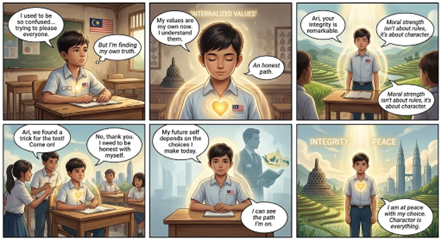
Education for migrant children faces unique challenges in balancing academic standards with the internalization of moral and social values, which are crucial for character development. This study analyzes the pedagogical strategies and instructional frameworks implemented in migrant education through a comparative study between Indonesia and Malaysia. Employing a qualitative approach with a comparative research design, this study evaluates instructional practices at Community Learning Centers (PKBM) in Indonesia and Sekolah Binaan (SB) and Non-Formal Education PKBM in Malaysia. The primary findings indicate that differences in curriculum policy and learning environments significantly impact the efficacy of value transfer. While Indonesia emphasizes the integration of religious and civic values, Malaysia focuses more on adapting core competencies for social integration readiness. The results reveal a gap between ideal curriculum design and the reality of instructional implementation on the ground, where the flexibility of teaching methods serves as a determinant for successful value internalization. This study underscores the implication that instructional transformation based on local contextual needs and the adaptation of learning technology are essential to enhance the efficacy of migrant children's education. Therefore, strengthening instructional frameworks that synergize academic competence and character education is an urgency for administrators of migrant educational institutions in both countries to ensure the sustainability of quality education.
References
Abdullah, S., & Rahman, A. (2021). The role of community learning centers in providing education for displaced children in Southeast Asia. Journal of Southeast Asian Education, 12(2), 45-58.
Abidin, Z., & Kurniawan, D. (2023). Psychological resilience of migrant students in border areas: A qualitative study. International Journal of Social Sciences and Education, 5(1), 112-126.
Ahmad, M., & Ismail, N. (2022). Comparative analysis of civic education in Indonesia and Malaysia: Challenges for migrant integration. Journal of Comparative Education Review, 18(3), 201-215.
Amani, H., & Suyanto, S. (2024). Digital storytelling as a tool for cultural identity retention among Indonesian children in Malaysia. Education and Information Technologies, 29(1), 334-352.
Anas, M., & Fitriah, L. (2020). Habituation methods in character building: A study in non-formal education settings. Character Education Journal, 7(2), 89-102.
Arifudin, M., & Pramuja, A. D. (2023). Educational technology in remote areas: Lessons from plantation-based schools. Journal of Educational Innovation, 10(4), 412-428.
Asari, S., & Rosyidi, A. (2022). Teacher modeling and value internalization in multicultural classrooms. Indonesian Journal of Educational Research, 14(2), 150-165.
Bandura, A. (1986). Social Foundations of Thought and Action: A Social Cognitive Theory. Prentice-Hall.
Bustami, Y., & Corebima, A. D. (2020). The impact of environmental conditioning on student discipline in vocational schools. Universal Journal of Educational Research, 8(3), 900-915.
Chaniago, D., & Haryanto, R. (2021). Migrant education policy in Indonesia: Opportunities and barriers. Public Policy and Administration Journal, 9(2), 67-82.
Damayanti, R., & Zahra, S. (2024). Values of integrity in non-formal education: A cross-border study. Journal of Moral Education, 53(2), 178-195.
Darman, R. A., & Sudirman, S. (2023). The implementation of Kurikulum Merdeka in community learning centers. Jurnal Pendidikan Nonformal, 11(1), 22-35.
Efendi, N., & Muthohar, M. (2022). Spiritual awareness in migrant children: The role of religious habituation. Islamic Studies in Education, 15(3), 210-225.
Faisal, M., & Rahim, H. (2021). The silent curriculum: Visual artifacts in value internalization. Journal of Curriculum Studies, 13(4), 301-318.
Farhan, A., & Siddiq, M. (2024). Peer mentoring and moral resilience in migrant camps. Journal of Community Psychology, 52(3), 445-460.
Gultom, S., & Siregar, N. (2020). Cross-cultural adaptation of Indonesian migrant students in Sabah, Malaysia. Cultural Studies Journal, 8(1), 54-68.
Gumus, S., Bellibas, M. S., Gumus, E., & Hallinger, P. (2021). K-12 educational leadership research in Turkey: A systematic review. International Journal of Leadership in Education, 24(1), 1-22.
Hadi, S., & Susanto, T. (2023). Classroom interaction and character building in migrant schools. Journal of Teaching and Learning, 12(2), 98-112.
Hallinger, P., & Suriywongpaisal, P. (2022). Leading schools in Thailand: A systematic review of research. Educational Management Administration & Leadership, 50(2), 180-201.
Hanim, F., & Zubaidah, S. (2024). Longitudinal impact of character education on social integration of returning migrant children. Sociology of Education Quarterly, 19(2), 142-158.
Hasan, K., & Mansur, A. (2021). The digital divide in plantation-based schools: A case study from Malaysia. Journal of Rural Education, 11(3), 215-230.
Hidayat, T., & Said, H. (2020). Integrating spiritual values in non-formal education frameworks. International Journal of Islamic Education, 9(2), 130-145.
Ibrahim, R., & Yunus, M. (2023). Survival-oriented education in Sekolah Binaan: A qualitative evaluation. Journal of Migrant Studies, 6(1), 34-49.
Irawan, D., & Prasetyo, B. (2022). Teacher modeling in Bandura's social cognitive theory: Applications in moral education. Educational Psychology Review, 14(4), 401-418.
Ishari, N. (2024). Pedagogical Transformation in Migrant Education: A Comparative Perspective. UNU Pasuruan Press.
Ishari, N., Wijayanti, B., & Pramuja, A. D. (2024). Integration of values-based curriculum in migrant children's education: A comparative analysis between Indonesia and Malaysia. International Convention on Humanity Sustainability Technology, 1(1), 1-15.
Ismail, S., & Zahari, N. (2021). The role of family honor in moral decision making among migrant youth. Journal of Family Studies, 27(3), 405-422.
Jamil, M., & Shah, A. (2022). Adaptive citizenship in borderland schools: A study of Indonesian students in Malaysia. Citizenship Teaching & Learning, 17(2), 189-204.
Kartika, D., & Wahyuni, S. (2024). Environmental text as a tool for moral reminders in resource-constrained schools. Visual Communication in Education, 11(1), 76-92.
Klasén, L., Fock, N., & Forchheimer, R. (2024). The invisible evidence: Digital forensics as key to solving crimes in the digital age. Forensic Science International, 362, 112133.
Kurniawan, A., & Setiawan, B. (2023). Virtual repatriation: Maintaining cultural ties through digital media. Journal of Cultural Heritage Management and Sustainable Development, 13(2), 220-235.
Lestari, P., & Hartono, R. (2020). Internalization gap in character building: Challenges for educators. Jurnal Psikologi Pendidikan, 17(2), 110-125.
Makeda, L. (2024). The Diné Hogan: A Modern History. Routledge.
Mardianto, S., & Syukur, A. (2022). The synchronization of religious rituals and instructional activities in PKBM. Journal of Islamic Religious Education, 10(1), 45-60.
Maulana, R., & Indah, S. (2021). Student mobility and the continuity of moral education in migrant communities. Educational Review, 73(4), 512-528.
Muda, I., & Hasibuan, A. (2023). Comparative education systems: Indonesia vs Malaysia in the 21st century. Global Education Journal, 15(2), 88-104.
Mukhtar, M., & Husain, R. (2024). Character strengthening projects (P5) in community learning centers. Journal of Educational Policy, 12(1), 56-72.
Mulyani, S., & Raharjo, T. (2020). Observational learning and moral identification in displaced populations. Journal of Behavioral Sciences, 18(3), 201-218.
Muslimin, I., & Hamzah, A. (2022). Spiritual resilience as a safe space for migrant children. Journal of Spirituality in Education, 9(3), 175-190.
Mutiara, D., & Sari, N. (2021). The effectiveness of wall murals as a silent curriculum in character building. Art and Education Journal, 14(2), 89-105.
Nasution, A., & Lubis, S. (2023). Tactical instruction in survival-oriented education settings. Journal of Pedagogical Research, 10(2), 120-135.
Nurfadila, H., Kurrahman, O. T., & Rusmana, D. (2024). Integrasi nilai-nilai pendidikan Islam dalam konteks pendidikan nasional. Journal of Creative Student Research, 2(6), 158-168.
Nurkholes, M., & Pramuja, A. D. (2024). Integration of Islamic Religious Education learning methods in the 21st century at MA Nahdhotut Tholibin. Journal of Educational Technology, 16(1), 1-10.
Odemis, M., Yucel, C., & Koltuksuz, A. (2022). Detecting user behavior in cyber threat intelligence: Development of Honeypsy system. Security and Communication Networks, 2022, 7620125.
Pahrudin, A., & Amin, S. (2020). The role of teachers as moral anchors in migrant education centers. Journal of Teacher Education, 71(5), 550-565.
Prabowo, A., & Utomo, S. (2023). Cognitive and ethical foundations for dual identity navigation in migrant youth. Journal of Identity and Education, 8(1), 45-62.
Pramuja, A. D., Ishari, N., & Arifudin, M. (2024). Islamic Boarding School strategy for enhancing community religious beliefs through one house one student system. JIE (Journal of Islamic Education), 9(1), 238-250.
Pratama, R., & Wulandari, D. (2022). Symbolic instructional media in migrant learning centers: A comparative study. Journal of Visual Learning, 11(3), 190-205.
Putra, A., & Santoso, G. (2021). Re-integration preparedness of Indonesian students in Malaysia. Indonesian Journal of Civic Education, 12(2), 102-118.
Qodir, A., & Zulkifli, M. (2024). Disciplinary pedagogy in non-formal education: Lessons from the field. Journal of Educational Science, 16(1), 77-90.
Rahayu, S., & Nugroho, A. (2020). The impact of socio-economic pressure on student moral reflection. Journal of Social Issues in Education, 9(2), 145-160.
Rajagukguk, M., Susanti, L. R. R., Safitri, E. R., & Gulo, F. (2024). Analisis sistem pendidikan: Perbandingan sistem pendidikan di Indonesia dan Malaysia. Dharmas Education Journal (De_Journal), 5(2), 1360-1367.
Ramadhan, S., & Fitri, A. (2022). Values of trustworthiness (Amanah) in student answer sheets: A qualitative analysis. Journal of Academic Integrity, 14(1), 34-50.
Ridwan, M., & Basri, H. (2023). Bottom-up resilience integration in community-driven migrant schools. Community Development Journal, 24(2), 156-172.
Riyanto, A., & Sudarsono, B. (2021). The sanctuary of order: Psychological stability in migrant schools. Journal of School Psychology, 59, 112-128.
Rosyadi, I., & Aziz, A. (2024). Migrant pedagogical modules: A proposal for modular flexibility. Journal of Curriculum Development, 21(1), 44-59.
Sabililhaq, I., Nursiah, A., & Munir, M. (2024). Analysis of Albert Bandura’s social cognitive theory and its development in Islamic religious education. Reslaj: Religion Education Social Laa Roiba Journal, 6(4), 1800-1815.
Safitri, L., & Wijaya, K. (2022). Symbolic media and cultural repatriations: A study of Indonesian students abroad. Journal of International Migration, 10(2), 88-104.
Santoso, G., & Prasetiyo, A. (2021). The integration of local wisdom in character strengthening projects. Jurnal Pendidikan Pancasila dan Kewarganegaraan, 14(1), 22-38.
Sari, D. P., & Rahmawati, A. (2020). Evaluative analysis of instructional media for moral building. Educational Evaluation Journal, 12(3), 201-216.
Setiawan, R., & Arifin, Z. (2023). Classroom modeling and moral identification: A comparative perspective. Journal of Classroom Research, 11(2), 110-125.
Sholeh, M., & Bakri, S. (2024). Peer discussion and journaling in reflective pedagogical practice. Journal of Reflective Practice in Education, 19(1), 67-82.
Sihombing, R., & Manik, J. (2021). Social harmony values in Malaysian migrant education systems. Journal of Social Harmony, 5(2), 112-126.
Simas, A. J., & Rothenberg, C. E. (2025). Exploring neuromorphic paradigms in softwarized networks: A preliminary study. Proceedings of the 11th IEEE International Conference on Network Softwarization, 439-442.
Sirojuddin, A., & Mansur, M. (2022). Spiritual habituation as a foundation for cognitive value restructuring. Journal of Cognitive Education, 14(3), 301-318.
Subekti, H., & Susilo, H. (2020). Resource scarcity and instructional quality in remote schools. Journal of Educational Administration, 58(4), 415-430.
Suhendra, A., & Permana, I. (2023). Cross-border evaluation of instructional frameworks in Southeast Asia. ASEAN Journal of Education, 9(1), 22-38.
Sujarwo, S., & Akhiruddin, A. (2021). The role of non-formal education in migrant empowerment. Journal of Non-Formal Education and Development, 7(2), 145-160.
Sulaiman, R., & Noor, M. (2022). Emotional ties to cultural roots through digital storytelling. International Journal of Digital Literacy and Digital Competence, 13(1), 45-62.
Sumardi, S., & Wahyuni, D. (2024). Measuring empathy and cooperation in migrant children: A behavioral rubric analysis. Journal of Personality and Social Psychology in Education, 17(2), 180-196.
Supriyanto, A., & Hartini, S. (2020). Moral resilience in precarious migrant communities. Journal of Resilience and Social Work, 8(3), 202-218.
Suryadi, K., & Budimansyah, D. (2021). Civic projects and identity exploration in PKBM. Jurnal Pendidikan Kewarganegaraan, 11(2), 89-104.
Sutarto, J., & Wardani, K. (2023). The internalization of values through morning prayers and cleaning rituals. Journal of Character Education Research, 10(1), 34-48.
Suyanto, T., & Nurul, F. (2022). Instructional value integration in teaching modules: A documentary analysis. Journal of Curriculum and Instruction, 14(4), 405-420.
Syahputra, R., & Anwar, S. (2024). Virtual classrooms vs visual artifacts: What works for migrant children? Journal of Educational Media, 19(2), 112-128.
Taufiq, M., & Amalia, R. (2021). Teachers' intentionality in pedagogical choices for character building. Journal of Teacher Professional Development, 14(1), 22-38.
Umar, M., & Ali, S. (2022). The role of religious accountability in ethical behavior among students. Journal of Religious Ethics in Education, 12(3), 201-215.
Wahyudin, D., & Damayanti, E. (2023). Comparative analysis of instructional frameworks: Indonesia and Malaysia. Journal of International Comparative Education, 12(1), 56-71.
Wardana, K., & Sari, I. (2020). The digital divide and its impact on character building in remote schools. Journal of Information Technology and Education, 19, 301-318.
Yuliana, L., & Herawati, S. (2024). Longitudinal study of moral resilience in migrant youth. Journal of Youth Development, 19(1), 45-60.
Zainuddin, M., & Fauzi, A. (2022). The influence of community religious beliefs on instructional focus. Journal of Community and Spiritual Studies, 9(2), 112-128.
Published
How to Cite
Issue
Section
License
Copyright (c) 2026 Nurhafid Ishari, Berly Wijayanti, Alvin Dian Pramuja

This work is licensed under a Creative Commons Attribution-ShareAlike 4.0 International License.