The Caliphate as a Foundation for Socio-Political Stability: A Theoretical Reconstruction of Authority and Governance In Islamic Administration
DOI:
https://doi.org/10.61650/ajme.v4i1.1250Keywords:
Caliphate, Islamic Governance, Maqāṣid al-Sharī'ah, Moral Governance, Socio-Political StabilityAbstract
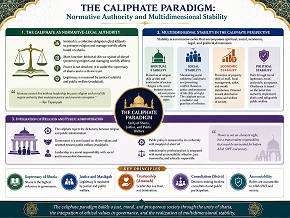
This study aims to reconstruct the concept of caliphate as a normative governance paradigm that functions as the foundation of socio-political stability within the framework of Islamic political thought. This study also examines the epistemological interaction between the concept of caliphate and modern state theories. Methods: This study employed a qualitative-interpretative approach based on doctrinal analysis. Primary data were obtained from normative Islamic political texts, while secondary data were derived from classical and contemporary literature related to Islamic governance, maqāṣid al-sharī'ah, political legitimacy, and modern governance theories. The analysis was conducted through conceptual classification, maqāṣid synthesis, and comparative epistemological dialogue. Results: The study found that the caliphate is conceptually positioned as a normative authority that maintains legal unity, multidimensional stability, and moral legitimacy. Stability within the caliphate framework is not limited to political order but includes spiritual, social, economic, and legal stability. Furthermore, political authority in Islam is fundamentally based on the concept of amanah (trusteeship), rather than absolute sovereignty. This study offers a reconstruction of the caliphate as a moral governance paradigm grounded in maqāṣid al-sharī'ah and provides a dialogical framework between Islamic political theory and modern governance discourse.
Downloads
References
Abdullah, M., Shahimi, S., & Ismail, A. G. (2022). Operationalizing maqasid al-Shariah in Islamic financial governance: A systematic review. ISRA International Journal of Islamic Finance, 14(3), 278–296. https://doi.org/10.55188/ijif.v14i3.220
Al-Ghazālī, A. H. (1993). Iḥyā’ ‘ulūm al-dīn. Dār al-Kutub al-‘Ilmiyyah.
Al-Māwardī, A. H. (1996). Al-aḥkām al-sulṭāniyyah wa al-wilāyāt al-dīniyyah. Dār al-Kutub al-‘Ilmiyyah.
Al-Shāṭibī, A. (1997). Al-muwāfaqāt fī uṣūl al-syarī‘ah. Dār al-Ma‘rifah.
Auda, J. (2008). Maqasid al-shariah as philosophy of Islamic law: A systems approach. International Institute of Islamic Thought.
Balaram, R. (2022). Islam and good governance: A political philosophy of Ihsan [Book review]. Political Theology, 23(6), 622–623. https://doi.org/10.1080/1462317X.2022.2060863
Brooks, M. C., Brooks, J. S., Mutohar, A., & Taufiq, I. (2020). Principals as socio-religious curators: Progressive and conservative approaches in Islamic schools. Journal of Educational Administration, 58(6), 677–695. https://doi.org/10.1108/JEA-01-2020-0017
Chapra, M. U. (2000). The future of economics: An Islamic perspective. Islamic Foundation.
Creswell, J. W., & Poth, C. N. (2018). Qualitative inquiry and research design: Choosing among five approaches (4th ed.). Sage Publications.
Crotty, M. (1998). The foundations of social research: Meaning and perspective in the research process. Sage Publications.
Gadamer, H.-G. (2004). Truth and method (2nd rev. ed.). Continuum.
Ghafran, C., & Yasmin, S. (2020). Ethical governance: Insight from the Islamic perspective and an empirical enquiry. Journal of Business Ethics, 167(3), 513–533. https://doi.org/10.1007/s10551-019-04181-2
Habermas, J. (1996). Between facts and norms: Contributions to a discourse theory of law and democracy. MIT Press.
Hallaq, W. B. (2009). An introduction to Islamic law. Cambridge University Press.
Hallaq, W. B. (2013). The impossible state: Islam, politics, and modernity’s moral predicament. Columbia University Press.
Hidayati, T., & Hidayatullah, M. S. (2021). Reconfiguring religious authority and ethical governance in Islamic political thought: A comparative literature review. In Da'wah, Islamic Political Thought, and Governance Transformation in the Muslim World. https://doi.org/10.4324/9781351044158
Ibn ‘Āshūr, M. T. (2006). Treatise on maqasid al-shariah. International Institute of Islamic Thought.
Ibn Khaldūn. (1967). The muqaddimah: An introduction to history. Princeton University Press.
Ibn Taymiyyah. (2005). Al-siyāsah al-shar‘iyyah fī iṣlāḥ al-rā‘ī wa al-ra‘iyyah. Dār al-Kutub al-‘Ilmiyyah.
Islam, J. S., & Eryiğit, A. (2022). Islam and the state in Ibn Taymiyya: Translation and analysis. Routledge. https://doi.org/10.4324/9781003197038
Kamali, M. H. (2014). The objectives of shariah and Islamic reform. Islam and Civilisational Renewal.
Kibtiah, T. M., & Putri, M. R. (2021). The existence of Hizbut Tahrir Indonesia: Strategies for engaging in Indonesian politics. Indonesian Journal of Political Research (IJPR), 2(1), 1–18. https://doi.org/10.24815/ijpr.v2i1.21045
Liew, H. H. (2025). 'The caliphate will last for thirty years': Polemic and political thought in the afterlife of a prophetic ḥadīth. Journal of Islamic Studies, 36(1), 38–82. https://doi.org/10.1093/jis/etae049
Lincoln, Y. S., & Guba, E. G. (1985). Naturalistic inquiry. Sage Publications.
Mandaville, P. (2020). Worlding the inward dimensions of Islam: Ihsan in search of a political praxis. In M. Khan (Ed.), Symposium on Islam and Good Governance. International Institute of Islamic Thought. https://doi.org/10.47816/01.003.20
March, A. F. (2019). The caliphate of man: Popular sovereignty in modern Islamic thought. Harvard University Press.
Moten, A. R. (2020). The concept of caliphate and its relevance to contemporary Muslim politics. Journal of Islam in Asia, 17(1), 228–248. https://doi.org/10.31436/jia.v17i1.876
Mukhlisin, M., Akbar, N., & Tahir, M. (2021). Constituting Islamic corporate governance theory through Islamic moral economy. Proceedings of the International Conference on Islamic Economics and Finance. https://doi.org/10.2991/aebmr.k.210421.038
Powell, E. J., McDowell, S. C., O'Brien, R., & Oksasoglu, J. (2020). Islam-based legal language and state governance: Democracy, strength of the judiciary and human rights. Constitutional Political Economy, 31(3), 376–412. https://doi.org/10.1007/s10602-020-09307-7
Rawls, J. (1993). Political liberalism. Columbia University Press.
Smolarski, J. M., & Murphy, M. J. (2020). Religion and CSR: An Islamic "political" model of corporate governance. Business and Society, 59(5), 823–854. https://doi.org/10.1177/0007650317749222
Sulayman, H., al-Attas, A., Awang, A. B., & al-Atribi, M. F. (2020). The objectives and principles of Islamic governance: Perspective of Imam al-Juwayni. Journal of Islam in Asia, 17(1), 228–248. https://doi.org/10.31436/jia.v17i1.876
Swinhoe, H. P. (2021). Shari'a, violence, and the caliphate: An analysis of the Islamic State's strategic narratives of sovereignty and political legitimacy [Doctoral dissertation, University of Leeds]. White Rose eTheses Online. https://etheses.whiterose.ac.uk/29470/
Tanjung, I. U. (2023). Khilafah political controversy in Indonesia. Jurnal Ilmiah Mahasiswa Pendidikan Sejarah, 8(2), 482–490. https://doi.org/10.24815/jimps.v8i2.24680
Weber, M. (1978). Economy and society: An outline of interpretive sociology. University of California Press.
Zatari, F. K. S. (2022). Rethinking ethics in international affairs: Reshaping civilizational discourse. Journal of Al-Tamaddun, 17(2), 1–15. https://doi.org/10.22452/JAT.vol17no2.1
Published
How to Cite
Issue
Section
License
Copyright (c) 2026 Safitri Agustina, Erlian Eka Damayanti, Muhammad Akmansyah, Zulhanan Zulhanan, Fachrul Ghazi

This work is licensed under a Creative Commons Attribution-ShareAlike 4.0 International License.