Authors
- Arum Muslikah Universitas Lambung Mangkurat Banjarmasin, Indonesia
- Ahmad Suriansyah Universitas Lambung Mangkurat Banjarmasin, Indonesia
 https://doi.org/10.61650/alj.v4i1.1030
Keywords: Instructional Management, Coastal Literacy, Reading Habituation, Higher-Order Thinking Skills, Principal Leadership
Abstract
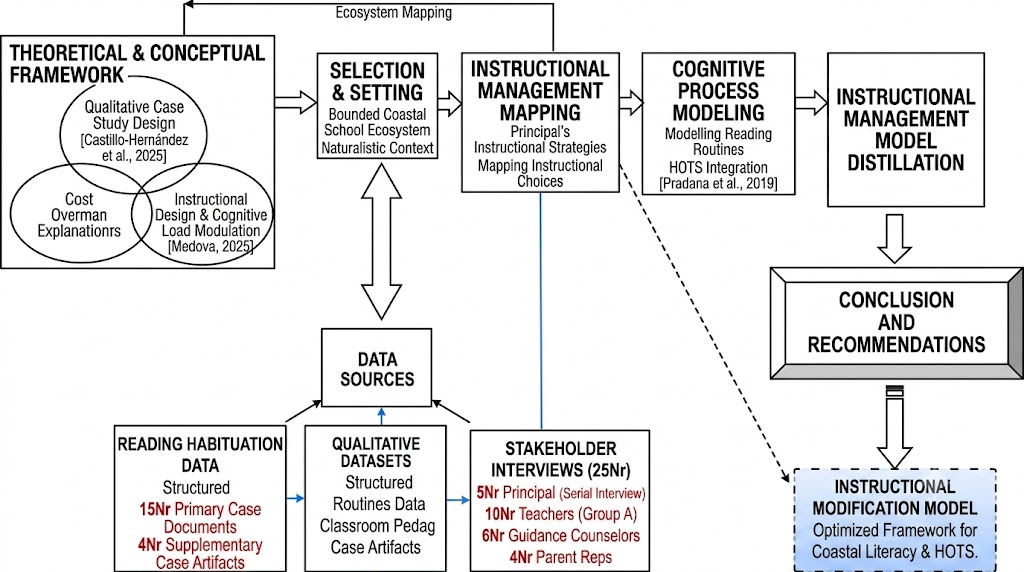
Building a strong literacy culture in coastal schools requires strategic leadership to overcome geographical and resource limitations. This study aims to analyze how the school principal optimizes instructional management to improve coastal literacy, focusing on reading habituation and Higher-Order Thinking Skills (HOTS) at SMPN 3 Satu Atap Angsana. A qualitative case study approach was employed, with data gathered through interviews, observation, and documentation, and analyzed using the Miles and Huberman model (data reduction, data presentation, and conclusion drawing). The results revealed that the principal successfully optimized instructional management through structural policies, a mandatory 15–20 minute pre-learning reading habituation, the integration of HOTS-based literacy into the learning process, program supervision, and periodic evaluations. This collaborative initiative actively engaged the vice principal, librarians, teachers, counselors, and parents. Despite coastal constraints, these strategies successfully fostered a positive literacy culture, significantly enhancing students' reading interest, analytical skills, and learning participation. Crucially, this optimization led to a measurable increase in literacy achievements on the school’s 2023–2025 Education Report Card. In conclusion, the principal’s instructional management plays a pivotal role in establishing a contextual, sustainable literacy culture that enhances higher-order thinking in coastal educational settings.
Adriyawati, Utomo, E., Rahmawati, Y., & Mardiah, A. (2020). Steam-project-based learning integration to improve elementary school students’ scientific literacy on alternative energy learning. Universal Journal of Educational Research, 8(5), 1863 – 1873. https://doi.org/10.13189/ujer.2020.080523
Ahn, J., Wang, Y., & Lee, Y. (2025). Interplay between leadership and school-level conditions: A review of literature on the Teaching and Learning International Survey (TALIS). Educational Management Administration and Leadership, 53(3), 681–703. https://doi.org/10.1177/17411432231177835
Arwidiyarti, D., Khaerudin, & Wibawa, B. (2022). Improving the Learning Effectiveness of Information System Analysis and Design Courses with Collassion Learning. International Journal of Information and Education Technology, 12(5), 456 – 462. https://doi.org/10.18178/ijiet.2022.12.5.1641
Ashmitha, K. A. A., Gopal, C. N. R., Sridhar, O. T. S., & Kancharla, K. (2024). Effectiveness of Psychosocial Intervention and Psychoeducation in Improving Psychological Well-being and Cognitive Functioning in Caregivers of Substance Use Issues: A Pilot Study. Annals of Neurosciences, 31(3), 157–165. https://doi.org/10.1177/09727531231185925
Astutik, S., Mahardika, I. K., Indrawati, Sudarti, & Supeno. (2020). HOTS student worksheet to identification of scientific creativity skill, critical thinking skill and creative thinking skill in physics learning. Journal of Physics: Conference Series, 1465(1). https://doi.org/10.1088/1742-6596/1465/1/012075
Atmojo, I. R. W. (2022). Application of Science Integrated Learning in Practicum Assessments to Improve Science Student Teachers’ Creative Thinking. International Journal of Instruction, 15(4), 113–146. https://doi.org/10.29333/iji.2022.1548a
Bada, H. A., Yusuf, H. A., Oladele, J. I., & Oloba, P. B. (2025). Adopting the principal instructional management rating scale for enhancing instructional delivery in Nigerian schools. International Journal of Evaluation and Research in Education, 14(6), 5067–5079. https://doi.org/10.11591/ijere.v14i6.34958
Barnes, S. (2026). A Bourdieusian Examination of the School Principal: Instructional Leadership vs Entrepreneurial Management. In A Bourdieusian Examination of the School Principal: Instructional Leadership vs Entrepreneurial Management. https://doi.org/10.4324/9781003633358
Becker, S., Viljoen, M. J., Botma, Y., & Bester, I. J. (2003). Integration of study material in the problem-based learning method. In Curationis (Vol. 26, Issue 1). scholar.ufs.ac.za. https://doi.org/10.4102/curationis.v26i1.1295
Berkovich, I. (2025). The dual increasing-reducing effects of principals’ digital instructional leadership on teacher burnout in online teaching mediated by teacher self-efficacy and collective efficacy. International Journal of Educational Management, 40(3), 444–458. https://doi.org/10.1108/IJEM-01-2025-0037
Berkovich, I. (2026). The great resignation: Exploring the effect of regular and digital instructional leadership on teachers’ intention to leave. Management in Education, 40(2), 61–69. https://doi.org/10.1177/08920206231163984
Bladh, M., Svedin, C. G., & Agnafors, S. (2023). Predictors of educational failure at 16 and 19 years of age-SESBiC longitudinal study. PLoS ONE, 18(1 January). https://doi.org/10.1371/journal.pone.0279531
Buchanan, M., Yee, C., Gordon, A., Pierse, N., O’Sullivan, K. C., & Leigh, L. (2026). Disabled children’s capabilities in housing: a mixed-methods survey of parents and guardians. Wellbeing, Space and Society, 10. https://doi.org/10.1016/j.wss.2026.100396
Bush, T., & Glover, D. (2025). Educational leadership preparation and development in Africa: a literature review. International Journal of Educational Management, 39(5), 1240–1255. https://doi.org/10.1108/IJEM-01-2025-0005
Cansoy, R., Gümüş, S., & Walker, A. (2025). Challenges in implementing instructional leadership: Insights from Turkish school principals. Educational Management Administration and Leadership, 53(5), 991–1015. https://doi.org/10.1177/17411432241263915
Castillo-Hernández, F.-J., Jiménez-Liso, M.-R., Couso, D., & López-Gay, R. (2025). Exploring the phenomena of floating and sinking in science education literature: a systematic review. Studies in Science Education. https://doi.org/10.1080/03057267.2025.2460927
Chessell, C., Halldorsson, B., Harvey, K., Guzman-Holst, C., & Creswell, C. (2021). Cognitive, behavioural and familial maintenance mechanisms in childhood obsessive compulsive disorders: A systematic review. Journal of Experimental Psychopathology, 12(2). https://doi.org/10.1177/20438087211036581
Chun, T. C., & Abdullah, M. N. L. Y. B. (2019). The teaching of higher order thinking skills (HOTS) in Malaysian schools: Policy and practices. Malaysian Online Journal of Educational Management, 7(3), 1–18. https://doi.org/10.22452/mojem.vol7no3.1
Dahuri, M., Che-Ani, A. I., Johar, S., Talib, O., Mokhatar, S. N., Abd Wahab, M. A., & Shamsuddin, M. (2026). Optimizing maintenance budget allocation in higher educational institutions: a systematic review of building condition assessment and service quality. Journal of Facilities Management, 24(2), 245–270. https://doi.org/10.1108/JFM-09-2024-0112
DeMatthews, D. E., Conroy, K., & McKenzie, L. (2026). Inclusive Principal Leadership from 1995 to 2024: A Systematic Literature Review. Review of Educational Research. https://doi.org/10.3102/00346543261446662
Derebecka, M., & Grzybowski, A. (2019). Rehabilitation of visually impaired children – methods and their effectiveness. OphthaTherapy. Therapies in Ophthalmology, 6(2), 132–136. https://doi.org/10.24292/01.OT.300619.10
Dobkowska, J. (2021). A signpost on educational paths or a strict code? Changes in provisions concerning language education in the core curricula of early childhood education as a source of uncertainty in the teacher’s work. In Obszary (nie)pewnosci w pracy wspólczesnego nauczyciela (pp. 149–166). https://www.scopus.com/pages/publications/105016838424?origin=resultslist
Dong, Y. (2026). Generative AI technologies and educational outcomes: a comprehensive meta-analysis comparing traditional and AI-driven approaches. Humanities and Social Sciences Communications, 13(1). https://doi.org/10.1057/s41599-026-06903-y
Elvira-Zorzo, M. N., & Velandia, J. C. S. (2025). PRISMA SYSTEMATIC REVIEW OF THE USE OF SOCIAL NETWORKS AS EDUCATIONAL TOOLS IN THE FIELD OF VISUAL CULTURE FROM A SOCIAL PSYCHOLOGY PERSPECTIVE. VISUAL Review. International Visual Culture Review / Revista Internacional de Cultura, 17(5), 73–86. https://doi.org/10.62161/revvisual.v17.5939
Farrokhnia, M., Banihashem, S. K., Noroozi, O., & Wals, A. (2024). A SWOT analysis of ChatGPT: Implications for educational practice and research. Innovations in Education and Teaching International, 61(3), 460–474. https://doi.org/10.1080/14703297.2023.2195846
Fonsén, E., Szecsi, T., Kupila, P., Liinamaa, T., Halpern, C., & Repo, M. (2023). Teachers’ pedagogical leadership in early childhood education. Educational Research, 65(1), 1–23. https://doi.org/10.1080/00131881.2022.2147855
Ganon-Shilon, S., & Becher, A. (2026). Principals’ sense-making and sense-giving of their professional role tensions: School leaders’ professionalism and creative mediation strategies during Covid-19 crisis. Educational Management Administration and Leadership, 54(2), 302–324. https://doi.org/10.1177/17411432241264693
Ginzburg, S. B., Deutsch, S., Bellissimo, J., Elkowitz, D. E., Stern, J. N. H., & Lucito, R. (2018). Integration of leadership training into a problem/ case-based learning program for first-and second-year medical students. Advances in Medical Education and Practice, 9, 221 – 226. https://doi.org/10.2147/AMEP.S155731
Gümüş, S., Xu, N., Berkovich, I., Buyukgoze, H., & DeMatthews, D. (2026). Exploring the Role of Context for Social Justice Leadership: Perceptions, Practices, and Challenges Through the Lens of Ecological Systems Theory. Asia-Pacific Education Researcher, 35(2), 435–445. https://doi.org/10.1007/s40299-025-01039-0
Gunawan, K. D. H., Liliasari, S., Kaniawati, I., & Setiawan, W. (2020). Exploring science teachers’ lesson plans by the implementation of intelligent tutoring systems in blended learning environments. Universal Journal of Educational Research, 8(10), 4776 – 4783. https://doi.org/10.13189/ujer.2020.081049
Hamzah, H., Hamzah, M. I., & Zulkifli, H. (2022). Systematic Literature Review on the Elements of Metacognition-Based Higher Order Thinking Skills (HOTS) Teaching and Learning Modules. Sustainability (Switzerland), 14(2). https://doi.org/10.3390/su14020813
Hasan, L. M., & Jaaffar, A. H. (2026). The Interplay Between Leadership Styles, Knowledge Management Practices, and Employee Performance: A PRISMA-Based Systematic Literature Review and Thematic Synthesis. Journal of Logistics, Informatics and Service Science, 13(5), 187–205. https://doi.org/10.33168/JLISS.2026.0511
Hasson, F., Keeney, S., & McKenna, H. (2000). Research guidelines for the Delphi survey technique. Journal of Advanced Nursing, 32(4), 1008–1015. https://doi.org/10.1046/j.1365-2648.2000.t01-1-01567.x
Hidayah, I., Isnarto, Masrukan, Asikin, M., & Margunani. (2020). Quality Management of Mathematics Manipulative Products to Support Students’ Higher Order Thinking Skills. International Journal of Instruction, 14(1), 537 – 554. https://doi.org/10.29333/IJI.2021.14132A
Hinsche, L., Hasseler, M., Tischendorf, T., & Schaal, T. (2026). Nursing education in conflict: How intersectionality impacts access to educational opportunities? Frontiers in Medicine, 13, 1–7. https://doi.org/10.3389/fmed.2026.1804741
Ismawati, E., Hersulastuti, Amertawengrum, I. P., & Anindita, K. A. (2023). Portrait of Education in Indonesia: Learning from PISA Results 2015 to Present. International Journal of Learning, Teaching and Educational Research, 22(1), 321 – 340. https://doi.org/10.26803/ijlter.22.1.18
Jaime, H. C., de Souza, A. D., Santos Machado, R. C., & Gomes, O. D. S. M. (2026). Machine Learning Models for Non-Intrusive Load Monitoring: A Systematic Review and Meta-Analysis. Inventions, 11(2). https://doi.org/10.3390/inventions11020029
Karakus, M., Toprak, M., & Chen, J. (2026). Demystifying the impact of educational leadership on teachers’ subjective well-being: A bibliometric analysis and literature review. Educational Management Administration and Leadership, 54(2), 363–387. https://doi.org/10.1177/17411432241242629
Kaur, B., Popli, R., & Bala, H. M. (2026). A PRISMA-based Comparative Analysis of Machine Learning Techniques in Diagnosing Electrocardiogram, Diabetes, Chronic Kidney Disease, and Breast Cancer. International Journal on Smart Sensing and Intelligent Systems, 19(1). https://doi.org/10.2478/ijssis-2026-0013
Khasawneh, Y. J. A., Khasawneh, N. A. S., & Khasawneh, M. A. S. (2026). Synergistic Scale for AI Integration in Spiritual Leadership and Educational Management Transformation (Ssai-Slem): Development, Network Analysis, and Validation Among Jordanian Secondary School Administrators. Journal of Religion and Health, 65(1), 875–921. https://doi.org/10.1007/s10943-025-02390-8
Khine, M. S., & Koul, R. (2026). Thematic Synthesis of Educational Learning Environments: A Curated Literature Overview. In Thematic Synthesis of Educational Learning Environments: A Curated Literature Overview. https://doi.org/10.1007/978-981-95-4326-7
Kiernan, J. M., Decamp, K., Sender, J., & Given, C. (2023). Barriers to Implementation of Music Listening Interventions for Cancer-Related Phenomena: A Mapping Review. Journal of Integrative and Complementary Medicine, 29(5), 279–291. https://doi.org/10.1089/jicm.2022.0623
Koen, W., & Grobler, A. (2026). Responsible Leadership in Organisations (2000–2025): A PRISMA-Guided Systematic Review of Definitions, Theories, Trends, and Research Gaps. Administrative Sciences, 16(3). https://doi.org/10.3390/admsci16030146
Kurniawan, E. S., Mundilarto, & Istiyono, E. (2024). Improving student higher order thinking skills using Synectic-HOTS-oriented learning model. International Journal of Evaluation and Research in Education , 13(2), 1132–1140. https://doi.org/10.11591/ijere.v13i2.25002
Liu, B., Xue, J., & Lehane, B. M. (2023). Centrifuge investigation of soil–foundation–superstructure interaction under static loading. Engineering Structures, 281. https://doi.org/10.1016/j.engstruct.2023.115779
Liu, R., Chen, Z., Yao, G., & Zhang, P. (2026). Exploring the challenge and value of deep learning in automated skin disease diagnosis. Biomedical Signal Processing and Control, 117. https://doi.org/10.1016/j.bspc.2026.109589
Liu, S., Hallinger, P., & Chen, S. (2026). Social justice directed instructional leadership: Does it make a difference for teacher professional learning. Educational Management Administration and Leadership. https://doi.org/10.1177/17411432261441720
Lufri, L., Yogica, R., Muttaqiin, A., & Fitri, R. (2020). The Course of Biology Learning Methodology: Are Concept-Based Learning and Drill Method Effective in Enhancing Higher-Order Thinking Skills of Students? In R. L.S., P. E.C., H. T., & A. P.J. (Eds.), Proceedings of the 7th Mathematics, Science, and Computer Science Education International Seminar, MSCEIS 2019. European Alliance for Innovation. https://doi.org/10.4108/eai.12-10-2019.2296314
Magnusson, C. G. (2020). Examining The Polestar Of Reading Comprehension: One Teacher’s Instruction In One L1 Classroom And Students’ Metacognitive Knowledge Of Reading. L1 Educational Studies in Language and Literature, 20, 1–35. https://doi.org/10.17239/L1ESLL-2020.20.01.18
Mäkinen, J., Upadyaya, K., & Hietajärvi, L. (2026). Social resources, work demands and workplace commitment among Finnish school principals and teachers. International Journal of Educational Management, 40(8), 58–74. https://doi.org/10.1108/IJEM-06-2025-0462
Manap, N. A., Toran, H., & Hamid, A. H. A. (2026). The Impact of Headmasters’ Culturally Responsive Leadership on the Development of Students with Special Educational Needs in Inclusive Education Programs: A Systematic Literature Review (SLR). International Journal of Special Education, 41(2S), 578–596. https://www.scopus.com/pages/publications/105041564750?origin=resultslist
Medova, A. (2025). Comprehending of Religion Phenomena: Heidegger’s Method vs Method of Dutch School. Horizon. Studies in Phenomenology, 14(1), 154–176. https://doi.org/10.21638/2226-5260-2025-14-1-154-176
Moulin, L., & Soncin, M. (2026). Digital instructional leadership and teaching practices in an emergency context: Evidence from Italy. Educational Management Administration and Leadership, 54(2), 325–344. https://doi.org/10.1177/17411432241259824
Mu’alimin, M., Muhith, A. M., & Hepni, H. (2026). School principals’ and teachers’ perspectives on school quality management in Islamic schools: insights from Indonesia. International Journal of Educational Management, 40(4), 727–741. https://doi.org/10.1108/IJEM-05-2025-0387
Muslikun, M., Trisanti, T., Anggoro, R. W., Giri, E. F., & Umar, A. (2026). Digital Governance-Informed Instructional Design Framework for Madrasah Education: A Systematic Literature Review. Online Learning In Educational Research, 6(1), 211–226. https://doi.org/10.58524/oler.v6i1.1027
Nakatsubo, F., Ueda, H., Yoshida, T., Inoue, M., Nakanishi, S., Sakai, A., & Li, L.-W. (2021). The Educational Intention behind Non-Intervention: A Case on the Japanese Mimamoru Approach as Early Childhood Teachers’ Professionalism. Croatian Journal of Education, 23(4), 1115–1138. https://doi.org/10.15516/cje.v23i4.3980
Orak, S. D. (2025). An overview of the place of games and gamification in SLA from the global skills perspective: A narrative literature review. In Educational Games: Enhancing Learning Through Interactive Experiences (pp. 61–82). https://www.scopus.com/pages/publications/86000225566?origin=resultslist
Otuka, C. I., Cai, D., Ukwuoma, C. C., Luo, S., Yang, Z., Bamisile, O., Ukwuoma, C. D., Otuka, C. U., Otuka, N. O., & Huang, Q. (2026). Experimental review and recent advances in deep learning techniques for solar irradiance forecasting and prediction. Solar Energy, 304. https://doi.org/10.1016/j.solener.2025.114175
Pini, S., Hugh-Jones, S., & Gardner, P. H. (2012). What effect does a cancer diagnosis have on the educational engagement and school life of teenagers? A systematic review. Psycho-Oncology, 21(7), 685–694. https://doi.org/10.1002/pon.2082
Pradana, F. A., Suyatna, A., Ertikanto, C., & Herlina, K. (2019). The Development of an Electronic Book on Quantum Phenomena to Enhance Higher-Order Thinking Skills of the Students. Journal of Physics: Conference Series, 1155(1). https://doi.org/10.1088/1742-6596/1155/1/012012
Puspita, L., Jalmo, T., Maulina, D., & Luthfi, N. F. (2025). Creative Thinking Skills in Science Education: A PRISMA-based Systematic Literature Review. Online Learning In Educational Research, 5(2), 479–495. https://doi.org/10.58524/oler.v5i2.822
Rejokirono, R., Supriadi, D., Maryono, M., & Nurwindah, H. (2025). Management of early childhood leadership character education through Leadership Soul for Kids program. Acta Scientiarum - Education, 47(1). https://doi.org/10.4025/actascieduc.v47i1.71157
Santos-Meneses, L. F., & Gyenes, A. (2026). A systematic literature review of online discussions in critical thinking interventions: Exploring dialectical E-discussions. Educational Research Review, 51. https://doi.org/10.1016/j.edurev.2026.100779
Scifo, L., Fulantelli, G., & Vivas, A. J. (2025). Special Educational Needs in Preschools: Types, Characteristics, and Needed Adaptations. In Physical Education in Early Childhood: Movement and Development from 3 to 6 Years (pp. 359–372). https://doi.org/10.4324/9781003615675-25
Şengür, D., & Hafeez-Baig, A. (2026). Beyond Prediction: Interpretable Evidence on Sustainable School Management Across Countries from PISA 2022. Sustainability (Switzerland), 18(10). https://doi.org/10.3390/su18104665
Seveso, G. (2018). The figure of the nurse in classical theatre from an educational perspective. History of Education and Children’s Literature, 13(1), 493–509. https://www.scopus.com/pages/publications/85058220896?origin=resultslist
Shabalala, N. P. (2026). School stakeholders’ conceptualisation and management of the environmental education curriculum in KwaZulu-Natal secondary schools. Discover Education, 5(1). https://doi.org/10.1007/s44217-026-01280-9
Shaked, H. (2025). How principals’ instructional leadership impacts schools’ middle leadership. Educational Management Administration and Leadership, 53(5), 977–990. https://doi.org/10.1177/17411432241238888
Shaked, H. (2026). Symbolic instructional leadership. Educational Management Administration and Leadership. https://doi.org/10.1177/17411432261435067
Simms, B. (1987). The route learning ability of young people with spina bifida and hydrocephalus and their able-bodied peers. Zeitschrift Für Kinderchirurgie : Organ Der Deutschen, Der Schweizerischen Und Der Osterreichischen Gesellschaft Für Kinderchirurgie = Surgery in Infancy and Childhood, 42 Suppl 1, 53–56. https://www.scopus.com/pages/publications/0023473823?origin=resultslist
Singh, A. (2020). Investigating the Benefits of Student Question Generation in Data Science MOOC Assessments. ICER 2020 - Proceedings of the 2020 ACM Conference on International Computing Education Research, 346–347. https://doi.org/10.1145/3372782.3407115
Smith, T., Fowler Davis, S., Nancarrow, S., Ariss, S., & Enderby, P. (2020). Towards a theoretical framework for Integrated Team Leadership (IgTL). Journal of Interprofessional Care, 34(6), 726–736. https://doi.org/10.1080/13561820.2019.1676209
Sutarto, Indrawati, Prihatin, J., & Dwi, P. A. (2018). Geometrical optics process image-based worksheets for enhancing students’ higher-order thinking skills and self-regulated learning. Jurnal Pendidikan IPA Indonesia, 7(4), 376–382. https://doi.org/10.15294/jpii.v7i4.14563
Suyatman, Saputro, S., Sunarno, W., & Sukarmin. (2021). The Conceptual Framework for Problem and Research-Based Learning (PRBL) Model in Learning the Natural Sciences to Empower Students’ Analytical Thinking Skills. Journal of Physics: Conference Series, 1842(1). https://doi.org/10.1088/1742-6596/1842/1/012051
T’Sas, J., & Daems, F. (2024). EXPLORATORY TALK IN TIMES OF GLOBALISATION AND DIGITALISATION: A NARRATIVE REVIEW. L1 Educational Studies in Language and Literature, 24(2), 1–38. https://doi.org/10.21248/l1esll.2024.24.2.609
Tanujaya, B., Prahmana, R. C. I., & Mumu, J. (2021). Mathematics Instruction to Promote Mathematics Higher-Order Thinking Skills of Students in Indonesia: Moving Forward. TEM Journal, 10(4), 1945 – 1954. https://doi.org/10.18421/TEM104-60
TENGBERG, M., JOHANSSON, M., & SØNNELAND, M. (2025). Navigating openness and ambiguity in literature discussions. L1 Educational Studies in Language and Literature, 25(1), 1–23. https://doi.org/10.21248/l1esll.2025.25.1.782
Ubaidillah, M., Marwoto, P., & Subali, B. (2023). How to Improve Critical Thinking in Physics Learning? A Systematic Literature Review. Journal of Educational, Cultural and Psychological Studies, 2023(28), 161–187. https://doi.org/10.7358/ecps-2023-028-ubai
Valdés, R., Améstica, J. M., & Coronado, C. (2026). Educational leadership for inclusive education: a systematic literature review. Cogent Education, 13(1). https://doi.org/10.1080/2331186X.2026.2666707
Verger, A., Fontdevila, C., & Parcerisa, L. (2019). Reforming governance through policy instruments: how and to what extent standards, tests and accountability in education spread worldwide. Discourse, 40(2), 248–270. https://doi.org/10.1080/01596306.2019.1569882
Vijaya, M., & Mishra, R. K. (2025). An Iterative PRISMA Review of CNN, Transfer Learning, and GANs for Skin Cancer Classification. 5th IEEE International Conference on Mobile Networks and Wireless Communications, ICMNWC 2025. https://doi.org/10.1109/ICMNWC66779.2025.11354449
Walsh, T. (2018). Concepts of Children and Childhood from an Educational Perspective 1900–1940: Context, Curriculum and Experiences. In Palgrave Studies in the History of Childhood (pp. 25–47). https://doi.org/10.1007/978-3-319-92822-7_2
Xie, X., Alias, B. S., & Nor, M. Y. M. (2025). Improving teacher professional learning through instructional leadership: For better school climate. Environment and Social Psychology, 10(7). https://doi.org/10.59429/esp.v10i7.3867
Yang, Y. T. C. (2012). Building virtual cities, inspiring intelligent citizens: Digital games for developing students’ problem solving and learning motivation. Computers and Education, 59(2), 365–377. https://doi.org/10.1016/j.compedu.2012.01.012
Zak-Doron, I., & Berkovich, I. (2026). A systematic review of the empirical literature on school leaders and school discipline: A sensemaking perspective. Educational Management Administration and Leadership. https://doi.org/10.1177/17411432261452800
Zee, M., Roorda, D. L., & Hanna, F. (2026). Principal–teacher relationships: Dimensionality and measurement invariance of a measure for primary and secondary school teachers. Management in Education, 40(1), 26–35. https://doi.org/10.1177/08920206231154740
Zheng, M., Feng, G. F., Jang, C. L., & Chang, C. P. (2021). Terrorism and green innovation in renewable energy. Energy Economics, 104. https://doi.org/10.1016/j.eneco.2021.105695
Published
How to Cite
Issue
Section
License
Copyright (c) 2026 Arum Muslikah, Ahmad Suriansyah

This work is licensed under a Creative Commons Attribution-ShareAlike 4.0 International License.