Exploration of Students' Experiences with Mobile-Based Mathematics Learning Media: A Study of MTs Students in Pasuruan
DOI:
https://doi.org/10.61650/dpjpm.v3i1.107Keywords:
mobile-based mathematics learning media, geometry, understanding mathematical conceptsAbstract
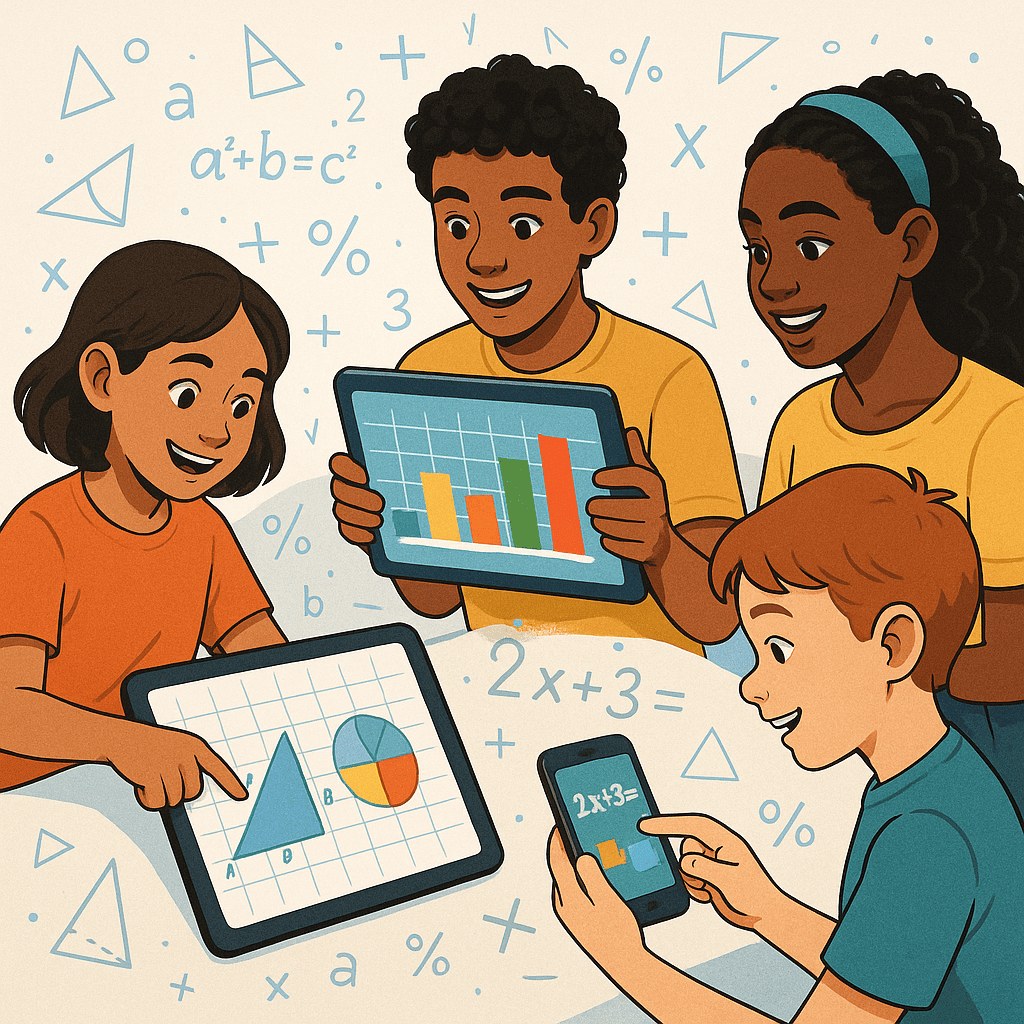
-In today's digital era, educational innovation is crucial for improving student learning, particularly in mathematics, which is often perceived as challenging. This study explores students' experiences and perceptions of the use of mobile-based mathematics learning media at the Madrasah Tsanawiyah (MTs) level in Pasuruan Regency. Using a qualitative approach, nine ninth-grade students were selected as primary participants. Data were collected through in-depth interviews, participant observation, and focus group discussions (FGDs), allowing researchers to understand the dynamics of students' interest, engagement, and challenges during mobile learning. Data analysis was conducted thematically to identify patterns in student experiences, perceived ease of use, and the impact of mobile media on understanding mathematical concepts such as algebra and geometry. The results showed that the majority of students experienced increased interest and engagement in learning thanks to the interactive features and flexible access offered by mobile media. Students also reported improved understanding of previously difficult material. However, several challenges remained, such as the need for technical assistance and adaptation to new methods. This study emphasizes the importance of a qualitative approach in understanding student learning experiences and provides recommendations for developing digital learning media that are responsive to student needs. These findings are expected to serve as a reference for educators and educational technology developers in designing more effective and meaningful learning innovations.
Downloads
References
Afifah, A., & Putri, A. D. (2021). Development of e-komatik media (mathematical e-comic) with a contextual approach to the material of rectangles and triangles. Jurnal Scientia, 10(1), 99–108. Retrieved from http://infor.seaninstitute.org/index.php/pendidikan
Afrilia, C. (2020). Development of mathematics learning device based on guided discovery of program of international student assessment model orientation (preliminary research). Journal of Physics Conference Series, 1481(1). http://doi.org/10.1088/1742-6596/1481/1/012130 DOI: https://doi.org/10.1088/1742-6596/1481/1/012130
Albano, G. (2024). Digital Experiences of Mathematical Cognitive Functions in Learning the Basic Concepts of General Topology. International Journal of Research in Undergraduate Mathematics Education, 10(3), 823–849. http://doi.org/10.1007/s40753-024-00245-3 DOI: https://doi.org/10.1007/s40753-024-00245-3
Anupan, A. (2022). A concept attainment model using cloud-based mobile learning to enhance the mathematical conceptual knowledge of undergraduate students. International Journal of Information and Education Technology, 12(2), 171–178. http://doi.org/10.18178/ijiet.2022.12.2.1601 DOI: https://doi.org/10.18178/ijiet.2022.12.2.1601
Bazán-Ramírez, A. (2022). Effects of Opportunities to Learn on Peruvian Students’ Science Achievement in Program for International Student Assessment 2015. Frontiers in Education, 7. http://doi.org/10.3389/feduc.2022.897473 DOI: https://doi.org/10.3389/feduc.2022.897473
Braido, P., & Zhang, X. (2004). Quantitative analysis of finger motion coordination in hand manipulative and gestic acts. Human Movement Science. Retrieved from https://www.sciencedirect.com/science/article/pii/S0167945703000836 DOI: https://doi.org/10.1016/j.humov.2003.10.001
Clarke-Midura, J. (2024). What Happened to the Geometry? Examining Spatial and Mathematical Concepts in Computational Toys and Kits for Young Children. ACM International Conference Proceeding Series, 47–56. http://doi.org/10.1145/3663433.3663459 DOI: https://doi.org/10.1145/3663433.3663459
Dhurandhar, S. (2024). Understanding Mathematical Concepts in Physics: Insights from Geometrical and Numerical Approaches. Lecture Notes in Physics, 1030, 1–351. http://doi.org/10.1007/978-3-031-60394-5 DOI: https://doi.org/10.1007/978-3-031-60394-5_1
Esbensen, K. H. (2020). 2.02 - Principal Component Analysis: Concept, Geometrical Interpretation, Mathematical Background, Algorithms, History, Practice. Comprehensive Chemometrics Chemical and Biochemical Data Analysis Second Edition Four Volume Set, 2, 3–15. http://doi.org/10.1016/B978-0-444-64165-6.05002-3 DOI: https://doi.org/10.1016/B978-0-444-64165-6.05002-3
Flood, V. J. (2020). Teaching with embodied learning technologies for mathematics: responsive teaching for embodied learning. Zdm Mathematics Education, 52(7), 1307–1331. http://doi.org/10.1007/s11858-020-01165-7 DOI: https://doi.org/10.1007/s11858-020-01165-7
Fujiarti, I. A. (2020). Pengembangan media pembelajaran Pocket Book Digital pada sub materi sistem rangka. digilib.uinsgd.ac.id. Retrieved from https://digilib.uinsgd.ac.id/35742/
Golse, N. (2020). Corrigendum: “Partial orthotopic liver transplantation in combination with two-stage hepatectomy: A proof-of-concept explained by mathematical modeling” (Clinical Biomechanics (2020) 73 (195–200), (S0268003320300462), (10.1016/j.clinbiomech.2020.01.020)). Clinical Biomechanics, 77. http://doi.org/10.1016/j.clinbiomech.2020.105047 DOI: https://doi.org/10.1016/j.clinbiomech.2020.01.020
Güler, M. (2022). A meta-analysis of the impact of mobile learning on mathematics achievement. Education and Information Technologies, 27(2), 1725–1745. http://doi.org/10.1007/s10639-021-10640-x DOI: https://doi.org/10.1007/s10639-021-10640-x
Guzmán, L. D. A., & Craig, J. (2019). The world in your pocket: Digital media as invitations for transdisciplinary inquiry in mathematics classrooms. Occasional Paper Series. Retrieved from https://educate.bankstreet.edu/occasional-paper-series/vol2019/iss41/6/ DOI: https://doi.org/10.58295/2375-3668.1274
Jacob, A., Brun, L., Jiménez Gil, P., Ménard, L., Bouzelha, M., Broucque, F., … Ayuso, E. (2021). Homologous Recombination Offers Advantages over Transposition‐Based Systems to Generate Recombinant Baculovirus for Adeno‐Associated Viral Vector Production. Biotechnology Journal, 16(1). http://doi.org/10.1002/biot.202000014 DOI: https://doi.org/10.1002/biot.202000014
Julie, H. (2020). The teachers’ ability in mathematical literacy for space and shape problems on Program for International Student Assessment (PISA) adaptation test. Journal of Physics Conference Series, 1470(1). http://doi.org/10.1088/1742-6596/1470/1/012096 DOI: https://doi.org/10.1088/1742-6596/1470/1/012096
Khulafa, F. N., & Santosa, P. (2018). The developmet of pocket book as learning media to make batik jumput in multicultural arts and scarf subject. Asia Pacific Journal of …. Retrieved from https://apiarpublications.com/wp-content/uploads/2017/08/6_ICTP_2017_BRR709_Edu-42-48.pdf
Kurvinen, E. (2020). Long term effects on technology enhanced learning: The use of weekly digital lessons in mathematics. Informatics in Education, 19(1), 51–75. http://doi.org/10.15388/INFEDU.2020.04 DOI: https://doi.org/10.15388/infedu.2020.04
Lein, A. E. (2020). Effectiveness of mathematical word problem solving interventions for students with learning disabilities and/or mathematics difficulties: A meta-analysis. Journal of Educational Psychology, 112(7), 1388–1408. http://doi.org/10.1037/edu0000453 DOI: https://doi.org/10.1037/edu0000453
Mamolo, L. A. (2022). Online Learning and Students’ Mathematics Motivation, Self-Efficacy, and Anxiety in the “new Normal.” Education Research International, 2022. http://doi.org/10.1155/2022/9439634 DOI: https://doi.org/10.1155/2022/9439634
McLaughlin, K. (2007). Expanding business with information-packed’pocket media’. Healthcare Advertising Review. Retrieved from https://go.gale.com/ps/i.do?id=GALE%7CA170372577&sid=googleScholar&v=2.1&it=r&linkaccess=abs&issn=87564513&p=HRCA&sw=w
Meeter, M. (2021). Primary school mathematics during the COVID-19 pandemic: No evidence of learning gaps in adaptive practicing results. Trends in Neuroscience and Education, 25. http://doi.org/10.1016/j.tine.2021.100163 DOI: https://doi.org/10.1016/j.tine.2021.100163
Mulenga, E. M. (2020). Is covid-19 the gateway for digital learning in mathematics education? Contemporary Educational Technology, 12(2), 1–11. http://doi.org/10.30935/cedtech/7949 DOI: https://doi.org/10.30935/cedtech/7949
Ningsih, U. (2019). Pengembangan media GPB (Geometry Pocket Box) pada bidang perkembangan kognitif anak usia 5-6 tahun di Desa Damarwulan. repository.um.ac.id. Retrieved from https://repository.um.ac.id/70666/
Noviyanti, M. (2025). TRANSFORMATION OF MATHEMATICAL KNOWLEDGE FOR TEACHING NON-EUCLIDEAN GEOMETRY CONCEPT THROUGH E-LEARNING BASED ON THE THEORY OF DIDACTIC SITUATIONS USING A MULTIPHASE MIXED METHOD. Jurnal Ilmiah Ilmu Terapan Universitas Jambi, 9(2), 578–597. http://doi.org/10.22437/jiituj.v9i2.42976 DOI: https://doi.org/10.22437/jiituj.v9i2.42976
Pardos, Z. A. (2024). ChatGPT-generated help produces learning gains equivalent to human tutor-authored help on mathematics skills. Plos One, 19(5). http://doi.org/10.1371/journal.pone.0304013 DOI: https://doi.org/10.1371/journal.pone.0304013
Pedro, F. (2021). Azbot-1C: An Educational Robot Prototype for Learning Mathematical Concepts. Communications in Computer and Information Science, 1488, 657–669. http://doi.org/10.1007/978-3-030-91885-9_49 DOI: https://doi.org/10.1007/978-3-030-91885-9_49
Pujiastuti, H. (2020). The development of interactive mathematics learning media based on local wisdom and 21st century skills: Social arithmetic concept. Journal of Physics Conference Series, 1521(3). http://doi.org/10.1088/1742-6596/1521/3/032019 DOI: https://doi.org/10.1088/1742-6596/1521/3/032019
Riabov, V. V. (2020). Exploring Mathematical and Computational Concepts for STEM Education in Colleges. International Journal of Technology Knowledge and Society, 16(4), 1–22. http://doi.org/10.18848/1832-3669/CGP/v16i04/1-22 DOI: https://doi.org/10.18848/1832-3669/CGP/v16i04/1-22
Shi, R. (2020). Exosomes derived from mmu_circ_0000250-modified adipose-derived mesenchymal stem cells promote wound healing in diabetic mice by inducing miR-128-3p/SIRT1-mediated autophagy. American Journal of Physiology Cell Physiology, 318(5). http://doi.org/10.1152/ajpcell.00041.2020 DOI: https://doi.org/10.1152/ajpcell.00041.2020
Spagnolo, F. S. (2020). The use of sampling weights in M-quantile random-effects regression: an application to Programme for International Student Assessment mathematics scores. Journal of the Royal Statistical Society Series C Applied Statistics, 69(4), 991–1012. http://doi.org/10.1111/rssc.12418 DOI: https://doi.org/10.1111/rssc.12418
Sumarwati, S. (2020). Developing mathematics learning media based on elearning using moodle on geometry subject to improve students’ higher order thinking skills. International Journal of Interactive Mobile Technologies, 14(4), 182–191. http://doi.org/10.3991/IJIM.V14I04.12731 DOI: https://doi.org/10.3991/ijim.v14i04.12731
Trimurtini, T. (2020). The effectivity of contextual teaching and learning (CTL) approach with Geoboard media on mathematics learning for four-grade elementary students. Journal of Physics Conference Series, 1663(1). http://doi.org/10.1088/1742-6596/1663/1/012050 DOI: https://doi.org/10.1088/1742-6596/1663/1/012050
Udhma, U. S., & Sari, R. C. (2017). The Development Of Learning Media By Using Pocket Book Of Financial Literacy To Improve Knowledge Of Vocational Student’s Personal Finance …. Kajian Pendidikan Akuntansi Indonesia. Retrieved from https://www.researchgate.net/profile/Umi-Udhma/publication/379082405_THE_DEVELOPMENT_OF_LEARNING_MEDIA_BY_USING_POCKET_BOOK_OF_FINANCIAL_LITERACY_TO_IMPROVE_KNOWLEDGE_OF_VOCATIONAL_STUDENT’S_PERSONAL_FINANCE_MANAGEMENT/links/65fa61ffa4857c796260eaa3/THE-D
Wang, J. (2020). Fuzzy mathematics and machine learning algorithms application in educational quality evaluation model. Journal of Intelligent and Fuzzy Systems, 39(4), 5583–5593. http://doi.org/10.3233/JIFS-189039 DOI: https://doi.org/10.3233/JIFS-189039
Yanti, A. W. (2021). Profile of concept shadows of students in solving mathematical problems viewed from learning style. Aip Conference Proceedings, 2330. http://doi.org/10.1063/5.0043374 DOI: https://doi.org/10.1063/5.0043374
Yuniati, B. Y. (2020). The influence of realistic mathematics education (RME) approach with the TANDUR on understanding the concepts and solving mathematical problems on grade 8 in smp negeri 1 pantai cermin. Journal of Physics Conference Series, 1554(1). http://doi.org/10.1088/1742-6596/1554/1/012063 DOI: https://doi.org/10.1088/1742-6596/1554/1/012063
Zhou, D. (2022). Relationships among problematic smartphone use, mathematics anxiety, learning interest, and achievement: A multiple mediation model. Computers in Human Behavior, 129. http://doi.org/10.1016/j.chb.2021.107171 DOI: https://doi.org/10.1016/j.chb.2021.107171
Published
How to Cite
Issue
Section
License
Copyright (c) 2025 Fitroh Ariansyah, Syed Muhammad Yousaf Farooq, Ahmad Munif

This work is licensed under a Creative Commons Attribution-ShareAlike 4.0 International License.




 ARTICLE TEMPLATE