Understanding the Role of Simulation-Based Mathematics Learning Media in Developing Early Childhood Cognitive Abilities
DOI:
https://doi.org/10.61650/dpjpm.v1i3.46Keywords:
Learning media, cognitive abilities, early childhoodAbstract
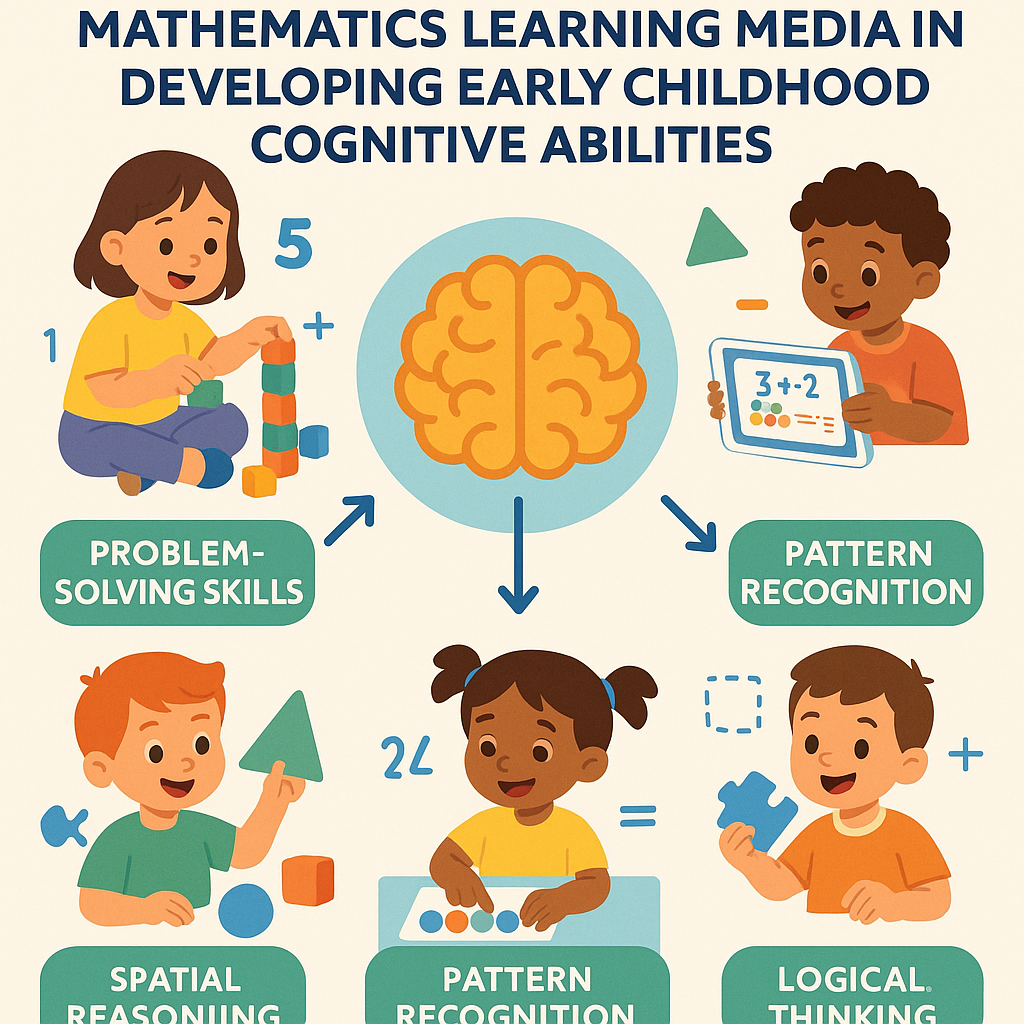
This study aims to understand the role of simulation-based mathematics learning media in developing the cognitive abilities of early childhood. This media is an interactive approach that utilizes a digital or virtual environment to represent mathematical concepts in a concrete and engaging manner for children. Through simulation, children can explore, manipulate, and solve mathematical problems directly, thereby encouraging active engagement and meaningful learning. Recent studies have shown that the use of simulation media can improve conceptual understanding, critical thinking skills, and problem-solving abilities in early childhood. Simulation also provides an adaptive learning experience that can be tailored to the needs and learning styles of each child, effectively accommodating the diversity of cognitive abilities in the classroom. In addition, simulation media supports cognitive development in accordance with Piaget's and Vygotsky's theories, where children learn through active interaction with the environment and guidance from adults. This study highlights the importance of selecting and developing simulation media that are appropriate to the cognitive developmental stage of early childhood, as well as the need to evaluate the effectiveness of these media through valid and reliable measuring instruments. Thus, simulation-based mathematics learning media has the potential to be an innovative solution in improving the quality of mathematics learning and supporting the optimal cognitive development of early childhood.
Downloads
References
Björklund, C. (2020). Research on early childhood mathematics teaching and learning. Zdm Mathematics Education, 52(4), 607–619. http://doi.org/10.1007/s11858-020-01177-3
Christou, C. (2024). Teachers’ mathematical problem posing: The role of processes and complexity levels in posing problems on the fraction part-whole concept. Journal of Mathematical Behavior, 73. http://doi.org/10.1016/j.jmathb.2024.101134
Codreanu, E. (2020). Between authenticity and cognitive demand: Finding a balance in designing a video-based simulation in the context of mathematics teacher education. Teaching and Teacher Education, 95. http://doi.org/10.1016/j.tate.2020.103146
DeLoache, J. S., Sugarman, S., & Brown, A. L. (1985). The development of error correction strategies in young children’s manipulative play. Child Development. Retrieved from https://www.jstor.org/stable/1130105
Desnita, D. (2022). The Effectiveness of CTL-based Physics E-module on the Improvement of the Creative and Critical Thinking Skills of Senior High School Students. TEM Journal, 11(2), 802–810. http://doi.org/10.18421/TEM112-38
Egara, F. O. (2024). Effect of flipped classroom learning approach on mathematics achievement and interest among secondary school students. Education and Information Technologies, 29(7), 8131–8150. http://doi.org/10.1007/s10639-023-12145-1
Erath, K. (2021). Designing and enacting instruction that enhances language for mathematics learning: a review of the state of development and research. Zdm Mathematics Education, 53(2), 245–262. http://doi.org/10.1007/s11858-020-01213-2
Fuller, A. (2020). Digital Twin: Enabling Technologies, Challenges and Open Research. IEEE Access, 8, 108952–108971. http://doi.org/10.1109/ACCESS.2020.2998358
Graham, S. (2020). The Effects of Writing on Learning in Science, Social Studies, and Mathematics: A Meta-Analysis. Review of Educational Research, 90(2), 179–226. http://doi.org/10.3102/0034654320914744
Guiney, P. A., Chou, R., Vianna, A., & ... (2005). Effects of osteopathic manipulative treatment on pediatric patients with asthma: a randomized controlled trial. Journal of Osteopathic …. http://doi.org/10.7556/jaoa.2005.105.1.7
Khasawneh, A. A. (2023). The impact of mathematics learning environment supported by error-analysis activities on classroom interaction. Eurasia Journal of Mathematics Science and Technology Education, 19(2). http://doi.org/10.29333/ejmste/12951
Kristanto Mulyono, & Yeni Apriyani. (2021). Analisis Pengendalian Qualitas Produk Dengan Metode Sqc (Statistical Quality Control). JENIUS : Jurnal Terapan Teknik Industri, 2(1), 41–50. http://doi.org/10.37373/jenius.v2i1.93
Lee, H. Y. (2024). Integrating Computational Thinking Into Scaffolding Learning: An Innovative Approach to Enhance Science, Technology, Engineering, and Mathematics Hands-On Learning. Journal of Educational Computing Research, 62(2), 431–467. http://doi.org/10.1177/07356331231211916
Lestari, A. S. B. L., Afifah, A., & Supriyo. (2023). Analisis Commognitive Matematis Siswa dalam Menyelesaikan Soal Cerita Secara Berpasangan. Jurnal Pendidikan Matematika (JPM), 9(2), 154–163. http://doi.org/10.33474/jpm.v9i2.20105
Marshall, L., & Swan, P. (2008). Exploring the use of mathematics manipulative materials: Is it what we think it is? ro.ecu.edu.au. Retrieved from https://ro.ecu.edu.au/ceducom/33/
Marsigit, M. (2020). Constructing mathematical concepts through external representations utilizing technology: An implementation in IRT course. TEM Journal, 9(1), 317–326. http://doi.org/10.18421/TEM91-44
Mo, Y. (2024). Design and Simulation of Intelligent Matching Algorithm for Online Primary School Mathematics Curriculum Based on Deep Learning. Lecture Notes of the Institute for Computer Sciences Social Informatics and Telecommunications Engineering Lnicst, 583, 89–97. http://doi.org/10.1007/978-3-031-63139-9_10
Nasution, M. L. (2020). Development of students’ understanding of mathematical concept with STAD type cooperative learning through student worksheets. Journal of Physics Conference Series, 1554(1). http://doi.org/10.1088/1742-6596/1554/1/012035
Poçan, S. (2023). The Effects of Mobile Technology on Learning Performance and Motivation in Mathematics Education. Education and Information Technologies, 28(1), 683–712. http://doi.org/10.1007/s10639-022-11166-6
Qisma, N., & Afifah, A. (2024). Pengembangan Media Pembelajaran Matematika Board Game Magic Shop Pada Materi Aritmatika Sosial. Jurnal PEKA (Pendidikan Matematika), 8(1), 28–34. http://doi.org/https://doi.org/10.37150/jp.v8i1.2540
Qurrotaini, L., Kusumawardani, S., & ... (n.d.). Efforts to Improve Learning Outcomes for Mathematics At SDN Aren Jaya VI Bekasi Through Media Pocket Counting. PROCEEDINGS OF …. Retrieved from https://humanities.utm.my/isei/wp-content/uploads/sites/27/2019/07/proceeding-colloquiumlatest.pdf#page=106
Rahayu, Y. T., Meilani, S. M., & ... (2019). The Effectiveness Of Mathematics Learning Outcomes Through Smart Pocket Card Media (Picture Card And Number Card) In The ABA 15 Kindergarten. Indonesian Journal of Early …. Retrieved from https://journal.unnes.ac.id/sju/ijeces/article/view/34235
Rittle-Johnson, B. (2020). How Can Cognitive-Science Research Help Improve Education? The Case of Comparing Multiple Strategies to Improve Mathematics Learning and Teaching. Current Directions in Psychological Science, 29(6), 599–609. http://doi.org/10.1177/0963721420969365
Robertson, S. A. (2020). Language as an including or excluding factor in mathematics teaching and learning. Mathematics Education Research Journal, 32(1), 77–101. http://doi.org/10.1007/s13394-019-00302-0
Rohimah, S. M. (2024). A learning trajectory to develop students’ mathematical proficiency of linear equation in one variable. Aip Conference Proceedings, 3058(1). http://doi.org/10.1063/5.0201061
Saripah, I. (2023). The Arrangement of Hots Question Card Instrument as A Complementary Forming For Student Critical Behavior to Achieve Learning Outcomes During Online Learning in New Normal Era. Aip Conference Proceedings, 2679. http://doi.org/10.1063/5.0111333
Setiawan, A. A. (2022). Blended Learning and Student Mathematics Ability in Indonesia: A Meta-Analysis Study. International Journal of Instruction, 15(2), 905–916. http://doi.org/10.29333/iji.2022.15249a
Shabana, K. M. (2023). Unsupervised Concept Tagging of Mathematical Questions from Student Explanations. Lecture Notes in Computer Science Including Subseries Lecture Notes in Artificial Intelligence and Lecture Notes in Bioinformatics, 13916, 627–638. http://doi.org/10.1007/978-3-031-36272-9_51
Sheromova, T. S. (2020). Learning styles and development of cognitive skills in mathematics learning. Eurasia Journal of Mathematics Science and Technology Education, 16(11). http://doi.org/10.29333/EJMSTE/8538
Suh, J., Moyer, P. S., & Heo, H. J. (2005). Examining technology uses in the classroom: Developing fraction sense using virtual manipulative concept tutorials. Journal of Interactive Online Learning. Retrieved from http://mason.gmu.edu/~jsuh4/tenure/part4thru8/papers/J.interactive online learnng .examining tech.pdf
Sümmermann, M. L. (2021). Mathematics in the Digital Age: The Case of Simulation-Based Proofs. International Journal of Research in Undergraduate Mathematics Education, 7(3), 438–465. http://doi.org/10.1007/s40753-020-00125-6
Takaria, J. (2020). Mathematical self-concept among prospective teachers. International Journal of Evaluation and Research in Education, 9(4), 799–806. http://doi.org/10.11591/ijere.v9i4.20464
Tare, M., Chiong, C., Ganea, P., & DeLoache, J. (2010). Less is more: How manipulative features affect children’s learning from picture books. Journal of Applied …. Retrieved from https://www.sciencedirect.com/science/article/pii/S0193397310000808
Toma, T. R. (2025). Answering User Questions About Machine Learning Models Through Standardized Model Cards. Proceedings International Conference on Software Engineering, 1488–1500. http://doi.org/10.1109/ICSE55347.2025.00066
von Bülow, K. (2023). SIMULATION-BASED MATHEMATICS AND SOCIAL JUSTICE ACTIVITIES LEARNING FROM STUDENT REFLECTIONS. Prometeica, (27), 316–326. http://doi.org/10.34024/prometeica.2023.27.15303
Wang, X. (2025). Simulation Research on Mathematical Model of Network Node Matching Problem Based on Fuzzy Mathematics. Proceedings 2025 International Conference on Electrical Drives Power Electronics and Engineering Edpee 2025, 1299–1303. http://doi.org/10.1109/EDPEE65754.2025.00234
Wankerl, S. (2023). Can Neural Networks Distinguish High-school Level Mathematical Concepts? Proceedings IEEE International Conference on Data Mining Icdm, 1397–1402. http://doi.org/10.1109/ICDM58522.2023.00181
Weinan, E. (2020). Machine learning and computational mathematics. Communications in Computational Physics, 28(5), 1639–1670. http://doi.org/10.4208/CICP.OA-2020-0185
Weng, X. (2023). Creativity Development With Problem-Based Digital Making and Block-Based Programming for Science, Technology, Engineering, Arts, and Mathematics Learning in Middle School Contexts. Journal of Educational Computing Research, 61(2), 304–328. http://doi.org/10.1177/07356331221115661
Wilkinson, H. R. (2020). Domain-Specific Inhibitory Control Training to Improve Children’s Learning of Counterintuitive Concepts in Mathematics and Science. Journal of Cognitive Enhancement, 4(3), 296–314. http://doi.org/10.1007/s41465-019-00161-4
Xu, W. (2022). The application of AI technologies in STEM education: a systematic review from 2011 to 2021. International Journal of Stem Education, 9(1). http://doi.org/10.1186/s40594-022-00377-5
Yang, H. (2022). Physical Concept Understanding and Mathematical Calculation of Active/Reactive Power in Dynamic Process of Three-phase System Under Time-varying Amplitude-frequency Signals. Zhongguo Dianji Gongcheng Xuebao Proceedings of the Chinese Society of Electrical Engineering, 42(2), 548–558. http://doi.org/10.13334/j.0258-8013.pcsee.202095
Yu, X. (2024). Adjustable Model and Database for Teaching Mathematics Based on Virtual Simulation. 2024 IEEE 7th Eurasian Conference on Educational Innovation Educational Innovations and Emerging Technologies Ecei 2024, 71–74. http://doi.org/10.1109/ECEI60433.2024.10510874
Zhang, X. (2020). Early Cognitive Precursors of Children’s Mathematics Learning Disability and Persistent Low Achievement: A 5-Year Longitudinal Study. Child Development, 91(1), 7–27. http://doi.org/10.1111/cdev.13123
Published
How to Cite
Issue
Section
License
Copyright (c) 2023 Delta-Phi: Jurnal Pendidikan Matematika

This work is licensed under a Creative Commons Attribution-ShareAlike 4.0 International License.




 ARTICLE TEMPLATE