Keywords: AI in Education, Adaptive Learning, Biometric Feedback, Instructional Technology, Swimming Competency
Abstract
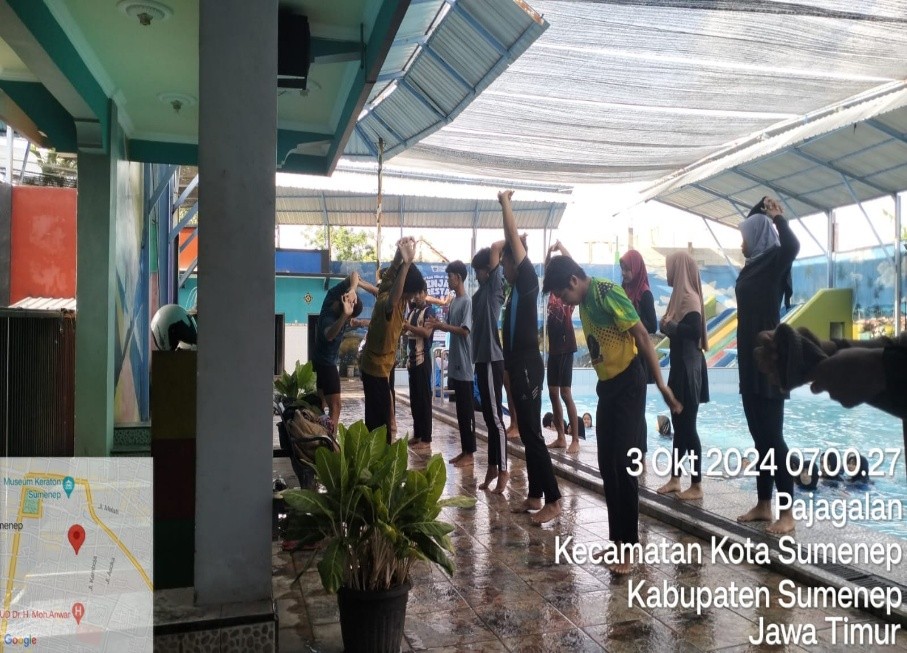
The digital transformation in higher education necessitates a shift from subjective, manual pedagogical evaluations toward objective, data-driven strategies, particularly in complex physical domains like aquatic skills. This study aims to develop and analyze an intelligent instructional navigation model using wearable sensor-based artificial intelligence (AI) to provide real-time biometric feedback and accelerate swimming competencies and student self-efficacy. Employing a quasi-experimental design, the research integrated smartwatches and AI algorithms to monitor biometric metrics and intensity zones (Z1–Z5), providing immediate haptic scaffolding during learning sessions. The results indicate that the AI-driven model significantly enhances evaluation objectivity and motor adaptation speed compared to conventional methods, with the experimental group achieving substantially higher psychomotor scores (8.8 vs. 7.1; p < 0.01). Notably, the findings reveal that training duration without precise intensity zone management does not significantly improve performance, highlighting biometric-based scaffolding as the critical variable for instructional success. This study concludes that transforming instructional frameworks through AI-driven navigation acts as a vital catalyst for achieving Sustainable Development Goals (SDGs), specifically Quality Education and Good Health, by ensuring a measurable, safe, and adaptive learning ecosystem. This model offers a scalable pedagogical framework for modernizing sports education through the scholarship of teaching and learning (SoTL).
References
Amirudin, N., Anwar, K., Ifadah, A. S., Sya’bani, M. A. Y., & Basri, H. (2025). Analysis of Learning Evaluation Issues Affecting Educational Goal Achievement in Islamic Education. International Research Journal of Multidisciplinary Scope, 6(4), 299–312. https://doi.org/10.47857/irjms.2025.v06i04.05800 DOI: https://doi.org/10.47857/irjms.2025.v06i04.05800
Arhesa, S., & Badriah, D. L. (2021). Aquatic training with play methods in improving swimming skills in preschool children. International Journal of Human Movement and Sports Sciences, 9(4), 106–111. https://doi.org/10.13189/saj.2021.091318 DOI: https://doi.org/10.13189/saj.2021.091318
Arifuddin, A., Zuchdi, D., Rosana, D., Arovah, N. I., Setiawan, C., Prihatni, Y., Setiawan, A., Nur, A. F., Dyastuti, N. E., & Arifuddin, H. (2023). Strengthening of early children’s character education stunting children in Indonesia. Journal of Education and Health Promotion, 12(1). https://doi.org/10.4103/jehp.jehp_1857_22 DOI: https://doi.org/10.4103/jehp.jehp_1857_22
Arre, A. M., & Horschler, D. J. (2021). Swimming and diving as social play in juvenile rhesus macaques (Macaca mulatta). Behaviour, 158(6), 529–546. https://doi.org/10.1163/1568539X-bja10074 DOI: https://doi.org/10.1163/1568539X-bja10074
Basri, H., Maulana, R. H., & Baihaqi, M. A. (2026). Tarbiyyah Ruhiyyah and Deviant Behavior in Islamic Schools: An Empirical Sem-Based Study. Jurnal Ilmiah Peuradeun, 14(1), 371–392. https://doi.org/10.26811/peuradeun.v14i1.2549 DOI: https://doi.org/10.26811/peuradeun.v14i1.2549
Bennett, S. H., Waldron, J. L., & Welch, S. M. (2012). Light bait improves capture success of aquatic funnel-trap sampling for larval amphibians. Southeastern Naturalist, 11(1), 49–58. https://doi.org/10.1656/058.011.0105 DOI: https://doi.org/10.1656/058.011.0105
Borioni, F., Biino, V., Tinagli, V., & Pesce, C. (2022). Effects of Baby Swimming on Motor and Cognitive Development: A Pilot Trial. Perceptual and Motor Skills, 129(4), 977–1000. https://doi.org/10.1177/00315125221090203 DOI: https://doi.org/10.1177/00315125221090203
Day, D. (2012). What girl will now remain ignorant of swimming? Agnes beckwith, aquatic entertainer and victorian role model. Women’s History Review, 21(3), 419–446. https://doi.org/10.1080/09612025.2012.661152 DOI: https://doi.org/10.1080/09612025.2012.661152
de Jesus, E. E. D., Sperandio, J., Brasilino, F. F., & Morales, P. J. C. (2023). Anthropometry and aquatic skills of children who attend swimming. Sport TK, 12. https://doi.org/10.6018/sportk.568291 DOI: https://doi.org/10.6018/sportk.568291
Dollah, S., Basri, M., Asiza, N., & Akib, M. (2025). Teachers’ Pedagogical Competencies in Implementing Contextual Teaching and Learning in Vocational High Schools in South Sulawesi. International Journal of Language Education, 9(1), 180–194. https://doi.org/10.26858/ijole.v1i1.74766
Effectiveness of the Use of Information Technology in the Merdeka Mengajar Platform in Islamic Religious Education Learning in Pringsewu Regency, 2 Assyfa Journal of Islamic Studies 97 (2024). https://journal.assyfa.com/index.php/ajis/article/view/550 DOI: https://doi.org/10.61650/ajis.v2i2.549
Esser-Noethlichs, M., & Hegland, L. (2026). PE teachers’ experiences with teaching outdoor swimming, self-rescue and lifesaving: A context for skill development or Bildung? European Physical Education Review, 32(2), 404–420. https://doi.org/10.1177/1356336X251358128 DOI: https://doi.org/10.1177/1356336X251358128
Guignard, B., Rouard, A., Chollet, D., Bonifazi, M., Dalla Vedova, D., Hart, J., & Seifert, L. (2020). Coordination Dynamics of Upper Limbs in Swimming: Effects of Speed and Fluid Flow Manipulation. Research Quarterly for Exercise and Sport, 91(3), 433–444. https://doi.org/10.1080/02701367.2019.1680787 DOI: https://doi.org/10.1080/02701367.2019.1680787
Hong, Z., Ying, T., Richmond, C., & Mosto, P. (2007). IMAPS - A multidisciplinary aquatic robot project. ASEE Annual Conference and Exposition, Conference Proceedings. https://www.scopus.com/pages/publications/85029104090?origin=resultslist
Isles, A. F., & Pearn, J. H. (2013). Swimming and survival: Two lessons from history. International Journal of Aquatic Research and Education, 7(2), 163–166. https://doi.org/10.25035/ijare.07.02.08 DOI: https://doi.org/10.25035/ijare.07.02.08
Janssen, J. D. (2024). Diversifying Aquatic Husbandry: Creating a Wake of Equity and Inclusion. Journal of Museum Education, 49(3), 296–305. https://doi.org/10.1080/10598650.2024.2386486 DOI: https://doi.org/10.1080/10598650.2024.2386486
Jochems, L., Brandt, J., Kingdon, C., Schurkamp, S. J., Monks, A., & Lishawa, S. C. (2024). Active remote sensing data and dispersal processes improve predictions for an invasive aquatic plant during a climatic extreme in Great Lakes coastal wetlands. Journal of Environmental Management, 370. https://doi.org/10.1016/j.jenvman.2024.122610 DOI: https://doi.org/10.1016/j.jenvman.2024.122610
Johnson, C. R. (1988). Aquatic therapy for an ALS patient. The American Journal of Occupational Therapy. : Official Publication of the American Occupational Therapy Association, 42(2), 115–120. https://doi.org/10.5014/ajot.42.2.115 DOI: https://doi.org/10.5014/ajot.42.2.115
Kalra, R., Chatterjee, S., Goyal, M., & Goyal, K. (2025). Aquatic Therapy and Autism: A Therapeutic Alliance. In Rehabilitation Approach in Autism (pp. 121–133). Springer Science+Business Media. https://doi.org/10.1007/978-981-96-4162-8_7 DOI: https://doi.org/10.1007/978-981-96-4162-8_7
Kaushal, J., & Mahajan, P. (2022). Aquatic macrophytes and algae in textile wastewater treatment. In Algae and Aquatic Macrophytes in Cities: Bioremediation, Biomass, Biofuels and Bioproducts (pp. 103–117). Elsevier. https://doi.org/10.1016/B978-0-12-824270-4.00002-X DOI: https://doi.org/10.1016/B978-0-12-824270-4.00002-X
Konukman, F., Sortwell, A., Filiz, B., Tüfekçioglu, E., & Hermassi, S. (2025). Aquatic Plyometric Drills for Children. Strategies, 38(1), 46–49. https://doi.org/10.1080/08924562.2024.2424728 DOI: https://doi.org/10.1080/08924562.2024.2424728
Lynch, T. (2015). Australian aquatic curriculum reform: Treading water carefully? International Journal of Aquatic Research and Education, 9(2), 201–213. https://doi.org/10.1123/ijare.2015-0005 DOI: https://doi.org/10.1123/ijare.2015-0005
Margaret Thompson, I., Warner, M., Hudson, D., Banks, J., & Logan, O. (2022). Coaching practices to develop underwater fly kick performance in swimming training. International Journal of Sports Science and Coaching, 17(5), 984–998. https://doi.org/10.1177/17479541221101598 DOI: https://doi.org/10.1177/17479541221101598
Mas’odi, M., Darmayanti, R., Basri, M. H., Prasetyo, D. A., Weldani, F., Hidayatullah, S. H., & Dhakal, A. (2025). Landscape Kompetensi Calon Guru Pjok Di STKIP PGRI Sumenep Melalui Pelaksanaan Kegiatan Outbound Di Bumi Perkemahan Bedengan Batu. Center of Education Journal (CEJou), 6(1). https://doi.org/10.55757/cejou.v6i1.567
Mas’odi, M., Ramadhani, D. D., Santoso, C. R., Agustin, F. W., & Darmayanti, R. (2025). Community Service Innovation of STKIP PGRI Sumenep Lecturers: Using Canva to Develop PE Modules in Elementary Schools. SSRN Electronic Journal. https://doi.org/10.2139/ssrn.5403502 DOI: https://doi.org/10.2139/ssrn.5403502
Mekkaoui, L., Potdevin, F., Derigny, T., Gandrieau, J., Staub, I., DeMartelaer, K., Kovács, Z., Olstad, B. H., Rejman, M., Soares, S., & Vogt, T. (2025). Towards a Consensus on the development of the Aquatic Curricula Analysis Tool using an Ecosystem Approach: A Delphi Method. Physical Activity Review, 13(1), 141–155. https://doi.org/10.16926/par.2025.13.13 DOI: https://doi.org/10.16926/par.2025.13.13
Min, W., Laouid, A., Hammoudeh, M., Ferik, B., & Azzedin, F. (2026). Protecting consumer healthcare imaging data from AI-tampering via blind reversible watermarking. IEEE Transactions on Consumer Electronics. https://doi.org/10.1109/TCE.2026.3670869 DOI: https://doi.org/10.1109/TCE.2026.3670869
Murcia, J. A. M., Hernandez, E. H., & Parra, J. A. R. (2017). Acquisition of aquatic motor skills through children’s motor stories. International Journal of Aquatic Research and Education, 10(3). https://doi.org/10.25035/ijare.10.03.01 DOI: https://doi.org/10.25035/ijare.10.03.01
Naczk, A., Gajewska, E., & Naczk, M. (2021). Effectiveness of swimming program in adolescents with down syndrome. International Journal of Environmental Research and Public Health, 18(14). https://doi.org/10.3390/ijerph18147441 DOI: https://doi.org/10.3390/ijerph18147441
odi, M. M., Darmayanti, R., Basri, M. H., Prasetyo, D. A., Weldani, F., & ... (2025). Landscape Kompetensi Calon Guru Pjok Di STKIP PGRI Sumenep Melalui Pelaksanaan Kegiatan Outbound Di Bumi Perkemahan Bedengan Batu. In Center of Education Journal (CEJou) (Vol. 6, Number 1, pp. 9–20). https://scholar.google.com/citations?view_op=view_citation&hl=en&user=3YBrj-MAAAAJ&cstart=100&pagesize=100&citation_for_view=3YBrj-MAAAAJ:1kzFgieWZDIC DOI: https://doi.org/10.55757/cejou.v6i1.567
Patil, M., Goudar, R. H., & Hukkeri, G. S. (2026). AI for swimming recommendation systems exploring the current landscape and research opportunities. Discover Applied Sciences, 8(2). https://doi.org/10.1007/s42452-025-08156-x DOI: https://doi.org/10.1007/s42452-025-08156-x
Pinto, R. F., & Moreno Murcia, J. A. (2023). Towards a Globalised Vision of Aquatic Competence. International Journal of Aquatic Research and Education, 14(1). https://doi.org/10.25035/ijare.14.01.11 DOI: https://doi.org/10.25035/ijare.14.01.11
Ponciano Núñez, P. D. (2025). Sport, consciousness, and epistemic justice: a critical model for decolonising sport-for-development in the Global South. Third World Quarterly, 46(17), 2371–2387. https://doi.org/10.1080/01436597.2025.2552350 DOI: https://doi.org/10.1080/01436597.2025.2552350
Ramón, J. M. S., & Valero, A. F. (2018a). Use of floating material in swimming. Apunts. Educacion Fisica y Deportes, (132), 48–59. https://doi.org/10.5672/APUNTS.2014-0983.CA.(2018/2).132.04 DOI: https://doi.org/10.5672/apunts.2014-0983.ca.(2018/2).132.04
Ramón, J. M. S., & Valero, A. F. (2018b). Use of floating material in swimming. Apunts. Educacion Fisica y Deportes, (132), 48–59. https://doi.org/10.5672/apunts.2014-0983.es.(2018/2).132.04 DOI: https://doi.org/10.5672/apunts.2014-0983.es.(2018/2).132.04
Ramón, J. M. S., & Valero, A. F. (2018c). Use of floating material in swimming. Apunts. Educacion Fisica y Deportes, (132), 48–59. https://doi.org/10.5672/apunts.2014-0983.cat.(2018/2).132.04
Rujito, L., Muhaimin, A., Pergodi, M. A., Darmawan, A. S., Ferine, M., & Wahyudin, W. (2026). Understanding AI adoption in medical education: Insights from students and faculty members in Indonesian medical schools. Journal of Education and Health Promotion, 15(1). https://doi.org/10.4103/jehp.jehp_580_25 DOI: https://doi.org/10.4103/jehp.jehp_580_25
Rushanan, S. G., Nilsen, D. M., Grajo, L., & Caroll, K. (2025). Assessing and Building Clinical Competence in Occupational Therapists Treating Patients with Neurodegenerative Disease: A Community of Practice Study. Occupational Therapy in Health Care, 39(1), 1–21. https://doi.org/10.1080/07380577.2022.2105470 DOI: https://doi.org/10.1080/07380577.2022.2105470
Santibañez-Gutierrez, A., Fernández-Landa, J., Calleja-González, J., Todorović, N., Ranisavljev, M., Štajer, V., Anđelić, B., Zenić, N., Bianco, A., & Drid, P. (2022). Epidemiology of children’s swimming competence and water safety. Frontiers in Public Health, 10. https://doi.org/10.3389/fpubh.2022.961342 DOI: https://doi.org/10.3389/fpubh.2022.961342
Segesdi, M., & Pecsics, T. (2022). Trends of avian locomotion in water - an overview of swimming styles. Ornis Hungarica, 30(1), 30–46. https://doi.org/10.2478/orhu-2022-0003 DOI: https://doi.org/10.2478/orhu-2022-0003
Setyawan, F. B., Priambadha, A. A., Sofyan, I., Susanto, B. H., Rohani, N., Astuti, D. T., & Chun, A. C. (2026). Needs Analysis for Designing and Developing a Traditional Games Application to Enhance Psychomotor and Cognitive Skills in Inclusive Elementary Education. Journal of Teaching and Learning, 20(2), 74–96. https://doi.org/10.22329/jtl.v20i2.10219 DOI: https://doi.org/10.22329/jtl.v20i2.10219
Stronach, M., & Adair, D. (2020). Swimming for Their Lives: PALAWA WOMEN OF LUTRUWITA (VAN DIEMEN’S LAND)1 . Sporting Traditions, 37(2), 47–70. https://www.scopus.com/pages/publications/85141069514?origin=resultslist
Suhartini, A., Nursobah, A., Basri, H., Hayati, T., & Erihadiana, M. (2025). Reflection Learning Experience of Islamic Religious Education Based on Spiritual and Social Values. Educational Process: International Journal, 18. https://doi.org/10.22521/edupij.2025.18.488 DOI: https://doi.org/10.22521/edupij.2025.18.488
Supriani, Y., Basri, H., & Suhartini, A. (2023). Leadership Role in the Formation of Students’ Morals. Munaddhomah, 4(3), 528–538. https://doi.org/10.31538/munaddhomah.v4i3.296 DOI: https://doi.org/10.31538/munaddhomah.v4i3.296
Szpilman, D., Gaino, P. A. M., Madormo, S., Palacios-Aguilar, J., Otero-Agra, M., Blitvich, J., & Barcala-Furelos, R. (2022). ANALYSIS OF THE DROWNING RISK ASSOCIATED WITH AQUATIC ENVIRONMENT AND SWIMMING ABILITY. Revista Internacional de Medicina y Ciencias de La Actividad Fisica y Del Deporte, 22(88), 917–932. https://doi.org/10.15366/rimcafd2022.88.012 DOI: https://doi.org/10.15366/rimcafd2022.88.012
Taylor, S. (2017). Marine and Aquatic Sciences Information Literacy. In Agriculture to Zoology: Information Literacy in the Life Sciences (pp. 63–85). Elsevier Inc. https://doi.org/10.1016/B978-0-08-100664-1.00005-3 DOI: https://doi.org/10.1016/B978-0-08-100664-1.00005-3
Yusuf, M., Jaenullah, J., & Anwar, M. S. (2026). Pedagogical Strategies for Character Building in Islamic Education: Addressing Moral Degradation in Secondary Schools. Assyfa Journal of Islamic …. https://journal.assyfa.com/index.php/ajis/article/view/975
Published
How to Cite
Issue
Section
License
Copyright (c) 2026 Feri Weldani, Masodi Masodi

This work is licensed under a Creative Commons Attribution-ShareAlike 4.0 International License.