Implementation of Block Center-Based Learning to Enhance Collaboration Skills in Children Aged 5–6 Years
DOI:
https://doi.org/10.61650/ajme.v4i2.1288Keywords:
Block Center Learning, Collaboration Skills, Early ChildhoodAbstract
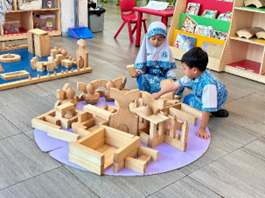
This study aims to describe the implementation of block center learning in improving collaboration skills of children aged 5-6 years at TK Al Fursan Islamic School. Collaboration skills are important abilities that need to be developed from an early age through learning that involves social interaction and cooperation. This study uses a qualitative approach with a case study design. Data collection was conducted through participatory observation, in-depth interviews, and documentation. Research subjects included the principal, block center teacher, classroom teacher, parents, and 12 children aged 5-6 years. Data analysis used the interactive model of Miles, Huberman, and Saldana. The results showed that the implementation of block center learning was carried out systematically through the stages of planning, implementation, and evaluation of learning. The teacher acts as a facilitator who prepares the play environment, provides scaffolding before, during, and after play, and provides assistance to children's social interactions. Supporting factors for implementation include adequate infrastructure and teacher competence, while obstacles include differences in children's characteristics and time limitations. Teachers overcome obstacles through consistent scaffolding and individual assistance. This study concludes that block center learning is effective in improving children's collaboration skills and contributes to the development of early childhood education.
Downloads
References
Bandura, A. (1977). Social learning theory. Prentice-Hall.
Beaty, J. J. (2014). Observing development of the young child (8th ed.). Pearson.
Bergen, D. (2002). The role of pretend play in children's cognitive development. Early Childhood Research & Practice, 4(1). https://www.ecrp.illinois.edu/v4n1/bergen.html
Berk, L. E. (2023). Child development (10th ed.). Pearson.
Bredekamp, S. (Ed.). (2022). Effective practices in early childhood education: Building a foundation (4th ed.). Pearson.
Brewer, J. A. (2014). Introduction to early childhood education: Preschool through primary grades (8th ed.). Pearson.
Bronfenbrenner, U. (1979). The ecology of human development: Experiments by nature and design. Harvard University Press. https://doi.org/10.4159/9780674028845
Bruce, T. (2021). Early childhood education (6th ed.). Hodder Education.
Bruner, J. S. (1966). Toward a theory of instruction. Belknap Press of Harvard University Press.
Catron, C. E., & Allen, J. (2008). Early childhood curriculum: A creative-play model (4th ed.). Pearson/Merrill Prentice Hall.
Charlesworth, R. (2017). Understanding child development (10th ed.). Cengage Learning.
Creswell, J. W., & Creswell, J. D. (2022). Research design: Qualitative, quantitative, and mixed methods approaches (6th ed.). SAGE Publications. https://edge.sagepub.com/creswellrd6e
Dewey, J. (1938). Experience and education. Free Press.
Dietze, B., & Kashin, D. (2019). Playing and learning in early childhood education (2nd ed.). Pearson Canada. https://doi.org/10.36510/learnland.v12i1.981
Dodge, D. T., Heroman, C., Colker, L. J., Bickart, T. S., Berke, K., & Baker, H. (2016). The creative curriculum for preschool (6th ed.). Teaching Strategies.
Elkind, D. (2007). The power of play: Learning what comes naturally. Da Capo Press.
Essa, E. L., & Burnham, M. M. (2020). Introduction to early childhood education (8th ed.). SAGE Publications. https://doi.org/10.7822/omuefd.604939
Fauziah, N., & Azizah, L. (2023). Peran guru dalam mengembangkan kemampuan sosial anak melalui kegiatan bermain balok. Jurnal Pendidikan Anak Usia Dini. https://doi.org/10.24042/ajipaud.v6i1.15884
Forman, G. E. (2012). Constructive play and learning in early childhood. Routledge.
Gardner, H. (1983). Frames of mind: The theory of multiple intelligences. Basic Books. https://doi.org/10.1177/001698628502900212
Garvey, C. (1977). Play. Harvard University Press.
Gestwicki, C. (2020). Developmentally appropriate practice: Curriculum and development in early education (6th ed.). Cengage Learning.
Goleman, D. (1995). Emotional intelligence: Why it can matter more than IQ. Bantam Books.
Hartati, S. (2017). Pembelajaran sentra pada pendidikan anak usia dini. Rajawali Pers. https://doi.org/10.21009/pip.222.4
Hasanah, N. H., & Basri, M. (2023). Permainan balok untuk meningkatkan kemampuan kerjasama anak usia 4-5 tahun. Aulad: Journal on Early Childhood, 6(1), 68–78. https://doi.org/10.31004/aulad.v6i1.461
Hidayati, N., & Wahyuni, S. (2021). Pengaruh permainan konstruktif terhadap kemampuan sosial anak usia dini. Jurnal Golden Age, 5(1).
Jackman, H. L. (2020). Early education curriculum: A child's connection to the world (7th ed.). Cengage Learning.
Johnson, D. W., & Johnson, R. T. (1989). Cooperation and competition: Theory and research. Interaction Book Company. https://doi.org/10.1108/QAE-11-2012-0041
Kamii, C. (1985). Young children reinvent arithmetic: Implications of Piaget's theory. Teachers College Press.
Katz, L. G., & Chard, S. C. (2000). Engaging children's minds: The project approach (2nd ed.). Ablex Publishing Corporation.
Lincoln, Y. S., & Guba, E. G. (1985). Naturalistic inquiry. SAGE Publications. https://doi.org/10.1016/0147-1767(85)90062-8
Mariamah, S., Yusri Bachtiar, M., & Indrawati. (2021). Penerapan Project Based Learning untuk meningkatkan kemampuan kolaborasi anak usia dini. Profesi Kependidikan, 2(1), 125–130. https://doi.org/10.33369/diadik.v9i1.17944
Maulany, F., & Putri, I. M. (2024). Penerapan pembelajaran anak usia dini menggunakan model sentra balok di TKIT Ihya As Sunnah. Indonesian Journal of Early Childhood, 6(2). https://doi.org/10.35473/ijec.v6i2.3525
Merriam, S. B., & Tisdell, E. J. (2024). Qualitative research: A guide to design and implementation (5th ed.). Jossey-Bass.
Miles, M. B., Huberman, A. M., & Saldana, J. (2020). Qualitative data analysis: A methods sourcebook (4th ed.). SAGE Publications.
Miller, D. F. (2019). Positive child guidance (9th ed.). Cengage Learning.
Montessori, M. (1995). The absorbent mind. Holt Paperbacks. (Original work published 1949)
Morrison, G. S. (2021). Early childhood ed ucation today (15th ed.). Pearson.
Ningsih, Y., & Rohita. (2024). Peningkatan kemampuan kerjasama melalui media balok kayu pada anak usia 5-6 tahun. Jurnal Anak Usia Dini Holistik Integratif (AUDHI), 7(1), 49–57. https://jurnal.uai.ac.id/index.php/AUDHI
Nourot, P. M., & Van Hoorn, J. (2013). Play at the center of the curriculum (5th ed.). Pearson.
Parten, M. B. (1932). Social participation among preschool children. Journal of Abnormal and Social Psychology, 27(3), 243–269. https://doi.org/10.1037/h0074524
Phelps, P. C. (2019). Teaching in the early childhood classroom. Cengage.
Piaget, J. (1951). The psychology of intelligence. Routledge.
Piaget, J. (1954). The construction of reality in the child. Basic Books. https://doi.org/10.1037/11168-000
Rahmawati, A., & Nurhayati, E. (2026). Aktivitas bermain balok dalam mengembangkan keterampilan sosial anak usia dini. Jurnal Pendidikan dan Perkembangan Anak. https://doi.org/10.62491/njpi.2026.v6i3-13
Santrock, J. W. (2023). Life-span development (18th ed.). McGraw-Hill Education.
Sari, D. P., & Hartati, S. (2022). Implementasi model pembelajaran sentra dalam mengembangkan sosial emosional anak usia dini. Jurnal Obsesi: Jurnal Pendidikan Anak Usia Dini, 6(4). https://doi.org/10.31004/obsesi.v6i6.2130
Singer, D. G., Golinkoff, R. M., & Hirsh-Pasek, K. (Eds.). (2006). Play = Learning: How play motivates and enhances children's cognitive and social-emotional growth. Oxford University Press. https://doi.org/10.1093/acprof:oso/9780195304381.001.0001
Slavin, R. E. (2014). Cooperative learning: Theory, research, and practice (2nd ed.). Pearson. https://doi.org/10.6018/analesps.30.3.201201
Sugiyono. (2026). Metode penelitian kuantitatif, kualitatif, dan R&D. Alfabeta.
Sujiono, Y. N. (2013). Konsep dasar pendidikan anak usia dini. Indeks.
Suyadi. (2014). Teori pembelajaran anak usia dini dalam kajian neurosains. PT Remaja Rosdakarya.
Sylvani, A. M., Lolita, A., & Aprily, N. M. (2024). Manfaat penggunaan media balok untuk anak usia dini. JECIE: Journal of Early Childhood and Inclusive Education, 7(2), 425–431. https://doi.org/10.31537/jecie.v7i2.1472
Vygotsky, L. S. (1978). Mind in society: The development of higher psychological processes. Harvard University Press. https://doi.org/10.2307/j.ctvjf9vz4
Wati, E., Abidin, R., & Kurniawati, T. (2023). Penerapan metode pembelajaran sentra balok untuk meningkatkan kemampuan motorik halus anak usia dini kelompok A1 RA Hidayatul Hikmah. J-SES: Journal of Science, Education and Studies, 2(1).
Published
How to Cite
Issue
Section
License
Copyright (c) 2026 Yayang Chisva, Choiriyah Choiriyah, Nina Yuminar Priyanti

This work is licensed under a Creative Commons Attribution-ShareAlike 4.0 International License.