Anak Toddler "Bisu" Digital: Intervensi Metode Talk-Back untuk Memulihkan Speech Delay
DOI:
https://doi.org/10.61650/jptk.v4i1.729Keywords:
Speech Delay, Metode Talk-Back, Toddler, Komunikasi Digital, Kemmis & McTaggartAbstract
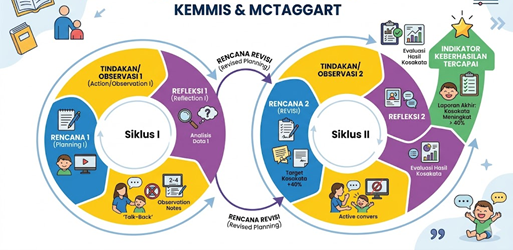
Fenomena keterlambatan bicara (speech delay) pada anak usia 2-4 tahun kini sering dipicu oleh paparan konten digital pasif yang bersifat instruksi satu arah. Penelitian ini dilatarbelakangi oleh meningkatnya kasus anak yang mengalami hambatan komunikasi verbal akibat pola asuh "bisu" digital, di mana interaksi sosial tergantikan oleh layar. Tujuan utama penelitian ini adalah untuk menguji efektivitas intervensi metode talk-back dalam memulihkan kemampuan bicara anak. Penelitian tindakan kelas ini menggunakan model Kemmis & McTaggart yang meliputi tahapan perencanaan, tindakan, observasi, dan refleksi dalam beberapa siklus. Hasil penelitian menunjukkan adanya peningkatan kosakata yang signifikan sebesar 40% pada subjek penelitian setelah dilakukan pelarangan total terhadap penggunaan instruksi satu arah dari video dan menggantinya dengan stimulus timbal balik. Kesimpulan dari penelitian ini adalah metode talk-back efektif dalam menstimulasi kemampuan linguistik anak dengan cara mengembalikan fungsi komunikasi sebagai proses dua arah. Implikasinya, orang tua dan pendidik perlu membatasi konsumsi media digital pasif dan mengedepankan dialog interaktif untuk mengatasi hambatan perkembangan bahasa pada fase toddler.
Downloads
References
Acco, R. C. (2026). Cultural Nuances in Game Speech: The Social Science Insights Challenge Transferred to AI-Mediated Localisation. In J. Abdelnour-Nocera, T. Clemmensen, M. K. Lárusdóttir, T. Macchia, R. B. M, & N. Yingta (Eds.), Communications in Computer and Information Science: 2797 CCIS (pp. 91–103). Springer Science and Business Media Deutschland GmbH. https://doi.org/10.1007/978-3-032-15516-0_6
Adams, I. T., Barter, M., McLean, K., Boehme, H. M., & Geary, I. A. (2026). No man’s hand: artificial intelligence does not improve police report writing speed. Journal of Experimental Criminology, 22(1), 137–154. https://doi.org/10.1007/s11292-024-09644-7
Akiba, D. (2025). Ctrl + Alt + Inner Speech: A Verbal–Cognitive Scaffold (VCS) Model of Pathways to Computational Thinking. Journal of Intelligence, 13(12). https://doi.org/10.3390/jintelligence13120156
Arias, R., Arias, R., & Ochoa, K. (2026). Application of Machine Learning Algorithms for Predicting Speeding Violations on Peruvian Highways: A Comparative Study. In R. Silhavy & P. Silhavy (Eds.), Lecture Notes in Networks and Systems: 1471 LNNS (pp. 198–211). Springer Science and Business Media Deutschland GmbH. https://doi.org/10.1007/978-3-031-94770-4_17
Bailo, P., Sirignano, A., Nittari, G., Visconti, G., Pesel, G., Spasari, T., & Ricci, G. (2026). A Review of Crime at Machine Speed: Criminological Aspects of Artificial Intelligence’s Industrialisation of Deception. Sci, 8(3). https://doi.org/10.3390/sci8030054
Chignell, M., Zhou, Y., Hu, Y. Z., Seok, J., Xu, Z., & Wu, J. (2025). Do Cognitive Speed and Executive Functions Follow the Expected Age Trajectory for Fluid Intelligence? Proceedings of the Human Factors and Ergonomics Society, 69(1), 2016–2021. https://doi.org/10.1177/10711813251360701
Dobrenko, E. (2021). Aatseel keynote speech/ laughing stalinism: The fate of the comic in a tragic age. Slavic and East European Journal, 65(1), 1–20. https://www.scopus.com/pages/publications/85117076649?origin=resultslist
Jacob, C., & Kanth, M. (2023). ‘Kill Two Million of Them’: Institutionalised Hate Speech, Impunity and 21st Century Atrocities in India. Global Responsibility to Protect, 15(2–3), 209–245. https://doi.org/10.1163/1875984X-20230002
Khasawneh, M. (2024). Study on the effectiveness of speech-to-text technology in supporting writing skills among special education students in Saudi Arabia. Journal of Infrastructure, Policy and Development, 8(6). https://doi.org/10.24294/jipd.v8i6.4611
Lee, D.-L., Hsu, C.-L., Yang, S.-Y., & Chen, W.-Y. (2010a). Initiated language Learning Machine with multi-media and speech-recognition techniques. 2010 International Conference on Machine Learning and Cybernetics, ICMLC 2010, 6, 2985–2989. https://doi.org/10.1109/ICMLC.2010.5580764
Lee, D.-L., Hsu, C.-L., Yang, S.-Y., & Chen, W.-Y. (2010b). Initiated language Learning Machine with multi-media and speech-recognition techniques. 2010 International Conference on Machine Learning and Cybernetics, ICMLC 2010, 6, 2985–2989. https://doi.org/10.1109/ICMLC.2010.5580764
Palla, L. (2024). The need for speed: identification of ‘the deviant’ as the ultimate goal for high returns in early childhood education and care. Critical Studies in Education, 65(4), 366–385. https://doi.org/10.1080/17508487.2023.2292540
Samonte, M. J. C., Bahia, R. J. D., Forlaje, S. B. A., Del Monte, J. G. J., Gonzales, J. A. J., & Sultan, M. V. (2018a). Assistive mobile app for children with hearing & speech impairment using character and speech recognition. ACM International Conference Proceeding Series, 265–270. https://doi.org/10.1145/3288155.3288182
Samonte, M. J. C., Bahia, R. J. D., Forlaje, S. B. A., Del Monte, J. G. J., Gonzales, J. A. J., & Sultan, M. V. (2018b). Assistive mobile app for children with hearing & speech impairment using character and speech recognition. ACM International Conference Proceeding Series, 265–270. https://doi.org/10.1145/3288155.3288182
Wood, E., Kika, M., Daub, O., & Molnar, M. (2025). Why Did You Use That Test? Exploring Speech-Language Pathologists’ Clinical Decision Making in Bilingual Language and Literacy Assessment. American Journal of Speech-Language Pathology, 34(5), 2666–2686. https://doi.org/10.1044/2025_AJSLP-24-00569
Published
How to Cite
Issue
Section
License
Copyright (c) 2026 Indi Mariani

This work is licensed under a Creative Commons Attribution-ShareAlike 4.0 International License.