Identification of Junior High School Students' Experiences in Using Question Card Media for Algebra Learning
DOI:
https://doi.org/10.61650/dpjpm.v3i1.105Keywords:
Student Experience, Question Card Media, Algebra, Interactive Learning, Qualitative ResearchAbstract
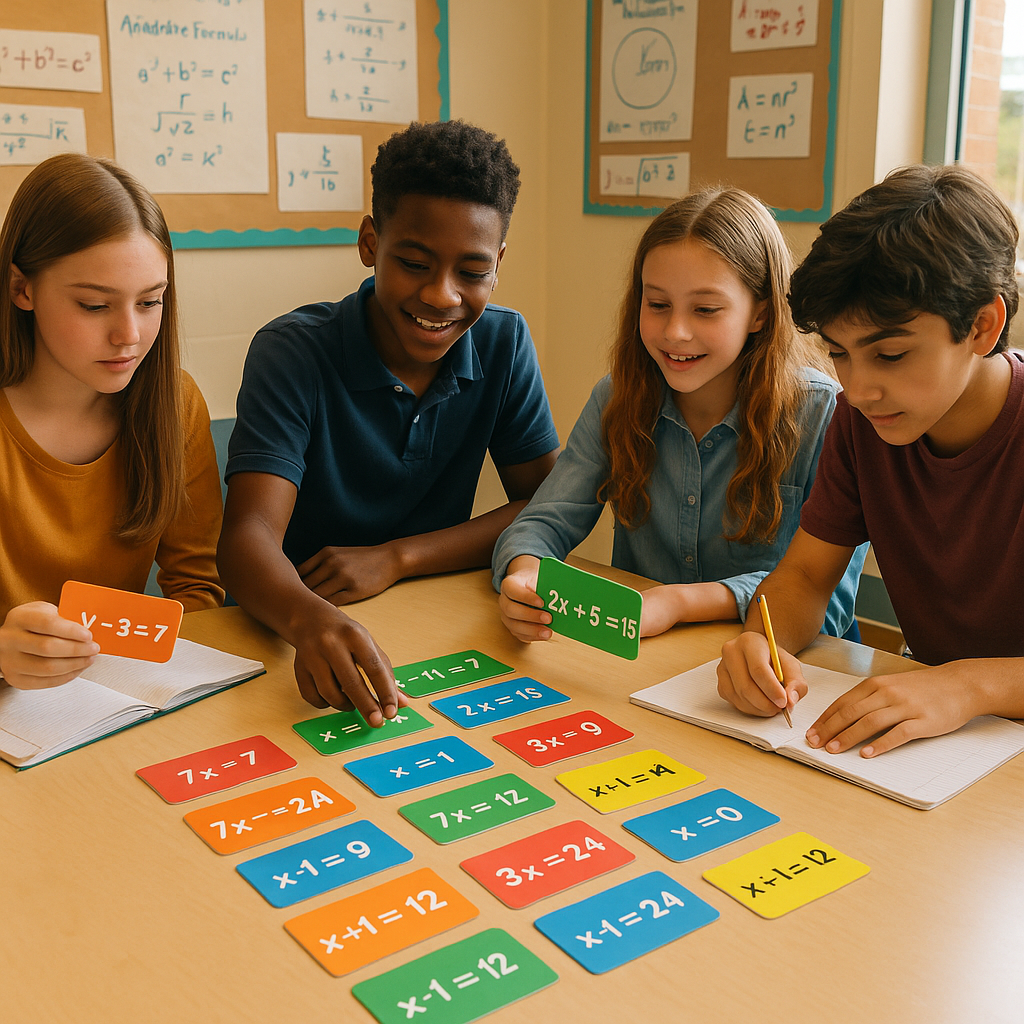
This study aims to explore junior high school students' experiences in using Question Card media in algebra learning. Using a qualitative approach, this study involved 26 students of grade VII B at SMP Darul Ulum 5 Rebalas as the main participants. Data were collected through classroom observations, interviews, and student response questionnaires to understand perceptions, engagement, and challenges faced during the learning process using Question Cards. The results showed that Question Card media was able to increase students' interest, attention, and engagement in algebra learning. Most students stated that using Question Cards made learning more interactive, enjoyable, and helped them understand abstract algebraic concepts. Data analysis showed that the level of student learning interest was in the high category (74.7%), with indicators of engagement and attention also showing high percentages. However, there were some students who still felt more comfortable with conventional methods, so further adaptation was needed. These findings confirm that Question Card media can be an innovative alternative in mathematics learning, especially algebra, to enhance students' learning experiences actively and meaningfully. This study recommends the development of similar media and training for teachers to optimize the use of interactive media in mathematics learning at the junior high school level.
Downloads
References
Afifah, A., & Putri, A. D. (2021). Development of e-komatik media (mathematical e-comic) with a contextual approach to the material of rectangles and triangles. Jurnal Scientia, 10(1), 99–108. Retrieved from http://infor.seaninstitute.org/index.php/pendidikan
Afni, N. (2020). Contextual teaching and learning (CTL) as a strategy to improve students mathematical literacy. Journal of Physics Conference Series, 1581(1). http://doi.org/10.1088/1742-6596/1581/1/012043 DOI: https://doi.org/10.1088/1742-6596/1581/1/012043
Anna, A. (2022). Developing and validating cardiovascular emergency gamification question cards. Nurse Education Today, 117. http://doi.org/10.1016/j.nedt.2022.105482 DOI: https://doi.org/10.1016/j.nedt.2022.105482
Behnamnia, N. (2020). The effective components of creativity in digital game-based learning among young children: A case study. Children and Youth Services Review, 116. http://doi.org/10.1016/j.childyouth.2020.105227 DOI: https://doi.org/10.1016/j.childyouth.2020.105227
Birgin, O. (2020). The effect of computer-supported collaborative learning using GeoGebra software on 11th grade students’ mathematics achievement in exponential and logarithmic functions. International Journal of Mathematical Education in Science and Technology, 1–18. http://doi.org/10.1080/0020739X.2020.1788186 DOI: https://doi.org/10.1080/0020739X.2020.1788186
Bockenhauer, S. E., Julliard, K. N., Lo, K. S., & ... (2002). Quantifiable effects of osteopathic manipulative techniques on patients with chronic asthma. Journal of …. http://doi.org/10.7556/jaoa.2002.102.7.371
Borsetti, A. (2022). The unresolved question on COVID-19 virus origin: The three cards game? Journal of Medical Virology, 94(4), 1257–1260. http://doi.org/10.1002/jmv.27519 DOI: https://doi.org/10.1002/jmv.27519
Brave, K. L. (2025). Using Manipulative-Based Instructional Sequences to Increase the Understanding of Fractional Concepts of Students With Mathematical Learning Disabilities. Teaching Exceptional Children, 57(5), 368–378. http://doi.org/10.1177/00400599241231228 DOI: https://doi.org/10.1177/00400599241231228
Cornwall, A. (2025). Question cards: Putting your cards on the table in the interview process. Qualitative Research, 25(3), 777–782. http://doi.org/10.1177/14687941241277749 DOI: https://doi.org/10.1177/14687941241277749
Crespo, S. (2020). Learning to pose collaborative mathematics problems with secondary prospective teachers. International Journal of Educational Research, 102. http://doi.org/10.1016/j.ijer.2019.05.003 DOI: https://doi.org/10.1016/j.ijer.2019.05.003
Davis, E. R. (2021). Media neglect of Indigenous student performance in the Programme for International Student Assessment (PISA) 2001-2015. Australian Journal of Indigenous Education, 50(1), 136–146. http://doi.org/10.1017/jie.2019.4 DOI: https://doi.org/10.1017/jie.2019.4
Demri, S. (2023). Constraint Automata on Infinite Data Trees: from CTLpZq/CTL*pZq to Decision Procedures. Leibniz International Proceedings in Informatics Lipics, 279. http://doi.org/10.4230/LIPIcs.CONCUR.2023.29
Desnita, D. (2022). The Effectiveness of CTL-based Physics E-module on the Improvement of the Creative and Critical Thinking Skills of Senior High School Students. TEM Journal, 11(2), 802–810. http://doi.org/10.18421/TEM112-38 DOI: https://doi.org/10.18421/TEM112-38
Dolapcioglu, S. (2022). Development of critical thinking in mathematics classes via authentic learning: an action research. International Journal of Mathematical Education in Science and Technology, 53(6), 1363–1386. http://doi.org/10.1080/0020739X.2020.1819573 DOI: https://doi.org/10.1080/0020739X.2020.1819573
Evendi, E. (2022). Assessing students’ critical thinking skills viewed from cognitive style: Study on implementation of problem-based e-learning model in mathematics courses. Eurasia Journal of Mathematics Science and Technology Education, 18(7). http://doi.org/10.29333/ejmste/12161 DOI: https://doi.org/10.29333/ejmste/12161
Goldberg, D., Fishkin, K. P., Gujar, A. U., Mynatt, E. D., & ... (2007). Manipulative user interface systems and methods. US Patent …. Retrieved from https://patents.google.com/patent/US7253800B2/en
Gülü, M. (2023). Exploring obesity, physical activity, and digital game addiction levels among adolescents: A study on machine learning-based prediction of digital game addiction. Frontiers in Psychology, 14. http://doi.org/10.3389/fpsyg.2023.1097145 DOI: https://doi.org/10.3389/fpsyg.2023.1097145
Irfan, M. (2020). CHALLENGES DURING THE PANDEMIC: USE OF E-LEARNING IN MATHEMATICS LEARNING IN HIGHER EDUCATION. Infinity Journal, 9(2), 147–158. http://doi.org/10.22460/infinity.v9i2.p147-158 DOI: https://doi.org/10.22460/infinity.v9i2.p147-158
Kaiser, G. (2022). Gender differences in mathematics achievement: A secondary analysis of Programme for International Student Assessment data from Shanghai. Asian Journal for Mathematics Education, 1(1), 115–130. http://doi.org/10.1177/27527263221091373 DOI: https://doi.org/10.1177/27527263221091373
Kim, J. (2020). A deep learning model for detecting mental illness from user content on social media. Scientific Reports, 10(1). http://doi.org/10.1038/s41598-020-68764-y DOI: https://doi.org/10.1038/s41598-020-68764-y
Lee, H. Y. (2024). Integrating Computational Thinking Into Scaffolding Learning: An Innovative Approach to Enhance Science, Technology, Engineering, and Mathematics Hands-On Learning. Journal of Educational Computing Research, 62(2), 431–467. http://doi.org/10.1177/07356331231211916 DOI: https://doi.org/10.1177/07356331231211916
Lestari, A. S. B. L., Afifah, A., & Supriyo. (2023). Analisis Commognitive Matematis Siswa dalam Menyelesaikan Soal Cerita Secara Berpasangan. Jurnal Pendidikan Matematika (JPM), 9(2), 154–163. http://doi.org/10.33474/jpm.v9i2.20105 DOI: https://doi.org/10.33474/jpm.v9i2.20105
Lestari, andika setyo budi, Indrawatiningsih, N., Afifah, A., & Supriyo. (2022). Commognition Framework: Types of Students’ Difficulty in Solving Fractional Task. In Social Science, Education and Humanities Research. atlantis-press.com. http://doi.org/10.2991/978-2-494069-15-2_12 DOI: https://doi.org/10.2991/978-2-494069-15-2_12
Mailizar. (2020). Secondary school mathematics teachers’ views on e-learning implementation barriers during the COVID-19 pandemic: The case of Indonesia. Eurasia Journal of Mathematics Science and Technology Education, 16(7). http://doi.org/10.29333/EJMSTE/8240 DOI: https://doi.org/10.29333/ejmste/8240
Malla, H. A. B. (2023). Teachers’ Digital Literacy Ability to Improve Islamic Religion Education Learning in Islamic Boarding School. International Journal of Educational Reform. http://doi.org/10.1177/10567879231211287 DOI: https://doi.org/10.1177/10567879231211287
Manda, T. G. (2021). Analysis of Students Mathematical Concept Understanding Ability in Operation Research Course. Journal of Physics Conference Series, 1742(1). http://doi.org/10.1088/1742-6596/1742/1/012014 DOI: https://doi.org/10.1088/1742-6596/1742/1/012014
Mascia, M. A. A. (2020). New govern(mentality) in Education: a Discursive Analysis of Documents about PISA (Programme for the International Student Assessment). Discurso Y Sociedad, 14(3), 482–498. Retrieved from https://www.scopus.com/inward/record.uri?partnerID=HzOxMe3b&scp=85189092379&origin=inward DOI: https://doi.org/10.14198/dissoc.14.3.1
Moore, K. (2023). Using Sentence Frames and Question Cards to Scaffold Discourse and Argumentation in Science. Teaching Science Students to Communicate A Practical Guide, 221–226. http://doi.org/10.1007/978-3-030-91628-2_27 DOI: https://doi.org/10.1007/978-3-030-91628-2_27
Moreno-Guerrero, A. J. (2020). E-learning in the teaching of mathematics: An educational experience in adult high school. Mathematics, 8(5). http://doi.org/10.3390/MATH8050840 DOI: https://doi.org/10.3390/math8050840
Mulenga, E. M. (2020). Prospective teachers’ online learning mathematics activities in the age of COVID-19: A cluster analysis approach. Eurasia Journal of Mathematics Science and Technology Education, 16(9). http://doi.org/10.29333/EJMSTE/8345 DOI: https://doi.org/10.29333/ejmste/8345
Nailurrohmah, A. (2022). Developing realistic mathematics education learning set in polyhedron subject to improve mathematical concepts understanding skills. Aip Conference Proceedings, 2575. http://doi.org/10.1063/5.0107950 DOI: https://doi.org/10.1063/5.0107950
Nemudryi, A. A., Valetdinova, K. R., Medvedev, S. P., & Zakian, S. M. (2014). TALEN and CRISPR/Cas Genome Editing Systems: Tools of Discovery. Acta Naturae, 6(3), 19–40. Retrieved from http://www.ncbi.nlm.nih.gov/pubmed/25349712 DOI: https://doi.org/10.32607/20758251-2014-6-3-19-40
Ok, M. W. (2020). Effects of Computer-Assisted Instruction on the Mathematics Performance of Students with Learning Disabilities: A Synthesis of the Research. Exceptionality, 28(1), 30–44. http://doi.org/10.1080/09362835.2019.1579723 DOI: https://doi.org/10.1080/09362835.2019.1579723
Pahrudin, A. (2021). The effectiveness of science, technology, engineering, and mathematics-inquiry learning for 15-16 years old students based on K-13 Indonesian curriculum: The impact on the critical thinking skills. European Journal of Educational Research, 10(2), 681–692. http://doi.org/10.12973/eu-jer.10.2.681 DOI: https://doi.org/10.12973/eu-jer.10.2.681
Pellas, N. (2020). A Scoping Review of Immersive Virtual Reality in STEM Education. IEEE Transactions on Learning Technologies, 13(4), 748–761. http://doi.org/10.1109/TLT.2020.3019405 DOI: https://doi.org/10.1109/TLT.2020.3019405
Priyanti, N. D. (2025). Critical Thinking of Students in Solving Mathematical Problems on The Material of The System of Linear Equations of One Variable in Terms of The Personality Type of Extroverts and Introverts of Class VII Students. Aip Conference Proceedings, 3142(1). http://doi.org/10.1063/5.0262253 DOI: https://doi.org/10.1063/5.0262253
Qisma, N., & Afifah, A. (2024). Pengembangan Media Pembelajaran Matematika Board Game Magic Shop Pada Materi Aritmatika Sosial. Jurnal PEKA (Pendidikan Matematika), 8(1), 28–34. http://doi.org/https://doi.org/10.37150/jp.v8i1.2540 DOI: https://doi.org/10.37150/jp.v8i1.2540
Rohimah, S. M. (2024). A learning trajectory to develop students’ mathematical proficiency of linear equation in one variable. Aip Conference Proceedings, 3058(1). http://doi.org/10.1063/5.0201061 DOI: https://doi.org/10.1063/5.0201061
Salsabila, E. (2021). Influence of learning strategy and authentic assessment toward students’ mathematical proving ability by controlling prerequisite concepts understanding. Aip Conference Proceedings, 2331. http://doi.org/10.1063/5.0041723 DOI: https://doi.org/10.1063/5.0041723
Sánchez-Ruiz, L. M. (2023). ChatGPT Challenges Blended Learning Methodologies in Engineering Education: A Case Study in Mathematics. Applied Sciences Switzerland, 13(10). http://doi.org/10.3390/app13106039 DOI: https://doi.org/10.3390/app13106039
Saripah, I. (2023). The Arrangement of Hots Question Card Instrument as A Complementary Forming For Student Critical Behavior to Achieve Learning Outcomes During Online Learning in New Normal Era. Aip Conference Proceedings, 2679. http://doi.org/10.1063/5.0111333 DOI: https://doi.org/10.1063/5.0111333
Sedory, S. A. (2020). Unrelated question model with two decks of cards. Statistica Neerlandica, 74(2), 192–215. http://doi.org/10.1111/stan.12202 DOI: https://doi.org/10.1111/stan.12202
Sinenko, S. A. (2020). To a question of a choice of a method of production of construction works on set of technological cards. Iop Conference Series Materials Science and Engineering, 905(1). http://doi.org/10.1088/1757-899X/905/1/012062 DOI: https://doi.org/10.1088/1757-899X/905/1/012062
Sözen, Ç. (2024). Clustering of countries according to programme for international student assessment (PISA) scores. Gumushane Universitesi Fen Bilimleri Dergisi, 14(2), 424–434. http://doi.org/10.17714/gumusfenbil.1291942 DOI: https://doi.org/10.17714/gumusfenbil.1291942
Sumarwati, S. (2020). Developing mathematics learning media based on elearning using moodle on geometry subject to improve students’ higher order thinking skills. International Journal of Interactive Mobile Technologies, 14(4), 182–191. http://doi.org/10.3991/IJIM.V14I04.12731 DOI: https://doi.org/10.3991/ijim.v14i04.12731
Usmiyatun;, U., Darmayanti, R., & Afifah, A. (2021). Cognitive style, thinking ability, mathematical problems, how do students solve open-ended problems? AMCA Journal of Education and Behavioral …, 1(2). DOI: https://doi.org/10.51773/ajst.v1i2.276
Wankerl, S. (2023). Can Neural Networks Distinguish High-school Level Mathematical Concepts? Proceedings IEEE International Conference on Data Mining Icdm, 1397–1402. http://doi.org/10.1109/ICDM58522.2023.00181 DOI: https://doi.org/10.1109/ICDM58522.2023.00181
Wu, H. (2020). Principal leadership effects on student achievement: a multilevel analysis using Programme for International Student Assessment 2015 data. Educational Studies, 46(3), 316–336. http://doi.org/10.1080/03055698.2019.1584853 DOI: https://doi.org/10.1080/03055698.2019.1584853
Yang, Z. (2021). The Emergence of Mathematical Understanding: Connecting to the Closest Superordinate and Convertible Concepts. Frontiers in Psychology, 12. http://doi.org/10.3389/fpsyg.2021.525493 DOI: https://doi.org/10.3389/fpsyg.2021.525493
Published
How to Cite
Issue
Section
License
Copyright (c) 2025 Nur Qomaria, Ani Afifah, Rathish Manivannan

This work is licensed under a Creative Commons Attribution-ShareAlike 4.0 International License.




 ARTICLE TEMPLATE