Development of a Bilingual Digital Module Based on Local History and Biodiversity of Banyuwangi for Contextual Learning
Authors
-
Irwan Efendi
 Universitas 17 Agustus 1945 Banyuwangi, Indonesia
-
Ayu Nabila Safitri
Universitas 17 Agustus 1945 Banyuwangi, Indonesia
-
Putri Balqis
Universitas 17 Agustus 1945 Banyuwangi, Indonesia
-
Durotul Muniroh
Universitas 17 Agustus 1945 Banyuwangi, Indonesia
-
Candra Hermawan
Universitas 17 Agustus 1945 Banyuwangi, Indonesia
DOI:
https://doi.org/10.61650/alj.v2i1.1237Keywords:
digital module development bilingual local history biodiversity contextual learningAbstract
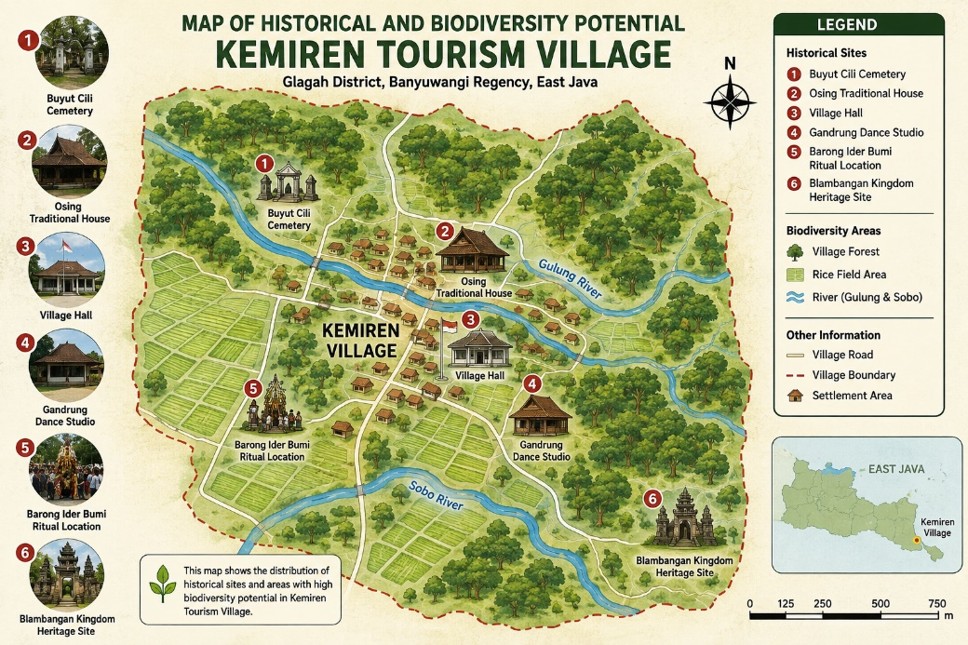
This study aims to develop and test the feasibility of a bilingual digital module (Indonesian–English) that integrates local history, biodiversity, and English for contextual learning in Banyuwangi. The results of local potential mapping require development into systematic, digital teaching materials that can be used in learning. This research employs the Research and Development (R&D) method with the ADDIE model (Analysis, Design, Development, Implementation, Evaluation). Research subjects consisted of teachers, students, history material experts, biology experts, English experts, and media experts. Data were collected through needs assessment questionnaires, expert validation questionnaires, and user response questionnaires, then analyzed using descriptive quantitative methods. The results showed that the developed bilingual digital module received a very feasible assessment from history material experts (90.4%), biology experts (91.2%), English experts (88.6%), and media experts (92.5%). Teacher responses to the module were also very positive with a percentage of 89.7%, and student responses reached 88.9%. This digital module contains materials on Banyuwangi's local history, biodiversity, and interactive English exercises presented in an easily accessible digital format. This research produces a validated multidisciplinary learning product that can be applied in schools to support contextual learning.
Downloads
Published
How to Cite
Issue
Section
License
Copyright (c) 2024 Irwan Efendi, Ayu Nabila Safitri, Putri Balqis, Durotul Muniroh, Candra Hermawan

This work is licensed under a Creative Commons Attribution-ShareAlike 4.0 International License.






 All publications by the CV. Bimbingan Belajar Assyfa [e-ISSN: