Keywords: Indonesian, Theater, Speech Recognition, Chatbot, Speaking Skills
Abstract
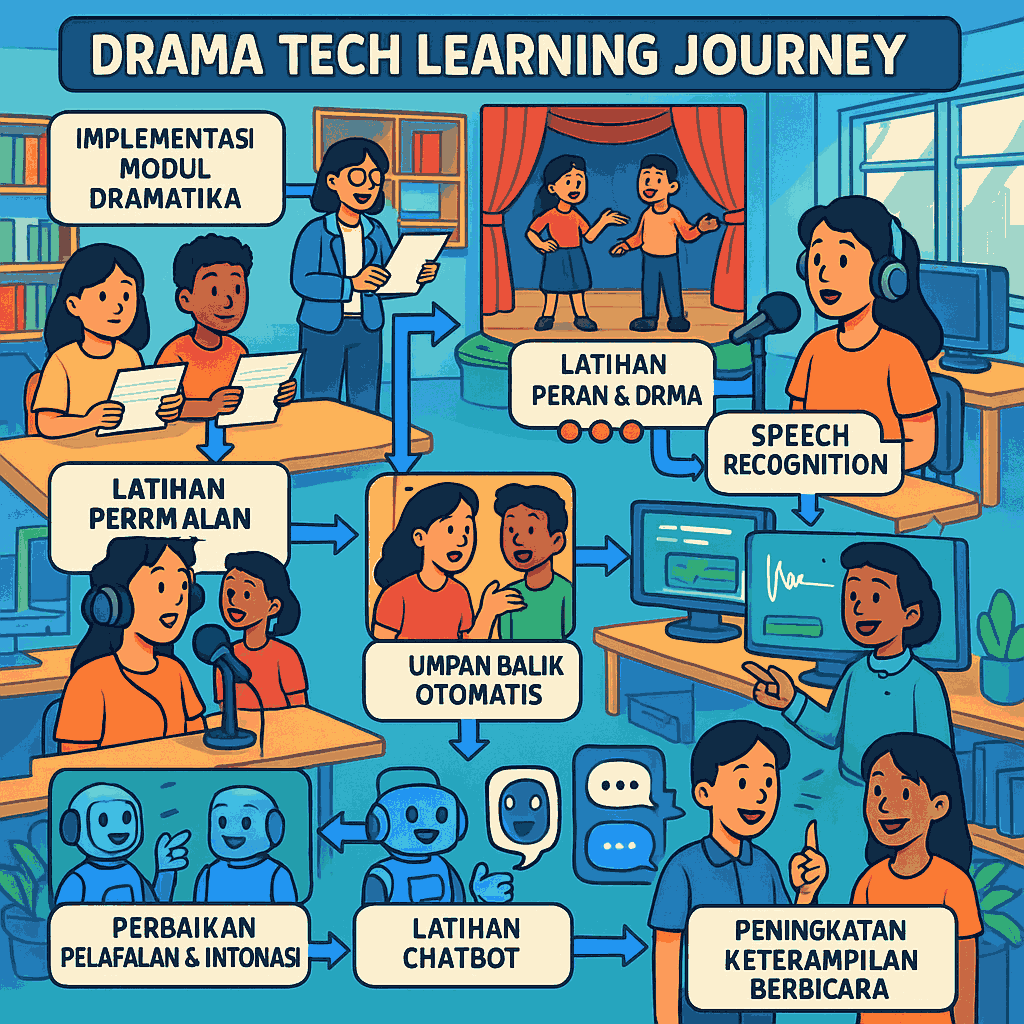
The development of digital technology and the unique characteristics of Generation Z have driven the need for innovation in Indonesian language learning, particularly to improve the speaking skills of junior high school students. Conventional learning methods are often ineffective in building student confidence, creativity, and active participation. This study aims to develop and test the effectiveness of synergy between theater, speech recognition technology, and chatbots as a more interactive and relevant learning innovation. Using a Research and Development (R&D) approach using the ADDIE model, this study collected data through observations, interviews, questionnaires, and a pilot test of the teaching module. The results showed significant improvements in students' speaking skills, including fluency, clarity, and argument structure. Students became more confident, creative, and engaged, thanks to the automatic feedback from the speech recognition technology and adaptive conversational practice provided by the chatbot. This innovative module also increases student motivation and engagement, supports the implementation of the Independent Curriculum, and the development of 21st-century skills. This synergy has proven effective and can be widely adopted to create more personalized learning that meets the demands of the digital age.
References
Afifah, A., & Putri, A. D. (2021). Development of e-komatik media (mathematical e-comic) with a contextual approach to the material of rectangles and triangles. Jurnal Scientia, 10(1), 99–108.
Baevski, A. (2020). wav2vec 2.0: A framework for self-supervised learning of speech representations. Advances in Neural Information Processing Systems, 2020.
Bai, L., Chang, R., Chen, G., & Zhou, Y. (2023). Speech-Visual Emotion Recognition via Modal Decomposition Learning. IEEE Signal Processing Letters, 30, 1452–1456. https://doi.org/10.1109/LSP.2023.3324294 DOI: https://doi.org/10.1109/LSP.2023.3324294
Baldimtsi, E. (2021). Cognitive and Affective Aspects of Theory of Mind in Greek-Speaking Children with Autism Spectrum Disorders. Journal of Autism and Developmental Disorders, 51(4), 1142–1156. https://doi.org/10.1007/s10803-020-04595-0 DOI: https://doi.org/10.1007/s10803-020-04595-0
Boekaerts, M. (2002). Interest in learning, learning to be interested. Learning and Instruction, 12(4), 375–382. https://doi.org/10.1016/S0959-4752(01)00007-X DOI: https://doi.org/10.1016/S0959-4752(01)00007-X
Borko, H. (2021). Learning to Lead: an Approach to Mathematics Teacher Leader Development. International Journal of Science and Mathematics Education, 19, 121–143. https://doi.org/10.1007/s10763-021-10157-2 DOI: https://doi.org/10.1007/s10763-021-10157-2
Capella-Peris, C. (2020). Innovative analysis of service-learning effects in physical education: A mixed-methods approach. Journal of Teaching in Physical Education, 39(1), 102–110. https://doi.org/10.1123/jtpe.2019-0030 DOI: https://doi.org/10.1123/jtpe.2019-0030
Castaño-Pulgarín, S. A. (2021). Internet, social media and online hate speech. Systematic review. Aggression and Violent Behavior, 58. https://doi.org/10.1016/j.avb.2021.101608 DOI: https://doi.org/10.1016/j.avb.2021.101608
Chaiwongyen, A., Duangpummet, S., Karnjana, J., Kongprawechnon, W., & Unoki, M. (2024). Potential of Speech-Pathological Features for Deepfake Speech Detection. IEEE Access, 12, 121958–121970. https://doi.org/10.1109/ACCESS.2024.3447582 DOI: https://doi.org/10.1109/ACCESS.2024.3447582
Drouin, M. (2020). How Parents and Their Children Used Social Media and Technology at the Beginning of the COVID-19 Pandemic and Associations with Anxiety. Cyberpsychology Behavior and Social Networking, 23(11), 727–736. https://doi.org/10.1089/cyber.2020.0284 DOI: https://doi.org/10.1089/cyber.2020.0284
Faridatul, I., Afifah, A., Nurmalitasari, D., & Naim, M. A. (2023). Penerapan Media Komik Matematika Islam Sebagai Upaya Meningkatkan Kemampuan Berpikir Kritis. 1(1), 11–17. DOI: https://doi.org/10.61650/jptk.v1i1.118
Ge, H. (2022). Research on Digital Inclusive Finance Promoting the Integration of Rural Three-Industry. International Journal of Environmental Research and Public Health, 19(6). https://doi.org/10.3390/ijerph19063363 DOI: https://doi.org/10.3390/ijerph19063363
Gil-Fernández, R. (2021). Influence of covid on the educational use of social media by students of teaching degrees. Education in the Knowledge Society, 22. https://doi.org/10.14201/eks.23623 DOI: https://doi.org/10.14201/eks.23623
Gonzales, M. G., Corcoran, P. M., Harte, N., & Schukat, M. (2024). Joint Speech-Text Embeddings for Multitask Speech Processing. IEEE Access, 12, 145955–145967. https://doi.org/10.1109/ACCESS.2024.3473743 DOI: https://doi.org/10.1109/ACCESS.2024.3473743
Holandyah, M. (2022). Speaking Challenges in a Life Skill Program for Islamic Boarding School Students: A Case Study. Journal of Language Teaching and Research, 13(3), 670–677. https://doi.org/10.17507/jltr.1303.23 DOI: https://doi.org/10.17507/jltr.1303.23
Horn, I. (2022). TEACHER LEARNING OF AMBITIOUS AND EQUITABLE MATHEMATICS INSTRUCTION: A Sociocultural Approach. Teacher Learning of Ambitious and Equitable Mathematics Instruction A Sociocultural Approach, 1–253. https://doi.org/10.4324/9781003182214 DOI: https://doi.org/10.4324/9781003182214
Horváth, I. (2023). Investigating the Operational Complexity of Digital Workflows Based on Human Cognitive Aspects. Electronics Switzerland, 12(3). https://doi.org/10.3390/electronics12030528 DOI: https://doi.org/10.3390/electronics12030528
Kholis, A. (2021). Elsa Speak App: Automatic Speech Recognition (ASR) for Supplementing English Pronunciation Skills. Pedagogy : Journal of English Language Teaching, 9(1), 01. https://doi.org/10.32332/joelt.v9i1.2723 DOI: https://doi.org/10.32332/joelt.v9i1.2723
Kim, Y., Shim, J., Gimm, G. W., Kang, S., Rhee, W., Lee, J., Kim, B., Yoon, D., Kim, M., & Cho, M. (2025). Speech-mediated manipulation of da Vinci surgical system for continuous surgical flow. Biomedical Engineering Letters, 15(1), 117–129. https://doi.org/10.1007/s13534-024-00429-5 DOI: https://doi.org/10.1007/s13534-024-00429-5
Leaning, M. (2019). An approach to digital literacy through the integration of media and information literacy. Media and Communication, 7(2), 4–13. https://doi.org/10.17645/mac.v7i2.1931 DOI: https://doi.org/10.17645/mac.v7i2.1931
Lennard, S., Tromans, S. J., Taub, R., Mitchell, S., & Shankar, R. (2024). SpeechMatch—A novel digital approach to supporting communication for neurodiverse groups. Healthcare Technology Letters, 11(6), 447–451. https://doi.org/10.1049/htl2.12090 DOI: https://doi.org/10.1049/htl2.12090
Lo, C. K. (2021). Developing a flipped learning approach to support student engagement: A design-based research of secondary school mathematics teaching. Journal of Computer Assisted Learning, 37(1), 142–157. https://doi.org/10.1111/jcal.12474 DOI: https://doi.org/10.1111/jcal.12474
Lorenz-Spreen, P. (2023). A systematic review of worldwide causal and correlational evidence on digital media and democracy. Nature Human Behaviour, 7(1), 74–101. https://doi.org/10.1038/s41562-022-01460-1 DOI: https://doi.org/10.1038/s41562-022-01460-1
Ma, Q., Bu, F., Wang, R., Bu, L., Wang, Y., & Li, Z. (2025). Cross-Modal Simplex Center Learning for Speech-Face Association. Computers, Materials and Continua, 82(3), 5169–5184. https://doi.org/10.32604/cmc.2025.061187 DOI: https://doi.org/10.32604/cmc.2025.061187
Maghfiroh, R., Setiawan, A., Saputra, A. A., Afifah, A., & Darmayanti, R. (2023). MOVEON : Motivation , anxiety , and their relationship to mathematics learning outcomes. 3(2), 44–47. DOI: https://doi.org/10.51773/ajeb.v3i2.271
Nailurrohmah, A. (2022). Developing realistic mathematics education learning set in polyhedron subject to improve mathematical concepts understanding skills. Aip Conference Proceedings, 2575. https://doi.org/10.1063/5.0107950 DOI: https://doi.org/10.1063/5.0107950
Nordin, N. (2022). REV-OPOLY: A Study on Educational Board Game with Webbased Augmented Reality. Asian Journal of University Education, 18(1), 81–90. https://doi.org/10.24191/ajue.v18i1.17172 DOI: https://doi.org/10.24191/ajue.v18i1.17172
Nurdalilah, Harahap, A. N., Nasution, P. R., & ... (2023). Development of E-learning teaching materials to improve student learning outcomes on mathematics statistics courses. THE 1ST …. DOI: https://doi.org/10.1063/5.0131089
Ochieng, P. J., & Kaburu, D. M. (2025). Phonology-guided speech-to-speech translation for African languages. Speech Communication, 174. https://doi.org/10.1016/j.specom.2025.103287 DOI: https://doi.org/10.1016/j.specom.2025.103287
Ponmani, M. (2022). Integration of Zone of Proximal Development (ZPD) and ICTs in Language Learning. Contemporary Elt Strategies in Engineering Pedagogy Theory and Practice, 237–252. https://doi.org/10.4324/9781003268529-20 DOI: https://doi.org/10.4324/9781003268529-20
Postill, J. (2012). Social media ethnography: The digital researcher in a messy web. Media International Australia, 145, 123–134. https://doi.org/10.1177/1329878x1214500114 DOI: https://doi.org/10.1177/1329878X1214500114
Qomaria, N., Afifah, A., & Manivannan, R. (2025). Identification of Junior High School Students ’ Experiences in Using Question Card Media for Algebra Learning. 3(April), 7–10. DOI: https://doi.org/10.61650/dpjpm.v3i1.105
Rivero, A. G. (2022). TikTok and Twitch: New Media and Formulas to Impact the Generation Z. Icono14, 20(1). https://doi.org/10.7195/ri14.v20i1.1770 DOI: https://doi.org/10.7195/ri14.v20i1.1770
Rost, K. (2016). Digital Social Norm Enforcement: Online Firestorms in Social Media. Plos One, 11(6). https://doi.org/10.1371/journal.pone.0155923 DOI: https://doi.org/10.1371/journal.pone.0155923
Safaya, A. (2020). KUISAIL at SemEval-2020 Task 12: BERT-CNN for Offensive Speech Identification in Social Media. 14th International Workshops on Semantic Evaluation Semeval 2020 Co Located 28th International Conference on Computational Linguistics Coling 2020 Proceedings, 2054–2059. https://doi.org/10.18653/v1/2020.semeval-1.271 DOI: https://doi.org/10.18653/v1/2020.semeval-1.271
Setyo, A., Lestari, B., Afifah, A., Indrawatiningsih, N., Rasida, I., Aufin, M., & Surabaya, U. N. (n.d.). Guru Matematika Di Universitas Pgri Wiranegara. 86–92.
Sharon, R. A., Sur, M., & Murthy, H. A. (2025). Harnessing the Multi-Phasal Nature of Speech-EEG for Enhancing Imagined Speech Recognition. IEEE Open Journal of Signal Processing, 6, 78–88. https://doi.org/10.1109/OJSP.2025.3528368 DOI: https://doi.org/10.1109/OJSP.2025.3528368
Shi, R. (2024). Dynamic analysis and optimal control of a fractional order HIV/HTLV co-infection model with HIV-specific CTL immune response. Aims Mathematics, 9(4), 9455–9493. https://doi.org/10.3934/math.2024462 DOI: https://doi.org/10.3934/math.2024462
Song, Y., Wong, R. C. W., & Zhao, X. (2024). Speech-to-SQL: toward speech-driven SQL query generation from natural language question. VLDB Journal, 33(4), 1179–1201. https://doi.org/10.1007/s00778-024-00837-0 DOI: https://doi.org/10.1007/s00778-024-00837-0
Team, A. (2018). English Language User Manual Pocket Media Assistant PMA430 (TM) Video Player &Recorder/Music &Audio/Wifi/Linux/Personal Information Manager …. XP055525286, Retrieved on Nov.
Tsapara, M. (2022). A Board Game for Sustainable Development Education: Kindergarten Students as Game Designers. Lecture Notes in Networks and Systems, 411, 1072–1084. https://doi.org/10.1007/978-3-030-96296-8_98 DOI: https://doi.org/10.1007/978-3-030-96296-8_98
Unsiah, F., Mukminatien, N., Anugerahwati, M., Astuti, U. P., & Megawati, F. (2024). Students’ Voices in English Medium Instruction Based on Lengths of English Exposure. Mextesol Journal, 48(2), 0–2. https://doi.org/10.61871/mj.v48n2-1 DOI: https://doi.org/10.61871/mj.v48n2-1
Videnovik, M. (2023). Game-based learning in computer science education: a scoping literature review. International Journal of Stem Education, 10(1). https://doi.org/10.1186/s40594-023-00447-2 DOI: https://doi.org/10.1186/s40594-023-00447-2
Vita-Barrull, N. (2024). Do you play in class? Board games to promote cognitive and educational development in primary school: A cluster randomized controlled trial. Learning and Instruction, 93. https://doi.org/10.1016/j.learninstruc.2024.101946 DOI: https://doi.org/10.1016/j.learninstruc.2024.101946
Xu, H., Yu, X., Cheng, Y., Xiao, M., & Yu, Y. (2024). Low-Rank Active Learning for Generating Speech-Drive Human Face Animation. IEEE Access, 12, 38758–38764. https://doi.org/10.1109/ACCESS.2024.3374777 DOI: https://doi.org/10.1109/ACCESS.2024.3374777
Yasin, M., Badu, S. Q., & Irfah, A. (2025). The Implementation of Canva-Assisted Flipped Classroom Model to Improve Mathematics Learning Outcomes. … MATHEMATICS LEARNING. DOI: https://doi.org/10.22460/jiml.v8i2.28248
Zapata, J. (2025). Research Brief Video Title: “I’ve had to take the TELPAS for so long even though I speak English fluently”: Using TikTok to Claim an English Language Identity. Tesol Journal, 16(3). https://doi.org/10.1002/tesj.70008 DOI: https://doi.org/10.1002/tesj.70008
Zhang, X. (2020). Self-efficacy and english public speaking performance: A mixed method approach. English for Specific Purposes, 59, 1–16. https://doi.org/10.1016/j.esp.2020.02.001 DOI: https://doi.org/10.1016/j.esp.2020.02.001
Zhang, Z. (2022). Speech timing cues reveal deceptive speech in social deduction board games. Plos One, 17(2). https://doi.org/10.1371/journal.pone.0263852 DOI: https://doi.org/10.1371/journal.pone.0263852
Zhang, Z., Chen, S., Zhou, L., Wu, Y., Ren, S., Liu, S., Yao, Z., Gong, X., Dai, L., & Li, J. (2024). SpeechLM: Enhanced Speech Pre-Training With Unpaired Textual Data. IEEE/ACM Transactions on Audio Speech and Language Processing, 32, 2177–2187. https://doi.org/10.1109/TASLP.2024.3379877 DOI: https://doi.org/10.1109/TASLP.2024.3379877
Published
How to Cite
Issue
Section
License
Copyright (c) 2025 Asrofi Asrofi, Joko Widodo, Nurul Zuhriah, Ribut Wahyu Eriyanti, Daroe Iswatiningsih, Hari Sunaryo

This work is licensed under a Creative Commons Attribution-ShareAlike 4.0 International License.