Utilizing Digital Storytelling to Enhance Students' Understanding of Local History, Environmental Awareness, and English Language Skills at SMA Negeri 1 Rogojampi
Authors
-
Intan Melani Putri
 Universitas 17 Agustus 1945 Banyuwangi, Indonesia
-
Amanda Sherly Marsellinda
Universitas 17 Agustus 1945 Banyuwangi, Indonesia
-
Septy Kumala Sari
Universitas 17 Agustus 1945 Banyuwangi, Indonesia
-
Putri Febrianti
Universitas 17 Agustus 1945 Banyuwangi, Indonesia
-
Dian Arief Pradana
Universitas 17 Agustus 1945 Banyuwangi, Indonesia
DOI:
https://doi.org/10.61650/alj.v2i1.1263Keywords:
digital storytelling local history environmental awareness English language skills project-based learningAbstract
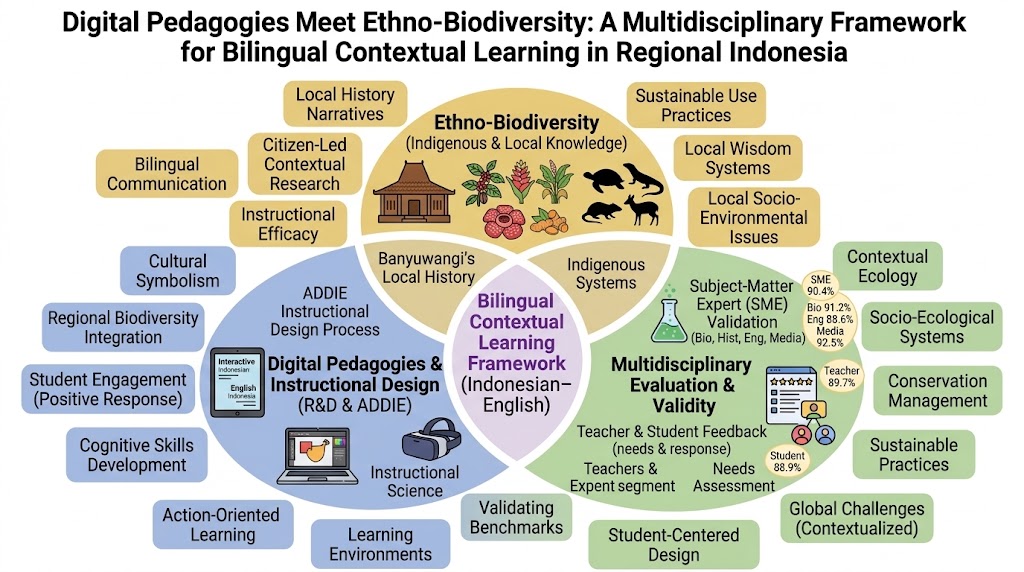
This study aims to analyze the effect of digital storytelling on students' understanding of local history, environmental awareness, and English speaking or writing skills at SMA Negeri 1 Rogojampi. Digital storytelling enables students to convey historical narratives and environmental issues in English through videos, podcasts, or digital presentations. This research employs a mixed methods approach with a pre-experimental one-group pretest-posttest design. Research subjects consisted of 32 students from SMA Negeri 1 Rogojampi who participated in an 8-week project-based digital storytelling learning program. Data were collected through history comprehension tests, environmental awareness tests, English language skills assessment rubrics, and student reflections. The results show that digital storytelling significantly improved students' understanding of local history (p<0.01), environmental awareness (p<0.01), and English speaking and writing skills (p<0.01). Qualitative analysis of student reflections revealed that the digital story creation process encouraged students to explore local history, understand environmental issues, and develop English language skills contextually. This research offers a digital learning approach that connects local content with language development and provides recommendations for integrating digital storytelling into the Merdeka Curriculum.
Downloads
Published
How to Cite
Issue
Section
License
Copyright (c) 2024 Intan Melani Putri, Amanda Sherly Marsellinda, Septy Kumala Sari, Putri Febrianti, Dian Arief Pradana

This work is licensed under a Creative Commons Attribution-ShareAlike 4.0 International License.






 All publications by the CV. Bimbingan Belajar Assyfa [e-ISSN: