Pengembangan Aplikasi Mobile Geo-Cost Untuk Integrasi Konsep Geometri Dan Analisis Biaya Kewirausahaan Kerajinan Tangan Dalam Kursus Menjahit
DOI:
https://doi.org/10.61650/dpjpm.v3i2.376Keywords:
Critical thinking skills, Math, PBL, Education, Improvement, High School Students,Abstract
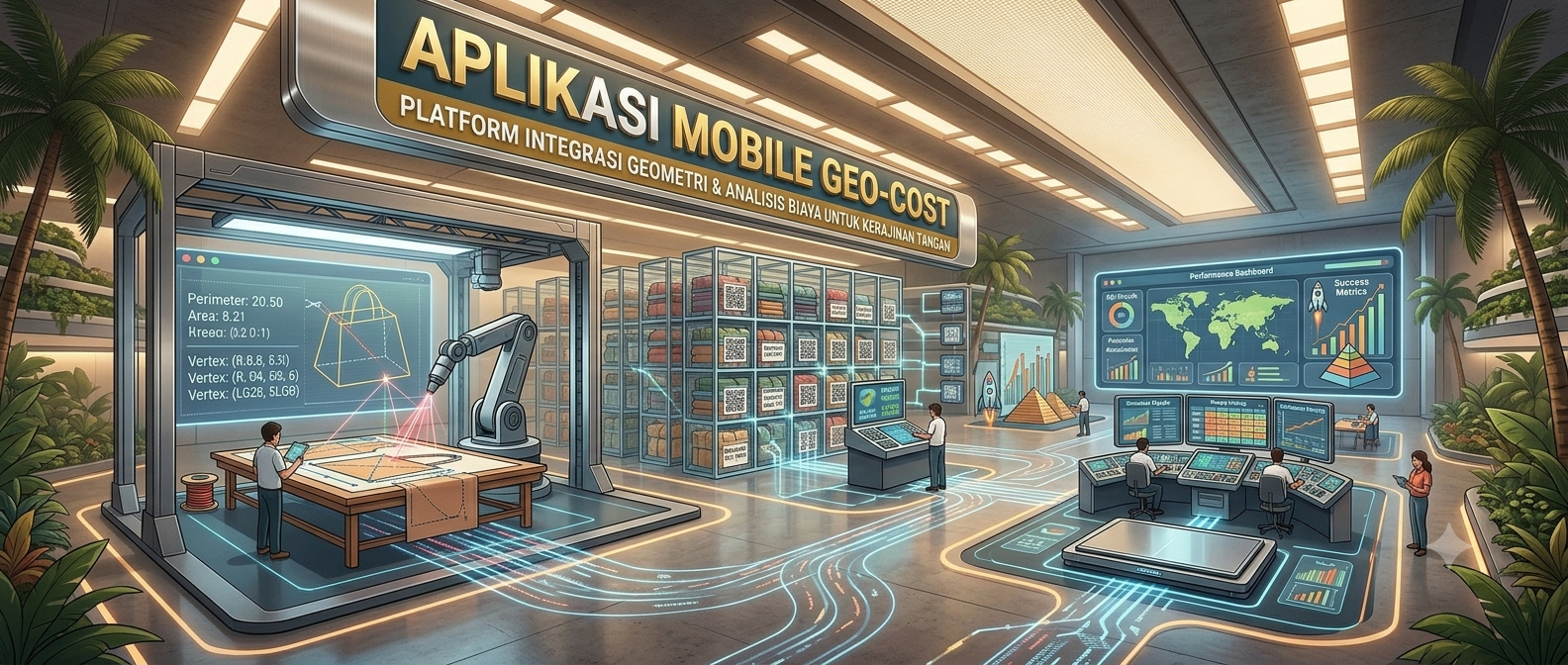
Penelitian ini dimotivasi oleh tantangan kepemimpinan pendidikan dalam mendorong inovasi dalam pembelajaran vokasional yang terintegrasi dengan teknologi, khususnya dalam menjembatani kesenjangan antara penguasaan konsep Geometri (Pendidikan Matematika) dengan Analisis Biaya dan kemampuan penetapan harga dalam konteks Kewirausahaan Kerajinan. Tujuan utama penelitian ini adalah untuk menganalisis kebutuhan dan merancang prototipe Aplikasi Mobile Geo-Cost sebagai solusi digital untuk mengintegrasikan kedua kompetensi tersebut. Metode Penelitian yang digunakan adalah Model Penelitian dan Pengembangan (R&D) 4D (Define, Design, Develop, Disseminate), tetapi terbatas hanya pada Tahap Desain. Desain Penelitian berfokus pada Analisis Front-End, Pembelajar, dan Konten untuk definisi produk, diikuti dengan desain arsitektur dan antarmuka aplikasi. Teknik Pengumpulan Data melibatkan Wawancara Mendalam dengan pengelola kursus ("Liana Taylor" dalam berkas observasi) dan siswa, Observasi Partisipatif, dan Analisis Dokumen Kurikulum. Instrumen yang digunakan meliputi panduan wawancara, lembar observasi, dan kuesioner analisis kebutuhan. Analisis data dilakukan secara kualitatif-deskriptif untuk merumuskan spesifikasi produk dan secara sintetis untuk menyusun rancangan aplikasi dan diagram alir. Temuan menunjukkan kebutuhan mendesak akan alat digital yang secara otomatis menghitung volume/luas bahan kerajinan (Geometri) dan kemudian menentukan Biaya Bahan Baku dan Biaya Barang yang Dijual (Indikator Kewirausahaan). Hal ini tercermin dalam hasil akhir, yaitu Prototipe Desain Fungsional Aplikasi Mobile Geo-Cost
Downloads
References
Alfiah, S., &; Dwikoranto, D. (2022). Application of PhET Virtual Laboratory-assisted Problem Based Learning Model to Improve HOTs of High School Students. Journal of Physics Learning Research, 13(1), 9–18. https://doi.org/10.26877/jp2f.v13i1.11494
Alvira, L. D., Ahyaningsih, F., &; Minarni, A. (2022). Development of learning tools based on CTL approach to improve mathematical critical thinking skills and mathematical resilience of students of SMP Gajah Mada Medan. Journal of Scholars: Journal of Mathematics Education, 6(2), 2253–2269.
Anggraeni, H., Rahayu, S., Rusdi, R., &; Ichsan, I. Z. (2018). The Effect of Reciprocal Teaching and Problem Based Learning on the Critical Thinking Ability of High School Students on Reproductive System Material. Biota, 11(1), 77–95. https://doi.org/10.20414/jb.v11i1.84
Aspini, N. N. A. (2020). Implementation of PBL learning assisted by question card media to improve HOTS skills in grade VI elementary school students. Undiksha Edutech Journal, 8(1), 72. https://doi.org/10.23887/jeu.v8i1.27087
Asriningtyas, A. N., Kristin, F., &; Anugraheni, I. (2018). Application of problem-based learning models to improve critical thinking skills and mathematics learning outcomes of grade 4 elementary school students. Journal of Mathematics Education Works.
Cahyandani, N. (2022). Implementation of Problem-Based Learning Model to Improve Learning Outcomes of Grade IV Students of SDN Jatisobo 4. NBER Working Papers, 5(5), 8.
Cahyani, H. D., Hadiyanti, A. H. D., & Saptoro, A. (2021). Improve students' discipline and critical thinking skills by applying problem-based learning models. Education : Journal of Educational Sciences, 3(3), 919–927.
Datreni, N. L. (2022). The problem-based learning model improves the mathematics learning outcomes of grade III elementary school students. Journal of Educational Action Research, 6(3), 369–375.
Dewanto, S. A., Marpanaji, E., Mahali, M. I., Hasanah, N., &; Wulandari, B. (2018). Application of Problem Based Learning for Higher Order Thinking Skills in Informatics Engineering Education Students. Elinvo (Electronics, Informatics, and Vocational Education), 3(1), 52–62. https://doi.org/10.21831/elinvo.v3i1.19779
Goddess, E. K., &; Jatiningsih, O. (2015). THE EFFECT OF USING A PROBLEM-BASED LEARNING MODEL ON STUDENTS' CRITICAL THINKING SKILLS IN CLASS X PPKn SUBJECTS AT SMAN 22 SURABAYA.
Dwi Haryanti, Y. (2017). The problem-based learning model builds the critical thinking skills of elementary school students. Journal of Cakrawala Pendas, 3(2), 57–63.
Facione, P. A. (2020). Critical thinking: what it is and why it matters.
Fatimah, N. (2019). Untitledس. ペインクリニック学会治療指針2, 2, 1–13.
Febrita, I., &; Harni. (2020). Problem-Based Learning Model in Integrated Thematic Learning Towards Critical Thinking of Grade IV Elementary School Students. Tambusai Journal of Education.
Hamdani. (2011). Teaching and Learning Strategies. C.V Library Faithful.
Kurino, YD (2020). Problem Based Learning (PBL) model in mathematics lessons in elementary schools. Elementaria Journal of Education, 3(1), 150–154. https://doi.org/10.31949/jee.v3i1.2240
Kurniawati, D., &; Ekayanti, A. (2020). THE IMPORTANCE OF CRITICAL THINKING IN MATHEMATICS LEARNING. PeTeKa. http://jurnal.um-tapsel.ac.id/index.php/ptk/article/view/1892
Kusrniasih, I., Sani, B., &; Jay, A. (2015). Various learning model development to improve teacher professionalism.
NGATIYEM. (2021). APPLICATION OF PROBLEM-BASED LEARNING TO IMPROVE STUDENTS' CRITICAL THINKING SKILLS. Journal of Classroom and School Action Research Innovation, 1(2), 149–157.
Priyono, S., &; Hermanto, R. (2015). Improve students' mathematical connection skills using problem-based learning (PBL) models with the help of Geogebra Software. Journal of Mathematics Education and Teaching Research, 3(1), 39–44.
Purnaningsih, W., Relmasira, S. C., &; Hardini, A. T. A. (2019). Thematic learning outcomes through the Problem Based Learning (PBL) model of grade V elementary school. Naturalistic: Journal of Research Studies and Education and Learning, 3(2), 367–375.
Putri, F. M., Susanti, E., Kritis, K. B. (2018). Students' mathematical critical thinking skills in mathematics learning using apos theory. 1–11.
Raga, SD, Fitriyah, C. Z., &; Finali, Z. (2020). Elementary School : Journal of Elementary School Teacher Education Volume 9 Number 4 August 2020 The Effect of the Application of Problem-Based Learning on the Higher Order Thinking Skills of Grade V Students on Hot and Transfer Themes at SD Negeri Kepatihan 06 Jember. 9, 482–491.
Rakhmawati, I. A., &; Alifia, N. N. (2018). Local wisdom in mathematics learning as a reinforcement of student character. Electronic Journal of Mathematics Learning, 5(2), 186–196.
Rezkillah, I. I., &; Haryanto, H. (2020). The effect of the problem-based learning model integrated higher-order thinking skills on critical thinking ability and confidence. Indonesian Journal of Science Education, 8(2), 257–268. https://doi.org/10.24815/jpsi.v8i2.17322
Rosidah, R., Wasonowati, T., Redjeki, T. *, Sri, D., &; Ariani, R. D. (2014). The application of the Problem Based Learning (PBL) model in learning Basic Principles of Chemistry is reviewed from the activities and learning outcomes of grade X students of SMA Negeri 2 Surakarta for the 2013/2014 academic year. Journal of Chemistry Education, 3(3), 66–75.
Rusman. (2014). Learning Models Develop Teacher Professionalism. Eagle Press.
Saputri, M. A. (2020). Application of the Problem Based Learning learning model to improve the critical thinking skills of grade V elementary school students. Journal of Education and Counseling (JPDK), 2(1), 92–98. https://doi.org/10.31004/jpdk.v1i2.602
Setiyawan, H. (2017). PBL (Problem Based Learning) Learning Mathematical Models in mathematics subjects Broad field material in grade III elementary school students. Innovation, 19(1), 5–24.
Setyawan, M., &; Koeswanti, H. D. (2021). Problem-based learning for critical thinking of elementary school students. MIMBAR PGSD Undiksha, 9(3), 489–496. https://doi.org/10.23887/jjpgsd.v9i3.41099
Shoimin, A. (2016). Innovative Learning Model in the 2013 Curriculum. Ar-Ruzz Media.
Sulistriani, E. (2016). The uniqueness and complexity of elements in mathematics subjects make students able to think critically in mathematics learning.
Suyadi, Kuswadi, &; Egkus. (2013). CHARACTER EDUCATION LEARNING STRATEGIES (Cet.2). Bandung : REMAJA ROSDAKARYA, 2013.
Shamsidah, &; Syriac, H. (2018). Peoblem Based Learning (PBL) Model Book. Books, 1–92.
Trisnadati, I. (2018). Comparison of realistic mathematical approaches with PBL and PjBL models in terms of interpersonal skills, critical thinking, and learning achievement. Pythagoras: Journal of Mathematics Education, 13(1), 99–109. https://doi.org/10.21831/pg.v13i1.21219
Vera, K., &; Wardani, K. W. (2018). Journal of educational technology and innovation research to improve critical thinking skills through an audio-visual assisted problem-based learning model in grade IV elementary school students. JARTIKA : Journal of Educational Technology and Innovation Research, 1(2), 33–45.
Wahyuni, S. (2020). Mathematical characteristics. https://www.sriwahyunisam.com/2020/07/karakteristik-matematika.html
Widayanti, R., &; Dwi Nur'aini, K. (2020). Application of Problematic Learning Models to Improve Mathematics Learning Achievement and Student Activities. Mathema: Journal of Mathematics Education, 2(1), 12. https://doi.org/10.33365/jm.v2i1.480
Published
How to Cite
Issue
Section
License
Copyright (c) 2026 khusnul Khuluq; Sabeeha Hamza Dehham

This work is licensed under a Creative Commons Attribution-ShareAlike 4.0 International License.




 ARTICLE TEMPLATE