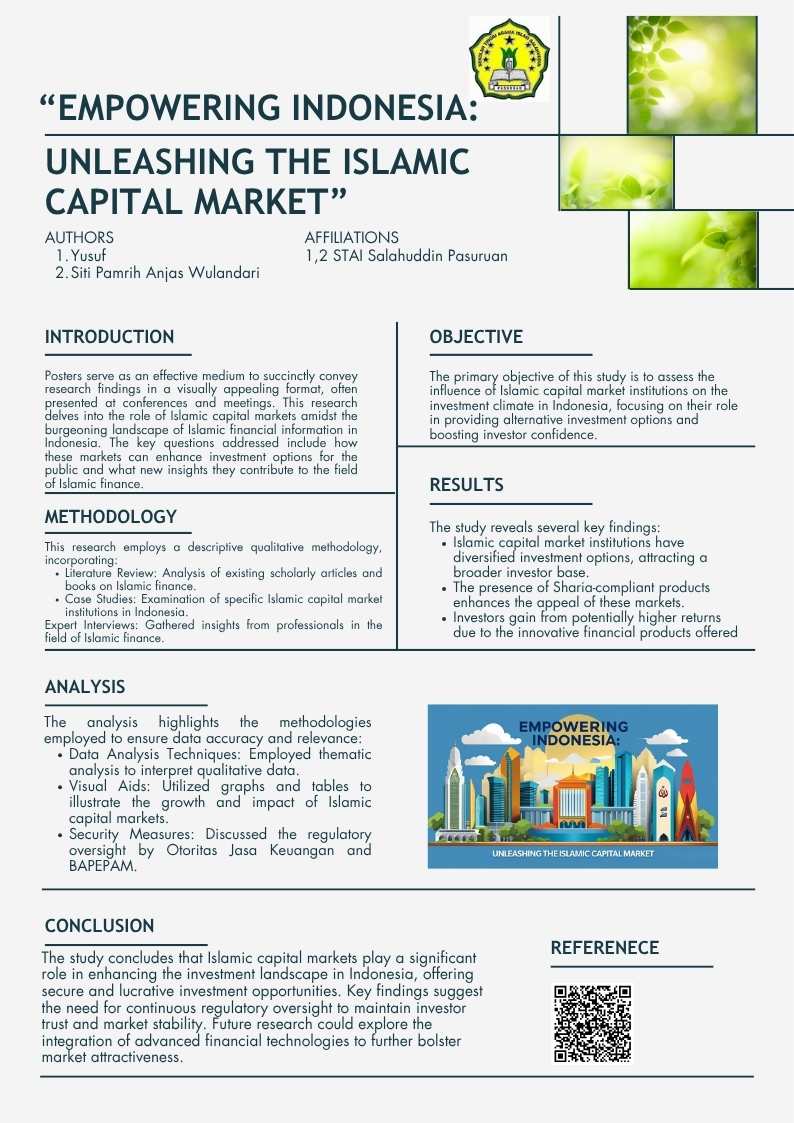
Empowering Indonesia: Unleashing The Islamic Capital Market
DOI:
https://doi.org/10.61650/aops.v1i1.824Keywords:
Islamic Capital Market, Empowering IndonesiaAbstract
Posters serve as an effective medium to succinctly convey research findings in a visually appealing format, often presented at conferences and meetings. This research delves into the role of Islamic capital markets amidst the burgeoning landscape of Islamic financial information in Indonesia. The key questions addressed include how these markets can enhance investment options for the public and what new insights they contribute to the field of Islamic finance.
Downloads
References
Ajala, I. (2022). Islamic Fashion: Subversion or Reinvention of Religious Values? Journal of Muslim Minority Affairs, 42(1), 26–40. https://doi.org/10.1080/13602004.2022.2064053
Azizah, L. F., & Mas’odi, M. (2020). Mengembangkan Kemandirian Dan Motorik Halus Pada Siswa Down Syndrome Di Sekolah Luar Biasa (Slb). Autentik : Jurnal Pengembangan Pendidikan Dasar, 3(1), 50–61. https://doi.org/10.36379/autentik.v3i1.33
Badriah, L. S., & Arintoko. (2024). The Dynamics Model of Cross-Regional to Enhance Economic Growth: New Empirical Evidence from Indonesia. ECONOMICS - Innovative and Economics Research Journal, 12(3), 379 – 395. https://doi.org/10.2478/eoik-2024-0046
Banowati, E. (2020). A lesson learn from empowerment program of integrated cassava-tapioca agroindustry actors in Pati District, Indonesia. Indonesian Journal of Geography, 35(2), 190–200. https://doi.org/10.22146/ijg.50405
Bunting, B. A., & Cranor, C. W. (2006). The Asheville Project: Long-term clinical, humanistic, and economic outcomes of a community-based medication therapy management program for asthma. Journal of the American Pharmacists Association, 46(2), 133–147. https://doi.org/10.1331/154434506776180658
Bunting, B. A., Smith, B. H., & Sutherland, S. E. (2008). The Asheville Project: Clinical and economic outcomes of a community-based long-term medication therapy management program for hypertension and dyslipidemia. Journal of the American Pharmacists Association, 48(1), 23–31. https://doi.org/10.1331/JAPhA.2008.07140
Calabrese, J. (2020). “Unnatural” Disasters and Injustice in the Indian Riskscape: Unleashing Youth Potential. Asian Affairs, 51(4), 913–936. https://doi.org/10.1080/03068374.2020.1834798
Cranor, C. W., Bunting, B. A., & Christensen, D. B. (2003). The Asheville project: Long-term clinical and economic outcomes of a community pharmacy diabetes care program. Journal of the American Pharmacists Association, 43(2), 173–184. https://doi.org/10.1331/108658003321480713
Ferriswara, D., Sayidah, N., & Agus Buniarto, E. (2022). Do corporate governance, capital structure predict financial performance and firm value?(empirical study of Jakarta Islamic index). Cogent Business and Management, 9(1). https://doi.org/10.1080/23311975.2022.2147123
Hardiansyah, F., & Mas’odi, M. (2020). Implementasi Nilai Religius Melalui Budaya Sekolah: Studi Fenomenologi. Autentik : Jurnal Pengembangan Pendidikan Dasar, 4(1), 15–24. https://doi.org/10.36379/autentik.v4i1.49
Helbing, D. (2018). Societal, economic, ethical and legal challenges of the digital revolution: From big data to deep learning, artificial intelligence, and manipulative technologies. Towards Digital Enlightenment: Essays on the Dark and Light Sides of the Digital Revolution, 47–72. https://doi.org/10.1007/978-3-319-90869-4_6
Hendratmi, A., Ryandono, M. N. H., & Sukmaningrum, P. S. (2020). Developing Islamic crowdfunding website platform for startup companies in Indonesia. Journal of Islamic Marketing, 11(5), 1041 – 1053. https://doi.org/10.1108/JIMA-02-2019-0022
Hiswanti, Sarwoprasodjo, S., Hubeis, A. V. S., & Hapsari, D. R. (2024). COMMUNICATION OF EMPOWERMENT “SHARING” DISABILITY INDONESIAN DISABILITY WOMEN’S ASSOCIATION (HWDI) WEST JAVA IN IMPROVING SELF-DEVELOPMENT; [COMUNICAÇÃO DO EMPODERAMENTO “COMPARTILHAMENTO” DE DEFICIÊNCIA ASSOCIAÇÃO INDONÉSIA DE MULHERES COM DEFICIÊNCIA (H. Revista de Gestao Social e Ambiental, 18(7). https://doi.org/10.24857/rgsa.v18n7-099
Ifada, L. M., Faisal, F., Ghozali, I., & Udin, U. (2019). Company attributes and firm value: Evidence from companies listed on Jakarta islamic index. Espacios, 40(37), 1–14.
Jayabalan, J., Dorasamy, M., Raman, M., Sambasivan, M., & Harun, S. (2022). Unleashing frugal innovation in private higher education institutions via intellectual capital and Information technology capability: A systematic literature review. F1000Research, 10. https://doi.org/10.12688/f1000research.73329.2
Jihadi, M., Vilantika, E., Widagdo, B., Sholichah, F., & Bachtiar, Y. (2021). Islamic social reporting on value of the firm: Evidence from Indonesia Sharia Stock Index. Cogent Business and Management, 8(1). https://doi.org/10.1080/23311975.2021.1920116
Kustono, A. S. (2021). Corporate governance mechanism as income smoothing suppressor. Accounting, 7(4), 977 – 986. https://doi.org/10.5267/j.ac.2021.1.010
Lindawati, L. (2022). The Role of Information and Communication Technology for Economic Sustainability through Social Entrepreneurship Practices in Indonesia: A Preliminary Study. Jurnal Ilmu Sosial Dan Ilmu Politik, 26(2), 213 – 226. https://doi.org/10.22146/jsp.71796
Mas’odi, M. (2014). Koherensi Program Pembentukan Kepribadian dan Kepemimpinan Universitas Muhammadiyah Malang dalam Pengembangan Pendidikan Karakter dan Budaya Bangsa. https://doi.org/10.22219/jkpp.v2i2.1916
Mas’odi, M. (2019). The Preferences of STKIP PGRI Sumenep The Students in Visiting Library of STKIP PGRI Sumenep. Publication Library and Information Science, 2(2), 53. https://doi.org/10.24269/pls.v2i2.1448
Mas’odi, M., Syaifuddin, M., & Amirullah, A. (2020). Pengembangan Karakter Siswa Melalui Kegiatan Home Visit (Studi Kasus Tingkat Sekolah Dasar di Kabupaten Sumenep). Jurnal Pemikiran Dan Pengembangan Sekolah Dasar (JP2SD), 8(2), 107–117. https://doi.org/10.22219/jp2sd.v8i2.11734
Miftahurrohmah, B., Iriawan, N., & Fithriasari, K. (2017). On the Value at Risk Using Bayesian Mixture Laplace Autoregressive Approach for Modelling the Islamic Stock Risk Investment. Journal of Physics: Conference Series, 855(1). https://doi.org/10.1088/1742-6596/855/1/012026
Murni, S., Rahmawati, Widagdo, A. K., & Sudaryono, E. A. (2022). Family control, leverage, and quality of earnings: a study on manufacturing companies in Indonesia. Economic Annals-XXI, 200(11–12), 34 – 41. https://doi.org/10.21003/ea.V200-06
Nurwidodo, N., Rahardjanto, A., Husamah, H., Mas’odi, M., & Mufrihah, A. (2017). Teacher Resilience in Remote Islands Area: A Case Study in Small Pagerungan Island Sumenep Regency, Indonesia. Journal of Education and Learning (EduLearn), 11(1), 47–56. https://doi.org/10.11591/edulearn.v11i1.4669
Putri, L. P. Y. K., Imarhiagbe, M., Mandira, I. M. C., Withnall, E. G., & Duarsa, P. Y. S. B. (2023). Comparative Analysis of Indonesia’s Minimum Capital Requirements for Foreign Direct Investment. Lex Scientia Law Review, 7(1), 179 – 214. https://doi.org/10.15294/lesrev.v7i1.64664
Ridwan, M., & Mas’odi , M. (2017). Tradisi Nyanyian Anak Terhadap Pembentukan Karakter Anak Usia Sekolah Dasar. Sekolah Dasar: Kajian Teori Dan Praktik Pendidikan, 26(1), 49–61. https://doi.org/10.17977/um009v26i12017p049
Samier, E. A. (2020). Missing non-Western voices on social justice for education: A postcolonial perspective on traditions of humanistic marginalized communities. Handbook on Promoting Social Justice in Education, 105–126. https://doi.org/10.1007/978-3-030-14625-2_45
Tien, J. M. (2013). Big Data: Unleashing information. Journal of Systems Science and Systems Engineering, 22(2), 127–151. https://doi.org/10.1007/s11518-013-5219-4
Tirole, J., & Rendall, S. (2017). Economics for the Common Good. Economics for the Common Good, 1–564. https://doi.org/10.3326/pse.42.2.12
Waluyo, A. (2022). Understanding the values of Islamic economics and Javanese philosophy pertaining to the work ethic of Muslim merchants in Salatiga. Indonesian Journal of Islam and Muslim Societies, 12(2), 393–419. https://doi.org/10.18326/ijims.v12i2.393-419
Yaqin, H., Hartati, Z., Salabi, A., Bahri, S., & Mizani, H. (2021). Influence of Image-building, Financial Stability and Curriculum development on Education Management with Moderating effect of Educational Leadership: An Islamic Perspective. Eurasian Journal of Educational Research, 2021(94), 422–443. https://doi.org/10.14689/ejer.2021.94.19
Downloads
Published
How to Cite
Issue
Section
License
Copyright (c) 2022 Yusuf Yusuf, Siti Pamrih Anjas Wulandari

This work is licensed under a Creative Commons Attribution-ShareAlike 4.0 International License.






 All publications by the CV. Bimbingan Belajar Assyfa [e-ISSN: