
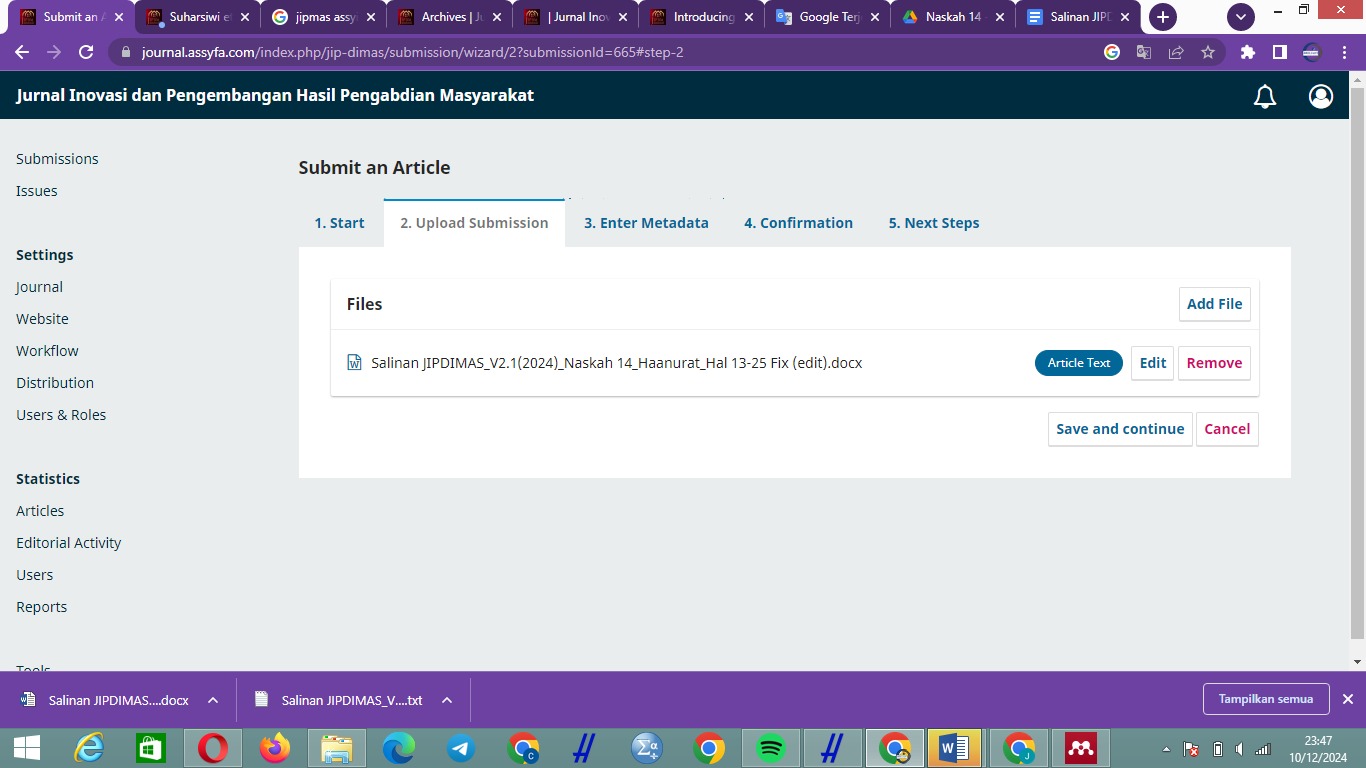
Journal submission challenges: mentoring and training students in open journal system scientific paper publication

Authors

DOI:

https://doi.org/10.61650/jip-dimas.v2i1.308

Keywords:

Submission, Paper publication, Mentoring and training, Open journal system

Abstract

Converting student theses or final projects into publishable articles poses a significant challenge. Many students struggle to articulate their ideas in scientific publications due to a lack of writing training. This study aims to identify and address the difficulties students face when submitting papers to scientific journals, particularly using the open journal system. The mentoring and training service implemented comprises four phases: preparation, implementation, analysis, and evaluation. Results indicate that students face challenges in areas such as metadata composition and article submission. However, the training increased student motivation and enthusiasm, enhancing their ability to complete academic assignments and submit them to scholarly journals. This study highlights the necessity of ongoing writing practice and focused mentoring to improve student competencies in scientific paper publication.

Downloads
Download data is not yet available.

References

Ahluwalia, K., Abernathy, M. J., Beierle, J., Cauchon, N. S., Cronin, D., Gaiki, S., Lennard, A., Mady, P., McGorry, M., Sugrue-Richards, K., & Xue, G. (2022). The Future of CMC Regulatory Submissions: Streamlining Activities Using Structured Content and Data Management. Journal of Pharmaceutical Sciences, 111(5), 1232 – 1244. https://doi.org/10.1016/j.xphs.2021.09.046

Alday, E. A. P. (2020). Classification of 12-lead ECGs: The PhysioNet/Computing in Cardiology Challenge 2020. Physiological Measurement, 41(12). https://doi.org/10.1088/1361-6579/abc960

Baas, J. (2020). Scopus as a curated, high-quality bibliometric data source for academic research in quantitative science studies. Quantitative Science Studies, 1(1), 377–386. https://doi.org/10.1162/qss_a_00019

Badulak, J. (2021). Extracorporeal Membrane Oxygenation for COVID-19: Updated 2021 Guidelines from the Extracorporeal Life Support Organization. ASAIO Journal, 67(5), 485–495. https://doi.org/10.1097/MAT.0000000000001422

Bateman, A. (2023). UniProt: the Universal Protein Knowledgebase in 2023. Nucleic Acids Research, 51. https://doi.org/10.1093/nar/gkac1052

Bi, D. (2020). Configuration and spin-up of ACCESS-CM2, the new generation Australian Community Climate and Earth System Simulator Coupled Model. Journal of Southern Hemisphere Earth Systems Science, 70(1), 225–251. https://doi.org/10.1071/ES19040

Black, S. (2022). GPT-NeoX-20B: An Open-Source Autoregressive Language Model. 2022 Challenges and Perspectives in Creating Large Language Models, Proceedings of the Workshop, 95–136.

Blanc, L. E. (2020). Scientific Challenges for the Implementation of Zn-Ion Batteries. Joule, 4(4), 771–799. https://doi.org/10.1016/j.joule.2020.03.002

Card, D. (2020). Are Referees and Editors in Economics Gender Neutral? Quarterly Journal of Economics, 135(1), 269–327. https://doi.org/10.1093/qje/qjz035

Chen, T. (2022). iProX in 2021: Connecting proteomics data sharing with big data. Nucleic Acids Research, 50. https://doi.org/10.1093/nar/gkab1081

Clark, J. (2020). A full systematic review was completed in 2 weeks using automation tools: a case study. Journal of Clinical Epidemiology, 121, 81–90. https://doi.org/10.1016/j.jclinepi.2020.01.008

Critchley, H. O. D. (2020). Menstruation: science and society. American Journal of Obstetrics and Gynecology, 223(5), 624–664. https://doi.org/10.1016/j.ajog.2020.06.004

Cuomo, S. (2022). Scientific Machine Learning Through Physics–Informed Neural Networks: Where we are and What’s Next. Journal of Scientific Computing, 92. https://doi.org/10.1007/s10915-022-01939-z

da San Martino, G. (2020). SemEval-2020 Task 11: Detection of Propaganda Techniques in News Articles. 14th International Workshops on Semantic Evaluation, SemEval 2020 - Co-Located 28th International Conference on Computational Linguistics, COLING 2020, Proceedings, 1377–1414.

de Blas, J. (2020). Higgs Boson studies at future particle colliders. Journal of High Energy Physics, 2020(1). https://doi.org/10.1007/JHEP01(2020)139

Deutsch, E. W. (2023). The ProteomeXchange consortium at 10 years: 2023 update. Nucleic Acids Research, 51. https://doi.org/10.1093/nar/gkac1040

DeVito, N. J. (2020). Compliance with legal requirement to report clinical trial results on ClinicalTrials.gov: a cohort study. The Lancet, 395(10221), 361–369. https://doi.org/10.1016/S0140-6736(19)33220-9

Ding, M. (2020). Learning depth-guided convolutions for monocular 3d object detection. Proceedings of the IEEE Computer Society Conference on Computer Vision and Pattern Recognition, 11669–11678. https://doi.org/10.1109/CVPR42600.2020.01169

du Sert, N. P. (2020a). Reporting animal research: Explanation and elaboration for the arrive guidelines 2.0. PLoS Biology, 18(7). https://doi.org/10.1371/journal.pbio.3000411

du Sert, N. P. (2020b). The arrive guidelines 2.0: Updated guidelines for reporting animal research. PLoS Biology, 18(7). https://doi.org/10.1371/journal.pbio.3000410

Dubey, J. P. (2023). Toxoplasmosis of animals and humans. Toxoplasmosis of Animals and Humans, 1–564. https://doi.org/10.1201/9781003199373

Erickson, L. A. (2022). Overview of the 2022 WHO Classification of Parathyroid Tumors. Endocrine Pathology, 33(1), 64–89. https://doi.org/10.1007/s12022-022-09709-1

Fröbe, M. (2023). Continuous Integration for Reproducible Shared Tasks with TIRA.io. Lecture Notes in Computer Science (Including Subseries Lecture Notes in Artificial Intelligence and Lecture Notes in Bioinformatics), 13982, 236–241. https://doi.org/10.1007/978-3-031-28241-6_20

Gonzalez-Galarza, F. F. (2020). Allele frequency net database (AFND) 2020 update: Gold-standard data classification, open access genotype data and new query tools. Nucleic Acids Research, 48. https://doi.org/10.1093/nar/gkz1029

Guangul, F. M. (2020). Challenges of remote assessment in higher education in the context of COVID-19: a case study of Middle East College. Educational Assessment, Evaluation and Accountability, 32(4), 519–535. https://doi.org/10.1007/s11092-020-09340-w

Haanurat, A. I., Darmayanti, R., & Choirudin, C. (2024). Journal submission challenges: mentoring and training students in open journal system scientific paper publication. Jurnal Inovasi Dan Pengembangan Hasil Pengabdian Masyarakat, 1.

Harrison, T., Ledezma, K., Morgan, M., & Morgan, J. (2024). The language of submission: a four-way duoethnography exploring translanguaging pedagogy with carceral students’ funds of knowledge and funds of identity. Innovation in Language Learning and Teaching, 18(3), 237 – 252. https://doi.org/10.1080/17501229.2024.2311840

Hellmich, B. (2020). 2018 Update of the EULAR recommendations for the management of large vessel vasculitis. Annals of the Rheumatic Diseases, 79(1), 19–130. https://doi.org/10.1136/annrheumdis-2019-215672

Hotimah, L. H., Hasyim, U. A. A., & Dewi, Y. A. S. (2024). Implementation of Islamic Religious Education in Cultivating Morals in Elementary School Students. Assyfa Journal of Multidisciplinary Education, 1, 5–9.

Hu, M. (2021). PENet: Towards Precise and Efficient Image Guided Depth Completion. Proceedings - IEEE International Conference on Robotics and Automation, 2021, 13656–13662. https://doi.org/10.1109/ICRA48506.2021.9561035

Jiang, S. (2021). Learning to Estimate Hidden Motions with Global Motion Aggregation. Proceedings of the IEEE International Conference on Computer Vision, 9752–9761. https://doi.org/10.1109/ICCV48922.2021.00963

Kaplon, H. (2021). Antibodies to watch in 2021. MAbs, 13(1). https://doi.org/10.1080/19420862.2020.1860476

Kaplon, H. (2023). Antibodies to watch in 2023. MAbs, 15(1). https://doi.org/10.1080/19420862.2022.2153410

Kavur, A. E. (2021). CHAOS Challenge - combined (CT-MR) healthy abdominal organ segmentation. Medical Image Analysis, 69. https://doi.org/10.1016/j.media.2020.101950

Kazeminia, S. (2020). GANs for medical image analysis. Artificial Intelligence in Medicine, 109. https://doi.org/10.1016/j.artmed.2020.101938

Kikhney, A. G. (2020). SASBDB: Towards an automatically curated and validated repository for biological scattering data. Protein Science, 29(1), 66–75. https://doi.org/10.1002/pro.3731

Kim, S. (2021). PubChem in 2021: New data content and improved web interfaces. Nucleic Acids Research, 49. https://doi.org/10.1093/nar/gkaa971

Kisantal, M. (2020). Satellite pose estimation challenge: Dataset, competition design, and results. IEEE Transactions on Aerospace and Electronic Systems, 56(5), 4083–4098. https://doi.org/10.1109/TAES.2020.2989063

Knoll, F. (2020). Advancing machine learning for MR image reconstruction with an open competition: Overview of the 2019 fastMRI challenge. Magnetic Resonance in Medicine, 84(6), 3054–3070. https://doi.org/10.1002/mrm.28338

Kreinsen, J. J. (2024). The Importance of Marbles in Science Education for Elementary School Children. Assyfa Learning Journal, 2, 99–115.

Krukowski, R. A. (2021). Academic productivity differences by gender and child age in science, technology, engineering, mathematics, and medicine faculty during the COVID-19 pandemic. Journal of Women’s Health, 30(3), 341–347. https://doi.org/10.1089/jwh.2020.8710

Leisman, D. E. (2020). Development and Reporting of Prediction Models: Guidance for Authors From Editors of Respiratory, Sleep, and Critical Care Journals. Critical Care Medicine, 48(5), 623–633. https://doi.org/10.1097/CCM.0000000000004246

Lembrechts, J. J. (2020). SoilTemp: A global database of near-surface temperature. Global Change Biology, 26(11), 6616–6629. https://doi.org/10.1111/gcb.15123

Li, Y. (2022). Competition-level code generation with AlphaCode. Science, 378(6624), 1092–1097. https://doi.org/10.1126/science.abq1158

Liu, Y. (2022). CB-Dock2: improved protein-ligand blind docking by integrating cavity detection, docking and homologous template fitting. Nucleic Acids Research, 50. https://doi.org/10.1093/nar/gkac394

Lu, B. (2020). Recent advances of hyperspectral imaging technology and applications in agriculture. Remote Sensing, 12(16). https://doi.org/10.3390/RS12162659

Macdonald, J. C., Isom, D. C., Evans, D. D., & Page, K. J. (2021). Digital Innovation in Medicinal Product Regulatory Submission, Review, and Approvals to Create a Dynamic Regulatory Ecosystem—Are We Ready for a Revolution? Frontiers in Medicine, 8. https://doi.org/10.3389/fmed.2021.660808

Makridakis, S. (2022). M5 accuracy competition: Results, findings, and conclusions. International Journal of Forecasting, 38(4), 1346–1364. https://doi.org/10.1016/j.ijforecast.2021.11.013

Malik-Sheriff, R. S. (2020). BioModels-15 years of sharing computational models in life science. Nucleic Acids Research, 48. https://doi.org/10.1093/nar/gkz1055

Mottet, N. (2021). EAU-EANM-ESTRO-ESUR-SIOG Guidelines on Prostate Cancer—2020 Update. Part 1: Screening, Diagnosis, and Local Treatment with Curative Intent. European Urology, 79(2), 243–262. https://doi.org/10.1016/j.eururo.2020.09.042

Muckley, M. J. (2021). Results of the 2020 fastMRI Challenge for Machine Learning MR Image Reconstruction. IEEE Transactions on Medical Imaging, 40(9), 2306–2317. https://doi.org/10.1109/TMI.2021.3075856

Naha, R. K. (2020). Deadline-based dynamic resource allocation and provisioning algorithms in Fog-Cloud environment. Future Generation Computer Systems, 104, 131–141. https://doi.org/10.1016/j.future.2019.10.018

Nevéus, T. (2020). Management and treatment of nocturnal enuresis—an updated standardization document from the International Children’s Continence Society. Journal of Pediatric Urology, 16(1), 10–19. https://doi.org/10.1016/j.jpurol.2019.12.020

Pang, S. (2020). CLOCs: Camera-LiDAR Object Candidates Fusion for 3D Object Detection. IEEE International Conference on Intelligent Robots and Systems, 10386–10393. https://doi.org/10.1109/IROS45743.2020.9341791

Perkins, M. (2023). Academic Integrity considerations of AI Large Language Models in the post-pandemic era: ChatGPT and beyond. Journal of University Teaching and Learning Practice, 20(2). https://doi.org/10.53761/1.20.02.07

Peters, M. D. J. (2020). Updated methodological guidance for the conduct of scoping reviews. JBI Evidence Synthesis, 18(10), 2119–2126. https://doi.org/10.11124/JBIES-20-00167

Pineau, J. (2021). Improving reproducibility in machine learning research (a report from the neurips 2019 reproducibility program). Journal of Machine Learning Research, 22, 1–20.

Porwal, P. (2020). IDRiD: Diabetic Retinopathy – Segmentation and Grading Challenge. Medical Image Analysis, 59. https://doi.org/10.1016/j.media.2019.101561

Pranckutė, R. (2021). Web of Science (WoS) and Scopus: the titans of bibliographic information in today’s academic world. Publications, 9(1). https://doi.org/10.3390/publications9010012

Qian, R. (2020). End-to-End Pseudo-LiDAR for Image-Based 3D Object Detection. Proceedings of the IEEE Computer Society Conference on Computer Vision and Pattern Recognition, 5880–5889. https://doi.org/10.1109/CVPR42600.2020.00592

Qiao, Y. L. (2020). Efficacy, safety, and immunogenicity of an escherichia coli-produced bivalent human papillomavirus vaccine: An interim analysis of a randomized clinical trial. Journal of the National Cancer Institute, 112(2), 145–153. https://doi.org/10.1093/JNCI/DJZ074

Reddi, V. J. (2020). MLPerf Inference Benchmark. Proceedings - International Symposium on Computer Architecture, 2020, 446–459. https://doi.org/10.1109/ISCA45697.2020.00045

Rei, R. (2022). COMET-22: Unbabel-IST 2022 Submission for the Metrics Shared Task. Conference on Machine Translation - Proceedings, 578–585.

Sanz, M. (2020). Treatment of stage I–III periodontitis—The EFP S3 level clinical practice guideline. Journal of Clinical Periodontology, 47, 4–60. https://doi.org/10.1111/jcpe.13290

Sayers, E. W. (2020). GenBank. Nucleic Acids Research, 48. https://doi.org/10.1093/nar/gkz956

Schoch, C. L. (2020). NCBI Taxonomy: A comprehensive update on curation, resources and tools. Database, 2020. https://doi.org/10.1093/database/baaa062

Smyl, S. (2020). A hybrid method of exponential smoothing and recurrent neural networks for time series forecasting. International Journal of Forecasting, 36(1), 75–85. https://doi.org/10.1016/j.ijforecast.2019.03.017

Song, X. (2020). EdgeStereo: An Effective Multi-task Learning Network for Stereo Matching and Edge Detection. International Journal of Computer Vision, 128(4), 910–930. https://doi.org/10.1007/s11263-019-01287-w

Staniscuaski, F. (2021). Gender, Race and Parenthood Impact Academic Productivity During the COVID-19 Pandemic: From Survey to Action. Frontiers in Psychology, 12. https://doi.org/10.3389/fpsyg.2021.663252

Tang, J. (2021). Learning Guided Convolutional Network for Depth Completion. IEEE Transactions on Image Processing, 30, 1116–1129. https://doi.org/10.1109/TIP.2020.3040528

Tenchov, R. (2021). Lipid Nanoparticles from Liposomes to mRNA Vaccine Delivery, a Landscape of Research Diversity and Advancement. ACS Nano, 15(11), 16982–17015. https://doi.org/10.1021/acsnano.1c04996

Theel, E. S. (2020). The role of antibody testing for sars-cov-2: Is there one? Journal of Clinical Microbiology, 58(8). https://doi.org/10.1128/JCM.00797-20

Tolliver, C. (2020). Policy targets behind green bonds for renewable energy: Do climate commitments matter? Technological Forecasting and Social Change, 157. https://doi.org/10.1016/j.techfore.2020.120051

Triono, T., Darmayanti, R., Saputra, N. D., Afifah, A., & Makwana, G. (2023). Open Journal System: Assistance and training in submitting scientific journals to be well-indexed in Google Scholar. Jurnal Inovasi Dan Pengembangan Hasil Pengabdian Masyarakat, 2, 106–114.

Tsao, C. W. (2023). Heart Disease and Stroke Statistics - 2023 Update: A Report from the American Heart Association. Circulation, 147(8). https://doi.org/10.1161/CIR.0000000000001123

Viceconti, M. (2021). In silico trials: Verification, validation and uncertainty quantification of predictive models used in the regulatory evaluation of biomedical products. Methods, 185, 120–127. https://doi.org/10.1016/j.ymeth.2020.01.011

Vogel, T. P. (2021). Multisystem inflammatory syndrome in children and adults (MIS-C/A): Case definition & guidelines for data collection, analysis, and presentation of immunization safety data. Vaccine, 39(22), 3037–3049. https://doi.org/10.1016/j.vaccine.2021.01.054

von Haehling, S. (2021). Ethical guidelines for publishing in the Journal of Cachexia, Sarcopenia and Muscle: update 2021. Journal of Cachexia, Sarcopenia and Muscle, 12(6), 2259–2261. https://doi.org/10.1002/jcsm.12899

Wang, A. I. (2020). The effect of using Kahoot! for learning – A literature review. Computers and Education, 149. https://doi.org/10.1016/j.compedu.2020.103818

Zahin, N. (2020). Nanoparticles and its biomedical applications in health and diseases: special focus on drug delivery. Environmental Science and Pollution Research, 27(16), 19151–19168. https://doi.org/10.1007/s11356-019-05211-0

Zhang, X. (2020). Application of PBPK Modeling and Simulation for Regulatory Decision Making and Its Impact on US Prescribing Information: An Update on the 2018-2019 Submissions to the US FDA’s Office of Clinical Pharmacology. Journal of Clinical Pharmacology, 60. https://doi.org/10.1002/jcph.1767

Zhang, Y. (2020). DP-GEN: A concurrent learning platform for the generation of reliable deep learning based potential energy models. Computer Physics Communications, 253. https://doi.org/10.1016/j.cpc.2020.107206

Zhang, Z. (2020). Database Resources of the National Genomics Data Center in 2020. Nucleic Acids Research, 48. https://doi.org/10.1093/nar/gkz913

Zhao, S. (2020). Maskflownet: Asymmetric feature matching with learnable occlusion mask. Proceedings of the IEEE Computer Society Conference on Computer Vision and Pattern Recognition, 6277–6286. https://doi.org/10.1109/CVPR42600.2020.00631

Zhao, W. M. (2020). The 2019 novel coronavirus resource. Yi Chuan = Hereditas, 42(2), 212–221. https://doi.org/10.16288/j.yczz.20-030

submission

Published

2024-06-29

How to Cite

Haanurat, A. I., Darmayanti, R., & Choirudin, C. (2024). Journal submission challenges: mentoring and training students in open journal system scientific paper publication. Jurnal Inovasi Dan Pengembangan Hasil Pengabdian Masyarakat, 2(1), 158–172. https://doi.org/10.61650/jip-dimas.v2i1.308

Most read articles by the same author(s)

Similar Articles

<< < 1 2 3 4 5 > >> 

You may also start an advanced similarity search for this article.