Evaluating Regional Fiscal Resource Optimization in Post-Pandemic Indonesia: A Non-Parametric Data Envelopment Analysis Frontier
Article Sidebar
Main Article Content
Abstract
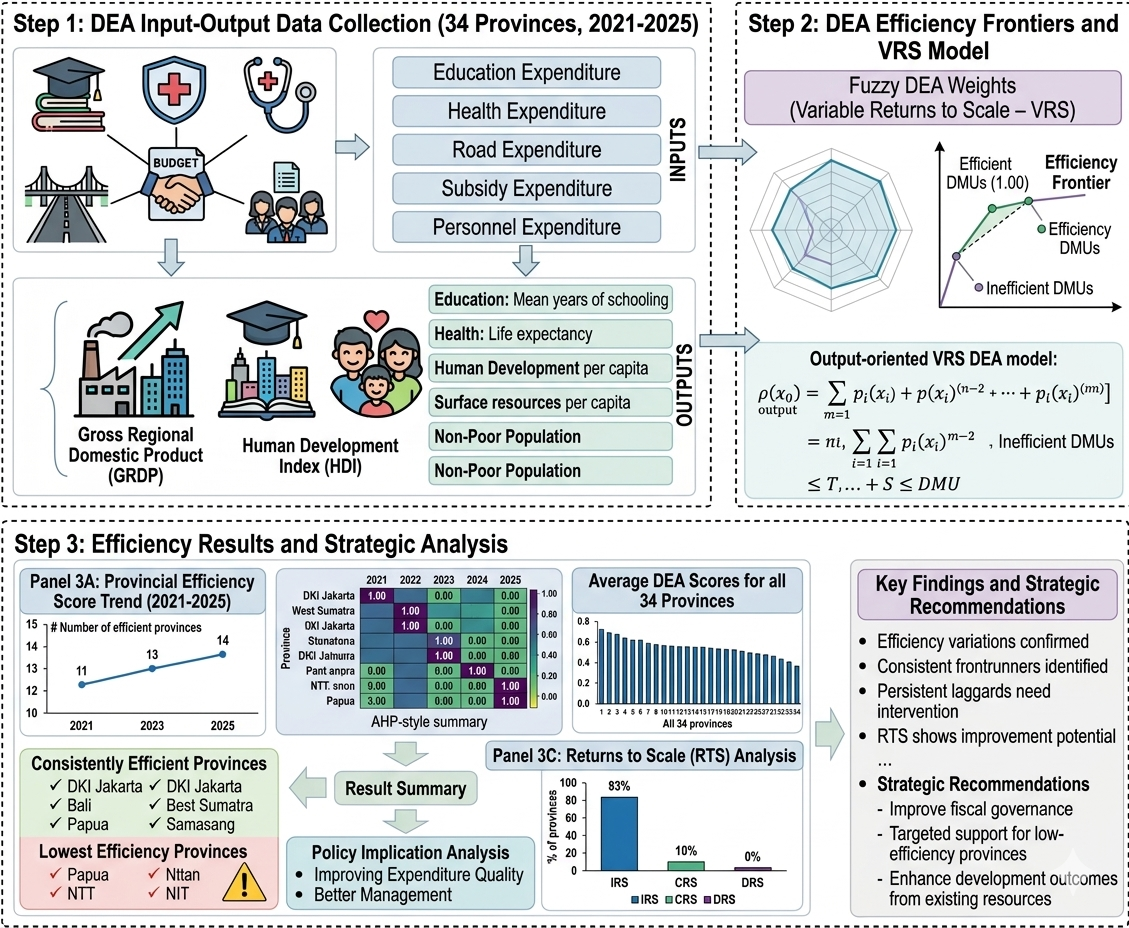
Following the COVID-19 pandemic, regional governments in decentralized Indonesia face critical pressures to optimize limited public spending while accelerating socioeconomic recovery. This study evaluates the relative efficiency of regional fiscal management across 34 provinces in Indonesia from 2021 to 2025. Utilizing an output-oriented Data Envelopment Analysis (DEA) under the Variable Returns to Scale (VRS) assumption, the framework maps five fiscal inputs (education, health, road, subsidy, and personnel expenditures) against three development outputs (Gross Regional Domestic Product, Human Development Index, and non-poor population percentage). The results reveal significant regional disparities, with the number of efficient provinces fluctuating between 11 and 14, culminating in 14 fully efficient provinces by 2025. While frontiers like DKI Jakarta and East Kalimantan consistently demonstrated optimal resource utilization, regions such as Papua, West Papua, and East Nusa Tenggara persistently exhibited the lowest efficiency scores. Furthermore, the Returns to Scale analysis indicates that most underperforming provinces operated under Increasing Returns to Scale (IRS), suggesting substantial latent potential to maximize developmental outcomes without expanding budget allocations. In conclusion, enhancing expenditure quality, targeting structural budget execution, and minimizing resource slack are imperative to bridge regional disparities and foster equitable national development.
Downloads
Article Details

This work is licensed under a Creative Commons Attribution-ShareAlike 4.0 International License.
References
Anayah, F. M. (2026). Evaluating Water Security and Comprehensive Energy Feasibility in the Palestinian Schools. Arabian Journal for Science and Engineering, 51(10), 13259–13277. https://doi.org/10.1007/s13369-025-11020-0
Apriyansyah, B., Mahmudi, G. N., Gunawan, J., Novianto, D. D., & Rudawska, E. (2026). Evaluating the marketing campaign of femvertising as strategical customer relationship. Central European Management Journal, 1–24. https://doi.org/10.1108/CEMJ-08-2025-0250
Chen, C.-W. (2026). Hybrid Framework for Evaluating and Selecting Sustainable Materials in Product Development. International Journal of Precision Engineering and Manufacturing - Green Technology, 13(2), 627–657. https://doi.org/10.1007/s40684-025-00699-z
Chen, J., On, T. J., Xu, Y., Tangsrivimol, J. A., Yangi, K., Tanikawa, R., Lawton, M. T., Santello, M., Li, B., & Preul, M. C. (2026). Artificial intelligence–based deep learning model for evaluating procedural consistency in microvascular anastomosis. Journal of Neurosurgery, 144(1), 1–10. https://doi.org/10.3171/2025.6.JNS25128
Cruz, J., Rodrigues, B., Alves, D., & Cadime, I. (2026). Boosting Emergent Literacy: Evaluating the Efficacy of a Universal Intervention for Preschoolers. Early Childhood Education Journal, 54(4), 2319–2332. https://doi.org/10.1007/s10643-025-02008-4
Endarti, A. T., Anggarini, I. M., & Sekarrini, L. (2026). Raising environmental awareness: evaluating microplastic education interventions in Jakarta’s high schools. International Journal of Adolescent Medicine and Health. https://doi.org/10.1515/ijamh-2025-0231
Farhood, H., Joudah, I., Beheshti, A., & Muller, S. (2024). Evaluating and Enhancing Artificial Intelligence Models for Predicting Student Learning Outcomes. Informatics, 11(3). https://doi.org/10.3390/informatics11030046
Ibrahim, A. M., Al-Shamrani, A. S. A., & Abdelmagid, A. S. (2026). Evaluating SERTPs: Sustainable and Environmentally Responsible Teaching Practices Among Science Teachers. Sustainability (Switzerland), 18(1). https://doi.org/10.3390/su18010271
Lakshmi, K. V, & Kumara, K. N. U. (2025). Graphical neural network-based MCDM for evaluating sustainable city logistics measures. International Journal of Mathematics in Operational Research, 32(2), 214–238. https://doi.org/10.1504/IJMOR.2025.148876
Lopez-Carreiro, I., & Cats, O. (2026). Practice what you preach? Evaluating academics’ attitudes towards conference travel habits. Transportation Research Part D: Transport and Environment, 151. https://doi.org/10.1016/j.trd.2025.105149
Molho, C., Monteiro, S., & Ribeiro, V. (2026). Evaluating the performance of Portuguese municipalities regarding the Sustainable Development Goals. Journal of Environmental Planning and Management, 69(5), 1225–1248. https://doi.org/10.1080/09640568.2024.2420344
Nadarajan, R., Sulaiman, N., & Mohamad-Saleh, J. (2024). Evaluating JA-ABC5 Hyperparameter Optimisation with Classifiers. In Md. Z. Z, N. Sulaiman, M. Mustafa, M. N. Shakib, & A. W. Jabbar (Eds.), Lecture Notes in Electrical Engineering: 1213 LNEE (pp. 425–436). Springer Science and Business Media Deutschland GmbH. https://doi.org/10.1007/978-981-97-3851-9_36
Orosz, T., Vági, R., Csányi, G. M., Nagy, D., Üveges, I., Vadász, J. P., & Megyeri, A. (2022). Evaluating human versus machine learning performance in a legaltech problem. Applied Sciences (Switzerland), 12(1). https://doi.org/10.3390/app12010297
Panwar, K., & Kumar, B. (2026). Evaluating India’s Journey Toward Sustainable Development. 2026 IEEE 3rd International Conference on Emerging Trends in Engineering and Medical Sciences, ICETEMS 2025. https://doi.org/10.1109/ICETEMS66917.2026.11469397
Sahashi, Y., Takeshita, R., Watanabe, T., Ishihara, T., Sekine, A., Watanabe, D., Ishihara, T., Ichiryu, H., Endo, S., Fukuoka, D., Hara, T., & Okura, H. (2024). Development of artificial intelligence-based slow-motion echocardiography and clinical usefulness for evaluating regional wall motion abnormalities. International Journal of Cardiovascular Imaging, 40(2), 385–395. https://doi.org/10.1007/s10554-023-02997-6
Sarkar, S., Mukherjee, A., Biswas, A., Gorain, S., Bera, B., Giri, A., Choudhury, M. R., Dutta, S., & Das, S. (2026). Evaluating farmers’ strategies and socioeconomic drivers for adaptation to climate uncertainty: A case study in the Himalayan region of West Bengal, India. Regional Sustainability, 7(2). https://doi.org/10.1016/j.regsus.2026.100334
Tian, G., Yuan, P., Yuan, G., Pham, D. T., El-Sherbeeny, A. M., & Li, Z. (2026). A hybrid approach to evaluating digital green smart manufacturing courses. Digital Engineering, 8. https://doi.org/10.1016/j.dte.2025.100075
Troussas, C., Papakostas, C., Krouska, A., Mylonas, P., & Sgouropoulou, C. (2024). Evaluating ChatGPT-driven Automated Test Generation for Personalized Programming Education. In Y. Jararweh, J. Jansen, & M. Alsmirat (Eds.), 2024 2nd International Conference on Foundation and Large Language Models, FLLM 2024 (pp. 194–200). Institute of Electrical and Electronics Engineers Inc. https://doi.org/10.1109/FLLM63129.2024.10852510
Wu, T.-H., Ho, C.-W., Yuo, T. S.-T., Rietdijk, C. E., & Trihatmoko, E. (2026). Evaluating Global Socio-Ecological System Performance: a Structural Perspective. Journal of the Knowledge Economy, 17(1), 944–980. https://doi.org/10.1007/s13132-025-02670-4
Yahaya, I., Adom, D., Adu-Agyem, J., & Steiner, R. (2026). Evaluating traditional pottery production techniques and environmental sustainability in Northern Ghana. Discover Environment, 4(1). https://doi.org/10.1007/s44274-026-00612-8