Spatial Analysis of Food Inadequacy Clusters: Managerial Implications for Regional Food Security Policy in Indonesia
Article Sidebar
Main Article Content
Abstract
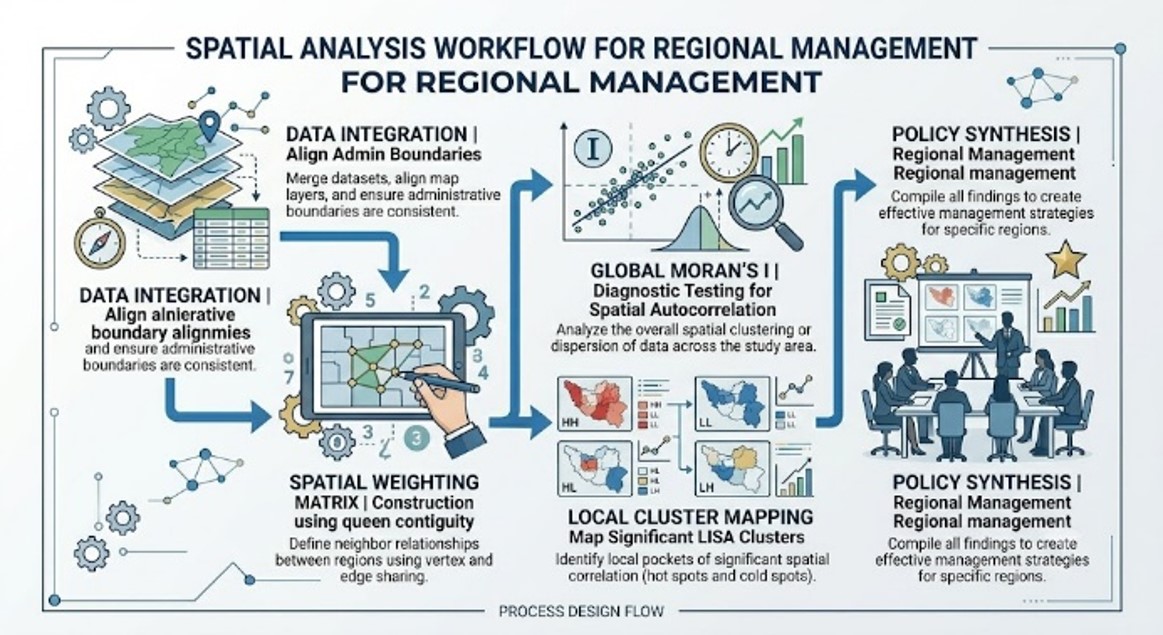
Persistent regional disparities in food access and distribution pose significant managerial and developmental challenges for Indonesian food security. This study aims to analyze the spatial distribution patterns of food inadequacy prevalence across 514 regencies and municipalities in Indonesia in 2025 to inform more effective regional management policies. Utilizing secondary data from official government institutions, this research adopts a quantitative spatial approach using GeoDa software, performing thematic mapping, Moran’s I spatial autocorrelation, and Local Indicators of Spatial Association (LISA) analysis. The findings reveal a strong positive spatial autocorrelation (Moran’s I = 0.804), indicating that food inadequacy is not randomly distributed but forms distinct clusters. High-High clusters, or insecurity hotspots, are predominantly concentrated in Eastern Indonesia—specifically in Papua, Maluku, and East Nusa Tenggara—driven by geographical isolation and inadequate infrastructure. Conversely, Low-Low clusters are concentrated in Java and Bali, benefitting from superior economic development and market accessibility. These results conclude that food inadequacy is strongly influenced by interregional development disparities, highlighting the need for spatially integrated management strategies. Policymakers should transition toward a region-based approach, prioritizing infrastructure connectivity, strengthening local food distribution systems, and reducing socio-economic inequalities to ensure targeted and sustainable food security interventions.
Downloads
Article Details

This work is licensed under a Creative Commons Attribution-ShareAlike 4.0 International License.
References
Abdolhosseinzadeh, M., & Abdolhamid, M. (2026). A comparative analysis of ‘development governance’ and ‘development management’ curricula in selected international universities. Curriculum Journal. https://doi.org/10.1002/curj.70063
Al Fadhel, L., Athari, S. A., Sassine, M. E., Olanrewaju, V. O., & Djafar Henni, M. (2026). Do artificial intelligence, knowledge management, and education skills drive sustainable energy transition? Social Sciences and Humanities Open, 13. https://doi.org/10.1016/j.ssaho.2026.102766
Aljohani, A. H., Alsufiani, H. A., AlSaadi, A. M., Alem, N. A., AliAbusunoon, M., & Madkhali, A. I. (2026). Severe Asthma Exacerbations in the Pediatric Intensive Care Unit: Clinical Profile, Management, and Outcomes—Retrospective Study. Children, 13(5). https://doi.org/10.3390/children13050710
Arora, S., Kumar, S., & Kumar, S. (2023). Artificial Intelligence in Disaster Management: A Survey. In M. Saraswat, C. Chowdhury, K. M. C, & A. H. Gandomi (Eds.), Lecture Notes in Networks and Systems (Vol. 552, pp. 793–805). Springer Science and Business Media Deutschland GmbH. https://doi.org/10.1007/978-981-19-6634-7_56
Basilico, P., D’Adamo, I., Del Giudice, M., Di Santo, F., Gastaldi, M., Passarelli, F., & Uricchio, A. F. (2026). Sustainable Schools and Knowledge Management: Driving Urban and Social Transitions for Sustainable Development. Sustainable Development, 34(S1), 915–935. https://doi.org/10.1002/sd.70215
Beno, M., & Caganova, D. (2026). Smart Sustainability in Management: Younger Supervisors, Older Subordinates. In K. L. & P. D. (Eds.), EAI/Springer Innovations in Communication and Computing (pp. 205–211). Springer Science and Business Media Deutschland GmbH. https://doi.org/10.1007/978-3-032-16896-2_15
Bolortuya, P., Weida, H., Arrive, J. T., & Getele, G. K. (2026). The impact of corporate social responsibility on educational management: evidence from learner tendencies. International Journal of Sustainability in Higher Education, 27(2), 361–380. https://doi.org/10.1108/IJSHE-03-2024-0191
Chembolu, V., & Dutta, S. (Eds.). (2024). 3rd International Conference on River Corridor Research and Management, RCRM 2023. Lecture Notes in Civil Engineering, 470. https://www.scopus.com/pages/publications/85192172561?origin=resultslist
Ciptomulyono, U., Fazlurrahman, H., Akbar, R. A., & Nareswari, N. (2026). Do green human resources management, digital technology, and green innovation shape university sustainability? Frontiers in Sustainability, 7. https://doi.org/10.3389/frsus.2026.1765721
Circular economy, resource management, and policy drivers of environmental performance: evidence from EU-22. (2026). Research in Globalization, 12. https://doi.org/10.1016/j.resglo.2026.100360
Daly, S., & Belkhamsa, M. (2026). Unveiling the Path to Sustainability in Africa: Insights from Education, Resource Management, and Economic Complexity. SAGE Open, 16(1). https://doi.org/10.1177/21582440251409119
De Feo, G. (2026). Engaging Environmental Education for Sustainable Waste Management—The Greenopoli Education Framework. Recycling, 11(1). https://doi.org/10.3390/recycling11010002
Dias, F., Gomes, D., Lavaredas, A., & Esteves, P. (2026). From ecological values to sustainable practices management: a study in Portuguese tourism companies. Frontiers in Sustainable Tourism, 5. https://doi.org/10.3389/frsut.2026.1791534
Dipankar, P., Salazar, D., Dennard, E., Mohiyuddin, S., & Nguyen, Q. C. (2025). Artificial intelligence based advancements in nanomedicine for brain disorder management: an updated narrative review. Frontiers in Medicine, 12. https://doi.org/10.3389/fmed.2025.1599340
Fárka, M., Fialová, J., & Bamwesigye, D. (2026). FOREST CLASSROOM AS A TOOL OF LANDSCAPE MANAGEMENT: INTEGRATING ENVIRONMENTAL EDUCATION, FORESTRY AND GAME MANAGEMENT. In F. J., B. D., & H. V. (Eds.), Public Recreation and Landscape Protection (Vols. 2026-May, Number 2026, pp. 151–155). Mendel University in Brno. https://doi.org/10.11118/978-80-7701-087-0-0151
Kassetty, N., Alang, K., Paruchuru, V., Sharma, S., Goel, P., & Kumar, S. (2025). Cloud Security Management: Advanced AI Techniques for Anomaly Detection and Response Automation. 2025 International Conference on Networks and Cryptology, NETCRYPT 2025, 1620–1624. https://doi.org/10.1109/NETCRYPT65877.2025.11102438
Lewis, G. T., Littlewood, J. R., & Sharma, S. (2026). Optimising University Space Usage for Energy and Carbon Management, a UK Case Study. In L. J.R., H. R.J., H. R.J., J. L.C., & J. L.C. (Eds.), Smart Innovation, Systems and Technologies: 113 SIST (pp. 585–597). Springer Science and Business Media Deutschland GmbH. https://doi.org/10.1007/978-981-96-5069-9_49
Marseglia, G., Miraglia del Giudice, M., Licari, A., Indolfi, C., Tosca, M. A., & Ciprandi, G. (2026). Azelastine-fluticasone intranasal therapy: A paradigm shift in pediatric allergic rhinitis management. A point of view of the Italian Society of Pediatric Allergy and Immunology. Pediatric Allergy and Immunology, 37(3). https://doi.org/10.1111/pai.70320
Mendoza, I. L., & Pasigon, C. P. (2026). Towards Sustainable Waste Management: Profiling the School Waste in Eastern Potia National High School. Nature Environment and Pollution Technology, 25(2). https://doi.org/10.46488/NEPT.2026.v25i02.D1833
Mere, K., Lukitaningtyas, F., & Sungkawati, E. (2024). Competence and Motivation: Keys to Success for BUMDes Management. In Dinasti International Journal of Economics, Finance &Accounting (DIJEFA …. https://scholar.google.com/citations?view_op=view_citation&hl=en&user=qhPL2fIAAAAJ&pagesize=100&citation_for_view=qhPL2fIAAAAJ:g3aElNc5_aQC
Metwally, A. B. M., Ali, S. A. M., & Mohamed, A. T. I. (2024). Thinking Responsibly About Responsible AI in Risk Management: The Darkside of AI in RM. 2024 ASU International Conference in Emerging Technologies for Sustainability and Intelligent Systems, ICETSIS 2024, 1–5. https://doi.org/10.1109/ICETSIS61505.2024.10459684
Monge, J. F., & Ruiz, J. L. (2026). Planning in management: identifying alternative ways of improving performance toward best practices. International Transactions in Operational Research, 33(2), 1362–1384. https://doi.org/10.1111/itor.13534
Sharma, V., Kumar, R., & Sood, K. (2026). Personal vs. organizational financial management: systematic review and future research agenda. Management Decision, 1–45. https://doi.org/10.1108/MD-01-2025-0202
Sujala Reddy, R. S., & Vishalakshi Prabhu, H. (2023). Role of Artificial Intelligence in Request Management: A Comprehensive Review. IEEE Region 10 Humanitarian Technology Conference, R10-HTC, 915–921. https://doi.org/10.1109/R10-HTC57504.2023.10461869
Wang, T., Fan, Y., Li, Z., Jiao, X., Fang, Q., Ma, J., & Lei, J. (2026). Exploring Self-Management–Based Mobile Health User Typologies and Associations Between User Types and Satisfaction With Key Mobile Health Functions: Comparative Study of Various Fitness and Weight Management App User Types. JMIR Medical Informatics, 14. https://doi.org/10.2196/64860
Widodo, T., Muhammad, I., Darmayanti, R., Nursaid, N., & Amany, D. A. L. (2023). Digital-based educational financial management: A literature review. In Indonesian Journal of Educational Management and Leadership (Vol. 1, Number 2, pp. 146–167). https://scholar.google.com/citations?view_op=view_citation&hl=en&user=3YBrj-MAAAAJ&cstart=200&pagesize=100&citation_for_view=3YBrj-MAAAAJ:9BrBD10KdIMC
Yassin Alzyoud, A. A. (2022). Artificial Intelligence for Sustaining Green Human Resource Management: A Literature Review. 2022 ASU International Conference in Emerging Technologies for Sustainability and Intelligent Systems, ICETSIS 2022, 321–326. https://doi.org/10.1109/ICETSIS55481.2022.9888840
Yevle, D. V, & Mann, P. S. (2025a). Artificial intelligence-based classification for waste management: a systematic review and future direction. Iran Journal of Computer Science, 8(4), 1291–1330. https://doi.org/10.1007/s42044-025-00336-7
Yevle, D. V, & Mann, P. S. (2025b). Artificial Intelligence-Based Waste Management: A Review of Classification, Techniques, Issues, and Challenges. Wiley Interdisciplinary Reviews: Data Mining and Knowledge Discovery, 15(2). https://doi.org/10.1002/widm.70025
Zhang, H., & Hope, A. J. (2026). Strategic responses to institutional pressures in university carbon management: a neo-institutional perspective. International Journal of Sustainability in Higher Education, 1–18. https://doi.org/10.1108/IJSHE-05-2025-0481