The Role of the Job Creation Law Policy in Overcoming Indonesia’s Middle Income Trap: Analysis of the Effects of FDI, HDI, and Minimum Wages on the Open Unemployment Rate
Article Sidebar
Main Article Content
Abstract
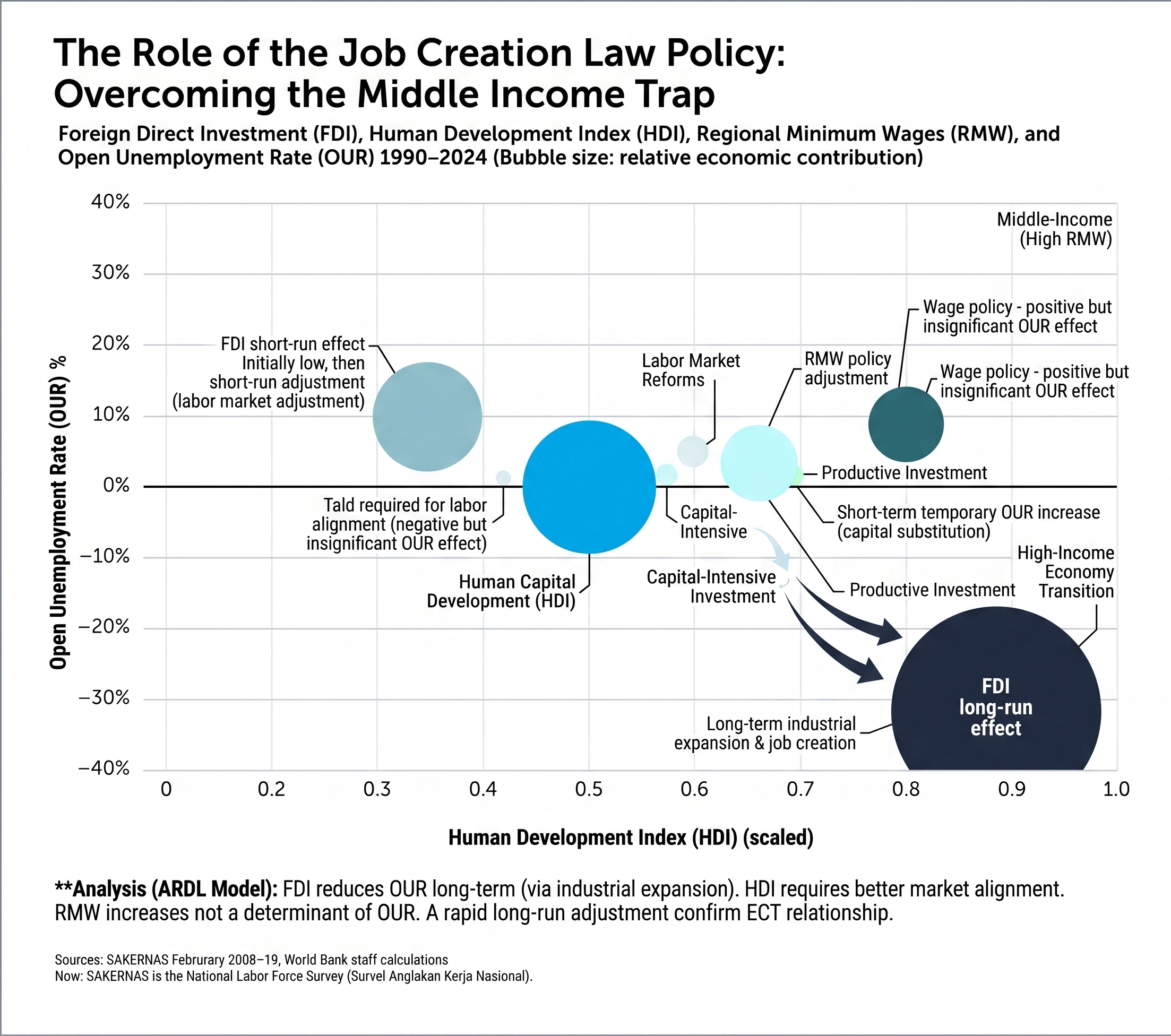
This study analyzes the effect of Foreign Direct Investment (FDI), Human Development Index (HDI), and Regional Minimum Wage (RMW) on the Open Unemployment Rate (OUR) in Indonesia within the context of the implementation of the Job Creation Law policy. The study aims to examine the role of these variables in supporting Indonesia’s efforts to overcome the Middle-Income Trap. This research employs a quantitative descriptive approach using secondary time series data covering the period 1990–2024. The analysis method applied is the Autoregressive Distributed Lag (ARDL) model to identify both short-run and long-run relationships among variables. The results indicate that FDI has a significant effect on the Open Unemployment Rate in both the short run and long run. In the short run, FDI initially reduces unemployment; however, its lagged effects show a temporary increase in unemployment due to labor market adjustments and the capital-intensive nature of foreign investment. In the long run, FDI significantly reduces unemployment through industrial expansion, productivity growth, and employment creation. Meanwhile, the Human Development Index has a negative but statistically insignificant effect on unemployment, indicating that improvements in human development have not yet been fully aligned with labor market demands. The Regional Minimum Wage also shows a positive but insignificant effect on unemployment, suggesting that wage increases are not the primary determinant of unemployment in Indonesia. Furthermore, the Error Correction Term (ECT) confirms the existence of a long-run equilibrium relationship with a relatively rapid adjustment process. Overall, the findings suggest that productive investment, labor market reforms, and improvements in human capital quality are essential to reducing unemployment and supporting Indonesia’s transition toward a high-income economy.
Downloads
Article Details

This work is licensed under a Creative Commons Attribution-ShareAlike 4.0 International License.
References
Abel, A., Bernanke, B., & Croushore, D. (2017). Macroeconomics. Pearson.
Asian Development Bank. (2020). Asian Development Outlook.
Badan Pusat Statistik. (2025). Ekonomi Indonesia Tahun 2025 Tumbuh 5,11 Persen. Badan Pusat Statistik.
Becker, G. S. (1964). Human capital: A theoretical and Empirical Analysis. University of Chicago Press.
Borensztein, E., De Gregorio, J., Lee, J.-W., Barro, R., Helpman, E., Jovanovic, B., Khan, M., Kim, S.-J., Mathieson, D., Rebelo, S., Sachs, J., & Wickham, P. (1998). How does foreign direct investment affect economic 1 growth? We are grateful for comments from. In Journal of International Economics (Vol. 45).
Dunning, J. D. (1993). Multinational Enterprises and the Global Economy. Wokingham: Addison-Wesley.
Gill, I. S., & Kharas Homi. (2007). An East Asian Renaissance: Ideas For Economic Growth. Library of Congress Cataloging-in-Publication Data.
Keynes, & John, M. (1936). The General Theory of Employment, Interest and Money. Macmillan.
Lisayoana, J., & Tasriah, E. (2024). Determinan Fenomena Middle Income Trap Delapan Negara Berpendapatan Menengah di Kawasan. JDEP, 7(1), 51–69. https://doi.org/10.14710/jdep.7.1.51-69
Novika, I., & Ida Budiarty. (2026). Analysis of the Impact of Minimum Wage, International Trade, Foreign Direct Investment, and Human Development Index on Open Unemployment Rate in Indonesia Period 1990-2023. International Journal of Economics and Management Sciences, 3(1), 44–52. https://doi.org/10.61132/ijems.v3i1.1114
Permatasari, Z., & Pasaribu, E. (2019). Pembentukan Indeks Middle Income Trap dan Faktor-FaktorYang Mempengaruhinya tahun 2015-2018. Jurnal Ekonomi Dan Pembangunan Indonesia, 19, 1–17.
Qamariyah, L., Mardianita, O. W., & Rusgianto, S. (2022). Pengaruh IPM, Investasi dan UMP Terhadap Tingkat Pengangguran Terbuka di Jawa Timur Tahun 2013-2020. 1.
Saputra, D. D., Ismiwati, B., & Wafik, A. Z. (2025). The Effect of Economic Growth, Minimum Wage, Human Development Index on Open Unemployment Rate in West Nusa Tenggara(2019-2023). Journal of Finance, Economics and Business, 4(1), 80–100. https://doi.org/10.59827/jfeb.v4i1.255
Sutrisno, Y. R., Arifin, Z., Pembangunan, E., Ekonomi, F., & Bisnis, D. (2024). Pengaruh Pertumbuhan Ekonomi, IPM, dan Kemiskinan Terhadap Tingkat Pengangguran Terbuka Kabupaten/Kota Provinsi Bali Tahun 2017-2021. In Jurnal Ilmu Ekonomi (JIE) (Vol. 08, Number 01).
Todaro, M. P., & Stephen C.Smith. (2015). Economic Development (12th ed.). Pearson Education.