Global Benchmarking and Best Practices in Islamic Education Management: A Systematic Literature Review
Article Sidebar
Main Article Content
Abstract
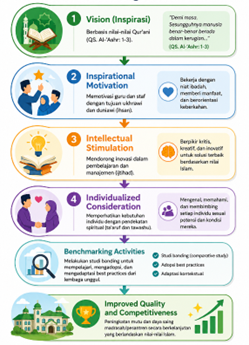
This study aims to analyze global benchmarking practices and best practices, as well as their implementation in Islamic education management, through a systematic literature review (SLR) approach. In the era of globalization and increasingly fierce competition between educational institutions, benchmarking has become a strategic instrument for improving the quality and competitiveness of madrasas and Islamic boarding schools (pesantren). This study uses the SLR method following the PRISMA 2020 protocol (Page et al., 2021), which includes the stages of identification, screening, eligibility, and inclusion. Data were collected from Scopus, Google Scholar, DOAJ, and Emerald Publishing databases spanning 2020 to 2025. A total of 45 qualitative, quantitative, and mixed-method articles were analyzed thematically. The study identified that the implementation of global benchmarking in Islamic educational institutions is still limited and not yet systematic. Best practices that can be adopted include transformational leadership strategies, integration of digital technology in learning and governance, development of a global competency-based curriculum, total quality management (TQM), and internal and external quality assurance systems. This research provides theoretical contributions to enriching the Islamic-based integrated quality management model and practical recommendations for policymakers and managers of Islamic educational institutions. The study's conclusions emphasize the need to build a culture of sustainable benchmarking and international collaboration to achieve superior and globally competitive Islamic education.
Downloads
Article Details

This work is licensed under a Creative Commons Attribution-ShareAlike 4.0 International License.
Letter of Acceptance (LoA)
References
Ahmad, G., Tewal, B., & Taroreh, R. (2019). Pengaruh beban kerja terhadap kinerja pegawai. Jurnal EMBA, 7(3), 2811–2820.
Al Farisi, F., Syarifuddin, E., & Zuhri, S. (2023). Collaborative leadership in Islamic education: Communication is the key to successful TQM practices. Tarbawi: Jurnal Keilmuan Manajemen Pendidikan, 9(1), 85–96. https://doi.org/10.32678/tarbawi.v9i01.7970
Alstete, J. W. (1995). Benchmarking in higher education: Adapting best practices to improve quality. George Washington University.
Andriani, D., & Wahyuningrum, M. (2012). Kompetensi manajerial kepala sekolah dalam peningkatan mutu pendidikan. Jurnal Manajemen Pendidikan, 7(1), 45–56.
Avolio, B. J., & Bass, B. M. (1995). Individual consideration viewed at multiple levels of analysis. The Leadership Quarterly, 6(2), 199–218. https://doi.org/10.1016/1048-9843(95)90035-7
Bakker, A. B., & Demerouti, E. (2007). The job demands-resources model: State of the art. Journal of Managerial Psychology, 22(3), 309–328. https://doi.org/10.1108/02683940710733115
Bass, B. M., & Riggio, R. E. (2006). Transformational leadership (2nd ed.). Psychology Press. https://doi.org/10.4324/9781410617095
Bathla, A., Chawla, G., & Gupta, A. (2025). Benchmarking design-thinking as a tool for education: A systematic review and future research agenda. Benchmarking: An International Journal, 32(3), 965–991. https://doi.org/10.1108/BIJ-08-2023-0542
Burhanuddin, H., Makbuloh, D., & Subandi, S. (2025). The digitalization of quality management in Islamic education toward quality education. Jurnal Thawalib, 6(1), 45–62.
Creswell, J. W., & Poth, C. N. (2018). Qualitative inquiry and research design (4th ed.). Sage.
Dara, N., et al. (2021). Teacher well-being in educational settings. Jurnal Pendidikan Indonesia, 10(2), 101–112.
Dawam, M., & Ilham, R. (2022). Beban kerja guru dalam perspektif ergonomi pendidikan. Jurnal Pendidikan Humaniora, 9(1), 23–31.
Deming, W. E. (1986). Out of the crisis. MIT Press.
Dewi, S., & Nasywa, N. (2019). Faktor-faktor yang memengaruhi teacher well-being. Jurnal Psikologi Pendidikan, 8(2), 119–128.
Dinata, Y., & Andriani, T. (2025). Critique of total quality management in Islamic education: Proposing prophetic leadership as a model for quality enhancement. Journal of Islamic Education and Ethics, 3(2), 212–230. https://doi.org/10.18196/jiee.v3i2.101
Fajriani, N., et al. (2023). Kompetensi manajerial kepala sekolah dalam pengelolaan sekolah dasar. Jurnal Administrasi Pendidikan, 12(1), 88–97.
Fauzi, A., Subandi, S., & Makbulloh, D. (2023). Indonesian education services quality: The influence of leadership and total quality management. Pedagogika, 149(1), 67–85. https://doi.org/10.15823/p.2023.149.5
Fitriani, D., Suryadi, K., & Mulyana, A. (2024). Implementing total quality management (TQM) to enhance the quality of Islamic education: A library research study. Journal of Educational Management Research, 4(4), 55–72. https://doi.org/10.61987/jemr.v4i4.1553
Fullan, M. (2020). Leading in a culture of change (2nd ed.). Jossey-Bass.
Gamil, A. D. A., & Al-Najjar, A. (2025). A proposed framework for quality e-learning programs in Center for Languages and Translation, Ibb University. University of Ibb Research Journal for Humanities Sciences, 1(1). https://doi.org/10.69844/a1m86w40
Garvin, D. A. (1991). How the Baldrige Award really works. Harvard Business Review, 69(6), 80–93.
Goetsch, D. L., & Davis, S. B. (2021). Quality management for organizational excellence: Introduction to total quality (9th ed.). Pearson.
Guru Honorer, T., et al. (2025). Teacher well-being and school climate. Journal of Educational Research, 5(2), 55–66.
Gusenbauer, M., & Haddaway, N. R. (2020). Which academic search systems are suitable for systematic reviews or meta-analyses? Research Synthesis Methods, 11(2), 181–217. https://doi.org/10.1002/jrsm.1378
Hanung Widiyarso, & Sumardjoko. (2022). Peran kepala sekolah dalam pengelolaan sumber daya pendidikan. Jurnal Pendidikan Dasar, 14(1), 70–82.
Hartadi, A. (2020). Indikator beban kerja guru dan dampaknya terhadap stres kerja. Jurnal Pendidikan Modern, 6(2), 144–151.
Hassan, R., & Omar, M. (2025). Integration of total quality management in national standards of Islamic education. Journal of Quality Assurance in Islamic Education (JQAIE), 5(1), 112–130. https://doi.org/10.47945/jqaie.v5i1.2377
Hattie, J. (2023). Visible learning: The sequel. Routledge. https://doi.org/10.4324/9781003380542
Hidayati, D., et al. (2023). Teacher well-being: The teachers perspective in the Special Region of Yogyakarta. Journal of Educational Psychology, 11(2), 201–215.
Hofstede, G. (2011). Dimensionalizing cultures: The Hofstede model in context. Online Readings in Psychology and Culture, 2(1), 8. https://doi.org/10.9707/2307-0919.1014
Integrating total quality management with Islamic values in modern Islamic education. (2025). Managere: Indonesian Journal of Educational Management, 7(1), 88–105. https://doi.org/10.52627/managere.v7i1.784
Issom, F., & Fachrurozzy, F. (2022). The effect of teacher stress on teacher well-being in teachers who teach in inclusive elementary schools. International Journal of Education, 14(1), 34–45.
Jannah, R., & Ramadhani, S. (2024). Social support and teacher well-being among elementary school teachers. Jurnal Psikologi Pendidikan, 15(1), 45–59.
Juran, J. M. (2017). Juran’s quality handbook (7th ed.). McGraw-Hill.
Kodir, F. (2024). Mubadalah dan relasi sosial dalam pendidikan Islam. IRCiSoD.
Komives, S. R., & Dugan, J. P. (2020). Leadership development in higher education. New Directions for Student Leadership, 2020(168), 11–24. https://doi.org/10.1002/yd.20410
Lick, D. W. (2021). Benchmarking for continuous improvement. In The SAGE encyclopedia of higher education (pp. 145–148). Sage. https://doi.org/10.4135/9781529714395.n55
Lifuka, E. (2025). Open distance and e-learning (ODeL) assessment indicators for quality learning. International Journal of Professional Development, Learners and Learning, 7(1), e2505. https://doi.org/10.30935/ijpdll/15733
Luthans, F., & Avolio, B. J. (2021). Authentic leadership development. In The Routledge companion to leadership (pp. 245–260). Routledge. https://doi.org/10.4324/9781315682347-18
Massie, R., et al. (2018). Beban kerja dan stres kerja pegawai. Jurnal EMBA, 6(4), 2728–2737.
Mertens, D. M. (2020). Research and evaluation in education and psychology (6th ed.). Sage.
Mohd Yusoff, N., Ariffin, T., & Noman, M. (2022). Principals’ contextual leadership on teachers’ organizational commitment: Teacher empowerment and teachers’ workplace well-being as a serial mediator. Sustainability, 14(19), 12967. https://doi.org/10.3390/su141912967
Muzakki, A., & Farida Fitrianing Arum. (2022). Psychological well-being among teachers. Jurnal Psikologi Pendidikan, 10(1), 67–76.
Nair, N., & Vohra, N. (2020). Diversity and inclusion in organizations. Journal of Organizational Behavior, 41(5), 423–426. https://doi.org/10.1002/job.2444
Nasution, D., Dewi, R., & Sarah, F. (2024). Job demands-resources model and teacher well-being. Journal of Educational Management, 13(2), 150–162.
Oakland, J. S., Oakland, R. J., & Turner, M. A. (2020). Total quality management and operational excellence: Text with cases (5th ed.). Routledge.
Page, M. J., McKenzie, J. E., Bossuyt, P. M., Boutron, I., Hoffmann, T. C., Mulrow, C. D., et al. (2021). The PRISMA 2020 statement: An updated guideline for reporting systematic reviews. BMJ, 372, n71. https://doi.org/10.1136/bmj.n71
Pan, Y., Chung, C., & Lin, Y. (2023). Exploring the predictors of teacher well-being: An analysis of teacher training preparedness, autonomy, and workload. Education Sciences, 13(5), 511. https://doi.org/10.3390/educsci13050511
Parri, J. (2020). Benchmarking as a tool for quality improvement in education. International Journal of Educational Management, 34(5), 789–804. https://doi.org/10.1108/IJEM-08-2019-0289
Pramithasari, D., & Miftahun, N. (2019). Psychological well-being guru sekolah dasar. Jurnal Psikologi, 16(2), 100–112.
Ragil, Y. A., Rahmawati, Y., & Supena, A. (2025). Implementasi kebijakan penyelenggaraan Pendidikan Profesi Guru (PPG) untuk sertifikasi guru PAUD. JEA (Jurnal Edukasi AUD), 11(1), 41–54. https://doi.org/10.18592/jea.v11i1.15243
Reza Gunawan, & Hendriani, W. (2019). Psychological well-being pada guru sekolah dasar. Jurnal Psikologi Klinis, 8(1), 56–67.
Sahni, S., Verma, S., & Kaurav, R. P. S. (2025). Understanding digital transformation challenges for online learning and teaching in higher education institutions: A review and research framework. Benchmarking: An International Journal, 32(5), 1487–1521. https://doi.org/10.1108/BIJ-04-2022-0245
Sallis, E. (2010). Total quality management in education (3rd ed.). Routledge. https://doi.org/10.4324/9780203417010
Schein, E. H., & Schein, P. A. (2021). Organizational culture and leadership (6th ed.). Wiley.
Senge, P. M. (2020). The fifth discipline: The art and practice of the learning organization (Rev. ed.). Currency.
Setyawati, E., Patimah, S., Subandi, S., & Makbulloh, D. (2025). Integrated total quality management model from the perspective of Islamic education. Global Education Journal, 3(3), 145–162. https://doi.org/10.59525/gej.v3i3.1078
Shumaila, N. (2025). Hubungan antara kepemimpinan transformasional kepala sekolah dan stres kerja dengan teacher well-being pada guru honorer di Kecamatan Sukarame Bandar Lampung (Skripsi). Universitas Lampung.
Subair, M. (2024). Kesejahteraan guru dalam perspektif pendidikan modern. Jurnal Pendidikan Nasional, 18(2), 89–99.
Suwarno, S., & Said, A. (2025). Teacher well-being: Sebuah utopia atau realita? Jurnal Pendidikan Indonesia, 15(1), 1–12.
Tholchah, M. (2024). Unveiling the excellence: Socio-cultural perspectives on the impact of teacher certification program for male teachers in Indonesian Islamic kindergartens. Nadwa: Jurnal Pendidikan Islam, 18(2), 145–162. https://doi.org/10.21580/nw.2024.18.2.20272
Thomas, J., & Harden, A. (2008). Methods for the thematic synthesis of qualitative research in systematic reviews. BMC Medical Research Methodology, 8(1), 45. https://doi.org/10.1186/1471-2288-8-45
Tiraswati, A. (2024). Teacher well-being dan kepuasan kerja guru. Jurnal Psikologi Pendidikan, 13(2), 77–90.
Tumiyati, S., et al. (2026). School management and teacher workload management. Journal of Educational Leadership, 7(1), 44–58.
Willmington, C., Belardi, P., Murante, A. M., & Vainieri, M. (2022). The contribution of benchmarking to quality improvement in healthcare: A systematic literature review. BMC Health Services Research, 22(1), 139. https://doi.org/10.1186/s12913-022-08366-4
Winanto, D., & Cahyaningdyah, D. (2025). School leadership and teacher well-being. Jurnal Manajemen Pendidikan, 19(1), 34–47.
Yuliati Zaqiah, Q., Hasanah, A., Heryati, Y., & Rohmatulloh, R. (2024). The impact of in-service teacher education program on competency improvement among Islamic religious education teachers using self-assessment. Education Sciences, 14(11), 1257. https://doi.org/10.3390/educsci14111257.