Evaluasi Keterampilan Dasar Olahraga Berbasis AI: Sebuah SLR Mengenai Keterbaruan Metodologi Pembelajaran Renang dan Futsal dalam Bingkai Keberlanjutan SDGs
Keywords:
Artificial Intelligence, Evaluasi Olahraga, Futsal, Pedagogi, RenangAbstract
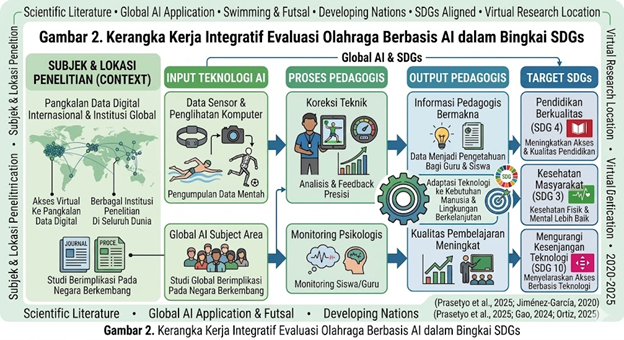
Di era transformasi digital saat ini, penguasaan keterampilan literasi fisik dan teknis seperti renang dan futsal menjadi kompetensi vital yang memerlukan strategi pengajaran inovatif, kreatif, dan adaptif berbasis teknologi. Penelitian ini dilatarbelakangi oleh urgensi evaluasi metodologi pembelajaran jasmani yang selama ini cenderung konvensional, di mana integrasi Artificial Intelligence (AI) dapat mengoptimalkan pemantauan kondisi fisik dan profil psikologis atlet secara real-time. Fokus utama kajian adalah mengevaluasi bagaimana perangkat cerdas memengaruhi pengembangan domain kognitif dan psikomotorik siswa, serta dampaknya terhadap efisiensi gerak. Tujuan penelitian ini adalah melakukan tinjauan sistematis terhadap keterbaruan metodologi evaluasi olahraga berbasis AI guna mendukung target Sustainable Development Goals (SDGs), khususnya pendidikan berkualitas dan kesehatan global. Metode yang digunakan adalah Systematic Literature Review (SLR) dengan menganalisis literatur dari basis data Scopus dan Google Scholar menggunakan teknik analisis konten (content analysis) pada studi periode 2020-2025. Hasil tinjauan menunjukkan bahwa penggunaan algoritma deep learning dan perangkat sensor (IMU) memberikan dampak positif signifikan terhadap akurasi koreksi teknik dan motivasi mental siswa, meskipun variabel aksesibilitas teknologi masih menjadi hambatan utama dalam implementasi skala luas. Kesimpulannya, integrasi AI dalam pedagogi olahraga tidak hanya memperbarui teknik evaluasi tetapi juga mempercepat pencapaian literasi fisik yang berkelanjutan
Downloads
References
Abduljabbar, H. M., Abdullah, W. M., Bazool, S. D. S., Muhsin, A. I., Alfalahi, S. T. Y., & Temnikov, V. (2025). AI-Driven Environmental Impact Assessments: Ethical and Legal Considerations. Environment and Social Psychology, 10(12). https://doi.org/10.59429/esp.v10i12.3994
Adigun, O. T., Tijani, F. A., Haihambo, C. K., & Enock, S. L. (2025). Understanding pre-service teachers’ intention to adopt and use artificial intelligence in Nigerian inclusive classrooms. Frontiers in Education, 10. https://doi.org/10.3389/feduc.2025.1519472
Adserà, A. (2025). Artificial intelligence and fertility: Gender and educational inequalities in family formation. Vienna Yearbook of Population Research, 23(1), 1–10. https://doi.org/10.1553/p-5fff-96k6
Albeihi, H. H. M., & Rice, M. F. (2025). Generative AI and Language Diversity: Implications for Teachers and Learners. Arab World English Journal, 16(1), 43–54. https://doi.org/10.24093/awej/vol16no1.3
Aldukhail, S. (2025). Mapping the Landscape of Generative Language Models in Dental Education: A Comparison Between ChatGPT and Google Bard. European Journal of Dental Education, 29(1), 136–148. https://doi.org/10.1111/eje.13056
Baber, C., Kandola, P., Apperly, I., & McCormick, E. (2025). Human-centred explanations for artificial intelligence systems. Ergonomics, 68(3), 391–405. https://doi.org/10.1080/00140139.2024.2334427
Baillifard, A., Gabella, M., Lavenex, P. B., & Martarelli, C. S. (2025). Effective learning with a personal AI tutor: A case study. Education and Information Technologies, 30(1), 297–312. https://doi.org/10.1007/s10639-024-12888-5
Bauermann, M., Rotthoff, T., Hallmen, T., Kunz, M., André, E., & Schindler, A.-K. (2025). Medical students’ perceptions of AI-based feedback and feedforward on communication skills in doctor–patient consultation - an acceptance study in a video-based simulation. Medical Education Online, 30(1). https://doi.org/10.1080/10872981.2025.2592414
Berber Sardinha, T. (2025). Corpus Linguistics and Artificial Intelligence. DELTA Documentacao de Estudos Em Linguistica Teorica e Aplicada, 41(4). https://doi.org/10.1590/1678-460x202541474063
Bhavani, Y. V. K. D., & Pagi, V. B. (2025). Human crime activity recognition and shooting weapon detection in video frames using the contour approximation algorithm, and FastDTW classifier. Cogent Social Sciences, 11(1). https://doi.org/10.1080/23311886.2025.2465834
Bierecki, D., Gaie, C., & Karpiuk, M. (2025). Artificial Intelligence in e-Administration. Prawo i Wiez, 54(1), 383–407. https://doi.org/10.36128/PRIW.VI54.1201
Chaaban, Y. (2025). Exploring research ethics through the lens of critical posthumanism in the age of Artificial Intelligence. Teaching in Higher Education, 30(7), 1740–1755. https://doi.org/10.1080/13562517.2025.2465995
Christou, P. A. (2025). Reliability and Validity in Qualitative Research Revisited and the Role of AI. Qualitative Report, 30(3), 3306–3314. https://doi.org/10.46743/2160-3715/2025.7523
Dehbi, A., Bakhouyi, A., Khaddar, A. M., & Talea, M. (2025). Education and smart technologies: towards a new pedagogical paradigm. International Journal of Evaluation and Research in Education, 14(1), 297–309. https://doi.org/10.11591/ijere.v14i1.30470
Dunleavy, P., & Margetts, H. (2025). Data science, artificial intelligence and the third wave of digital era governance. Public Policy and Administration, 40(2), 185–214. https://doi.org/10.1177/09520767231198737
Ejaz, H., Tsui, H. L. K., Patel, M., Ulloa Paredes, L. R., Knights, E., Aftab, S. B., & Subbe, C. P. (2025). Comparison of a Novel Machine Learning–Based Clinical Query Platform With Traditional Guideline Searches for Hospital Emergencies: Prospective Pilot Study of User Experience and Time Efficiency. JMIR Human Factors, 12. https://doi.org/10.2196/52358
Elías-Collantes, M. M., Palacios-Núñez, M. L., & Toribio-López, A. (2025). Artificial Intelligence in University Teaching: A Qualitative Analysis from the Faculty Perspective. In L. P. M. M, J. Texier, & R. M. R. A (Eds.), Proceedings of the LACCEI international Multi-conference for Engineering, Education and Technology. Latin American and Caribbean Consortium of Engineering Institutions. https://doi.org/10.18687/LEIRD2025.1.1.702
Girón, D. C. A., Yovera, S. E. R. Y., Torres de Salinas, F. M. G., Soto, F. G. C., & Cadenas, D. I. V. (2025). The relationship between knowledge management and artificial intelligence: A thematic analysis from Scopus. Iberoamerican Journal of Science Measurement and Communication, 5(1). https://doi.org/10.47909/ijsmc.1713
Harsanti, H. R., Sudibjo, N., Riady, S., & Yu, P. (2025). Exploring Indonesian teachers’ intention to use artificial intelligence in schools: the impact of digital leadership, digital readiness, and perceived usefulness. Cogent Social Sciences, 11(1). https://doi.org/10.1080/23311886.2025.2593596
Henman, P. W. F. (2025). Robodebt cultures and useful idiots: Why Robodebt was not a techno-failure. Australian Journal of Social Issues, 60(1), 4–20. https://doi.org/10.1002/ajs4.383
Hirsbrunner, S. D., Kleemann, S., & Tahraoui, M. N. (2025). Contestation in artificial intelligence as a practice: from a system-centered perspective of contestability toward normative contextualization, situative critique and organizational culture. Frontiers in Communication, 10. https://doi.org/10.3389/fcomm.2025.1638257
Isaac, J. S., & Sundaram, A. (2025). Dilemma of Authorship in Artificial Intelligence – From the Perspective of Music Copyright. Journal of Intellectual Property Rights, 30(1), 51–58. https://doi.org/10.56042/jipr.v30i1.9841
Jacobs, C., Johnson, H., Tan, N., Brownlie, K., Joiner, R., & Thompson, T. (2025). Application of AI Communication Training Tools in Medical Undergraduate Education: Mixed Methods Feasibility Study Within a Primary Care Context. JMIR Medical Education, 11. https://doi.org/10.2196/70766
Kassa, B. Y., & Worku, E. K. (2025). The impact of artificial intelligence on organizational performance: The mediating role of employee productivity. Journal of Open Innovation: Technology, Market, and Complexity, 11(1). https://doi.org/10.1016/j.joitmc.2025.100474
Lau, K., Fernie, G., & Roshan Fekr, A. (2025). Estimating the slip resistant quality of winter footwear using Artificial Intelligence. Safety Science, 181. https://doi.org/10.1016/j.ssci.2024.106686
Lizano-Sánchez, F., Idoyaga, I., Orduña, P., Rodríguez-Gil, L., & Arguedas-Matarrita, C. (2025). Teachers’ perspective on the use of artificial intelligence on remote experimentation. Frontiers in Education, 10. https://doi.org/10.3389/feduc.2025.1518896
Medina-Gual, L., & Parejo, J.-L. (2025). Perceptions and Use of AI in Higher Education Students: Impact on Teaching, Learning, and Ethical Considerations. European Journal of Education, 60(1). https://doi.org/10.1111/ejed.12919
Mohebbi, A. (2025). Enabling learner independence and self-regulation in language education using AI tools: a systematic review. Cogent Education, 12(1). https://doi.org/10.1080/2331186X.2024.2433814
Mondal, H., Karri, J. K. K., Ramasubramanian, S., Mondal, S., Juhi, A., & Gupta, P. (2025). A qualitative survey on perception of medical students on the use of large language models for educational purposes. Advances in Physiology Education, 49(1), 27–36. https://doi.org/10.1152/ADVAN.00088.2024
Nishihara, T. W., Kalaw, F. G. P., Engmann, A., Motoyoshi, A., Mensah-Kane, P., Gupta, D., Patronilo, V., Zangwill, L. M., Hallaj, S., Panahi, A., Cottrell, G. W., Voytek, B., de Sa, V. R., & Baxter, S. L. (2025). Fostering Multidisciplinary Collaboration in Artificial Intelligence and Machine Learning Education: Tutorial Based on the AI-READI Bootcamp. JMIR Medical Education, 11. https://doi.org/10.2196/83154
Rubio-Gragera, M., Palacios-Rodríguez, A. D. P., & Colomo-Magaña, E. (2025). VALIDATION OF A DIGITAL COMPETENCE IN ARTIFICIAL INTELLIGENCE SCALE FOR NON-UNIVERSITY STUDENTS BASED ON THE DIGCOMP MODEL. Journal of Technology and Science Education, 15(3), 730–745. https://doi.org/10.3926/jotse.3616
Salmon, P. M., Burns, C., Broadbent, S., Chari, S., Clay-Williams, R., Hancock, P. A., Jenkins, D. P., Mills, A., Parnell, K., Plant, K. L., Read, G. J. M., Sharples, S., Shorrock, S., Stanton, N. A., Walker, G. H., Williams, C., Waterson, P., & Young, M. S. (2025). The Chartered Institute of Ergonomics and Human Factors at 75: perspectives on contemporary challenges and future directions for Ergonomics and Human Factors. Ergonomics, 68(6), 759–775. https://doi.org/10.1080/00140139.2024.2378355
Sciurti, A., Migliara, G., Siena, L. M., Isonne, C., De Blasiis, M. R., Sinopoli, A., Iera, J., Marzuillo, C., De Vito, C., Villari, P., & Baccolini, V. (2025). Compact large language models for title and abstract screening in systematic reviews: An assessment of feasibility, accuracy, and workload reduction. Research Synthesis Methods. https://doi.org/10.1017/rsm.2025.10044
Škare, M., Porada-Rochoń, M., & Celić, R. V. (2025). Total factor productivity dynamics and the artificial intelligence paradox: Evidence from long-memory analysis. Journal of International Studies, 18(4), 218–242. https://doi.org/10.14254/2071-8330.2025/18-4/11
Smith, H. (2025). The metaverse-industrial complex. Information Communication and Society, 28(5), 797–814. https://doi.org/10.1080/1369118X.2024.2423346
Sukma, I. M., & Chustecki, J. (2025). A MICROPOLITICAL LENS ON MIGRATION: COMPARING POLITICAL CORRECTNESS IN CHATGPT AND DEEPSEEK. Studia Socjologiczne, 2025(4), 211–231. https://doi.org/10.24425/sts.2025.157351
Suliman, S., Kassab, S. E., Iqbal, M. Z., Al-Bualy, R., Asoodar, M., Susilo, A. P., Aymée de Mortier, C., Boussé, M., Hancock, N. J., Mathew, T., Sriranga, J., & Könings, K. D. (2025). The role of artificial intelligence in co-creation of health professions education: Integrating innovation into collaboration: AMEE Guide No. 190. Medical Teacher. https://doi.org/10.1080/0142159X.2025.2581163
Tan, J. S., & Thelen, K. (2025). Cloud Capitalism and the AI Transition. Politics and Society. https://doi.org/10.1177/00323292251396395
Veiga, A. D. (2025). Ethical guidelines for the use of generative artificial intelligence and artificial intelligence-assisted tools in scholarly publishing: a thematic analysis. Science Editing, 12(1), 28–34. https://doi.org/10.6087/kcse.352
Wagner, G., Ringeval, M., Raymond, L., & Paré, G. (2025). Digital health competences and AI beliefs as conditions for the practice of evidence-based medicine: a study of prospective physicians in Canada. Medical Education Online, 30(1). https://doi.org/10.1080/10872981.2025.2459910
Ward, M. E., Geary, U., Brennan, R., Vining, R., McKenna, L., O’Connell, B., Bergin, C., Byrne, D., Creagh, D., Fogarty, M., Healy, U., McDonald, G., Ebiele, M., Crane, M., Pham, M.-K., Bendechache, M., Bezbradica, M., Liang, J., Doyle, B., … McDonald, N. (2025). A systems approach to managing the risk of healthcare acquired infection in an acute hospital setting supported by human factors ergonomics, data science, data governance and AI. Ergonomics, 68(8), 1239–1259. https://doi.org/10.1080/00140139.2024.2396527
Zheng, S., Feng, Y., Long, J., Li, X., Zhang, M., Chen, H., Du, X., Duan, H., Jia, S., Wu, N., & Lu, X. (2025). Need Analysis of Clinician-Oriented Integrated Precision Oncology Decision Support Tools: Qualitative Descriptive Study. JMIR Human Factors, 12. https://doi.org/10.2196/67476
Published
Issue
Section
License
Copyright (c) 2026 Feri Weldani

This work is licensed under a Creative Commons Attribution-ShareAlike 4.0 International License.











 All publications by the CV. Bimbingan Belajar Assyfa [e-ISSN: