Training in Pesantren Manuscript Editing for Mahasantri in Lampung Province Through the Khastara Digital Portal of the National Library of Indonesia
DOI:
https://doi.org/10.61650/jip-dimas.v4i1.1133Keywords:
Manuscript Editing, Pesantren, Khastara, Mahasantri, Digital PhilologyAbstract
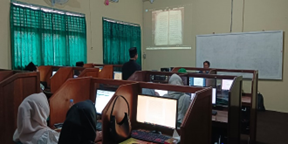
This study aims to analyze the implementation and impact of a training program on pesantren manuscript editing for mahasantri (university students from Islamic boarding schools) in Lampung Province through the Khastara digital portal of the National Library of Indonesia. This community service program employed a service-learning approach involving four stages: investigation, preparation, action, and reflection. Participants included 16 mahasantri from 10 pesantren in Lampung Province. Training was conducted through an intensive workshop at the Computer Laboratory of Universitas Ma'arif Lampung, utilizing the digital manuscript Kitab Safinatun Najah accessed via the Khastara portal. Results: reveal significant improvements in participants' philological and digital literacy competencies: 100% of participants successfully accessed and inventoried digital manuscripts through Khastara, 90% mastered standard Arabic-Latin transliteration, and the majority demonstrated proficiency in manuscript description, translation, and basic textual criticism. The program also established productive collaboration between universities, pesantren, and national institutions for preserving Indonesia's Islamic intellectual heritage. The service-learning-based manuscript editing training effectively enhances mahasantri's philological competencies while fostering academic responsibility and cultural preservation awareness. This integrated model offers a sustainable framework for digital philology education that can be adapted by other Islamic higher education institutions.
Downloads
References
Alfadla, M. T., Riva, R., & Darwis, A. A. (2023). The meaning of ghirah learning (Study phenomenology of mahasantri at Islamic boarding school-based university). Shibghoh: Prosiding Ilmu Kependidikan UNIDA Gontor, 1, 460–466.
Aminullah, Z. P., & Habibah, N. (2022). Pendampingan pelatihan penulisan artikel populer berbasis manuskrip Jawa bagi anggota komunitas Jangkah Nusantara. Bakti Budaya: Jurnal Pengabdian kepada Masyarakat, 5(1), 96–115. https://doi.org/10.22146/bakti.4079
Astin, A. W., Vogelgesang, L. J., Ikeda, E. K., & Yee, J. A. (2000). How service learning affects students. Higher Education Research Institute, University of California, Los Angeles. https://digitalcommons.unomaha.edu/slceval/144
Baso, A. (2014). Kajian filologi dan teks-teks pesantren: Mashlahat atau madlarat? Tashwirul Afkar, 34(1).
Creswell, J. W., & Poth, C. N. (2018). Qualitative inquiry and research design: Choosing among five approaches (4th ed.). SAGE Publications.
Djamaris, E. (2002). Metode penelitian filologi. CV Manasco.
DOAJ. (2025). Revitalizing the study of Nusantara manuscripts through the Ngariksa Program: Oman Fathurrahman's contribution to the development of digital philology.
El-Mawa, M. (2014). Menuju filologi pesantren: Sebuah ikhtiar. Tashwirul Afkar, 34(1).
Elmawa, M. (2016). Filologi Nusantara dan perpustakaan: Potret layanan khusus pengguna studi Islam Indonesia. Pustakaloka: Jurnal Kajian Informasi dan Perpustakaan, 8(1), 57–70.
Felten, P., & Clayton, P. H. (2011). Service-learning. New Directions for Teaching and Learning, 2011(128), 75–84. https://doi.org/10.1002/tl.470
Fakultas Ilmu Budaya Universitas Airlangga. (2025). Pakar filologi soroti pentingnya sinergi antar perguruan tinggi.
Garuda. (2026). Dissemination programs for ancient manuscripts at the National Library of the Republic of Indonesia.
Idahram, S. (2012). Mereka memalsukan kitab-kitab karya ulama klasik. Pustaka Pesantren.
Jahuri, J., & Fauji, S. (2022). Arab Pegon dalam khazanah manuskrip Islam di Jawa. Jurnal Penelitian Agama, 23(1), 61–80. https://doi.org/10.24090/JPA.V23I1.2022.PP61-80
Kementerian Agama Republik Indonesia. (2025). Kemenag gandeng MANASSA perkuat manhaj tahqiq (filologi) pada bahs ilmiah Ma'had Aly.
Kompas TV. (2025). Cara efektif lestarikan naskah kuno dengan digitalisasi, Perpusnas pastikan koleksi digital gratis.
Latiar, H. (2018). Preservasi naskah kuno sebagai upaya pelestarian budaya bangsa. Al-Kuttab: Jurnal Perpustakaan dan Informasi, 5(1), 67–83. https://doi.org/10.24952/ktb.v5i1.827
Media Indonesia. (2024). Perpusnas buka akses 8.000 naskah digital Nusantara untuk masyarakat.
Majelis Ulama Indonesia. (2026). Komisi Pesantren MUI dorong digitalisasi perpustakaan dan manuskrip pesantren.
Nurdin, N. (2015). Apresiasi intelektual Islam terhadap naskah klasik keagamaan. Jurnal Lektur Keagamaan, 13(2), 497–512.
Setiawan, H., Artha, K. G., & Prasetyo, A. (2020). Pelatihan dan pendampingan digitisasi naskah lontar koleksi Museum Lontar Dukuh Penaban Kabupaten Karangasem Bali. Jurnal ISI Abdi Seni, 11(2), 137–144.
Wekke, I. S. (2022). Metode pengabdian masyarakat: Dari rancangan ke publikasi. Penerbit Adab.
Downloads
Published
How to Cite
Issue
Section
License
Copyright (c) 2026 M. Agus Mushodiq, Ikhwan Aziz Q, Adi Wijaya, Azzalya Itmi Nurekta, Hanafi Umar

This work is licensed under a Creative Commons Attribution-ShareAlike 4.0 International License.